Introduction
Digital Adoption Platforms (DAPs) are software tools that help users learn and adopt new applications directly within the workflow through in-app guidance, tooltips, walkthroughs, and automation. These platforms sit on top of existing software and guide users in real time, reducing the need for traditional training.
As organizations rapidly adopt complex SaaS ecosystems, ensuring employees can effectively use tools has become a major challenge. DAPs solve this by improving user experience, accelerating onboarding, and increasing productivity through contextual, just-in-time learning and support.
Common Use Cases
- Employee onboarding for new software
- In-app training and guided workflows
- Reducing support tickets and training costs
- Driving adoption of enterprise applications
- Improving user productivity and efficiency
What Buyers Should Evaluate
- In-app guidance and walkthrough capabilities
- Analytics and user behavior tracking
- Integration with enterprise applications
- Ease of implementation and maintenance
- Customization and scalability
- Multi-language and accessibility support
- Security and compliance features
- Pricing and ROI
Best for: Enterprises, IT teams, and organizations managing multiple software tools and complex workflows.
Not ideal for: Small teams with minimal software complexity or low training needs.
Key Trends in Digital Adoption Platforms
- AI-driven personalized user guidance
- No-code and low-code content creation
- Integration with analytics and performance tools
- Automation of workflows and tasks
- Expansion into customer-facing adoption use cases
- Real-time user behavior tracking and insights
- Increased focus on compliance and governance
- Mobile and cross-platform support
- Integration with AI copilots and assistants
How We Selected These Tools (Methodology)
- Evaluated market adoption and industry recognition
- Assessed feature completeness and usability
- Reviewed integration capabilities and ecosystem
- Considered scalability across enterprise environments
- Analyzed analytics and reporting depth
- Evaluated customization and flexibility
- Reviewed support and onboarding experience
- Balanced innovation with practical usability
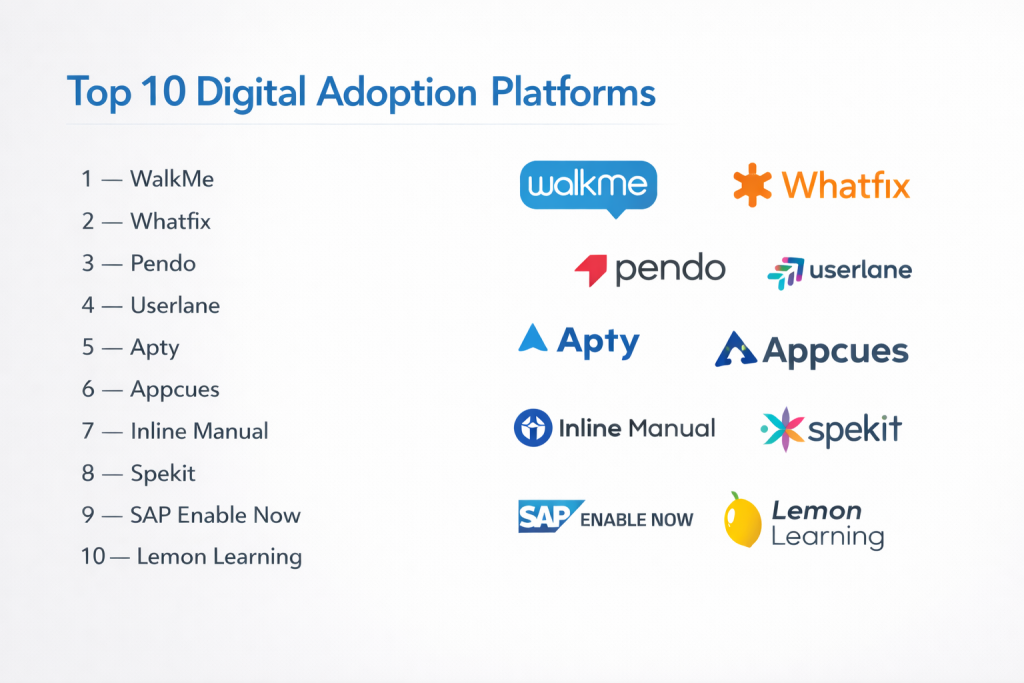
Top 10 Digital Adoption Platforms
#1 — WalkMe
Short description: Enterprise-grade DAP that provides in-app guidance, automation, and analytics to drive user adoption across complex software environments.
Key Features
- In-app walkthroughs
- Automation tools
- User analytics
- Workflow guidance
- No-code content creation
Pros
- Strong enterprise capabilities
- Advanced analytics
Cons
- Expensive
- Complex implementation
Platforms / Deployment
Web / Cloud
Security & Compliance
Not publicly stated
Integrations & Ecosystem
Integrates with enterprise applications and tools.
- CRM systems
- ERP platforms
- APIs
Support & Community
Enterprise-level support and onboarding.
#2 — Whatfix
Short description: Digital adoption platform offering interactive guidance, analytics, and self-help support to improve user experience and software adoption.
Key Features
- Interactive walkthroughs
- Self-help widgets
- Analytics dashboards
- Content creation tools
- Multi-language support
Pros
- Easy to use
- Strong analytics
Cons
- Premium pricing
- Limited customization
Platforms / Deployment
Web / Cloud
Security & Compliance
Not publicly stated
Integrations & Ecosystem
Supports integration with business applications.
- CRM tools
- HR systems
- APIs
Support & Community
Good customer support and onboarding.
#3 — Pendo
Short description: Product experience platform with digital adoption capabilities, enabling user guidance, analytics, and feedback collection.
Key Features
- In-app messaging
- User analytics
- Feedback collection
- Feature adoption tracking
- Segmentation
Pros
- Strong analytics
- Product-focused insights
Cons
- Not purely DAP-focused
- Pricing complexity
Platforms / Deployment
Web / Cloud
Security & Compliance
Not publicly stated
Integrations & Ecosystem
Integrates with analytics and product tools.
- CRM systems
- APIs
Support & Community
Strong documentation and support.
#4 — Userlane
Short description: DAP focused on delivering real-time, step-by-step guidance to users within applications for faster adoption and onboarding.
Key Features
- In-app guidance
- Step-by-step walkthroughs
- Analytics
- Automation tools
- Multi-language support
Pros
- Easy implementation
- Strong user guidance
Cons
- Limited advanced analytics
- Smaller ecosystem
Platforms / Deployment
Web / Cloud
Security & Compliance
Not publicly stated
Integrations & Ecosystem
Supports integration with enterprise applications.
- CRM tools
- APIs
Support & Community
Responsive support and onboarding.
#5 — Apty
Short description: Enterprise DAP focused on compliance, process adherence, and performance optimization through guided workflows and analytics.
Key Features
- Workflow guidance
- Compliance tracking
- Analytics dashboards
- Process automation
- User insights
Pros
- Strong compliance features
- Good analytics
Cons
- Complex setup
- Premium pricing
Platforms / Deployment
Web / Cloud
Security & Compliance
Not publicly stated
Integrations & Ecosystem
Integrates with enterprise systems.
- ERP platforms
- CRM tools
- APIs
Support & Community
Enterprise-level support.
#6 — Appcues
Short description: Product adoption platform enabling teams to create in-app onboarding and user engagement experiences without coding.
Key Features
- In-app messaging
- Onboarding flows
- User segmentation
- Analytics
- No-code builder
Pros
- Easy to use
- No-code setup
Cons
- Limited enterprise depth
- Basic analytics
Platforms / Deployment
Web / Cloud
Security & Compliance
Not publicly stated
Integrations & Ecosystem
Supports integrations with product tools.
- CRM systems
- APIs
Support & Community
Good support and documentation.
#7 — Inline Manual
Short description: Digital adoption tool focused on creating interactive guides, tutorials, and onboarding experiences within applications.
Key Features
- Interactive guides
- Tooltips and walkthroughs
- Analytics
- Content management
- Localization support
Pros
- Flexible content creation
- Easy deployment
Cons
- Limited advanced automation
- Smaller ecosystem
Platforms / Deployment
Web / Cloud
Security & Compliance
Not publicly stated
Integrations & Ecosystem
Supports integrations with business tools.
- APIs
- CRM systems
Support & Community
Helpful support and onboarding.
#8 — Spekit
Short description: Digital adoption and enablement platform focused on delivering just-in-time learning directly within workflows.
Key Features
- In-app knowledge delivery
- Microlearning modules
- Analytics
- Content management
- Workflow integration
Pros
- Strong just-in-time learning
- Easy adoption
Cons
- Limited deep analytics
- Niche focus
Platforms / Deployment
Web / Cloud
Security & Compliance
Not publicly stated
Integrations & Ecosystem
Integrates with CRM and productivity tools.
- Salesforce
- Slack
- APIs
Support & Community
Good support and onboarding.
#9 — SAP Enable Now
Short description: Digital adoption and training platform integrated within the SAP ecosystem for enterprise learning and process guidance.
Key Features
- In-app guidance
- Content creation
- Simulation tools
- Analytics
- Knowledge management
Pros
- Strong SAP integration
- Enterprise capabilities
Cons
- Limited outside SAP ecosystem
- Complex implementation
Platforms / Deployment
Cloud
Security & Compliance
Not publicly stated
Integrations & Ecosystem
Deep integration with SAP tools.
- SAP ecosystem
- APIs
Support & Community
Enterprise-level support.
#10 — Lemon Learning
Short description: Digital adoption platform designed to simplify user onboarding and improve software usage through contextual guidance and analytics.
Key Features
- In-app guidance
- Tooltips and walkthroughs
- Analytics
- Content management
- Multi-language support
Pros
- Easy to use
- Quick deployment
Cons
- Limited advanced features
- Smaller ecosystem
Platforms / Deployment
Web / Cloud
Security & Compliance
Not publicly stated
Integrations & Ecosystem
Supports integration with business applications.
- CRM tools
- APIs
Support & Community
Good support and onboarding.
Comparison Table (Top 10)
| Tool Name | Best For | Platform(s) Supported | Deployment | Standout Feature | Public Rating |
|---|---|---|---|---|---|
| WalkMe | Enterprise | Web | Cloud | Workflow automation | N/A |
| Whatfix | Enterprise UX | Web | Cloud | Interactive guidance | N/A |
| Pendo | Product analytics | Web | Cloud | User insights | N/A |
| Userlane | Onboarding | Web | Cloud | Step-by-step guides | N/A |
| Apty | Compliance | Web | Cloud | Process tracking | N/A |
| Appcues | Product teams | Web | Cloud | No-code onboarding | N/A |
| Inline Manual | Guides | Web | Cloud | Tutorials | N/A |
| Spekit | Just-in-time learning | Web | Cloud | Workflow learning | N/A |
| SAP Enable Now | SAP users | Web | Cloud | SAP integration | N/A |
| Lemon Learning | SMB adoption | Web | Cloud | Ease of use | N/A |
Evaluation & Scoring of Digital Adoption Platforms
| Tool Name | Core | Ease | Integrations | Security | Performance | Support | Value | Weighted Total |
|---|---|---|---|---|---|---|---|---|
| WalkMe | 9 | 7 | 9 | 7 | 9 | 8 | 6 | 8.2 |
| Whatfix | 8 | 8 | 8 | 7 | 8 | 8 | 7 | 8.0 |
| Pendo | 8 | 8 | 8 | 6 | 8 | 8 | 7 | 7.9 |
| Userlane | 7 | 9 | 7 | 6 | 7 | 7 | 8 | 7.6 |
| Apty | 8 | 7 | 8 | 7 | 8 | 8 | 6 | 7.9 |
| Appcues | 7 | 9 | 7 | 6 | 7 | 7 | 8 | 7.6 |
| Inline Manual | 7 | 8 | 6 | 6 | 7 | 7 | 7 | 7.2 |
| Spekit | 7 | 8 | 7 | 6 | 7 | 7 | 7 | 7.3 |
| SAP Enable Now | 8 | 6 | 8 | 7 | 8 | 8 | 6 | 7.7 |
| Lemon Learning | 7 | 9 | 6 | 6 | 7 | 7 | 8 | 7.5 |
How to interpret scores:
These scores provide a comparative overview of each platform’s strengths across key criteria. Higher scores indicate well-rounded enterprise-ready platforms, while mid-range scores highlight tools suited for specific use cases or budgets. Always evaluate based on your organization’s software ecosystem and adoption goals.
Which Digital Adoption Platform Is Right for You?
Solo / Freelancer
Appcues or Lemon Learning are simple and easy to deploy.
SMB
Userlane and Inline Manual offer strong usability and quick implementation.
Mid-Market
Whatfix and Spekit provide balanced features and integrations.
Enterprise
WalkMe, Apty, and SAP Enable Now are best suited for large organizations.
Budget vs Premium
- Budget: Lemon Learning, Inline Manual
- Premium: WalkMe, Whatfix
Feature Depth vs Ease of Use
- Deep features: WalkMe, Apty
- Easy to use: Userlane, Appcues
Integrations & Scalability
Choose tools with strong API and enterprise integrations.
Security & Compliance Needs
Enterprise tools provide better compliance and governance support.
Frequently Asked Questions (FAQs)
1. What is a Digital Adoption Platform?
It helps users learn and adopt software through in-app guidance.
2. Why are DAPs important?
They improve productivity and reduce training costs.
3. Are DAPs only for enterprises?
No, SMBs can also benefit from simpler tools.
4. Do they require coding?
Many platforms offer no-code or low-code options.
5. Can DAPs integrate with existing tools?
Yes, most support integrations with business applications.
6. How long does implementation take?
Typically a few days to weeks depending on complexity.
7. Are DAPs secure?
Security varies; verify compliance requirements.
8. Can they reduce support tickets?
Yes, by guiding users directly within applications.
9. What is the cost?
Pricing varies based on features and scale.
10. What are alternatives?
Traditional training or documentation tools.
Conclusion
Digital Adoption Platforms are becoming essential for organizations navigating increasingly complex software environments. By providing real-time guidance, automation, and actionable insights, these tools help improve user productivity, accelerate onboarding, and maximize the value of digital investments. While enterprise platforms offer deep analytics and advanced integrations, smaller teams can benefit from lightweight and easy-to-use solutions. The right choice depends on your organization’s size, software ecosystem, and adoption challenges. To make the best decision, shortlist a few platforms, test them in real workflows, and evaluate how effectively they improve user adoption and overall efficiency.
