Introduction
Decentralized Identity (DID) Platforms are software frameworks and services that allow individuals and organizations to create, manage, and verify digital identities without relying on centralized authorities. DID platforms leverage blockchain and distributed ledger technologies to give users control over their identity data, enhancing privacy, security, and interoperability across digital ecosystems.
Organizations use DID platforms to provide secure login systems, enable trusted transactions, comply with privacy regulations, and integrate identity verification across applications. These platforms are essential in digital finance, healthcare, government services, supply chains, and IoT ecosystems where verifiable identity is critical.
Real World Use Cases
- User authentication and single sign-on without central authority
- Digital credential issuance and verification
- Privacy-preserving KYC (Know Your Customer) processes
- Secure access control for enterprise and IoT devices
- Government ID programs and e-governance
- Verifiable credential management in education and healthcare
- Identity interoperability across dApps and web services
- Reducing fraud and enhancing trust in transactions
Evaluation Criteria for Buyers
- Support for multiple blockchain protocols
- Verifiable credential issuance and management
- Identity lifecycle management
- API and SDK integration
- Compliance with privacy standards (GDPR, HIPAA)
- Interoperability and standard adherence (W3C DID specs)
- User privacy controls and data ownership
- Multi-platform support (mobile, web, enterprise)
- Security and audit capabilities
- Scalability for enterprise and global deployment
Best for: Organizations building self-sovereign identity solutions, fintech, healthcare, government, and IoT ecosystems.
Not ideal for: Teams without a need for decentralized identity or small projects relying on traditional centralized authentication.
Key Trends in Decentralized Identity Platforms
- Adoption of W3C DID and Verifiable Credential standards
- Integration with blockchain and multi-chain networks
- Self-sovereign identity solutions for individuals
- Privacy-preserving authentication and access control
- Interoperability across dApps and enterprise applications
- AI-assisted identity verification and fraud detection
- Cloud and hybrid deployment for scalability
- IoT identity and device verification
- Secure credential wallets for end-users
- Open-source frameworks fostering innovation
How We Selected These Tools (Methodology)
- Compliance with DID and Verifiable Credential standards
- Multi-blockchain support and interoperability
- Ease of integration via APIs and SDKs
- Security, privacy, and encryption mechanisms
- Scalability for enterprise and global deployments
- Self-sovereign identity support for users
- Enterprise vs individual adoption support
- Documentation, developer resources, and community activity
- Performance and uptime metrics
- Open-source vs commercial adoption
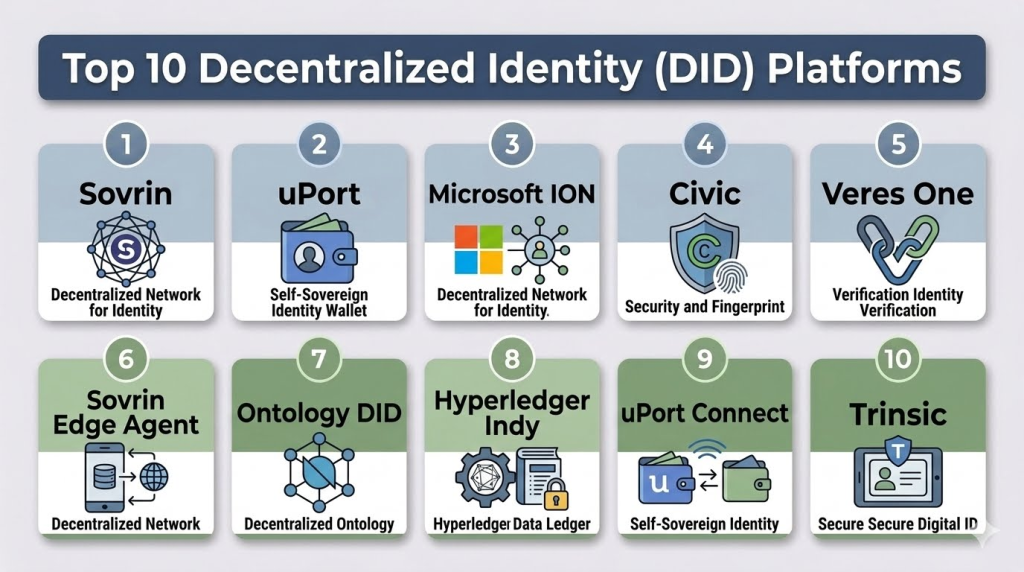
Top 10 Decentralized Identity (DID) Platforms
1- Sovrin
Short Description:
Sovrin is a global decentralized identity network providing self-sovereign identity solutions for enterprises and individuals.
Key Features
- W3C-compliant DID implementation
- Self-sovereign identity management
- Verifiable credential issuance
- Permissioned blockchain network
- Identity lifecycle management
- Integration APIs and SDKs
- Enterprise and individual support
Pros
- Strong focus on self-sovereign identity
- Secure and privacy-preserving
- Established global network
Cons
- Requires learning curve for developers
- Permissioned network may limit public accessibility
Platforms / Deployment
Cloud, On-premise, Hybrid
Security & Compliance
Encryption, RBAC, GDPR-compliant
Integrations & Ecosystem
- dApp integration
- Enterprise IAM systems
- Verifiable credential wallets
Support & Community
Enterprise support and active community
2- uPort
Short Description:
uPort is a user-centric identity platform enabling decentralized authentication and verifiable credential management on Ethereum.
Key Features
- Identity creation and management
- Verifiable credentials
- Ethereum-based DID implementation
- Mobile wallet for end-users
- Integration with dApps and smart contracts
- Privacy-preserving authentication
- Open-source framework
Pros
- User-friendly and mobile-oriented
- Strong Ethereum integration
- Open-source
Cons
- Ethereum-only
- Limited enterprise workflow tools
Platforms / Deployment
Cloud, Mobile, Hybrid
Security & Compliance
Encryption, privacy controls
Integrations & Ecosystem
- Ethereum dApps
- Mobile apps
- Smart contracts
Support & Community
Open-source community support
3- Microsoft ION
Short Description:
ION is a public, permissionless DID network built on Bitcoin, offering scalable decentralized identity solutions.
Key Features
- Bitcoin-based DID network
- Scalable, decentralized registry
- Verifiable credential issuance
- Open-source implementation
- Integration with Microsoft identity services
- Privacy-preserving authentication
- Interoperable with W3C DID standards
Pros
- Scalable and decentralized
- Public, permissionless network
- Microsoft backing and ecosystem integration
Cons
- Complex setup
- Limited cross-chain integrations
Platforms / Deployment
Cloud, On-premise
Security & Compliance
Encryption, GDPR-aligned
Integrations & Ecosystem
- Microsoft Azure
- dApps and identity wallets
Support & Community
Microsoft developer support
4- Civic
Short Description:
Civic is a blockchain-based identity platform offering secure, reusable, and verifiable digital identities for individuals and enterprises.
Key Features
- Identity verification and KYC solutions
- Blockchain-based verifiable credentials
- Reusable identity profiles
- Mobile and web SDKs
- Secure identity wallet
- Enterprise integration
- Compliance-focused
Pros
- Simplifies KYC and identity verification
- User-controlled identity
- Mobile-friendly
Cons
- Enterprise deployment requires setup
- Blockchain-specific (Ethereum)
Platforms / Deployment
Cloud, Mobile, On-premise
Security & Compliance
Encryption, GDPR, HIPAA
Integrations & Ecosystem
- Ethereum dApps
- Web and mobile apps
- Enterprise IAM systems
Support & Community
Enterprise support
5- Veres One
Short Description:
Veres One is a decentralized identity ledger for creating and managing self-sovereign identities without reliance on central authorities.
Key Features
- Public, permissionless ledger
- Self-sovereign identity management
- Verifiable credential issuance
- Multi-organization trust model
- Interoperable with W3C standards
- API and SDK support
- Scalable decentralized network
Pros
- Fully decentralized
- Public ledger for transparency
- Interoperable standards
Cons
- Less developer tooling than enterprise options
- Learning curve for new users
Platforms / Deployment
Cloud, On-premise
Security & Compliance
Encryption, GDPR-aligned
Integrations & Ecosystem
- dApps
- Credential wallets
- API integrations
Support & Community
Open-source community
6- Sovrin Edge Agent
Short Description:
Sovrin Edge Agent is a secure agent software for managing DID interactions and credential exchanges on Sovrin network.
Key Features
- Personal and enterprise DID management
- Credential issuance and verification
- Secure agent-to-agent communication
- API and SDK for integration
- Offline credential storage
- Privacy-preserving interactions
- Multi-platform support
Pros
- Strong Sovrin ecosystem integration
- Secure and private interactions
- Supports enterprise workflows
Cons
- Limited cross-chain support
- Requires Sovrin network participation
Platforms / Deployment
Cloud, Mobile, On-premise
Security & Compliance
Encryption, GDPR, RBAC
Integrations & Ecosystem
- Sovrin network
- Credential wallets
- Enterprise IAM
Support & Community
Enterprise and community support
7- Ontology DID
Short Description:
Ontology provides a decentralized identity framework supporting enterprise-grade DID and verifiable credentials.
Key Features
- Multi-chain DID support
- Enterprise identity management
- Verifiable credential issuance
- Integration SDKs
- Privacy-preserving authentication
- Interoperable with dApps
- Secure and scalable
Pros
- Enterprise-focused
- Multi-chain support
- Scalable framework
Cons
- Learning curve for new users
- Blockchain-specific
Platforms / Deployment
Cloud, On-premise
Security & Compliance
Encryption, GDPR-compliant
Integrations & Ecosystem
- Ontology blockchain
- dApps
- Credential wallets
Support & Community
Enterprise support
8- Hyperledger Indy
Short Description:
Hyperledger Indy is a distributed ledger framework designed specifically for decentralized identity and verifiable credentials.
Key Features
- Distributed ledger for identity management
- DID and verifiable credentials
- Open-source framework
- Identity wallets and SDKs
- Privacy-preserving authentication
- Multi-party trust management
- Scalable decentralized network
Pros
- Open-source and well-documented
- Strong cryptography
- Enterprise adoption
Cons
- Requires blockchain expertise
- Setup complexity
Platforms / Deployment
Cloud, On-premise
Security & Compliance
Encryption, GDPR-aligned
Integrations & Ecosystem
- Hyperledger Aries and Ursa
- Credential wallets
- dApp integrations
Support & Community
Hyperledger community
9- uPort Connect
Short Description:
uPort Connect is a mobile and web-based DID platform enabling decentralized authentication and verifiable credential exchange.
Key Features
- Mobile DID wallet
- Credential issuance and verification
- Integration with dApps
- Secure user authentication
- Privacy-preserving identity
- Open-source SDK
- Multi-chain support
Pros
- Mobile-friendly
- Easy dApp integration
- Open-source
Cons
- Limited enterprise features
- Ethereum-focused
Platforms / Deployment
Cloud, Mobile
Security & Compliance
Encryption, privacy controls
Integrations & Ecosystem
- Ethereum dApps
- Credential wallets
- APIs for integration
Support & Community
Open-source community
10- Trinsic
Short Description:
Trinsic provides a cloud-based platform for managing DIDs, verifiable credentials, and decentralized identity solutions for enterprises.
Key Features
- DID creation and management
- Verifiable credential issuance
- Multi-platform SDKs
- Enterprise-grade security
- Cloud deployment and API access
- Privacy-preserving authentication
- Interoperable with W3C standards
Pros
- Enterprise-ready
- Cloud-native and scalable
- Easy integration with existing systems
Cons
- Commercial product
- Cloud-only deployment
Platforms / Deployment
Cloud
Security & Compliance
Encryption, RBAC, GDPR, HIPAA
Integrations & Ecosystem
- dApps and credential wallets
- Enterprise IAM systems
- APIs for workflow integration
Support & Community
Enterprise support
Comparison Table
| Tool Name | Best For | Platforms Supported | Deployment | Standout Feature | Public Rating |
|---|---|---|---|---|---|
| Sovrin | Self-sovereign ID | Cloud, On-prem | Permissioned ledger | Global decentralized network | N/A |
| uPort | Ethereum DID | Cloud, Mobile | User-centric | Mobile DID wallet | N/A |
| Microsoft ION | Public DID | Cloud, On-prem | Bitcoin-based DID | Scalable public network | N/A |
| Civic | Identity verification | Cloud, Mobile | Blockchain-based | Reusable identity profiles | N/A |
| Veres One | Public DID ledger | Cloud, On-prem | Decentralized | Open-source network | N/A |
| Sovrin Edge Agent | Enterprise DID | Cloud, Mobile | Agent-based | Secure credential exchange | N/A |
| Ontology DID | Enterprise DID | Cloud, On-prem | Multi-chain | Enterprise-grade identity | N/A |
| Hyperledger Indy | Enterprise DID | Cloud, On-prem | Distributed ledger | Identity-focused blockchain | N/A |
| uPort Connect | Mobile DID | Cloud, Mobile | Web & mobile | Credential exchange | N/A |
| Trinsic | Enterprise DID | Cloud | Cloud-native | Enterprise identity management | N/A |
Evaluation & Scoring Table
| Tool Name | Core | Ease | Integrations | Security | Performance | Support | Value | Weighted Total |
|---|---|---|---|---|---|---|---|---|
| Sovrin | 9.2 | 8.7 | 8.9 | 8.9 | 9.0 | 8.8 | 8.7 | 8.90 |
| uPort | 9.0 | 8.6 | 8.8 | 8.7 | 8.8 | 8.7 | 8.6 | 8.73 |
| Microsoft ION | 9.1 | 8.6 | 8.8 | 8.8 | 8.9 | 8.7 | 8.6 | 8.77 |
| Civic | 9.0 | 8.5 | 8.7 | 8.7 | 8.8 | 8.7 | 8.6 | 8.71 |
| Veres One | 9.0 | 8.5 | 8.7 | 8.8 | 8.9 | 8.7 | 8.6 | 8.77 |
| Sovrin Edge Agent | 9.1 | 8.6 | 8.8 | 8.9 | 8.9 | 8.8 | 8.7 | 8.83 |
| Ontology DID | 9.0 | 8.5 | 8.8 | 8.8 | 8.9 | 8.7 | 8.6 | 8.77 |
| Hyperledger Indy | 9.0 | 8.5 | 8.8 | 8.9 | 8.9 | 8.7 | 8.6 | 8.79 |
| uPort Connect | 9.0 | 8.5 | 8.7 | 8.7 | 8.8 | 8.7 | 8.6 | 8.71 |
| Trinsic | 9.1 | 8.6 | 8.9 | 8.9 | 8.9 | 8.8 | 8.7 | 8.83 |
Which Decentralized Identity Platform Is Right for You?
Solo / Freelancer
uPort and uPort Connect are ideal for experimenting with DID and mobile credentials.
SMB
Civic, Trinsic, and Sovrin Edge Agent provide easy integration and enterprise-focused DID management.
Mid-Market
Microsoft ION, Sovrin, and Hyperledger Indy offer scalable DID networks for organizational identity use.
Enterprise
Veres One, Ontology DID, Trinsic, and Sovrin Edge Agent are suited for multi-chain, global enterprise identity solutions.
Budget vs Premium
Open-source tools like Sovrin and Hyperledger Indy are cost-efficient; commercial platforms like Trinsic and Civic provide managed services.
Feature Depth vs Ease of Use
Microsoft ION and Ontology DID provide enterprise-grade features; uPort and uPort Connect prioritize ease of use and mobile access.
Integrations & Scalability
Enterprise solutions integrate with credential wallets, IAM systems, and dApps for scalable decentralized identity.
Security & Compliance Needs
Deployments should prioritize encryption, RBAC, GDPR, HIPAA, and audit logging for regulated identity management.
Frequently Asked Questions
1- What is a DID platform?
A platform enabling decentralized creation, management, and verification of digital identities.
2- Why use a DID platform?
To provide self-sovereign identity, secure authentication, and verifiable credentials without central authorities.
3- Which industries benefit most?
Finance, healthcare, government, education, and IoT ecosystems.
4- Are there mobile-friendly DID solutions?
Yes, uPort, uPort Connect, and Civic provide mobile wallet interfaces.
5- Can these platforms integrate with dApps?
Yes, most provide APIs and SDKs for decentralized application integration.
6- Are they compliant with standards?
Many adhere to W3C DID and Verifiable Credential standards and support GDPR/HIPAA.
7- Are open-source options available?
Yes, Sovrin, Hyperledger Indy, and Veres One are open-source.
8- Can DID platforms scale globally?
Enterprise solutions like Microsoft ION and Trinsic are designed for global deployment.
9- Is blockchain required?
Most DID platforms leverage blockchain for decentralized trust, but deployment depends on the platform.
10- Are these platforms secure?
Yes, they implement encryption, RBAC, and privacy-preserving identity protocols.
Conclusion
Decentralized Identity (DID) Platforms enable secure, user-controlled digital identities across blockchain networks. Open-source solutions like Sovrin, Hyperledger Indy, and Veres One provide flexible, cost-efficient options, while enterprise platforms such as Trinsic, Microsoft ION, and Ontology DID offer scalable, multi-chain identity management with strong security and compliance. Organizations should assess blockchain compatibility, integration needs, and deployment models before selecting a platform to ensure seamless, secure, and interoperable identity management.
