Introduction
DDI platforms combine DNS (Domain Name System), DHCP (Dynamic Host Configuration Protocol), and IP Address Management (IPAM) into a unified solution for managing network infrastructure. In simple terms, DDI ensures that devices can connect to networks, receive IP addresses, and resolve domain names efficiently—all from a centralized system.
As organizations adopt hybrid cloud, edge computing, and distributed architectures, managing DNS, DHCP, and IP addresses separately becomes inefficient and error-prone. DDI platforms solve this by offering centralized visibility, automation, and policy enforcement, making them critical for modern IT operations.
Real-World Use Cases
- Centralized DNS, DHCP, and IP address management
- Automated IP allocation and tracking
- Network segmentation and access control
- Hybrid cloud and multi-site infrastructure management
- Compliance auditing and reporting
What Buyers Should Evaluate
- Integration between DNS, DHCP, and IPAM
- Automation and API capabilities
- Scalability for large environments
- Security features (RBAC, DNSSEC, audit logs)
- Multi-cloud and hybrid support
- Reporting and analytics capabilities
- Ease of deployment and management
- Vendor support and ecosystem
Best for: Enterprises, telecom providers, cloud infrastructure teams, and organizations managing large, distributed networks.
Not ideal for: Small businesses with simple networking needs or those using basic router-based DNS/DHCP.
Key Trends in DDI Platforms
- Cloud-native DDI solutions for hybrid and multi-cloud environments
- Automation-first networking using APIs and Infrastructure as Code
- Integration with Zero Trust security models
- AI-driven network analytics and anomaly detection
- IPv6 adoption and dual-stack management
- Unified dashboards for network visibility
- Real-time monitoring and compliance enforcement
- Edge and IoT network integration
How We Selected These Tools (Methodology)
- Strong market presence and enterprise adoption
- Comprehensive DDI capabilities (DNS, DHCP, IPAM)
- Proven performance and scalability
- Advanced security features
- Rich integration ecosystem and APIs
- Suitability across SMB to enterprise environments
- Availability of support and documentation
- Flexibility across cloud, on-premise, and hybrid deployments
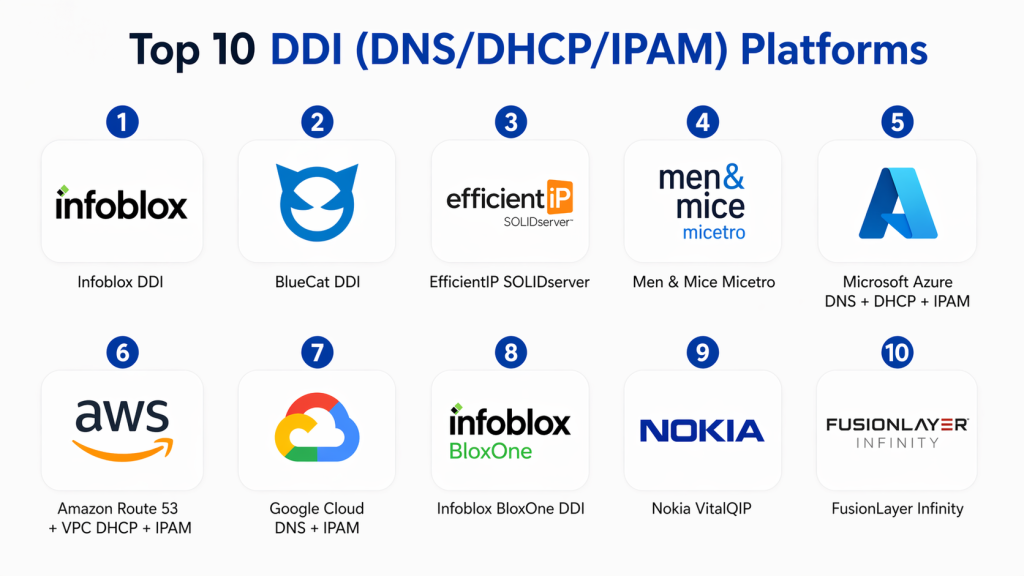
Top 10 DDI (DNS/DHCP/IPAM) Platforms
#1 — Infoblox DDI
Short description :
Infoblox DDI is one of the most widely adopted enterprise platforms for managing DNS, DHCP, and IP address infrastructure. It provides centralized control, automation, and high availability. Known for scalability and security, it is ideal for large enterprises and service providers. It supports hybrid and multi-cloud environments with strong reporting capabilities.
Key Features
- Integrated DNS, DHCP, and IPAM
- Automation and orchestration
- Centralized management
- Advanced analytics and reporting
- High availability architecture
Pros
- Enterprise-grade scalability
- Strong automation and security
Cons
- High cost
- Complex deployment
Platforms / Deployment
On-premise / Hybrid
Security & Compliance
RBAC, audit logs, DNSSEC
Integrations & Ecosystem
Integrates with enterprise networking and cloud platforms.
- APIs
- ITSM tools
- Cloud services
Support & Community
Strong enterprise support
#2 — BlueCat DDI
Short description :
BlueCat DDI is a powerful enterprise platform providing unified DNS, DHCP, and IPAM management. It offers automation and analytics for complex environments. Ideal for large organizations needing centralized network control.
Key Features
- DDI integration
- Automation
- Centralized visibility
- Network analytics
Pros
- Scalable
- Strong automation
Cons
- Expensive
- Complex setup
Platforms / Deployment
Cloud / On-premise
Security & Compliance
RBAC, audit logs
Integrations & Ecosystem
- APIs
- Cloud platforms
Support & Community
Enterprise support
#3 — EfficientIP SOLIDserver
Short description :
EfficientIP SOLIDserver is a secure DDI platform focused on automation and DNS security. It supports large-scale deployments and hybrid environments. Ideal for organizations prioritizing security and performance.
Key Features
- Secure DNS
- DDI automation
- Real-time analytics
- Centralized control
Pros
- Strong security
- Scalable
Cons
- Complex
- Expensive
Platforms / Deployment
Cloud / On-premise
Security & Compliance
RBAC, DNSSEC
Integrations & Ecosystem
- APIs
- Security tools
Support & Community
Enterprise support
#4 — Men & Mice Micetro
Short description :
Micetro is a flexible DDI management platform that integrates with multiple DNS and DHCP systems. It provides centralized control and automation. Ideal for enterprises with mixed environments.
Key Features
- DDI management
- Automation
- Multi-vendor support
- Centralized dashboard
Pros
- Flexible integration
- Strong automation
Cons
- Expensive
- Requires expertise
Platforms / Deployment
Cloud / On-premise
Security & Compliance
RBAC
Integrations & Ecosystem
- APIs
- DNS/DHCP systems
Support & Community
Enterprise support
#5 — Microsoft Azure DNS + DHCP + IPAM
Short description :
Microsoft provides DDI capabilities through a combination of Azure DNS, DHCP services, and IP management tools. It is ideal for Azure-based environments and offers scalability and integration with Microsoft ecosystem.
Key Features
- DNS hosting
- DHCP services
- IP management
- Cloud integration
Pros
- Seamless Azure integration
- Scalable
Cons
- Limited outside Azure
- Requires multiple services
Platforms / Deployment
Cloud
Security & Compliance
RBAC, encryption
Integrations & Ecosystem
- Azure services
- APIs
Support & Community
Enterprise support
#6 — Amazon Route 53 + VPC DHCP + IPAM
Short description :
AWS offers DDI capabilities through Route 53, DHCP options sets, and IPAM services. It provides scalable and automated network management for AWS environments.
Key Features
- DNS management
- DHCP configuration
- IPAM integration
- Automation
Pros
- Highly scalable
- Deep AWS integration
Cons
- AWS-specific
- Complex pricing
Platforms / Deployment
Cloud
Security & Compliance
IAM, DNSSEC
Integrations & Ecosystem
- AWS services
- APIs
Support & Community
Strong support
#7 — Google Cloud DNS + IPAM
Short description :
Google Cloud provides DNS and IP management capabilities for cloud environments. It offers high availability and automation features. Ideal for GCP users.
Key Features
- Managed DNS
- IP management
- High availability
- API-driven
Pros
- Reliable
- Easy integration
Cons
- Limited DDI depth
- Cloud-only
Platforms / Deployment
Cloud
Security & Compliance
DNSSEC
Integrations & Ecosystem
- Google Cloud services
- APIs
Support & Community
Strong support
#8 — Infoblox BloxOne DDI
Short description :
BloxOne DDI is Infoblox’s cloud-native platform offering DNS, DHCP, and IPAM services. It provides automation and centralized visibility for hybrid environments.
Key Features
- Cloud-native DDI
- Automation
- Centralized management
- Analytics
Pros
- Modern architecture
- Scalable
Cons
- Costly
- Learning curve
Platforms / Deployment
Cloud
Security & Compliance
RBAC, DNSSEC
Integrations & Ecosystem
- APIs
- Cloud tools
Support & Community
Enterprise support
#9 — Nokia VitalQIP
Short description :
Nokia VitalQIP is a telecom-grade DDI platform designed for large-scale networks. It offers high performance and automation. Ideal for service providers and large enterprises.
Key Features
- DDI integration
- High scalability
- Automation
- Centralized control
Pros
- Telecom-grade performance
- Reliable
Cons
- Expensive
- Complex
Platforms / Deployment
On-premise / Hybrid
Security & Compliance
RBAC
Integrations & Ecosystem
- APIs
- Telecom tools
Support & Community
Enterprise support
#10 — FusionLayer Infinity
Short description :
FusionLayer Infinity is a DDI platform focused on automation and cloud environments. It offers IPAM, DNS, and DHCP capabilities with strong API support.
Key Features
- Automated DDI
- IPAM integration
- API-driven
- Centralized management
Pros
- Automation-focused
- Cloud-ready
Cons
- Less mainstream
- Limited ecosystem
Platforms / Deployment
Cloud / Hybrid
Security & Compliance
Not publicly stated
Integrations & Ecosystem
- APIs
- Cloud platforms
Support & Community
Varies / Not publicly stated
Comparison Table (Top 10)
| Tool Name | Best For | Platform(s) Supported | Deployment | Standout Feature | Public Rating |
|---|---|---|---|---|---|
| Infoblox DDI | Enterprise | Varies | Hybrid | Full DDI suite | N/A |
| BlueCat | Enterprise | Varies | Hybrid | Automation | N/A |
| EfficientIP | Enterprise | Varies | Hybrid | DNS security | N/A |
| Micetro | Enterprise | Varies | Hybrid | Multi-vendor | N/A |
| Azure DDI | Azure users | Web | Cloud | Azure integration | N/A |
| AWS DDI | AWS users | Web | Cloud | Scalability | N/A |
| Google Cloud | GCP users | Web | Cloud | High availability | N/A |
| BloxOne | Enterprise | Web | Cloud | Cloud-native DDI | N/A |
| Nokia VitalQIP | Telecom | Varies | Hybrid | Telecom-grade | N/A |
| FusionLayer | Cloud | Web | Hybrid | Automation | N |
Evaluation & Scoring of DDI Platforms
| Tool Name | Core (25%) | Ease (15%) | Integrations (15%) | Security (10%) | Performance (10%) | Support (10%) | Value (15%) | Weighted Total |
|---|---|---|---|---|---|---|---|---|
| Infoblox | 9 | 7 | 9 | 9 | 9 | 9 | 6 | 8.6 |
| BlueCat | 9 | 6 | 8 | 9 | 9 | 8 | 6 | 8.1 |
| EfficientIP | 9 | 6 | 8 | 9 | 9 | 8 | 6 | 8.1 |
| Micetro | 8 | 6 | 8 | 8 | 8 | 8 | 7 | 7.7 |
| Azure | 8 | 7 | 9 | 8 | 8 | 8 | 7 | 7.9 |
| AWS | 9 | 7 | 9 | 9 | 9 | 8 | 7 | 8.4 |
| Google Cloud | 8 | 8 | 8 | 8 | 9 | 8 | 8 | 8.3 |
| BloxOne | 9 | 7 | 8 | 9 | 9 | 8 | 6 | 8.2 |
| Nokia | 9 | 5 | 7 | 8 | 9 | 8 | 6 | 7.8 |
| FusionLayer | 7 | 6 | 7 | 6 | 7 | 6 | 7 | 6.8 |
How to interpret:
These scores are comparative and reflect strengths across enterprise requirements. Higher scores indicate better overall capability, but the best choice depends on your infrastructure, scale, and integration needs.
Which DDI Platform Is Right for You?
Solo / Freelancer
DDI platforms are typically not required unless managing complex infrastructure.
SMB
Cloud-based solutions like Azure or AWS provide simple and scalable options.
Mid-Market
Micetro or EfficientIP offer balanced automation and flexibility.
Enterprise
Infoblox, BlueCat, or Nokia VitalQIP provide scalability and security.
Budget vs Premium
- Budget: Cloud-native options
- Premium: Infoblox, BlueCat
Feature Depth vs Ease of Use
- Advanced: Infoblox, EfficientIP
- Easier: Cloud providers
Integrations & Scalability
Choose API-first platforms for automation and scalability.
Security & Compliance Needs
Prioritize DNSSEC, RBAC, and audit logging.
Frequently Asked Questions (FAQs)
1. What is a DDI platform?
A DDI platform combines DNS, DHCP, and IP address management into a unified system. It centralizes network management and improves efficiency. It helps automate IP allocation and DNS resolution. It also enhances visibility across networks. This makes it essential for modern IT infrastructure.
2. How much do DDI platforms cost?
Pricing varies widely depending on vendor and scale. Enterprise solutions are typically expensive due to advanced features. Cloud-based options offer flexible pricing models. Costs may include licensing, usage, and support. Always evaluate total cost of ownership.
3. Why use DDI instead of separate tools?
DDI platforms provide centralized control and automation. Managing DNS, DHCP, and IPAM separately can lead to errors. Integration improves efficiency and reduces manual work. It also enhances security and compliance. Unified management simplifies operations.
4. Are DDI platforms secure?
Yes, most platforms include security features like RBAC and DNSSEC. They provide audit logs and access controls. Security depends on configuration and vendor capabilities. Enterprises should prioritize secure platforms. Proper setup is critical.
5. How long does implementation take?
Implementation time depends on network complexity. Small setups can be quick. Large environments may take weeks. Integration with existing systems adds complexity. Planning and testing are essential.
6. Do DDI platforms support cloud environments?
Yes, many modern platforms support hybrid and multi-cloud environments. Cloud-native solutions offer scalability and flexibility. Integration with cloud services is a key feature. Always verify compatibility.
7. How do DDI platforms improve performance?
They optimize DNS resolution and automate IP allocation. This reduces latency and improves network efficiency. Centralized management enhances visibility. Performance improvements depend on implementation.
8. Can DDI platforms integrate with DevOps?
Yes, most platforms provide APIs for automation. This allows integration with CI/CD pipelines. It supports Infrastructure as Code practices. Automation improves efficiency and consistency.
9. What are common mistakes in DDI adoption?
Common mistakes include poor planning and lack of integration. Ignoring scalability can limit growth. Not training staff reduces effectiveness. Choosing the wrong tool can cause issues. Proper evaluation is key.
10. How to choose the right DDI platform?
Evaluate your network size and requirements. Consider features, integrations, and budget. Test shortlisted platforms. Ensure scalability and security. Choose based on long-term needs.
Conclusion
DDI platforms have become a critical foundation for managing modern network infrastructure by unifying DNS, DHCP, and IP address management into a single, cohesive system. As organizations continue to expand across hybrid and multi-cloud environments, the need for centralized visibility, automation, and security becomes increasingly important. The right DDI solution can significantly reduce operational complexity, improve network reliability, and enhance security posture. However, the best platform depends on your specific use case—whether you need deep enterprise control, cloud-native flexibility, or cost-effective scalability. Instead of selecting based purely on features, focus on alignment with your infrastructure and long-term growth strategy. A practical next step is to shortlist a few platforms, run a controlled pilot, and validate performance, integrations, and security before making a final decision.
