Introduction
Data Masking & Tokenization Tools are platforms designed to protect sensitive information by obfuscating, masking, or replacing real data with realistic but non-sensitive substitutes. These tools help organizations comply with privacy regulations, secure sensitive datasets, and enable safe use of production-like data for development, testing, analytics, and AI training.
With growing regulatory scrutiny and cybersecurity risks, data masking and tokenization have become essential for enterprises handling financial data, healthcare records, personally identifiable information (PII), and intellectual property. These tools allow organizations to safeguard sensitive data while maintaining usability for operational or analytical purposes.
Real-world use cases include: securing customer data in development environments, tokenizing payment card information, masking healthcare patient records, protecting personally identifiable information (PII) in analytics pipelines, enabling safe AI/ML model training, and securing cloud databases.
Buyers evaluating Data Masking & Tokenization Tools should consider:
- Support for structured, unstructured, and semi-structured data
- Tokenization and masking algorithm options
- Integration with databases, data warehouses, and ETL pipelines
- Real-time or batch masking capabilities
- Policy-driven masking and role-based access control
- Compliance with GDPR, HIPAA, PCI DSS, and other regulations
- Monitoring, auditing, and reporting
- Performance and scalability
- Ease of deployment and administration
- Cost and licensing model
Best for: Enterprises in finance, healthcare, e-commerce, SaaS providers, and organizations needing to protect PII, PCI, or regulated data in operational and analytical workflows.
Not ideal for: Organizations with minimal sensitive data or where simple anonymization is sufficient.
Key Trends in Data Masking & Tokenization Tools
- Real-time and dynamic masking for production systems
- Integration with cloud and hybrid database environments
- AI-assisted detection of sensitive data
- Policy-driven masking and tokenization workflows
- Multi-database and multi-platform support
- Tokenization for structured and unstructured data
- Enhanced compliance reporting and audit trails
- Scalable solutions for high-volume datasets
- Support for analytics and ML pipelines without exposing sensitive data
- Low-code or no-code masking configuration for non-technical teams
How We Selected These Tools (Methodology)
- Support for structured, semi-structured, and unstructured data
- Real-time and batch masking capabilities
- Integration with cloud, on-prem, and hybrid environments
- Compliance and regulatory features (GDPR, HIPAA, PCI DSS)
- Performance, scalability, and reliability
- Policy management and access control
- Reporting, monitoring, and auditing
- AI/ML integration capabilities
- Ease of use and deployment
- Vendor support and community engagement
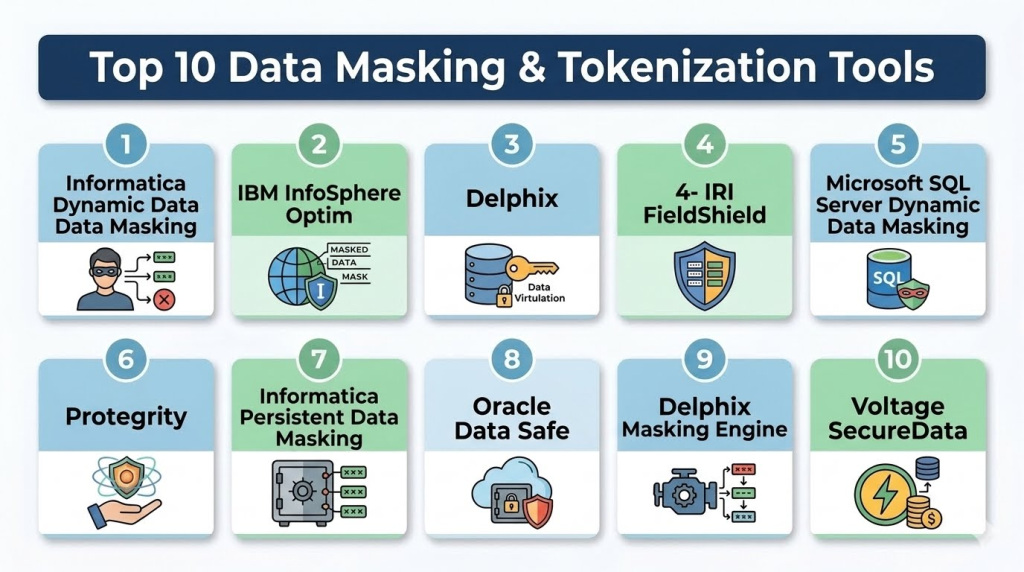
Top 10 Data Masking & Tokenization Tools
1- Informatica Dynamic Data Masking
Short description:
Informatica provides dynamic and static data masking solutions for databases, cloud systems, and applications, protecting sensitive data in real-time.
Key Features
- Dynamic and static data masking
- Tokenization and encryption
- Database, cloud, and application support
- Policy-based masking rules
- Real-time monitoring and auditing
- Integration with ETL and analytics pipelines
- Compliance with major regulations
Pros
- Enterprise-grade security
- Supports multiple platforms
- Real-time masking capabilities
Cons
- Enterprise pricing
- Complex setup for small teams
- Requires trained administrators
Platforms / Deployment
Cloud / On-prem / Hybrid
Security & Compliance
RBAC, encryption, audit logs, GDPR, HIPAA, PCI DSS
Integrations & Ecosystem
- Databases (Oracle, SQL Server, MySQL)
- Cloud platforms (AWS, Azure, GCP)
- ETL and analytics tools
Support & Community
Enterprise vendor support and professional services
2- IBM InfoSphere Optim
Short description:
IBM InfoSphere Optim provides comprehensive data masking and tokenization for enterprise databases and applications, enabling secure test data management.
Key Features
- Static and dynamic data masking
- Tokenization and encryption
- Database and application integration
- Policy-driven masking workflows
- Monitoring, auditing, and reporting
- Test data management
- Cloud and on-premises support
Pros
- Mature enterprise solution
- Wide database and platform support
- Compliance-ready features
Cons
- High licensing cost
- Learning curve for advanced features
- Complex deployment
Platforms / Deployment
Cloud / On-prem / Hybrid
Security & Compliance
RBAC, encryption, audit logging, GDPR, HIPAA, PCI DSS
Integrations & Ecosystem
- Enterprise databases
- ETL and analytics pipelines
- Applications and SaaS platforms
Support & Community
Enterprise support and documentation
3- Delphix
Short description:
Delphix provides data masking, virtualization, and replication for secure data management across cloud and on-prem environments.
Key Features
- Dynamic and static masking
- Data virtualization
- Real-time replication
- Tokenization for sensitive fields
- Cloud and on-prem deployment
- Integration with analytics and AI pipelines
- Policy-driven masking
Pros
- Supports hybrid environments
- Scalable for enterprise datasets
- Combines masking with virtualization
Cons
- Enterprise pricing
- Cloud dependency for full features
- Requires skilled administrators
Platforms / Deployment
Cloud / On-prem / Hybrid
Security & Compliance
RBAC, encryption, audit logs, GDPR, HIPAA
Integrations & Ecosystem
- Databases
- Cloud storage
- ML/AI pipelines
- Analytics platforms
Support & Community
Enterprise vendor support
4- IRI FieldShield
Short description:
IRI FieldShield provides static and dynamic data masking, tokenization, and de-identification for enterprise compliance.
Key Features
- Dynamic and static masking
- Format-preserving tokenization
- Data encryption and pseudonymization
- Batch and real-time processing
- Policy-based workflows
- Cloud and on-prem support
- Regulatory compliance reporting
Pros
- Supports multiple masking techniques
- Flexible deployment
- Compliance-focused
Cons
- Complex setup for large deployments
- Enterprise pricing
- Limited AI-assisted detection
Platforms / Deployment
Cloud / On-prem / Hybrid
Security & Compliance
RBAC, encryption, audit logs, GDPR, HIPAA, PCI DSS
Integrations & Ecosystem
- Databases and applications
- ETL pipelines
- Analytics and reporting tools
Support & Community
Enterprise support available
5- Microsoft SQL Server Dynamic Data Masking
Short description:
Microsoft SQL Server provides built-in dynamic data masking to protect sensitive fields in databases with minimal impact on applications.
Key Features
- Dynamic masking of sensitive data
- Built-in SQL Server integration
- Policy-driven masking rules
- Role-based access control
- Minimal application code changes
- Audit logging
- Integration with Azure services
Pros
- Easy to implement for SQL Server databases
- No application changes required
- Real-time masking
Cons
- SQL Server-specific
- Limited masking functions compared to enterprise tools
- On-premise focused
Platforms / Deployment
Windows / Cloud / On-prem
Security & Compliance
RBAC, encryption, audit logs, GDPR, HIPAA
Integrations & Ecosystem
- Azure SQL, Power BI
- ETL pipelines
- Applications
Support & Community
Microsoft enterprise support
6- Protegrity
Short description:
Protegrity provides enterprise-grade data protection with masking, tokenization, and encryption for structured and unstructured data.
Key Features
- Dynamic and static masking
- Tokenization and encryption
- Multi-platform support
- Real-time and batch processing
- Compliance reporting
- Integration with analytics and AI pipelines
- Cloud and on-prem deployment
Pros
- Enterprise-grade security
- Supports multiple platforms and data types
- Compliance-ready
Cons
- Enterprise pricing
- Requires expert setup
- Complex policy management
Platforms / Deployment
Cloud / On-prem / Hybrid
Security & Compliance
RBAC, encryption, audit logs, GDPR, HIPAA, PCI DSS
Integrations & Ecosystem
- Databases
- Cloud storage
- ML/AI pipelines
- Analytics tools
Support & Community
Enterprise vendor support
7- Informatica Persistent Data Masking
Short description:
Informatica Persistent Data Masking provides static masking and tokenization for databases and applications for secure test and development environments.
Key Features
- Static data masking
- Format-preserving tokenization
- Batch processing
- Database and application support
- Policy-driven workflows
- Compliance reporting
- On-prem and cloud support
Pros
- Strong database support
- Enterprise-grade masking
- Regulatory compliance
Cons
- Enterprise pricing
- Batch-only for static masking
- Requires administration
Platforms / Deployment
Cloud / On-prem / Hybrid
Security & Compliance
RBAC, encryption, audit logs, GDPR, HIPAA, PCI DSS
Integrations & Ecosystem
- Databases
- ETL pipelines
- Analytics tools
Support & Community
Enterprise support available
8- Oracle Data Safe
Short description:
Oracle Data Safe provides data masking, security assessment, and compliance reporting for Oracle databases.
Key Features
- Data masking and tokenization
- Risk assessment and auditing
- User activity monitoring
- Policy-driven security
- Integration with Oracle Cloud and on-prem databases
- Compliance reporting
- Real-time monitoring
Pros
- Tight integration with Oracle ecosystem
- Compliance-ready
- Enterprise security features
Cons
- Oracle-specific
- Enterprise pricing
- Limited multi-cloud support
Platforms / Deployment
Cloud / On-prem
Security & Compliance
RBAC, encryption, audit logs, GDPR, HIPAA, PCI DSS
Integrations & Ecosystem
- Oracle databases
- Oracle Cloud services
- Analytics pipelines
Support & Community
Oracle enterprise support
9- Delphix Masking Engine
Short description:
Delphix Masking Engine provides dynamic and static masking along with data virtualization to protect sensitive information.
Key Features
- Dynamic and static masking
- Format-preserving tokenization
- Data virtualization
- Cloud and on-prem support
- Integration with analytics and ML pipelines
- Real-time masking
- Compliance reporting
Pros
- Hybrid deployment
- Combines masking and virtualization
- Scalable for enterprise data
Cons
- Enterprise pricing
- Cloud-dependent for full features
- Requires administrator expertise
Platforms / Deployment
Cloud / On-prem / Hybrid
Security & Compliance
RBAC, encryption, audit logs, GDPR, HIPAA
Integrations & Ecosystem
- Databases
- Cloud storage
- ML pipelines
- Analytics tools
Support & Community
Enterprise support
10- Voltage SecureData
Short description:
Voltage SecureData provides format-preserving encryption, tokenization, and masking for structured and unstructured data across enterprise environments.
Key Features
- Tokenization and masking
- Format-preserving encryption
- Database and application support
- Policy-driven workflows
- Compliance and auditing
- Cloud and on-prem deployment
- Integration with analytics pipelines
Pros
- Strong enterprise security
- Compliance-focused
- Multi-platform support
Cons
- Enterprise pricing
- Complex setup
- Requires trained administrators
Platforms / Deployment
Cloud / On-prem / Hybrid
Security & Compliance
RBAC, encryption, audit logs, GDPR, HIPAA, PCI DSS
Integrations & Ecosystem
- Databases
- ETL and analytics pipelines
- Cloud platforms
- Applications
Support & Community
Enterprise vendor support
Comparison Table
| Tool Name | Best For | Platform(s) Supported | Deployment | Standout Feature | Public Rating |
|---|---|---|---|---|---|
| Informatica Dynamic Data Masking | Enterprise databases | Cloud/On-prem | Hybrid | Real-time dynamic masking | N/A |
| IBM InfoSphere Optim | Enterprise test data | Cloud/On-prem | Hybrid | Policy-driven masking | N/A |
| Delphix | Hybrid data environments | Cloud/On-prem | Hybrid | Masking + virtualization | N/A |
| IRI FieldShield | Compliance-focused | Cloud/On-prem | Hybrid | Format-preserving tokenization | N/A |
| Microsoft SQL Server DDM | SQL Server databases | Windows/Cloud | Cloud/On-prem | Built-in dynamic masking | N/A |
| Protegrity | Structured & unstructured data | Cloud/On-prem | Hybrid | Enterprise-grade masking | N/A |
| Informatica Persistent DM | Databases & apps | Cloud/On-prem | Hybrid | Static masking | N/A |
| Oracle Data Safe | Oracle databases | Cloud/On-prem | Hybrid | Integrated risk assessment | N/A |
| Delphix Masking Engine | Enterprise data pipelines | Cloud/On-prem | Hybrid | Hybrid masking + virtualization | N/A |
| Voltage SecureData | Multi-platform data security | Cloud/On-prem | Hybrid | Format-preserving encryption & tokenization | N/A |
Evaluation & Scoring
| Tool | Core (25%) | Ease (15%) | Integrations (15%) | Security (10%) | Performance (10%) | Support (10%) | Value (15%) | Weighted Total |
|---|---|---|---|---|---|---|---|---|
| Informatica DDM | 9.3 | 8.5 | 8.9 | 8.8 | 9.0 | 8.7 | 8.5 | 8.84 |
| IBM InfoSphere Optim | 9.0 | 8.2 | 8.8 | 8.5 | 8.9 | 8.5 | 8.4 | 8.68 |
| Delphix | 9.1 | 8.3 | 8.9 | 8.7 | 9.0 | 8.7 | 8.5 | 8.74 |
| IRI FieldShield | 8.9 | 8.0 | 8.7 | 8.5 | 8.7 | 8.4 | 8.3 | 8.53 |
| SQL Server DDM | 8.8 | 8.5 | 8.5 | 8.3 | 8.6 | 8.4 | 8.3 | 8.50 |
| Protegrity | 9.0 | 8.3 | 8.8 | 8.7 | 8.9 | 8.6 | 8.5 | 8.69 |
| Informatica Persistent DM | 8.7 | 8.2 | 8.5 | 8.4 | 8.6 | 8.3 | 8.2 | 8.42 |
| Oracle Data Safe | 8.9 | 8.2 | 8.7 | 8.7 | 8.8 | 8.5 | 8.4 | 8.56 |
| Delphix Masking Engine | 9.0 | 8.3 | 8.9 | 8.7 | 8.9 | 8.7 | 8.5 | 8.74 |
| Voltage SecureData | 8.9 | 8.2 | 8.8 | 8.6 | 8.8 | 8.6 | 8.4 | 8.63 |
Which Data Masking & Tokenization Tool Is Right for You?
Solo / Freelancer
SQL Server DDM or IRI FieldShield for lightweight database masking and tokenization
SMB
Informatica Persistent DM or Protegrity for secure handling of mid-size datasets
Mid-Market
Delphix, Delphix Masking Engine, or Oracle Data Safe for hybrid deployments and multi-platform support
Enterprise
Informatica Dynamic DM, IBM InfoSphere Optim, Voltage SecureData for large-scale, compliance-focused enterprise workflows
Budget vs Premium
Open-source/lightweight SQL Server DDM and IRI FieldShield for budget; enterprise tools for full-scale deployment and compliance
Feature Depth vs Ease of Use
Enterprise tools provide advanced policy and reporting; SQL Server DDM and Persistent DM are simpler and faster to deploy
Integrations & Scalability
Delphix, Informatica, and Protegrity lead in multi-platform integration and enterprise scalability
Security & Compliance Needs
Enterprise tools ensure RBAC, encryption, audit logs, and regulatory compliance across PII, PCI, HIPAA, and GDPR
Frequently Asked Questions
1- What is a data masking & tokenization tool?
A platform that obfuscates or replaces sensitive data with non-sensitive substitutes for security, compliance, and safe usage.
2- Can these tools work in real-time?
Yes, many enterprise tools support dynamic real-time masking in production systems.
3- Which data types are supported?
Structured, unstructured, and semi-structured data including databases, applications, and files.
4- Are there open-source options?
SQL Server Dynamic Data Masking and IRI FieldShield provide lighter or budget-friendly options.
5- Can these tools integrate with AI/ML pipelines?
Yes, enterprise platforms integrate with analytics and ML pipelines while protecting sensitive data.
6- How do they ensure compliance?
Policy-based masking, audit logging, RBAC, and encryption help meet GDPR, HIPAA, and PCI DSS requirements.
7- Are cloud deployments supported?
Most enterprise tools provide cloud, hybrid, and on-premises deployment options.
8- Do they support tokenization and encryption?
Yes, many platforms provide format-preserving tokenization and encryption alongside masking.
9- How complex is deployment?
Open-source and built-in SQL Server features are simpler; enterprise tools require planning and administration.
10- What factors should guide tool selection?
Dataset volume, sensitivity, compliance requirements, deployment environment, integration needs, and budget.
Conclusion
Data Masking & Tokenization Tools are essential for protecting sensitive information while enabling safe data usage for analytics, AI, and testing. Lightweight tools like SQL Server DDM and IRI FieldShield provide cost-effective solutions, while enterprise-grade platforms like Informatica Dynamic DM, IBM InfoSphere Optim, Delphix, and Protegrity deliver advanced policy management, compliance, and scalability. Organizations should evaluate dataset size, regulatory requirements, deployment environment, and integration needs before choosing a platform. Piloting ensures effectiveness, performance, and compliance before enterprise deployment.
