Introduction
Data Catalog & Metadata Management tools help organizations discover, understand, govern, and trust their data assets. In simple terms, these platforms act like a searchable inventory for all your data—tables, dashboards, pipelines, reports, APIs, and more—while also capturing metadata such as lineage, ownership, definitions, usage, and quality signals. Instead of teams guessing where data lives or what it means, a data catalog provides clarity, consistency, and governance.
This category is increasingly critical because modern organizations operate across multiple data warehouses, lakes, SaaS tools, and analytics platforms. Without proper metadata management, data becomes fragmented, unreliable, and hard to use. These tools enable self-service analytics, data governance, compliance, AI readiness, and cross-team collaboration. They are also foundational for initiatives like data mesh, data fabric, and governed AI pipelines.
Common use cases include:
- Data discovery and self-service analytics
- Data governance and compliance tracking
- Data lineage and impact analysis
- Business glossary and semantic layer management
- Data quality visibility and trust scoring
Buyers should evaluate:
- Metadata ingestion and automation
- Search and discovery experience
- Data lineage depth (column-level vs table-level)
- Governance and access control features
- Integration with data stack tools
- Collaboration and documentation capabilities
- AI-assisted metadata enrichment
- Scalability across large environments
- Ease of adoption for business users
- Pricing and operational overhead
Best for: data teams, governance leaders, analytics engineers, data stewards, compliance teams, and organizations managing complex multi-source data environments. Particularly valuable for mid-market and enterprise companies.
Not ideal for: very small teams with limited data assets or organizations without a centralized data strategy. If your data environment is simple, a full catalog may be unnecessary.
Key Trends in Data Catalog & Metadata Management Tools
- AI-powered data discovery is growing rapidly with automated tagging, classification, and semantic understanding.
- Active metadata is becoming standard, enabling real-time insights into usage, lineage, and data quality.
- Data governance is shifting left, integrating directly into pipelines and workflows rather than being an afterthought.
- Column-level lineage is becoming expected, especially for compliance-heavy industries.
- Integration with modern data stacks is critical, especially with warehouses, dbt, BI tools, and orchestration systems.
- Business user adoption is a priority, with improved UI, search, and glossary features.
- Security and access governance are tightly integrated, especially for sensitive data environments.
- Data quality signals are being embedded directly into catalogs.
- Composable data architectures are influencing tool design.
- Cloud-native platforms are dominating new deployments.
How We Chose These Data Catalog Tools (Methodology)
We selected the Top 10 tools based on:
- Market adoption and industry recognition
- Metadata management depth and automation
- Data lineage and governance capabilities
- Integration ecosystem and extensibility
- Ease of use for both technical and business users
- Security and compliance readiness
- Scalability for enterprise environments
- Support for modern data stacks (warehouse, lake, dbt, BI)
- Innovation in AI and automation features
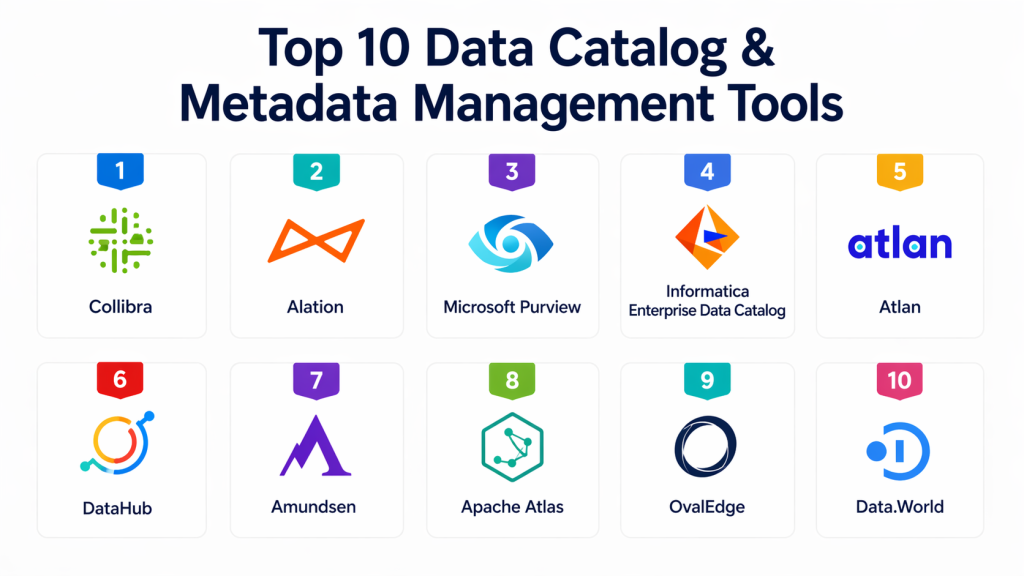
Top 10 Data Catalog & Metadata Management Tools
#1 — Collibra
Short description : Collibra is one of the most established enterprise data governance and catalog platforms. It is widely used for managing data policies, business glossaries, lineage, and compliance workflows. Collibra is especially strong in regulated industries where governance, auditability, and control are critical. It provides deep metadata management capabilities combined with enterprise workflow automation. Best suited for large organizations with mature data governance programs.
Key Features
- Enterprise-grade data governance workflows
- Business glossary and policy management
- Data lineage and impact analysis
- Data stewardship and ownership tracking
- Integration with enterprise data systems
- Workflow automation for governance processes
Pros
- Strong governance and compliance capabilities
- Mature enterprise adoption
- Robust workflow and policy management
Cons
- Complex implementation
- Higher cost for smaller teams
- Requires governance maturity
Platforms / Deployment
Cloud / Hybrid
Security & Compliance
Supports enterprise governance, RBAC, and compliance frameworks.
Integrations & Ecosystem
Strong enterprise integration ecosystem including data warehouses, BI tools, and governance systems.
- Warehouse integrations
- BI tool connectivity
- Governance tooling support
- API extensibility
Support & Community
Strong enterprise support and consulting ecosystem.
#2 — Alation
Short description : Alation is a leading data catalog platform known for its strong user experience and search-driven data discovery. It combines metadata management with collaboration features and query behavior analysis. Alation is widely adopted for enabling self-service analytics across organizations. It is particularly strong in helping business users find and trust data quickly. A top choice for data-driven companies.
Key Features
- Powerful search and data discovery
- Behavioral metadata analysis
- Data lineage visualization
- Collaboration and annotation features
- Data governance capabilities
- Query usage tracking
Pros
- Excellent usability
- Strong adoption among business users
- Powerful search capabilities
Cons
- Can be expensive
- Advanced features require configuration
- Governance depth less than Collibra
Platforms / Deployment
Cloud / Hybrid
Security & Compliance
Supports access control and governance workflows.
Integrations & Ecosystem
Works well with modern data stacks and BI tools.
- Warehouse integrations
- BI and analytics tools
- Query engines
- Data pipelines
Support & Community
Active community and strong documentation.
#3 — Microsoft Purview
Short description : Microsoft Purview is a unified data governance and catalog platform designed for Azure and hybrid environments. It provides automated data discovery, classification, lineage, and policy enforcement. Purview is particularly strong for organizations using Microsoft data services. It integrates governance directly into the data lifecycle. A strong option for enterprise-scale data environments.
Key Features
- Automated data scanning and classification
- Data lineage and mapping
- Unified governance framework
- Policy enforcement and compliance tracking
- Integration with Azure ecosystem
- Data access insights
Pros
- Strong integration with Microsoft ecosystem
- Automated governance capabilities
- Scalable enterprise solution
Cons
- Best suited for Azure users
- Less flexible outside Microsoft ecosystem
- Learning curve for advanced features
Platforms / Deployment
Cloud
Security & Compliance
Supports enterprise-grade governance and compliance controls.
Integrations & Ecosystem
Deep integration with Microsoft data services.
- Azure data services
- BI tools
- Data lakes and warehouses
- Identity systems
Support & Community
Backed by Microsoft enterprise support.
#4 — Informatica Enterprise Data Catalog
Short description : Informatica Enterprise Data Catalog is a powerful metadata management platform with strong automation capabilities. It uses AI-driven scanning and classification to help organizations understand their data landscape. It is well suited for large enterprises with complex data environments. Informatica combines cataloging with governance and data quality features. A strong option for enterprise data management.
Key Features
- AI-driven metadata discovery
- Data lineage and impact analysis
- Data quality integration
- Business glossary support
- Automated classification
- Enterprise-scale metadata management
Pros
- Strong automation capabilities
- Enterprise-grade scalability
- Integrated data quality features
Cons
- Complex setup
- Higher cost
- Requires skilled resources
Platforms / Deployment
Cloud / Hybrid
Security & Compliance
Supports enterprise governance and compliance standards.
Integrations & Ecosystem
Strong enterprise integration ecosystem.
- Data warehouses
- ETL tools
- BI systems
- Data governance tools
Support & Community
Strong enterprise support and training ecosystem.
#5 — Atlan
Short description : Atlan is a modern data catalog designed for the cloud-first data stack. It focuses on collaboration, usability, and integration with tools like dbt, Snowflake, and BI platforms. Atlan is popular among fast-growing data teams that want a flexible and intuitive catalog. It supports active metadata and modern workflows. A strong choice for modern data teams.
Key Features
- Active metadata platform
- Collaboration and documentation features
- Integration with modern data tools
- Data lineage and governance
- Search and discovery capabilities
- API-first architecture
Pros
- Modern UI and user experience
- Strong integration with modern data stack
- Good for agile data teams
Cons
- Newer compared to enterprise incumbents
- Some advanced governance features still evolving
- Enterprise depth varies
Platforms / Deployment
Cloud
Security & Compliance
Supports role-based access and governance controls.
Integrations & Ecosystem
Excellent integration with modern tools.
- dbt
- Snowflake
- BI tools
- Data pipelines
Support & Community
Growing community and strong documentation.
#6 — DataHub
Short description : DataHub is an open-source metadata platform originally developed at LinkedIn. It focuses on real-time metadata, lineage, and extensibility. DataHub is ideal for engineering-driven teams that want control and customization. It supports a wide range of integrations and use cases. A strong option for open-source adoption.
Key Features
- Open-source metadata platform
- Real-time metadata updates
- Data lineage tracking
- Extensible architecture
- Strong developer APIs
- Broad integration support
Pros
- Open and flexible
- Strong engineering control
- Growing community
Cons
- Requires technical expertise
- Setup and maintenance effort
- Limited out-of-the-box UI polish
Platforms / Deployment
Cloud / Self-hosted
Security & Compliance
Depends on deployment architecture.
Integrations & Ecosystem
Broad integration support through connectors and APIs.
Support & Community
Strong open-source community.
#7 — Amundsen
Short description : Amundsen is an open-source data discovery and metadata platform originally developed at Lyft. It focuses on search, discovery, and data usability. It is lightweight compared to enterprise tools but still powerful for engineering teams. Amundsen is best for organizations that want a simple and customizable catalog. It works well in modern data stacks.
Key Features
- Data discovery and search
- Metadata indexing
- Open-source architecture
- Lightweight deployment
- Integration with data tools
- User-friendly search interface
Pros
- Lightweight and flexible
- Good for engineering teams
- Open-source customization
Cons
- Limited governance features
- Requires engineering effort
- Smaller ecosystem
Platforms / Deployment
Self-hosted
Security & Compliance
Depends on deployment setup.
Integrations & Ecosystem
Supports integration with modern data tools.
Support & Community
Active open-source community.
#8 — Apache Atlas
Short description : Apache Atlas is an open-source metadata governance and data catalog platform often used in Hadoop ecosystems. It provides classification, lineage, and policy management features. Atlas is particularly useful in big data environments. It is best suited for organizations with existing Hadoop-based infrastructure. A solid open-source governance tool.
Key Features
- Metadata classification
- Data lineage tracking
- Governance policy framework
- Integration with Hadoop ecosystem
- Open-source architecture
- Security tagging
Pros
- Strong governance capabilities
- Open-source flexibility
- Good for big data environments
Cons
- Complex setup
- Limited UI experience
- Requires Hadoop ecosystem
Platforms / Deployment
Self-hosted
Security & Compliance
Supports governance and classification policies.
Integrations & Ecosystem
Works best within Hadoop ecosystems.
Support & Community
Active open-source community.
#9 — OvalEdge
Short description : OvalEdge is a data governance and catalog platform focused on usability and automation. It provides data lineage, governance workflows, and business glossary capabilities. OvalEdge is designed to make data governance accessible for business users. It is particularly useful for organizations balancing governance and usability. A practical enterprise option.
Key Features
- Data catalog and governance
- Business glossary
- Data lineage
- Workflow automation
- Data quality tracking
- User-friendly interface
Pros
- Good balance of usability and governance
- Practical enterprise features
- Strong data quality integration
Cons
- Smaller market presence
- Fewer integrations than leaders
- Enterprise scaling considerations
Platforms / Deployment
Cloud / Hybrid
Security & Compliance
Supports governance and access controls.
Integrations & Ecosystem
Integrates with enterprise data tools.
Support & Community
Growing enterprise adoption.
#10 — Data.World
Short description : Data.World is a collaborative data catalog platform focused on knowledge graphs and data discovery. It emphasizes usability, collaboration, and semantic relationships between data assets. It is particularly strong for organizations that want a business-friendly catalog experience. It supports governance while maintaining accessibility. A good option for collaborative data teams.
Key Features
- Knowledge graph-based data catalog
- Collaboration and documentation
- Data discovery and search
- Governance support
- Semantic relationships
- Business-friendly interface
Pros
- Strong collaboration features
- Easy to use for business users
- Knowledge graph approach
Cons
- Less enterprise-heavy than top competitors
- Governance depth varies
- Not ideal for very complex environments
Platforms / Deployment
Cloud
Security & Compliance
Supports access control and governance features.
Integrations & Ecosystem
Works with modern data platforms and tools.
Support & Community
Active community and growing adoption.
Comparison Table (Top 10)
| Tool Name | Best For | Platform(s) Supported | Deployment | Standout Feature | Public Rating |
|---|---|---|---|---|---|
| Collibra | Enterprise governance | Web / Cloud | Cloud / Hybrid | Deep governance workflows | N/A |
| Alation | Data discovery | Web / Cloud | Cloud / Hybrid | Powerful search experience | N/A |
| Microsoft Purview | Azure governance | Web / Cloud | Cloud | Unified governance platform | N/A |
| Informatica EDC | Enterprise metadata automation | Web / Cloud | Cloud / Hybrid | AI-driven metadata discovery | N/A |
| Atlan | Modern data teams | Web / Cloud | Cloud | Active metadata platform | N/A |
| DataHub | Open-source metadata | Web / Cloud | Cloud / Self-hosted | Real-time metadata system | N/A |
| Amundsen | Lightweight discovery | Web | Self-hosted | Fast data search | N/A |
| Apache Atlas | Hadoop governance | Web | Self-hosted | Metadata governance framework | N/A |
| OvalEdge | Governance + usability | Web / Cloud | Cloud / Hybrid | Balanced governance tools | N/A |
| Data.World | Collaborative catalog | Web / Cloud | Cloud | Knowledge graph catalog | N/A |
Evaluation & Scoring of Data Catalog Tools
| Tool Name | Core (25%) | Ease (15%) | Integrations (15%) | Security (10%) | Performance (10%) | Support (10%) | Value (15%) | Weighted Total |
|---|---|---|---|---|---|---|---|---|
| Collibra | 9.5 | 7.5 | 8.8 | 9.5 | 8.5 | 9.0 | 7.0 | 8.65 |
| Alation | 9.0 | 8.8 | 8.7 | 8.8 | 8.5 | 8.7 | 7.5 | 8.62 |
| Microsoft Purview | 8.8 | 8.2 | 8.9 | 9.0 | 8.6 | 8.8 | 8.0 | 8.60 |
| Informatica EDC | 9.2 | 7.2 | 8.6 | 9.2 | 8.7 | 8.9 | 7.2 | 8.52 |
| Atlan | 8.5 | 9.0 | 8.8 | 8.2 | 8.3 | 8.5 | 8.5 | 8.57 |
| DataHub | 8.4 | 6.8 | 8.5 | 7.8 | 8.2 | 8.0 | 8.8 | 8.07 |
| Amundsen | 7.5 | 7.5 | 7.8 | 7.0 | 7.8 | 7.5 | 8.5 | 7.73 |
| Apache Atlas | 8.0 | 6.5 | 7.5 | 8.5 | 8.0 | 7.8 | 8.2 | 7.93 |
| OvalEdge | 8.2 | 8.0 | 7.8 | 8.2 | 8.0 | 7.9 | 8.0 | 8.01 |
| Data.World | 8.0 | 8.5 | 7.9 | 7.8 | 7.8 | 8.0 | 8.2 | 8.02 |
Scores are comparative and help identify trade-offs. Higher scores indicate broader capability, but the best tool depends on your use case, team maturity, and governance needs.
Which Data Catalog Tool Is Right for You?
Solo / Freelancer
Choose lightweight or open-source options like DataHub or Amundsen.
SMB
Atlan or Data.World are great for usability and quick adoption.
Mid-Market
Alation, Atlan, or Microsoft Purview offer balance between usability and governance.
Enterprise
Collibra, Informatica, and Purview are top choices for governance-heavy environments.
Budget vs Premium
Open-source tools offer flexibility, while enterprise tools offer governance depth.
Feature Depth vs Ease of Use
Collibra = depth
Atlan = usability
Alation = balance
Integrations & Scalability
Choose tools aligned with your warehouse and BI ecosystem.
Security & Compliance Needs
Enterprise tools like Collibra and Purview are strongest.
Frequently Asked Questions (FAQs)
1. What is a data catalog?
A data catalog is a centralized system that helps users discover, understand, and trust data assets across an organization. It indexes datasets, dashboards, tables, and pipelines while adding metadata such as ownership, definitions, and usage patterns. This makes it easier for teams to find the right data without relying on tribal knowledge. It improves productivity, reduces duplication, and supports self-service analytics. Over time, it becomes a core layer of data governance and collaboration.
2. Why is metadata important?
Metadata provides context about data, including where it comes from, how it is structured, who owns it, and how it should be used. Without metadata, data becomes difficult to interpret and trust. It enables lineage tracking, governance enforcement, and better decision-making. Metadata also helps automate processes like classification, tagging, and access control. In modern data stacks, it is essential for scalability and data quality.
3. Who uses data catalog tools?
Data catalog tools are used by a wide range of roles including data engineers, analysts, data scientists, governance teams, and business users. Engineers use them for lineage and pipeline visibility, while analysts use them for discovery and reporting. Governance teams rely on them for compliance and policy enforcement. Business users benefit from simplified search and business definitions. This cross-functional usage is what makes catalogs so valuable.
4. Are data catalogs necessary for small teams?
Not always, but they can still provide value depending on data complexity. Small teams with limited datasets may manage without a full catalog initially. However, as data sources grow, even small teams can face confusion and duplication issues. A lightweight or modern catalog can help maintain clarity and structure early on. It becomes more critical as teams scale and data usage expands.
5. What is data lineage?
Data lineage shows how data flows from source systems through transformations to final outputs like dashboards or reports. It helps users understand dependencies and trace issues back to their origin. Lineage is especially important for debugging, auditing, and compliance. Advanced tools provide column-level lineage for deeper visibility. This improves trust and reduces risk in data-driven decisions.
6. What is a business glossary?
A business glossary is a centralized collection of standardized definitions for key business terms. It ensures that everyone in the organization uses consistent language when working with data. This reduces confusion and misinterpretation across teams. Glossaries are often integrated with data catalogs for better context. They are essential for aligning technical and business users.
7. Are these tools cloud-based?
Most modern data catalog tools are cloud-based, offering scalability, flexibility, and easier integration with modern data stacks. However, some tools also support hybrid or self-hosted deployments for enterprises with strict compliance needs. Cloud deployment simplifies maintenance and updates. It also enables better collaboration across distributed teams. The choice depends on security and infrastructure requirements.
8. Do they support governance?
Yes, governance is one of the core functions of data catalog tools. They help enforce policies, manage access, track data usage, and ensure compliance with regulations. Advanced tools also support role-based access control, audit logs, and automated policy enforcement. Governance features are especially critical for regulated industries. They ensure data is used responsibly and securely.
9. How long does implementation take?
Implementation timelines vary based on organization size, data complexity, and tool selection. Small deployments can take a few weeks, while enterprise implementations may take several months. Initial setup includes data source integration, metadata ingestion, and user onboarding. Ongoing refinement is usually required to maintain quality and adoption. A phased rollout approach is often recommended.
10. Can they integrate with BI tools?
Yes, most data catalog tools integrate seamlessly with popular BI tools to provide context and metadata directly within reporting environments. This helps users understand data sources behind dashboards. Integration improves trust and usability of analytics outputs. It also enables lineage tracking from reports back to source data. This is a key requirement for modern analytics workflows.
Conclusion
Data Catalog & Metadata Management tools are no longer optional in modern data environments. As organizations scale their data ecosystems across warehouses, lakes, SaaS tools, and AI pipelines, the need for structured metadata, governance, and discoverability becomes critical. These tools help teams move from data chaos to data clarity by enabling better search, lineage visibility, ownership tracking, and standardized definitions. Without a catalog, even the most advanced data stack can become fragmented and unreliable over time.
The right platform depends heavily on your organization’s size, data maturity, and governance requirements. Enterprise tools like Collibra and Informatica offer deep control and compliance, while modern platforms like Atlan and Alation focus on usability and faster adoption. Open-source options like DataHub and Amundsen provide flexibility for engineering-led teams. Instead of chasing a single “best” tool, shortlist two or three options aligned with your ecosystem and run a pilot. Validate integrations, usability, and governance fit before scaling. This approach ensures long-term success and sustainable data trust.
