Introduction
Corporate Travel Booking Platforms are digital solutions that help organizations manage business travel bookings, expenses, and policies in a centralized system. These platforms streamline the process of booking flights, hotels, and transportation while ensuring compliance with company policies.
As organizations expand globally and adopt hybrid work models, managing travel efficiently has become critical. Modern platforms offer automation, real-time tracking, cost control, and integration with expense management tools. They improve employee experience while helping companies control travel spend and maintain compliance.
Common use cases:
- Booking flights, hotels, and transportation
- Managing travel policies and approvals
- Tracking travel expenses
- Monitoring employee travel in real time
- Generating travel analytics and reports
What buyers should evaluate:
- Ease of use and booking experience
- Policy enforcement and compliance features
- Integration with expense and finance tools
- Cost optimization and reporting
- Global coverage and supplier network
- Mobile access and user experience
- Security and data protection
- Customer support and service
Best for: Enterprises, mid-sized businesses, travel managers, and finance teams managing corporate travel.
Not ideal for: Individuals or small teams with minimal travel needs.
Key Trends in Corporate Travel Booking Platforms
- AI-driven travel recommendations and cost optimization
- Integration with expense management systems
- Mobile-first travel booking experiences
- Real-time travel tracking and alerts
- Automation of approvals and workflows
- Focus on traveler safety and compliance
- Integration with HR and finance systems
- Data-driven travel analytics
How We Evaluate Corporate Travel Booking Platforms (Methodology)
- Market adoption and global presence
- Feature completeness and flexibility
- Ease of use and user experience
- Integration ecosystem
- Performance and reliability
- Security capabilities
- Scalability across organizations
- Customer support quality
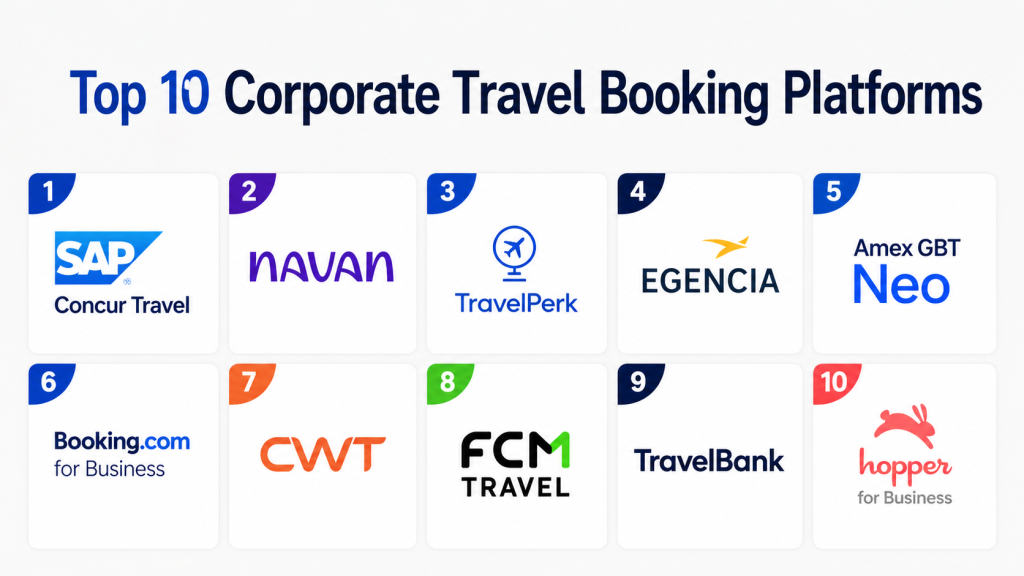
Top 10 Corporate Travel Booking Platforms
#1 — SAP Concur Travel
Short description:
SAP Concur Travel is a leading corporate travel platform that combines booking and expense management. It provides policy enforcement and automation features. The platform is suitable for enterprises. It improves cost control and compliance.
Key Features
- Travel booking
- Expense management
- Policy enforcement
- Reporting
Pros
- Enterprise-grade
- Strong integrations
Cons
- Complex setup
- High cost
Platforms / Deployment
Web, Mobile / Cloud
Security & Compliance
Not publicly stated
Integrations & Ecosystem
Integrates with finance and HR systems.
- ERP tools
- Expense systems
Support & Community
Enterprise support.
#2 — Navan
Short description:
Navan is a modern travel and expense platform designed for user experience. It offers booking, policy management, and analytics. The platform is suitable for businesses. It improves efficiency and traveler satisfaction.
Key Features
- Travel booking
- Expense management
- Policy control
- Analytics
Pros
- User-friendly
- Modern interface
Cons
- Pricing varies
- Limited customization
Platforms / Deployment
Web, Mobile / Cloud
Security & Compliance
Not publicly stated
Integrations & Ecosystem
Supports integrations with business tools.
- Finance systems
- HR tools
Support & Community
Strong support.
#3 — TravelPerk
Short description:
TravelPerk is a corporate travel platform focused on flexibility and cost control. It offers booking, policy enforcement, and reporting features. The platform is suitable for SMBs and enterprises. It improves travel management.
Key Features
- Booking management
- Policy control
- Reporting
- Automation
Pros
- Flexible
- Easy to use
Cons
- Limited advanced features
- Pricing varies
Platforms / Deployment
Web, Mobile / Cloud
Security & Compliance
Not publicly stated
Integrations & Ecosystem
Integrates with business tools.
- Finance systems
- CRM tools
Support & Community
Good support.
#4 — Egencia
Short description:
Egencia is a corporate travel management platform that provides booking and reporting features. It is designed for enterprises. It offers global coverage. It improves travel efficiency.
Key Features
- Travel booking
- Reporting
- Policy management
- Analytics
Pros
- Global reach
- Reliable
Cons
- Complex setup
- Pricing varies
Platforms / Deployment
Web, Mobile / Cloud
Security & Compliance
Not publicly stated
Integrations & Ecosystem
Supports integrations with enterprise tools.
- Finance systems
- HR tools
Support & Community
Enterprise support.
#5 — Amex GBT Neo
Short description:
Amex GBT Neo is a corporate travel platform offering booking and policy management. It provides analytics and automation features. The platform is suitable for enterprises. It improves travel control.
Key Features
- Travel booking
- Policy enforcement
- Analytics
- Automation
Pros
- Strong brand
- Reliable
Cons
- Pricing varies
- Limited flexibility
Platforms / Deployment
Web / Cloud
Security & Compliance
Not publicly stated
Integrations & Ecosystem
Integrates with business tools.
- Finance systems
Support & Community
Good support.
#6 — Booking.com for Business
Short description:
Booking.com for Business is a travel platform focused on hotel bookings and travel management. It provides simple booking and reporting features. The platform is suitable for SMBs. It is easy to use.
Key Features
- Hotel booking
- Travel management
- Reporting
- Notifications
Pros
- Easy to use
- Wide inventory
Cons
- Limited enterprise features
- Focused on hotels
Platforms / Deployment
Web / Cloud
Security & Compliance
Not publicly stated
Integrations & Ecosystem
Supports integrations with booking systems.
- Travel platforms
Support & Community
Reliable support.
#7 — CWT
Short description:
CWT is a corporate travel management platform providing booking and analytics features. It is designed for enterprises. It offers global services. It improves travel efficiency.
Key Features
- Travel booking
- Analytics
- Reporting
- Policy management
Pros
- Enterprise-focused
- Global coverage
Cons
- Complex
- Pricing varies
Platforms / Deployment
Web, Mobile / Cloud
Security & Compliance
Not publicly stated
Integrations & Ecosystem
Integrates with enterprise tools.
- Finance systems
Support & Community
Enterprise support.
#8 — FCM Travel
Short description:
FCM Travel is a corporate travel platform offering booking and management features. It supports global travel needs. The platform is suitable for enterprises. It improves travel control.
Key Features
- Booking management
- Reporting
- Policy enforcement
- Analytics
Pros
- Global reach
- Reliable
Cons
- Complex setup
- Pricing varies
Platforms / Deployment
Web, Mobile / Cloud
Security & Compliance
Not publicly stated
Integrations & Ecosystem
Supports integrations with enterprise systems.
- Finance tools
Support & Community
Enterprise support.
#9 — TravelBank
Short description:
TravelBank is a travel and expense management platform focused on cost optimization. It provides booking and expense tracking features. The platform is suitable for SMBs. It improves efficiency.
Key Features
- Travel booking
- Expense tracking
- Reporting
- Automation
Pros
- Cost-focused
- Easy to use
Cons
- Limited enterprise features
- Pricing varies
Platforms / Deployment
Web, Mobile / Cloud
Security & Compliance
Not publicly stated
Integrations & Ecosystem
Supports integrations with business tools.
- Finance systems
Support & Community
Good support.
#10 — Hopper for Business
Short description:
Hopper for Business is a travel booking platform with predictive pricing features. It helps optimize travel costs. The platform is suitable for businesses. It improves booking efficiency.
Key Features
- Travel booking
- Price prediction
- Notifications
- Analytics
Pros
- Innovative features
- Cost optimization
Cons
- Limited enterprise features
- Newer platform
Platforms / Deployment
Web, Mobile / Cloud
Security & Compliance
Not publicly stated
Integrations & Ecosystem
Supports integrations with travel tools.
- Booking platforms
Support & Community
Moderate support.
Comparison Table
| Tool Name | Best For | Platform(s) | Deployment | Standout Feature | Public Rating |
|---|---|---|---|---|---|
| SAP Concur | Enterprise | Web/Mobile | Cloud | Expense integration | N/A |
| Navan | SMB | Web/Mobile | Cloud | UX | N/A |
| TravelPerk | SMB | Web/Mobile | Cloud | Flexibility | N/A |
| Egencia | Enterprise | Web/Mobile | Cloud | Global reach | N/A |
| Amex Neo | Enterprise | Web | Cloud | Reliability | N/A |
| Booking.com | SMB | Web | Cloud | Inventory | N/A |
| CWT | Enterprise | Web/Mobile | Cloud | Coverage | N/A |
| FCM | Enterprise | Web/Mobile | Cloud | Global | N/A |
| TravelBank | SMB | Web/Mobile | Cloud | Cost control | N/A |
| Hopper | SMB | Web/Mobile | Cloud | Pricing AI | N/A |
Evaluation & Scoring Table
| Tool | Core | Ease | Integrations | Security | Performance | Support | Value | Total |
|---|---|---|---|---|---|---|---|---|
| SAP Concur | 9 | 7 | 9 | 8 | 9 | 9 | 7 | 8.4 |
| Navan | 9 | 9 | 8 | 7 | 8 | 8 | 8 | 8.4 |
| TravelPerk | 8 | 9 | 8 | 7 | 8 | 8 | 8 | 8.2 |
| Egencia | 9 | 7 | 8 | 7 | 9 | 9 | 7 | 8.3 |
| Amex Neo | 8 | 7 | 7 | 7 | 8 | 8 | 7 | 7.7 |
| Booking.com | 7 | 9 | 6 | 6 | 7 | 7 | 8 | 7.4 |
| CWT | 9 | 7 | 8 | 7 | 9 | 9 | 7 | 8.3 |
| FCM | 9 | 7 | 8 | 7 | 9 | 9 | 7 | 8.3 |
| TravelBank | 8 | 9 | 7 | 7 | 8 | 8 | 8 | 8.0 |
| Hopper | 8 | 8 | 6 | 6 | 8 | 7 | 8 | 7.6 |
Which Corporate Travel Booking Platform Is Right for You?
Solo / Small Teams
If you are a small team or startup with limited travel needs, platforms like Booking.com for Business or TravelBank are good choices. These tools are simple, easy to use, and require minimal setup. They allow basic booking and expense tracking without complexity. You can manage travel without dedicated admin support. For small teams, ease of use and affordability are key factors.
SMB / Growing Businesses
Small to mid-sized businesses should consider platforms like TravelPerk or Navan. These tools offer a balance of usability and advanced features like policy control and reporting. They help manage travel bookings efficiently while keeping costs under control. Integration with finance tools improves workflow. These platforms are ideal for growing organizations.
Mid-Market / Expanding Organizations
Organizations with increasing travel needs should look at platforms like Egencia or TravelPerk. These tools provide better reporting, global coverage, and policy enforcement. They help manage multiple travelers and bookings efficiently. They also provide analytics for cost optimization. These platforms support scaling operations.
Enterprise / Large Organizations
Large enterprises should choose platforms like SAP Concur, CWT, or FCM Travel. These solutions offer advanced automation, compliance, and global support. They handle complex workflows and high travel volumes. They also integrate with ERP and finance systems. These platforms are designed for enterprise-level management.
Budget vs Premium
Budget tools focus on basic booking and expense management at a lower cost. Premium tools offer advanced analytics, policy enforcement, and integrations. If your travel needs are simple, budget tools are sufficient. For large organizations, premium solutions provide better control and visibility. Choose based on your operational requirements.
Feature Depth vs Ease of Use
Some platforms offer advanced features but require training and setup. Others are simple but limited in functionality. Small teams should prioritize ease of use. Enterprises can benefit from feature-rich platforms. The right choice depends on your team’s expertise.
Integrations & Scalability
Travel platforms should integrate with finance, HR, and expense systems. This improves workflow efficiency and automation. Scalability is important for growing businesses. Choose tools that can handle increased travel demand. Integration capability ensures long-term success.
Security & Compliance Needs
Corporate travel platforms handle sensitive employee and financial data. Choose tools with secure data handling and compliance features. Enterprises should prioritize policy enforcement and data protection. Reviewing security measures is essential. Protecting data ensures reliability and trust.
Frequently Asked Questions (FAQs)
1. What is a corporate travel booking platform?
A corporate travel booking platform is a software solution that helps businesses manage travel bookings and expenses. It allows employees to book flights, hotels, and transportation. It also enforces company travel policies. These tools improve efficiency and control costs. They are widely used by organizations.
2. How do these platforms help reduce travel costs?
These platforms provide cost visibility and analytics. They allow companies to set travel policies and limits. Automated approvals help control spending. Some tools offer price comparisons and recommendations. This helps businesses reduce unnecessary expenses.
3. Are corporate travel platforms suitable for small businesses?
Yes, many platforms offer solutions for small businesses. They provide basic booking and expense features. Small teams can manage travel efficiently without complexity. Affordable plans are available. It depends on travel volume and needs.
4. Can these platforms integrate with other systems?
Yes, most platforms integrate with finance, HR, and expense management tools. Integration improves workflow and data accuracy. It allows seamless operations across systems. Compatibility is important when choosing a tool. Integration enhances efficiency.
5. Do these platforms support mobile access?
Yes, most modern platforms offer mobile apps. Employees can book and manage travel on the go. This improves convenience and flexibility. Mobile access is essential for frequent travelers. It enhances user experience.
6. Are corporate travel platforms secure?
Security depends on the provider. Many platforms offer secure data handling and access control. Some include compliance features. Businesses should evaluate security before choosing. Protecting sensitive data is critical.
7. Can I track employee travel in real time?
Yes, many platforms provide real-time tracking features. Companies can monitor employee travel status. This improves safety and visibility. It is useful for managing travel disruptions. Real-time tracking is a key feature.
8. What features should I look for?
Look for booking management, policy enforcement, and reporting features. Integration with finance systems is important. Ease of use should be considered. Choose features based on your needs. Scalability is also important.
9. What are common mistakes when choosing a platform?
Choosing overly complex tools is a common mistake. Ignoring integration needs can cause issues. Not considering scalability can limit growth. Overpaying for unused features is another issue. Proper evaluation is important.
10. What are alternatives to corporate travel platforms?
Alternatives include manual booking or travel agencies. These methods are less efficient and harder to manage. Software platforms provide automation and insights. They improve control and efficiency. They are better for modern businesses.
Conclusion
Corporate Travel Booking Platforms have become essential tools for organizations managing business travel in a structured and efficient way. They simplify booking processes, enforce company policies, and provide real-time visibility into travel activities. By automating workflows and centralizing data, these platforms help reduce operational complexity and improve overall travel management.
Selecting the right platform depends on your organization’s size, travel frequency, and operational needs. Small teams may prioritize ease of use and affordability, while larger enterprises require advanced features like analytics, policy enforcement, and integrations with finance systems. Evaluating usability, scalability, and security is key to making an informed decision.
To move forward, identify your travel requirements, shortlist a few platforms, and test their capabilities in real scenarios. Ensure compatibility with your existing systems and validate security features before implementation. The right corporate travel platform will not only optimize costs but also enhance employee experience and support long-term business growth.
