Introduction
Compensation Management Tools help organizations design, manage, and optimize employee compensation structures, including salaries, bonuses, incentives, and equity. These platforms centralize compensation planning, improve transparency, and ensure alignment with business goals.
In today’s competitive talent market, compensation management has become a strategic function. Organizations must balance fair pay, performance incentives, and budget constraints while maintaining compliance and equity. Modern tools now include automation, analytics, and AI-driven insights to support data-driven compensation decisions.
Common use cases include:
- Salary planning and adjustments
- Bonus and incentive management
- Pay equity analysis
- Budget allocation and forecasting
- Compensation review cycles
Key evaluation criteria:
- Compensation planning capabilities
- Analytics and reporting features
- Integration with HR and payroll systems
- Ease of use and collaboration
- Security and compliance
- Scalability and performance
- Customization and flexibility
- Budgeting and forecasting tools
Best for: HR teams, finance teams, enterprises, and mid-sized organizations managing structured compensation processes.
Not ideal for: Small businesses with simple compensation structures or minimal workforce.
Key Trends in Compensation Management Tools
- AI-driven compensation insights and benchmarking
- Pay equity and transparency analysis
- Automation of compensation cycles
- Integration with HRIS and payroll systems
- Cloud-based compensation platforms
- Real-time analytics and dashboards
- Scenario planning for compensation strategies
- API-first architectures for integrations
- Enhanced security with RBAC and encryption
- Subscription-based pricing models
How We Evaluated Compensation Management Tools
- Market adoption across HR and finance teams
- Feature completeness for compensation planning
- Performance, scalability, and reliability
- Security features and compliance readiness
- Integration ecosystem with HR and payroll tools
- Ease of use and onboarding experience
- Vendor support and documentation quality
- Suitability across SMB, mid-market, and enterprise
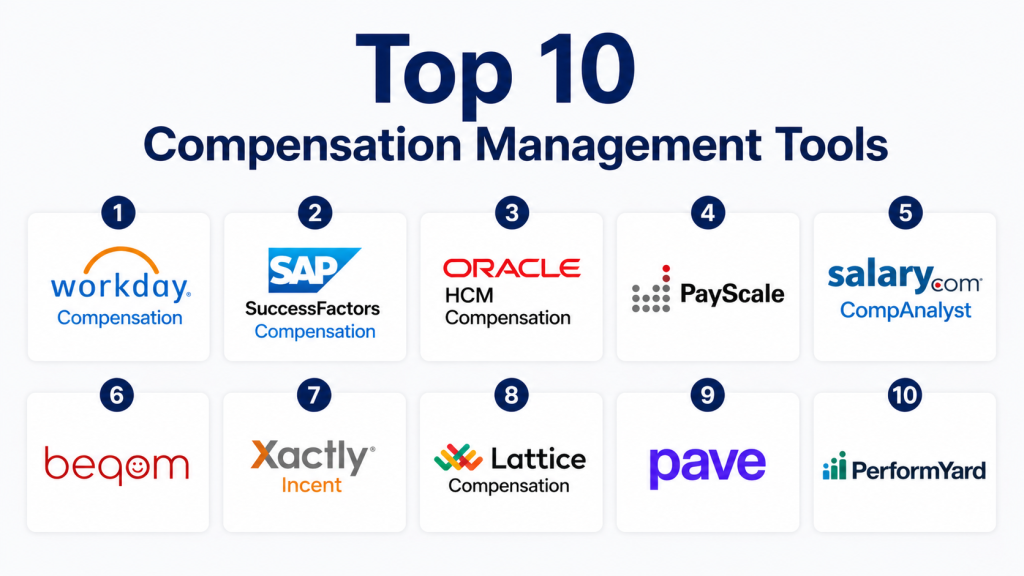
Top 10 Compensation Management Tools
#1 — Workday Compensation
Short description :
Workday Compensation is an enterprise-grade platform designed for managing employee pay and rewards. It provides tools for salary planning, bonus allocation, and compensation analysis. The platform integrates deeply with Workday HR systems. It supports global operations and compliance. It is ideal for large enterprises. Workday helps streamline compensation processes and improve decision-making.
Key Features
- Salary planning
- Bonus management
- Compensation analytics
- Integration
- Reporting
Pros
- Strong enterprise capabilities
- Deep HR integration
Cons
- Complex implementation
- Expensive
Platforms / Deployment
Cloud
Security & Compliance
SSO, RBAC, encryption
Integrations & Ecosystem
- Workday HR
- Payroll systems
Support & Community
Enterprise support
#2 — SAP SuccessFactors Compensation
Short description :
SAP SuccessFactors Compensation is a cloud-based solution for managing employee compensation. It provides tools for salary planning, bonus distribution, and pay equity analysis. The platform integrates with SAP HR systems. It is ideal for enterprises. It supports global compensation strategies. It helps ensure compliance and fairness.
Key Features
- Compensation planning
- Bonus management
- Pay equity analysis
- Reporting
- Integration
Pros
- Strong integration
- Global capabilities
Cons
- Complex setup
- Requires SAP ecosystem
Platforms / Deployment
Cloud
Security & Compliance
RBAC, encryption
Integrations & Ecosystem
- SAP HR
- Payroll systems
Support & Community
Enterprise support
#3 — Oracle HCM Compensation
Short description :
Oracle HCM Compensation provides tools for managing employee compensation within Oracle HCM. It supports salary planning, bonus allocation, and analytics. The platform offers scalability and integration with Oracle systems. It is ideal for large enterprises. It helps streamline compensation workflows. It ensures compliance.
Key Features
- Salary planning
- Bonus management
- Analytics
- Integration
- Reporting
Pros
- Scalable
- Strong analytics
Cons
- Complex
- Requires Oracle ecosystem
Platforms / Deployment
Cloud
Security & Compliance
RBAC, encryption
Integrations & Ecosystem
- Oracle HCM
- Payroll systems
Support & Community
Enterprise support
#4 — PayScale
Short description :
PayScale is a compensation management platform focused on salary benchmarking and analytics. It provides insights into market pay trends. The platform helps organizations design competitive compensation structures. It is easy to use and deploy. It is ideal for SMBs and mid-market companies. PayScale supports data-driven decisions.
Key Features
- Salary benchmarking
- Analytics
- Reporting
- Market insights
- Integration
Pros
- Strong benchmarking
- Easy to use
Cons
- Limited enterprise features
- Pricing varies
Platforms / Deployment
Cloud
Security & Compliance
Encryption
Integrations & Ecosystem
- HR systems
- Payroll tools
Support & Community
Reliable support
#5 — Salary.com CompAnalyst
Short description :
CompAnalyst is a compensation management platform providing benchmarking and planning tools. It offers salary data and analytics. The platform helps organizations manage pay structures. It is ideal for mid-market companies. It supports compliance and reporting. It integrates with HR systems.
Key Features
- Salary benchmarking
- Compensation planning
- Analytics
- Reporting
- Integration
Pros
- Strong data insights
- Reliable
Cons
- Limited customization
- Pricing varies
Platforms / Deployment
Cloud
Security & Compliance
Encryption
Integrations & Ecosystem
- HR tools
- Payroll systems
Support & Community
Good support
#6 — beqom
Short description :
beqom is a compensation management platform focused on total rewards and incentives. It provides tools for salary, bonus, and equity management. The platform supports global operations. It is ideal for enterprises. beqom offers scalability and flexibility. It helps optimize compensation strategies.
Key Features
- Total rewards management
- Incentive management
- Analytics
- Reporting
- Integration
Pros
- Flexible
- Scalable
Cons
- Complex
- Expensive
Platforms / Deployment
Cloud
Security & Compliance
RBAC, encryption
Integrations & Ecosystem
- HR systems
- Finance tools
Support & Community
Enterprise support
#7 — Xactly Incent
Short description :
Xactly Incent is a compensation management tool focused on sales incentives. It provides automation and analytics for commission management. The platform is widely used by sales teams. It helps improve performance. It is ideal for mid-market and enterprise companies. It integrates with CRM systems.
Key Features
- Incentive management
- Commission tracking
- Analytics
- Reporting
- Integration
Pros
- Strong sales focus
- Automation
Cons
- Limited general compensation features
- Requires setup
Platforms / Deployment
Cloud
Security & Compliance
Encryption
Integrations & Ecosystem
- CRM systems
- Finance tools
Support & Community
Reliable support
#8 — Lattice Compensation
Short description :
Lattice Compensation is part of the Lattice performance management suite. It provides tools for compensation planning and reviews. The platform integrates with HR systems. It is easy to use and deploy. It is ideal for SMBs and mid-market companies. Lattice helps align compensation with performance.
Key Features
- Compensation planning
- Performance integration
- Reporting
- Analytics
- Integration
Pros
- Easy to use
- Performance alignment
Cons
- Limited enterprise features
- Growing ecosystem
Platforms / Deployment
Cloud
Security & Compliance
Encryption
Integrations & Ecosystem
- HR systems
- Performance tools
Support & Community
Good support
#9 — Pave
Short description :
Pave is a modern compensation management platform focused on benchmarking and planning. It provides real-time market data and analytics. The platform is easy to use. It is ideal for startups and SMBs. Pave helps design competitive compensation. It integrates with HR tools.
Key Features
- Benchmarking
- Analytics
- Planning
- Reporting
- Integration
Pros
- Modern interface
- Strong insights
Cons
- Limited enterprise features
- Smaller ecosystem
Platforms / Deployment
Cloud
Security & Compliance
Encryption
Integrations & Ecosystem
- HR systems
- Payroll tools
Support & Community
Reliable support
#10 — PerformYard Compensation Management
Short description :
PerformYard provides compensation management as part of its performance management suite. It offers tools for salary planning and reviews. The platform is easy to use and deploy. It is ideal for SMBs. PerformYard helps streamline compensation processes. It integrates with HR systems.
Key Features
- Compensation planning
- Performance integration
- Reporting
- Analytics
- Integration
Pros
- Easy to use
- Affordable
Cons
- Limited advanced features
- Not for large enterprises
Platforms / Deployment
Cloud
Security & Compliance
Encryption
Integrations & Ecosystem
- HR systems
- Payroll tools
Support & Community
Good support
Comparison Table (Top 10)
| Tool Name | Best For | Platform(s) | Deployment | Standout Feature | Rating |
|---|---|---|---|---|---|
| Workday | Enterprise | Web | Cloud | HR integration | N/A |
| SAP | Enterprise | Web | Cloud | Global compliance | N/A |
| Oracle | Enterprise | Web | Cloud | Analytics | N/A |
| PayScale | SMB | Web | Cloud | Benchmarking | N/A |
| CompAnalyst | Mid | Web | Cloud | Data insights | N/A |
| beqom | Enterprise | Web | Cloud | Total rewards | N/A |
| Xactly | Sales teams | Web | Cloud | Incentives | N/A |
| Lattice | SMB/Mid | Web | Cloud | Performance link | N/A |
| Pave | SMB | Web | Cloud | Market data | N/A |
| PerformYard | SMB | Web | Cloud | Simplicity | N/A |
Evaluation & Scoring of Compensation Management Tools
| Tool | Core | Ease | Integrations | Security | Performance | Support | Value | Total |
|---|---|---|---|---|---|---|---|---|
| Workday | 9 | 6 | 9 | 9 | 9 | 9 | 6 | 8.4 |
| SAP | 9 | 6 | 9 | 9 | 9 | 9 | 6 | 8.4 |
| Oracle | 9 | 6 | 9 | 9 | 9 | 9 | 6 | 8.4 |
| PayScale | 7 | 9 | 7 | 7 | 7 | 7 | 9 | 7.6 |
| CompAnalyst | 7 | 8 | 7 | 7 | 7 | 7 | 8 | 7.4 |
| beqom | 9 | 6 | 9 | 9 | 9 | 9 | 6 | 8.4 |
| Xactly | 8 | 7 | 8 | 8 | 8 | 8 | 7 | 7.8 |
| Lattice | 7 | 8 | 7 | 7 | 7 | 7 | 8 | 7.4 |
| Pave | 6 | 9 | 7 | 7 | 7 | 7 | 9 | 7.5 |
| PerformYard | 6 | 9 | 6 | 7 | 7 | 7 | 9 | 7.3 |
How to interpret scores:
These scores provide a comparative overview across key criteria such as features, usability, and value. Enterprise platforms score higher in scalability and compliance, while SMB tools perform better in ease of use and affordability. These are relative comparisons, not absolute benchmarks.
Which Compensation Management Tool Is Right for You?
Solo / Freelancer
Not typically required.
SMB
Pave, Lattice, and PerformYard are ideal.
Mid-Market
PayScale and CompAnalyst provide balanced features.
Enterprise
Workday, SAP, Oracle, and beqom are best.
Budget vs Premium
Budget: Pave, PerformYard
Premium: Workday, SAP
Feature Depth vs Ease of Use
Deep: Workday, Oracle
Easy: Pave, Lattice
Integrations & Scalability
Strong: SAP, Oracle
Scalable: Workday, beqom
Security & Compliance Needs
High: SAP, Oracle
Moderate: Pave, Lattice
Frequently Asked Questions (FAQs)
1. What are compensation management tools?
Compensation management tools help businesses plan and manage employee salaries, bonuses, and incentives. They centralize compensation data and automate processes. These tools improve transparency and fairness. They also support data-driven decisions. HR teams use them to streamline compensation planning.
2. How much do these tools cost?
Pricing varies depending on features and company size. SMB tools are generally affordable. Enterprise solutions are more expensive. Most platforms use subscription pricing. Additional costs may include integrations and customization.
3. Are these tools necessary?
They are useful for organizations with structured compensation processes. They improve efficiency and reduce errors. They ensure fair pay practices. Small businesses may not need them initially. Growing companies benefit most.
4. How long does implementation take?
Cloud platforms can be deployed quickly. Enterprise systems take longer due to integrations. Implementation depends on complexity. Planning helps reduce delays. Testing ensures smooth deployment.
5. What integrations are important?
Important integrations include HRIS, payroll, and finance systems. APIs enable flexibility. Integration improves efficiency. It reduces manual work. Compatibility is important.
6. Can these tools improve pay equity?
Yes, they provide analytics and benchmarking. They help identify pay gaps. They support fair compensation practices. Organizations can ensure compliance. This improves employee satisfaction.
7. What security features should they have?
They should include encryption, RBAC, and authentication. Data protection is critical. Compliance is important. Secure systems ensure reliability. Businesses should evaluate security carefully.
8. Can they manage global compensation?
Yes, many platforms support global compensation planning. They handle multiple currencies and regulations. This improves scalability. Global organizations benefit from centralized management. Compliance features are included.
9. Can you switch tools later?
Switching is possible but complex. It involves data migration and integration changes. Costs may be high. Planning reduces risks. Choose scalable tools initially.
10. What are alternatives?
Alternatives include spreadsheets or HR systems. These lack automation. Compensation tools provide efficiency and insights. They are more scalable. They are better for growing organizations.
Conclusion
Compensation Management Tools are essential for organizations aiming to manage employee pay effectively and strategically. From enterprise platforms like Workday and SAP SuccessFactors to SMB-friendly solutions like Pave and Lattice, there are tools available for every organization size and complexity. These platforms help improve transparency, ensure fair compensation, and streamline planning processes.
Choosing the right tool depends on your organization’s size, complexity, and integration needs. Instead of focusing only on features, evaluate ease of use, scalability, and compatibility with your existing systems. A practical approach is to shortlist a few tools, test them in real scenarios, and validate integrations before making a final decision. This ensures better workforce management and long-term success.
