Introduction
Classroom Management Software helps teachers organize, monitor, and control classroom activities using digital tools. It enables educators to manage student behavior, track engagement, distribute assignments, and maintain discipline across both physical and virtual learning environments. As education becomes more technology-driven, these tools play a crucial role in ensuring productive, distraction-free classrooms.
Common use cases include student screen monitoring, assignment management, attendance tracking, communication, behavior tracking, and remote classroom control. These tools are widely used in schools, colleges, coaching centers, and online learning platforms.
Buyers should evaluate ease of use, device compatibility, real-time monitoring, LMS integrations, reporting features, scalability, security controls, pricing, and support quality.
Best for: schools, colleges, EdTech platforms, and digital classrooms.
Not ideal for: traditional classrooms without digital infrastructure.
Key Trends in Classroom Management Software
- AI-based student behavior analysis
- Growth of hybrid and remote learning
- Real-time monitoring becoming standard
- Integration with LMS platforms
- Cloud-based deployment dominance
- Focus on student engagement metrics
- Mobile-first classroom tools
- Increased data privacy controls
- Automation in grading and attendance
- Enhanced collaboration tools
How We Selected Classroom Management Software
- Market adoption and popularity
- Feature completeness
- Ease of use
- Integration capability
- Performance reliability
- Security features
- Device compatibility
- Support availability
- Scalability
- Value for money
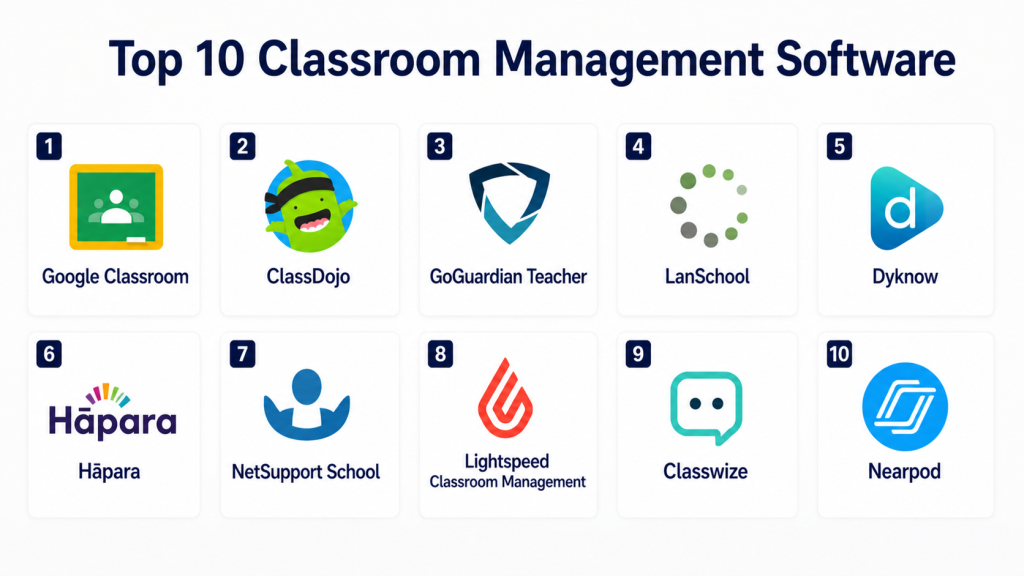
Top 10 Classroom Management Software
#1 — Google Classroom
Short description:
Google Classroom is a widely adopted classroom management platform that simplifies teaching workflows. It allows teachers to create classes, distribute assignments, and communicate with students efficiently. The platform integrates with productivity tools to enhance collaboration. It supports both in-person and remote learning environments. Teachers can track student progress and provide feedback in real time. It is highly scalable and suitable for schools of all sizes. Its simplicity makes it ideal for beginners and experienced educators alike.
Key Features
- Assignment management
- Real-time collaboration
- Class communication
- Progress tracking
- Cloud storage integration
- Mobile access
- Easy class setup
Pros
- User-friendly interface
- Strong ecosystem integration
- Widely adopted
Cons
- Limited monitoring tools
- Basic analytics
- Internet dependency
Platforms / Deployment
Web / iOS / Android
Cloud
Security & Compliance
Access control and authentication features available. Specific compliance varies by organization.
Integrations & Ecosystem
Integrates with productivity and collaboration tools, making classroom workflows seamless.
- Document tools
- Video tools
- Cloud storage
- Education apps
- Collaboration tools
Support & Community
Strong global community with extensive documentation and tutorials.
#2 — GoGuardian Teacher
Short description:
GoGuardian Teacher is designed for real-time classroom monitoring and student engagement. It allows teachers to view student screens, control browsing, and maintain discipline. The platform is especially popular in device-enabled classrooms. It helps reduce distractions and ensures students stay focused during lessons. Teachers can intervene quickly when needed. It provides actionable insights into student behavior. It is ideal for schools using Chromebooks or similar devices.
Key Features
- Screen monitoring
- Website filtering
- Activity tracking
- Alerts system
- Session control
- Screen locking
- Teacher dashboard
Pros
- Strong monitoring
- Improves discipline
- Easy to use
Cons
- Requires devices
- Privacy concerns
- Limited offline use
Platforms / Deployment
Web / Chromebook
Cloud
Security & Compliance
Includes monitoring controls. Privacy compliance depends on institutional policies.
Integrations & Ecosystem
Works well with school device ecosystems.
- Device systems
- Admin tools
- Monitoring dashboards
- Classroom tools
- IT systems
Support & Community
Provides onboarding support and training resources.
#3 — LanSchool
Short description:
LanSchool is a classroom management solution focused on controlling and monitoring student devices. It enables teachers to view screens, share content, and guide students effectively. The platform is widely used in computer labs and digital classrooms. It supports both in-person and hybrid learning models. Teachers can maintain control over classroom devices. It helps improve focus and engagement. It is suitable for institutions needing device-level control.
Key Features
- Screen sharing
- Device control
- Activity monitoring
- Communication tools
- Assessment tools
- Teacher dashboard
- Classroom management
Pros
- Strong control features
- Ideal for labs
- Improves focus
Cons
- Outdated UI
- Setup complexity
- Limited analytics
Platforms / Deployment
Windows / macOS / Web
Cloud / On-premise
Security & Compliance
Supports access control policies. Specific compliance not publicly stated.
Integrations & Ecosystem
Integrates with IT systems and classroom tools.
- School networks
- Device systems
- Admin tools
- Classroom apps
- IT infrastructure
Support & Community
Offers documentation and training support.
#4 — ClassDojo
Short description:
ClassDojo focuses on student engagement and behavior tracking. It allows teachers to communicate with parents and students effectively. The platform promotes positive classroom culture. It supports multimedia sharing and classroom announcements. Teachers can reward student behavior. It is widely used in K-12 environments. It is ideal for engagement-focused teaching.
Key Features
- Behavior tracking
- Parent communication
- Announcements
- Rewards system
- Media sharing
- Student engagement tools
- Class updates
Pros
- Easy to use
- Parent-friendly
- Improves engagement
Cons
- Limited monitoring
- Basic analytics
- Not ideal for advanced classrooms
Platforms / Deployment
Web / iOS / Android
Cloud
Security & Compliance
Basic privacy and access controls.
Integrations & Ecosystem
Supports communication and engagement tools.
- Messaging tools
- Media sharing
- Parent apps
- Classroom tools
Support & Community
Large user base with strong community support.#5 — Civic Wallet
Short description: Civic Wallet is a blockchain-based identity wallet designed for secure identity verification. It enables users to control their identity data. It focuses on privacy and decentralized identity. It is commonly used in Web3 environments. It supports identity verification without sharing sensitive data. It enhances user trust and control.
Key Features
- Blockchain-based identity
- Privacy-focused design
- Identity verification
- Secure credential storage
- Decentralized authentication
Pros
- Strong privacy focus
- User-controlled identity
Cons
- Limited enterprise adoption
- Web3 dependency
Platforms / Deployment
Mobile / Cloud
Security & Compliance
Encryption
Integrations & Ecosystem
Works with blockchain and Web3 applications.
- Crypto platforms
- Web3 apps
- APIs
Support & Community
Community-driven support
#6 — Dock Wallet
Short description: Dock Wallet enables decentralized identity and verifiable credential management. It is designed for organizations that need secure identity solutions. It supports blockchain-based identity storage. It allows secure credential issuance. It is used in education and certification use cases. It supports interoperability.
Key Features
- Verifiable credentials
- Blockchain identity
- Credential issuance
- Identity verification
- Interoperability
Pros
- Strong credential management
- Open standards support
Cons
- Limited enterprise tools
- Requires technical knowledge
Platforms / Deployment
Cloud
Security & Compliance
Encryption
Integrations & Ecosystem
Supports blockchain integrations and APIs.
- Blockchain networks
- APIs
- SDKs
Support & Community
Growing ecosystem
#7 — Evernym Wallet
Short description: Evernym focuses on decentralized identity and self-sovereign identity solutions. It enables users to own and control their digital identity. It supports verifiable credentials. It is widely used in identity innovation projects. It promotes privacy and secure identity sharing. It aligns with global identity standards.
Key Features
- Self-sovereign identity
- Verifiable credentials
- Secure identity sharing
- Privacy-first architecture
- Identity verification
Pros
- Strong privacy model
- Standards-based approach
Cons
- Limited mainstream adoption
- Niche use cases
Platforms / Deployment
Cloud
Security & Compliance
Encryption
Integrations & Ecosystem
Works with decentralized identity networks.
- DID frameworks
- APIs
- Identity ecosystems
Support & Community
Niche but active community
#8 — Jolocom Wallet
Short description: Jolocom Wallet is a decentralized identity wallet focused on privacy and secure credential management. It allows users to store and share identity credentials securely. It supports open standards. It is used in identity verification scenarios. It provides mobile-first solutions. It emphasizes user control.
Key Features
- Decentralized identity
- Credential storage
- Secure sharing
- Mobile-first design
- Privacy-focused
Pros
- User-centric design
- Strong privacy
Cons
- Limited enterprise features
- Smaller ecosystem
Platforms / Deployment
Mobile
Security & Compliance
Encryption
Integrations & Ecosystem
Focused on decentralized identity ecosystems.
- APIs
- Identity protocols
Support & Community
Limited but growing
#9 — uPort Wallet
Short description: uPort is a blockchain-based identity wallet designed for decentralized identity management. It allows users to manage digital identities securely. It supports credential verification and sharing. It is used in Web3 ecosystems. It focuses on user control and privacy. It integrates with decentralized applications.
Key Features
- Blockchain identity
- Credential verification
- Secure storage
- Identity sharing
- Decentralized apps integration
Pros
- Strong Web3 integration
- User-controlled identity
Cons
- Limited enterprise adoption
- Requires blockchain knowledge
Platforms / Deployment
Mobile / Cloud
Security & Compliance
Encryption
Integrations & Ecosystem
Works with decentralized apps and blockchain networks.
- Web3 apps
- APIs
- Blockchain
Support & Community
Community-driven
#10 — Spruce ID Wallet
Short description: Spruce ID focuses on decentralized identity infrastructure and identity wallets. It enables secure identity verification using verifiable credentials. It supports developer integrations. It is used in Web3 and enterprise identity use cases. It focuses on interoperability and privacy. It supports identity standards.
Key Features
- Verifiable credentials
- Decentralized identity
- Developer APIs
- Identity verification
- Interoperability
Pros
- Developer-friendly
- Supports standards
Cons
- Emerging ecosystem
- Limited enterprise tooling
Platforms / Deployment
Cloud
Security & Compliance
Encryption
Integrations & Ecosystem
Strong API-driven ecosystem for developers.
- APIs
- SDKs
- Identity protocols
Support & Community
Growing developer support
Comparison Table
| Tool Name | Best For | Platform(s) | Deployment | Standout Feature | Rating |
|---|---|---|---|---|---|
| Microsoft Entra | Enterprise | Web | Cloud | Verifiable credentials | N/A |
| Okta | SaaS Identity | Web | Cloud | Identity management | N/A |
| Ping Identity | Enterprise | Web | Hybrid | Federation | N/A |
| Trinsic | Developers | Web | Cloud | API-first DID | N/A |
| Civic | Web3 | Mobile | Cloud | Privacy-first identity | N/A |
| Dock | Credentials | Web | Cloud | Credential issuance | N/A |
| Evernym | SSI | Web | Cloud | Self-sovereign identity | N/A |
| Jolocom | Mobile identity | Mobile | Cloud | Privacy wallet | N/A |
| uPort | Web3 identity | Mobile | Cloud | DApp integration | N/A |
| Spruce ID | Developers | Web | Cloud | Interoperability | N/A |
Evaluation & Scoring
| Tool | Core | Ease | Integrations | Security | Performance | Support | Value | Total |
|---|---|---|---|---|---|---|---|---|
| Microsoft | 9 | 8 | 9 | 9 | 8 | 8 | 7 | 8.5 |
| Okta | 9 | 9 | 10 | 9 | 9 | 9 | 7 | 8.8 |
| Ping | 8 | 7 | 8 | 9 | 8 | 7 | 7 | 7.9 |
| Trinsic | 7 | 8 | 7 | 8 | 7 | 7 | 8 | 7.5 |
| Civic | 7 | 7 | 6 | 8 | 7 | 6 | 7 | 7.0 |
| Dock | 7 | 7 | 6 | 8 | 7 | 6 | 7 | 7.0 |
| Evernym | 7 | 6 | 6 | 8 | 7 | 6 | 7 | 6.8 |
| Jolocom | 6 | 7 | 6 | 7 | 7 | 6 | 7 | 6.7 |
| uPort | 7 | 6 | 6 | 7 | 7 | 6 | 7 | 6.8 |
| Spruce | 7 | 8 | 7 | 8 | 7 | 7 | 8 | 7.5 |
Interpretation: Scores are comparative and reflect relative strengths across tools. Higher scores indicate better overall balance across enterprise needs. Choose based on your specific use case rather than total score alone.
Scores are comparative and help shortlist tools based on needs and priorities.
Which Classroom Management Software Is Right for You?
Solo / Freelancer
If you are an independent educator or tutor, tools like Google Classroom or ClassDojo are ideal. They are simple, easy to use, and do not require complex setup. These tools help manage assignments, communication, and engagement without technical overhead. You can quickly start teaching without needing IT support. They are best for small-scale operations.
SMB
Small schools and coaching institutes benefit from tools like GoGuardian or DyKnow. These tools provide monitoring and engagement insights while remaining easy to deploy. They help maintain discipline and track student behavior effectively. They also offer scalability as your student base grows. They are a good balance of cost and features.
Mid-Market
Mid-sized institutions should consider Lightspeed or NetSupport. These tools provide better analytics, control, and integration capabilities. They support multiple classrooms and centralized management. Administrators can monitor performance and enforce policies. They are suitable for growing institutions with digital infrastructure.
Enterprise
Large schools, universities, and districts require advanced tools like Impero or enterprise-grade platforms. These tools offer strong security, scalability, and administrative control. They support compliance, reporting, and integration with other systems. They are best for large-scale classroom management.
Budget vs Premium
Budget tools are sufficient for basic classroom needs like assignments and communication. Premium tools offer advanced monitoring, analytics, and control features. Choose based on your classroom complexity and budget constraints. Always start with core needs before upgrading.
Feature Depth vs Ease of Use
Simple tools are easier to use but offer limited features. Advanced tools provide deep monitoring and analytics but may require training. Choose based on teacher skill level and classroom requirements.
Integrations & Scalability
Ensure the tool integrates with LMS, communication platforms, and device systems. Scalability is important for growing institutions. Choose tools that can handle increasing users and classrooms.
Security & Compliance Needs
Schools should prioritize student data privacy and security. Look for tools with access control, monitoring policies, and compliance support. Ensure safe handling of student data and activity logs.
Frequently Asked Questions (FAQs)
1. What is classroom management software?
It is a digital tool that helps teachers manage classroom activities, monitor students, and improve engagement. It supports assignments, communication, and behavior tracking. These tools are used in both physical and online classrooms. They help maintain discipline and organization. They also improve teaching efficiency.
2. Why is classroom management software important?
It helps teachers maintain control and structure in classrooms. It improves student focus and reduces distractions. It enables better communication and collaboration. It also supports remote and hybrid learning. Overall, it enhances the teaching and learning experience.
3. Does classroom management software monitor students?
Yes, many tools provide monitoring features like screen tracking and activity insights. Teachers can view student behavior in real time. Some tools allow control over browsing and apps. This helps maintain discipline and focus. However, privacy policies should be considered.
4. Is classroom management software secure?
Most tools offer basic security features like access control and authentication. Advanced tools provide better privacy and monitoring controls. Schools should review data handling policies before adoption. Security depends on vendor and implementation. Proper usage ensures safe environments.
5. Can it integrate with LMS platforms?
Yes, many tools integrate with learning management systems. This helps streamline assignments and communication. Integration improves workflow efficiency. It also allows better tracking of student performance. Compatibility should be checked before selection.
6. Is classroom management software expensive?
Some tools are free, while others offer paid plans. Pricing depends on features and scale. Small classrooms can use free or low-cost tools. Larger institutions may require premium solutions. Always compare features before investing.
7. Does it support remote learning?
Yes, most tools support online and hybrid classrooms. Teachers can manage students remotely. Features like screen sharing and monitoring help maintain engagement. These tools became essential during remote learning growth. They continue to support flexible education models.
8. What devices are supported?
Most tools support web, mobile, and desktop devices. Some are optimized for Chromebooks or school devices. Compatibility depends on the platform. Schools should ensure all devices are supported. Cross-platform support is a key factor.
9. Can parents use classroom management software?
Some tools offer parent communication features. Parents can track student progress and updates. This improves transparency and engagement. Not all tools support this feature. It depends on the platform chosen.
10. Is it easy to use for teachers?
Most tools are designed with user-friendly interfaces. Teachers can quickly learn basic features. Advanced tools may require training. Ease of use varies by platform. Choosing the right tool reduces learning time.
Conclusion
Classroom Management Software has become an essential part of modern education systems, especially with the growth of digital and hybrid learning environments. These tools help teachers maintain discipline, improve engagement, and streamline classroom operations. From simple platforms like Google Classroom to advanced monitoring tools like GoGuardian, there is a wide range of solutions available for different needs. Choosing the right tool depends on your classroom size, teaching style, and technology usage.
The best approach is to clearly define your requirements before selecting a tool. Start with a shortlist of two or three options and test them in real classroom scenarios. Evaluate factors such as usability, performance, and integration with existing systems. This will help you identify the most suitable solution for your institution.
Ultimately, the right classroom management software should enhance both teaching efficiency and student learning outcomes. A well-chosen tool can reduce administrative workload, improve student behavior, and create a more productive learning environment. Investing in the right solution ensures long-term benefits for educators and students alike.
