Introduction
Attack Surface Management (ASM) tools are cybersecurity solutions designed to discover, monitor, and manage all externally exposed digital assets of an organization. These assets include domains, IPs, cloud resources, APIs, and shadow IT components that attackers can exploit.
As organizations rapidly expand across cloud, SaaS, and hybrid environments, their attack surface grows significantly. ASM tools help security teams gain continuous visibility into unknown and unmanaged assets, identify vulnerabilities, and reduce risk exposure. Modern ASM platforms also leverage automation, AI-driven risk scoring, and real-time monitoring to keep pace with evolving threats.
Real-world use cases:
- Discovering unknown internet-facing assets
- Monitoring shadow IT and third-party exposures
- Identifying misconfigurations and vulnerabilities
- Continuous attack surface monitoring
- Strengthening external security posture
What buyers should evaluate:
- Asset discovery accuracy and coverage
- Continuous monitoring capabilities
- Risk prioritization and scoring
- Integration with vulnerability management tools
- Automation and alerting features
- Cloud and multi-environment support
- Ease of use and dashboard visibility
- Reporting and compliance support
- API and integration capabilities
- Pricing and scalability
Best for: Enterprises, SOC teams, security analysts, and organizations with complex or distributed infrastructure
Not ideal for: Small organizations with minimal external assets
Key Trends in Attack Surface Management (ASM)
- Continuous and automated asset discovery
- AI-driven risk prioritization and scoring
- Integration with vulnerability management and EDR tools
- Expansion into cloud and SaaS environments
- Focus on external attack surface visibility
- Real-time monitoring and alerting
- Integration with Zero Trust security models
- Increased focus on third-party risk management
- API and application exposure tracking
- Unified security posture management platforms
How We Selected These Tools (Methodology)
- Market adoption and reputation
- Depth of asset discovery capabilities
- Continuous monitoring features
- Integration with security ecosystems
- Automation and analytics capabilities
- Scalability across environments
- Ease of deployment and usability
- Vendor innovation and maturity
- Support and community strength
- Fit across SMB and enterprise environments
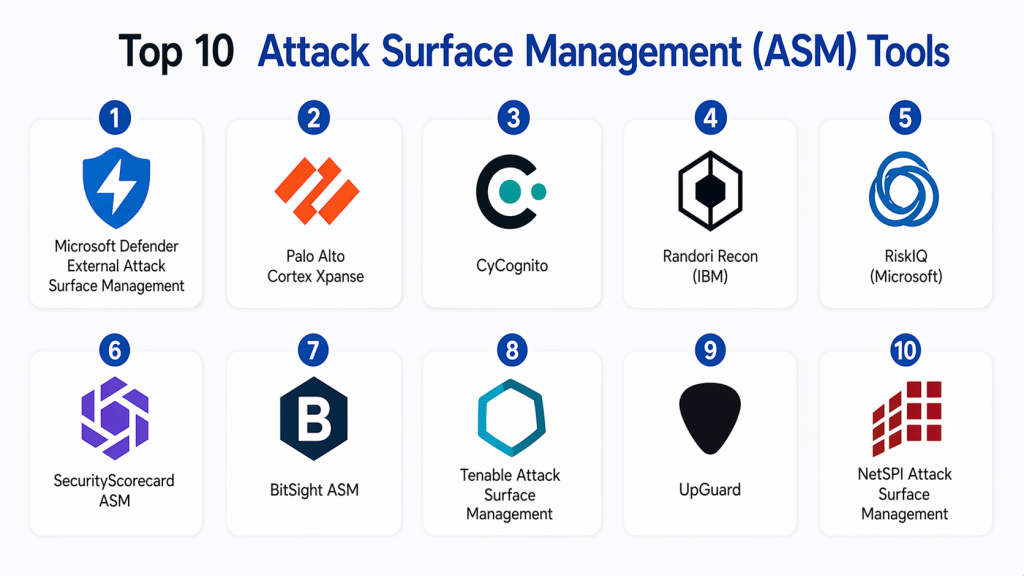
Top 10 Attack Surface Management (ASM) Tools
#1 — Microsoft Defender External Attack Surface Management
Short description :
Microsoft Defender EASM provides comprehensive visibility into external assets. It helps discover unknown resources and vulnerabilities. It integrates with Microsoft ecosystem. It offers continuous monitoring. It is scalable. It is suitable for enterprises.
Key Features
- Asset discovery
- Continuous monitoring
- Risk scoring
- Integration
- Reporting
Pros
- Strong integration
- Scalable
- Enterprise-ready
Cons
- Microsoft dependency
- Configuration required
Platforms / Deployment
- Cloud
Security & Compliance
- RBAC
- Compliance: Not publicly stated
Integrations & Ecosystem
- Microsoft tools
- APIs
Support & Community
- Enterprise support
#2 — Palo Alto Cortex Xpanse
Short description :
Cortex Xpanse provides ASM capabilities with strong asset discovery and risk management. It offers real-time monitoring. It integrates with Palo Alto ecosystem. It is scalable. It is widely used. It provides strong visibility.
Key Features
- Asset discovery
- Risk management
- Monitoring
- Integration
- Analytics
Pros
- Strong visibility
- Scalable
- Advanced features
Cons
- Expensive
- Complex setup
Platforms / Deployment
- Cloud
Security & Compliance
- RBAC
- Compliance: Not publicly stated
#3 — Randori Recon (IBM)
Short description :
Randori Recon provides external attack surface visibility and risk insights. It helps identify vulnerabilities. It integrates with IBM ecosystem. It is scalable. It supports continuous monitoring. It is suitable for enterprises.
Key Features
- Asset discovery
- Risk insights
- Monitoring
- Integration
- Analytics
Pros
- Strong insights
- Scalable
- Enterprise-ready
Cons
- Complex
- Cost
Platforms / Deployment
- Cloud
Security & Compliance
- RBAC
- Compliance: Not publicly stated
#4 — CyCognito
Short description :
CyCognito provides ASM with strong asset discovery and risk analysis. It identifies unknown assets and vulnerabilities. It offers continuous monitoring. It is scalable. It supports enterprises. It provides strong visibility.
Key Features
- Asset discovery
- Risk analysis
- Monitoring
- Integration
- Reporting
Pros
- Strong detection
- Scalable
- Flexible
Cons
- Learning curve
- Cost
Platforms / Deployment
- Cloud
Security & Compliance
- RBAC
- Compliance: Not publicly stated
#5 — RiskIQ (Microsoft)
Short description :
RiskIQ provides attack surface visibility and threat intelligence. It helps discover external assets and risks. It integrates with Microsoft ecosystem. It is scalable. It supports monitoring. It provides strong insights.
Key Features
- Asset discovery
- Threat intelligence
- Monitoring
- Analytics
- Integration
Pros
- Strong intelligence
- Scalable
- Integration
Cons
- Limited outside Microsoft
- Cost
Platforms / Deployment
- Cloud
Security & Compliance
- RBAC
- Compliance: Not publicly stated
#6 — SecurityScorecard ASM
Short description :
SecurityScorecard provides ASM with risk scoring and monitoring. It evaluates external security posture. It supports third-party risk management. It is scalable. It is widely used. It offers strong analytics.
Key Features
- Risk scoring
- Monitoring
- Asset discovery
- Analytics
- Reporting
Pros
- Easy to use
- Strong scoring
- Scalable
Cons
- Limited deep scanning
- Data accuracy concerns
Platforms / Deployment
- Cloud
Security & Compliance
- RBAC
- Compliance: Not publicly stated
#7 — Bitsight ASM
Short description :
Bitsight provides external security ratings and ASM capabilities. It helps monitor risk exposure. It supports third-party risk management. It is scalable. It is widely used. It provides strong insights.
Key Features
- Risk scoring
- Monitoring
- Analytics
- Reporting
- Integration
Pros
- Strong scoring
- Scalable
- Easy to use
Cons
- Limited technical depth
- Cost
Platforms / Deployment
- Cloud
Security & Compliance
- RBAC
- Compliance: Not publicly stated
#8 — Tenable Attack Surface Management
Short description :
Tenable ASM provides asset discovery and vulnerability insights. It integrates with Tenable ecosystem. It supports continuous monitoring. It is scalable. It is suitable for enterprises. It provides strong detection.
Key Features
- Asset discovery
- Vulnerability insights
- Monitoring
- Integration
- Reporting
Pros
- Strong detection
- Scalable
- Integration
Cons
- Complex setup
- Cost
Platforms / Deployment
- Cloud
Security & Compliance
- RBAC
- Compliance: Not publicly stated
#9 — UpGuard
Short description :
UpGuard provides ASM with focus on risk management and monitoring. It evaluates external security posture. It supports vendor risk management. It is scalable. It is easy to use. It provides insights.
Key Features
- Risk monitoring
- Asset discovery
- Analytics
- Reporting
- Integration
Pros
- Easy to use
- Flexible
- Scalable
Cons
- Limited deep scanning
- Smaller ecosystem
Platforms / Deployment
- Cloud
Security & Compliance
- RBAC
- Compliance: Not publicly stated
#10 — NetSPI Attack Surface Management
Short description :
NetSPI ASM provides continuous discovery and monitoring of external assets. It helps identify vulnerabilities and risks. It supports automation. It is scalable. It is suitable for enterprises. It provides strong visibility.
Key Features
- Asset discovery
- Monitoring
- Risk analysis
- Automation
- Reporting
Pros
- Strong visibility
- Scalable
- Flexible
Cons
- Complex
- Cost
Platforms / Deployment
- Cloud
Security & Compliance
- RBAC
- Compliance: Not publicly stated
Comparison Table
| Tool | Best For | Platform | Deployment | Feature | Rating |
|---|---|---|---|---|---|
| Microsoft | Enterprise | Cloud | Cloud | Discovery | N/A |
| Cortex | Enterprise | Cloud | Cloud | Monitoring | N/A |
| Randori | Enterprise | Cloud | Cloud | Insights | N/A |
| CyCognito | Enterprise | Cloud | Cloud | Detection | N/A |
| RiskIQ | Enterprise | Cloud | Cloud | Intelligence | N/A |
| SecurityScorecard | SMB | Cloud | Cloud | Scoring | N/A |
| Bitsight | SMB | Cloud | Cloud | Ratings | N/A |
| Tenable | Enterprise | Cloud | Cloud | Integration | N/A |
| UpGuard | SMB | Cloud | Cloud | Simplicity | N/A |
| NetSPI | Enterprise | Cloud | Cloud | Visibility | N/A |
Evaluation & Scoring of ASM Tools
| Tool | Core | Ease | Integration | Security | Performance | Support | Value | Total |
|---|---|---|---|---|---|---|---|---|
| Microsoft | 9 | 9 | 10 | 9 | 9 | 9 | 9 | 9.2 |
| Cortex | 10 | 7 | 9 | 10 | 9 | 9 | 7 | 8.9 |
| Randori | 9 | 7 | 8 | 9 | 8 | 8 | 7 | 8.2 |
| CyCognito | 9 | 8 | 8 | 9 | 8 | 8 | 8 | 8.5 |
| RiskIQ | 9 | 8 | 9 | 9 | 8 | 8 | 8 | 8.6 |
| SecurityScorecard | 8 | 9 | 7 | 8 | 8 | 8 | 9 | 8.4 |
| Bitsight | 8 | 9 | 7 | 8 | 8 | 8 | 9 | 8.4 |
| Tenable | 9 | 8 | 9 | 9 | 8 | 8 | 8 | 8.6 |
| UpGuard | 8 | 9 | 7 | 8 | 8 | 8 | 9 | 8.4 |
| NetSPI | 9 | 7 | 8 | 9 | 8 | 8 | 7 | 8.2 |
Which ASM Tool Is Right for You?
Solo / Freelancer
- Not required
SMB
- UpGuard, SecurityScorecard
Mid-Market
- CyCognito, Tenable
Enterprise
- Microsoft, Cortex, Randori
Budget vs Premium
- Budget → UpGuard
- Premium → Cortex Xpanse
Feature Depth vs Ease
- Easy → SecurityScorecard
- Advanced → Cortex
Integrations & Scalability
- Best → Microsoft
Security Needs
- High security → Cortex
Frequently Asked Questions (FAQs)
1. What is Attack Surface Management (ASM)?
Attack Surface Management (ASM) is a cybersecurity approach that identifies and monitors all external digital assets of an organization. It helps discover unknown systems, domains, and services that could be exposed to attackers. ASM tools provide visibility into these assets. This helps organizations reduce potential attack vectors.
2. Why is ASM important for organizations?
ASM is important because organizations often have hidden or unmanaged assets that can be exploited. It helps detect these assets and identify associated risks. By continuously monitoring the attack surface, organizations can prevent breaches. This improves overall security posture.
3. How does ASM work?
ASM tools continuously scan the internet to discover assets related to an organization. They analyze these assets for vulnerabilities and misconfigurations. The tools then provide risk scores and alerts. This allows security teams to take corrective actions quickly.
4. Who should use ASM tools?
ASM tools are used by enterprises, security teams, and organizations with large digital footprints. They are especially useful for companies operating in cloud and hybrid environments. Organizations handling sensitive data benefit the most. Any company with external assets should consider ASM.
5. Are ASM tools scalable?
Yes, modern ASM tools are highly scalable and designed to handle large environments. Cloud-based solutions make it easier to monitor assets across multiple regions. This ensures continuous visibility. Scalability is essential for growing organizations.
6. Do ASM tools integrate with other security tools?
Yes, ASM tools integrate with vulnerability management, SIEM, and SOAR platforms. This creates a unified security ecosystem. Integration improves threat detection and response. It allows organizations to act on risks more effectively.
7. Are ASM tools secure?
Yes, ASM tools are designed with security controls such as access management and encryption. They help improve security rather than introduce risk. Proper configuration is important for optimal performance. They provide insights to strengthen defenses.
8. Are ASM tools difficult to implement?
Implementation complexity depends on the tool and environment. Many cloud-based ASM tools are easy to deploy. However, advanced configurations may require expertise. Proper planning ensures successful implementation.
9. What are alternatives to ASM?
ASM works alongside vulnerability management and penetration testing tools. These tools focus on different aspects of security. They are complementary rather than replacements. Together, they provide a complete security approach.
10. Are ASM tools expensive?
Pricing varies depending on features and scale. SMB-focused tools are generally affordable. Enterprise solutions can be more expensive due to advanced capabilities. Investing in ASM helps prevent costly security breaches.
Conclusion
Attack Surface Management (ASM) tools are essential for modern cybersecurity, providing continuous visibility into external assets and helping organizations proactively identify and reduce risks. As digital environments expand, ASM plays a critical role in maintaining a strong security posture.
The best ASM solution depends on your organization’s size and requirements. Enterprise tools like Microsoft Defender and Cortex Xpanse offer advanced capabilities, while tools like UpGuard and SecurityScorecard provide cost-effective options. Organizations should evaluate their needs, test solutions, and integrate ASM into their overall security strategy
