Introduction
API Aggregators are platforms that consolidate multiple APIs from diverse providers into a single unified interface. This simplifies development by reducing integration complexity, standardizing data formats, and providing a centralized workflow for managing API requests. Businesses increasingly rely on multi-service ecosystems and third-party APIs, making API aggregation essential for rapid digital innovation.
Real-world use cases include:
- Fintech companies integrating banking, payments, and investment APIs seamlessly
- E-commerce platforms consolidating shipping, inventory, and payment gateways
- Marketing platforms combining social media, analytics, and advertising APIs
- Travel aggregators unifying flight, hotel, and car rental APIs
- SaaS providers offering a one-stop integration layer for clients to connect multiple services
Evaluation criteria for buyers:
- API coverage and reliability
- Standardization and normalization capabilities
- Ease of onboarding and documentation quality
- Security and compliance support
- Performance and scalability
- Pricing model and total cost of ownership
- Integration flexibility and SDK support
- Monitoring and analytics capabilities
- Customer support and community strength
- Deployment options (Cloud / Hybrid / On-prem)
Best for: Developers, IT managers, and companies of all sizes seeking to simplify API integrations, reduce development overhead, and accelerate time-to-market across industries like fintech, e-commerce, logistics, and marketing
Not ideal for: Organizations that rely solely on one or two APIs with minimal integration needs, or where native, direct API connections provide better performance without aggregation overhead
Key Trends in API Aggregators
- Increasing adoption of AI-assisted API mapping for automated schema translation
- Low-code and no-code integration platforms combining aggregation and workflow automation
- Stronger focus on security and compliance, including SOC 2 and GDPR
- Growth of unified API marketplaces offering multiple service categories in one ecosystem
- Improved real-time data handling and event-driven architectures
- Integration of observability tools for monitoring latency, throughput, and error tracking
- Serverless and edge deployment options for ultra-low latency
- Consolidation of payment, identity, and messaging APIs for fintech and enterprise SaaS
- Flexible tiered pricing models, from pay-per-call to subscription-based enterprise licensing
- Emphasis on cross-platform SDKs for web, mobile, and IoT devices
How We Selected These Tools (Methodology)
- Market adoption and brand recognition in the integration ecosystem
- Feature completeness, including normalization, orchestration, and monitoring
- Reliability and performance benchmarks where publicly available
- Security posture, including encryption, access control, and audit features
- Ecosystem breadth and ability to integrate with popular third-party APIs
- Fit for various customer segments: freelancers, SMBs, mid-market, and enterprise
- Documentation quality, SDK availability, and developer support
- Cloud, hybrid, and on-prem deployment flexibility
- Observability and analytics support for production monitoring
- Pricing transparency and value relative to feature depth
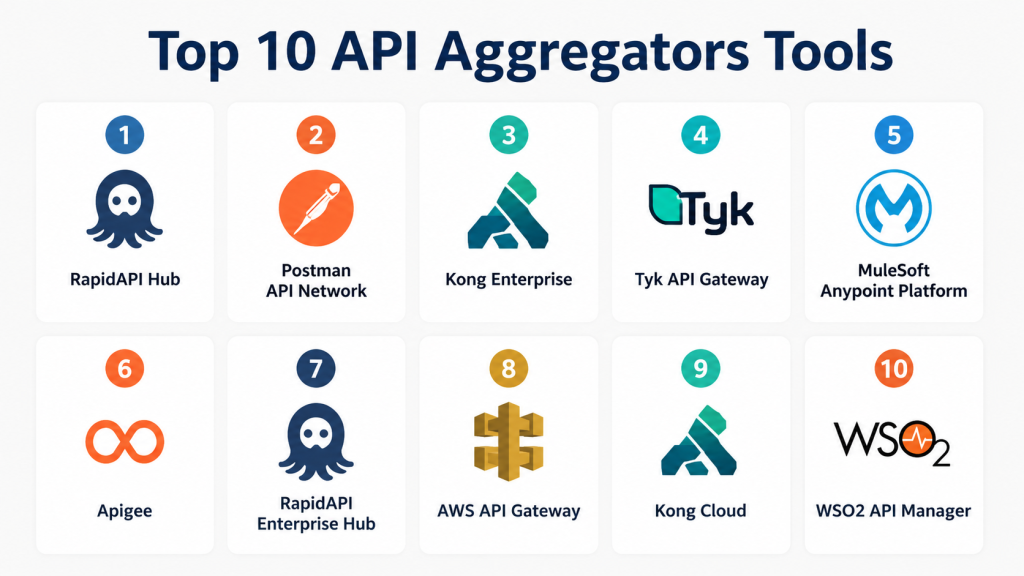
Top 10 API Aggregators Tools
1- RapidAPI Hub
Short description: Centralizes thousands of public and private APIs for developers and enterprises, streamlining integration and billing
Key Features
- Unified API marketplace with discovery tools
- Automatic SDK generation for multiple languages
- Centralized billing for paid APIs
- API request throttling and caching
- Analytics dashboard for usage monitoring
- Access control and team collaboration
- Subscription management for API providers
Pros
- Simplifies finding and connecting APIs
- Reduces development time with SDKs
- Scalable usage tracking
Cons
- Marketplace focus may limit customization
- Pricing can escalate with high-volume API calls
Platforms / Deployment
- Web / Cloud
Security & Compliance
- Not publicly stated
Integrations & Ecosystem
RapidAPI Hub supports major REST and GraphQL APIs with OAuth and API key management. SDKs are available for Node.js, Python, Java, and PHP. Team collaboration is supported with access controls and billing integration
Support & Community
- Extensive documentation and developer forum
- Email and ticket support available
- Active developer community
2- Postman API Network
Short description: Provides API aggregation alongside robust testing tools, enabling developers to access multiple APIs in a single environment
Key Features
- API workspace collaboration
- Schema validation and mock servers
- Collection-based API aggregation
- Automated testing and CI/CD integration
- Environment and variable management
Pros
- Excellent testing and debugging support
- Developer-friendly collaboration features
- Free tier suitable for SMBs and freelancers
Cons
- Not focused on enterprise-level API billing
- Aggregation limited to accessible APIs within Postman workspace
Platforms / Deployment
- Web / Windows / macOS / Linux / Cloud
Security & Compliance
- Not publicly stated
Integrations & Ecosystem
Supports REST, SOAP, and GraphQL APIs. Integrates with CI/CD pipelines, GitHub, and Slack. SDKs are available for multiple languages
Support & Community
- Strong documentation and tutorials
- Active community and forums
3- Kong Enterprise
Short description: API management and aggregation platform with enterprise features including routing, transformations, and security
Key Features
- API gateway for unified traffic management
- Plugin architecture for transformations and logging
- Rate limiting and caching
- Developer portal and API catalog
- Security policies with authentication and ACLs
Pros
- Highly customizable for enterprise needs
- Scales for high-traffic applications
- Supports microservices architecture
Cons
- Complexity may be high for small teams
- Self-hosted setup requires DevOps support
Platforms / Deployment
- Web / Cloud / Self-hosted / Hybrid
Security & Compliance
- OAuth2, JWT, RBAC
- Not publicly stated on ISO/SOC 2
Integrations & Ecosystem
Integrates with Kubernetes and Docker, plugins for logging, metrics, and authentication. SDKs available for major programming languages
Support & Community
- Enterprise support tiers
- Active open-source community
- Extensive documentation
4- Tyk API Gateway
Short description: Lightweight, open-source API gateway offering analytics, throttling, and policy enforcement
Key Features
- API management dashboard
- Rate limiting and access control
- Analytics and monitoring
- Developer portal for API consumers
- Middleware for request transformations
Pros
- Open-source flexibility
- Lightweight and fast
- Supports cloud and on-prem deployment
Cons
- Advanced features require enterprise subscription
- Learning curve for configuration
Platforms / Deployment
- Web / Cloud / Self-hosted / Hybrid
Security & Compliance
- OAuth, JWT, API keys
- Not publicly stated
Integrations & Ecosystem
Supports Kubernetes, Docker, REST, GraphQL, and gRPC APIs. Offers webhooks and CI/CD integration
Support & Community
- Community support for open-source
- Enterprise SLA available
- Extensive docs and tutorials
5- MuleSoft Anypoint Platform
Short description: Enterprise integration platform with API aggregation, orchestration, and governance capabilities
Key Features
- API lifecycle management
- Orchestration across multiple services
- Data mapping and transformation
- Security policies and governance
- Analytics and monitoring dashboards
Pros
- Enterprise-ready features
- Strong governance and compliance support
- Wide ecosystem and connector library
Cons
- Higher cost for SMBs
- Requires specialized training
Platforms / Deployment
- Cloud / Hybrid / On-prem
Security & Compliance
- OAuth2, SAML, RBAC
- Not publicly stated on ISO/SOC 2
Integrations & Ecosystem
Prebuilt connectors for Salesforce, SAP, Oracle, CI/CD integration, SDKs for Java and .NET
Support & Community
- Enterprise support plans
- Developer forums and tutorials
6- Apigee
Short description: API management and aggregation solution offering analytics, security, and hybrid deployment options
Key Features
- API gateway and routing
- Analytics dashboard
- OAuth2 and API key management
- Traffic management and caching
- Developer portal with API discovery
Pros
- Reliable enterprise-grade solution
- Hybrid deployment support
- Strong analytics and monitoring
Cons
- Complex setup for smaller teams
- Cost may be high for low-volume use
Platforms / Deployment
- Web / Cloud / Hybrid
Security & Compliance
- OAuth2, SAML, TLS
- Not publicly stated
Integrations & Ecosystem
Google Cloud integrations, REST and GraphQL support, CI/CD pipeline integration
Support & Community
- Enterprise support tiers
- Active developer community
7- RapidAPI Enterprise Hub
Short description: Enterprise-focused API aggregation platform centralizing API consumption and access management
Key Features
- Team collaboration and access control
- API usage analytics
- Centralized billing for multiple APIs
- SDK generation and client libraries
- Security and monitoring features
Pros
- Streamlines multi-API consumption
- Scalable for enterprise workloads
- Centralized billing reduces overhead
Cons
- Enterprise pricing only
- Less suited for individual developers
Platforms / Deployment
- Web / Cloud
Security & Compliance
- Not publicly stated
Integrations & Ecosystem
SDKs for multiple programming languages, REST and GraphQL support, CI/CD pipelines integration
Support & Community
- Enterprise-level support
- Documentation and training resources
8- AWS API Gateway
Short description: Fully managed API gateway for building, deploying, and aggregating APIs on AWS cloud
Key Features
- REST, WebSocket, and HTTP APIs
- Rate limiting and throttling
- Caching and monitoring via CloudWatch
- Security via IAM, Cognito, and API keys
- Integration with Lambda and other AWS services
Pros
- Tight AWS ecosystem integration
- Scales automatically with demand
- Secure and reliable
Cons
- Limited multi-cloud support
- Can be complex for beginners
Platforms / Deployment
- Cloud (AWS)
Security & Compliance
- AWS security standards (IAM, encryption)
- Not publicly stated
Integrations & Ecosystem
Native AWS services, SDKs for multiple languages, CI/CD pipeline support
Support & Community
- AWS enterprise support
- Extensive documentation
- Large active community
9- Kong Cloud
Short description: Managed API gateway offering aggregation, security, and observability for modern microservices
Key Features
- API routing and transformation
- Analytics and monitoring dashboards
- Rate limiting and authentication
- Developer portal
- Plugins for extensions
Pros
- Fully managed for cloud-first teams
- Flexible plugin ecosystem
- Enterprise-ready observability
Cons
- Less control than self-hosted Kong
- Pricing varies based on consumption
Platforms / Deployment
- Cloud / Hybrid
Security & Compliance
- OAuth2, JWT
- Not publicly stated
Integrations & Ecosystem
Supports REST, GraphQL, gRPC, integrates with Kubernetes, CI/CD, extensible plugin architecture
Support & Community
- Enterprise support available
- Community forums for self-help
10- WSO2 API Manager
Short description: Open-source API management and aggregation platform with developer-friendly tools and enterprise-grade capabilities
Key Features
- API lifecycle management
- Analytics and monitoring
- Access control and throttling
- Developer portal
- Cloud and on-prem deployment support
Pros
- Open-source flexibility
- Supports hybrid environments
- Strong community backing
Cons
- Self-hosted setup requires DevOps expertise
- Advanced features need enterprise subscription
Platforms / Deployment
- Cloud / Self-hosted / Hybrid
Security & Compliance
- OAuth2, JWT
- Not publicly stated
Integrations & Ecosystem
Supports REST, SOAP, GraphQL, CI/CD pipeline integration, SDKs for multiple languages
Support & Community
- Open-source community support
- Enterprise support plans
Comparison Table (Top 10)
| Tool Name | Best For | Platform(s) Supported | Deployment | Standout Feature | Public Rating |
|---|---|---|---|---|---|
| RapidAPI Hub | Developers / SMBs | Web | Cloud | Unified marketplace & billing | N/A |
| Postman API Network | Freelancers / SMBs | Web / Windows / macOS / Linux | Cloud | API testing + aggregation | N/A |
| Kong Enterprise | Enterprise / Mid-Market | Web | Cloud / Hybrid / Self-hosted | Plugin architecture | N/A |
| Tyk API Gateway | SMB / Mid-Market | Web | Cloud / Hybrid / Self-hosted | Open-source lightweight gateway | N/A |
| MuleSoft Anypoint | Enterprise | Web | Cloud / Hybrid / On-prem | Full API lifecycle | N/A |
| Apigee | Enterprise | Web | Cloud / Hybrid | Analytics & hybrid support | N/A |
| RapidAPI Enterprise Hub | Enterprise | Web | Cloud | Centralized team access | N/A |
| AWS API Gateway | Cloud-native / DevOps | Web | Cloud (AWS) | Lambda & AWS integration | N/A |
| Kong Cloud | Enterprise / Cloud teams | Web | Cloud / Hybrid | Managed gateway & observability | N/A |
| WSO2 API Manager | Mid-Market / Enterprise | Web | Cloud / Self-hosted / Hybrid | Open-source flexibility | N/A |
Evaluation & Scoring of API Aggregators
| Tool Name | Core (25%) | Ease (15%) | Integrations (15%) | Security (10%) | Performance (10%) | Support (10%) | Value (15%) | Weighted Total |
|---|---|---|---|---|---|---|---|---|
| RapidAPI Hub | 9 | 8 | 8 | 7 | 8 | 7 | 8 | 8.0 |
| Postman API Network | 8 | 9 | 7 | 6 | 7 | 8 | 8 | 7.7 |
| Kong Enterprise | 9 | 7 | 8 | 8 | 9 | 7 | 7 | 8.0 |
| Tyk API Gateway | 8 | 7 | 7 | 7 | 8 | 7 | 8 | 7.6 |
| MuleSoft Anypoint | 9 | 7 | 9 | 8 | 9 | 8 | 6 | 8.2 |
| Apigee | 8 | 7 | 8 | 8 | 8 | 7 | 7 | 7.8 |
| RapidAPI Enterprise Hub | 8 | 7 | 8 | 7 | 8 | 7 | 7 | 7.6 |
| AWS API Gateway | 9 | 6 | 8 | 8 | 9 | 7 | 7 | 7.9 |
| Kong Cloud | 8 | 7 | 8 | 7 | 8 | 7 | 7 | 7.5 |
| WSO2 API Manager | 8 | 6 | 7 | 7 | 8 | 7 | 8 | 7.5 |
Scores are comparative across features, ease of use, integrations, security, performance, support, and value. Weighted totals highlight overall fit based on multiple criteria.
Which API Aggregators Tool Is Right for You?
Solo / Freelancer
Postman and RapidAPI Hub are ideal for individual developers seeking quick integration without heavy overhead
SMB
Tyk and RapidAPI Hub provide flexibility and low operational complexity for small teams
Mid-Market
Kong Enterprise and WSO2 offer scalability, observability, and customization needed for mid-sized operations
Enterprise
MuleSoft, Apigee, and AWS API Gateway deliver enterprise-grade reliability, governance, and hybrid deployment capabilities
Budget vs Premium
Open-source gateways like Tyk or WSO2 are cost-effective, while premium platforms such as MuleSoft or Apigee offer advanced lifecycle management, monitoring, and compliance
Feature Depth vs Ease of Use
Developers valuing simplicity may prefer Postman or RapidAPI Hub. Teams requiring deep orchestration and policy management benefit from MuleSoft or Kong Enterprise
Integrations & Scalability
Multi-cloud or microservices environments favor AWS API Gateway or Kong Cloud. Platforms with broad connectors like MuleSoft support large-scale enterprise workflows
Security & Compliance Needs
Enterprises with strict regulatory requirements should prioritize tools offering RBAC, SSO, and audit logs, e.g., Kong Enterprise, Apigee, and MuleSoft
Frequently Asked Questions (FAQs)
1- What is an API aggregator?
An API aggregator consolidates multiple APIs into a single interface, reducing integration complexity and standardizing data handling
2- How do I choose between open-source and premium API aggregators?
Consider team size, integration complexity, compliance needs, and budget. Open-source may suffice for SMBs, while enterprises may require premium features
3- Can API aggregators handle both REST and GraphQL?
Yes, most modern aggregators support multiple API protocols including REST, GraphQL, SOAP, and gRPC
4- How is security handled in API aggregation?
Security varies by platform. Features often include OAuth2, JWT, API key management, rate limiting, and encryption. Verify platform compliance for your industry
5- Do API aggregators improve performance?
They can reduce redundant calls via caching, throttling, and request optimization, but may introduce slight latency compared to direct API calls
6- Can freelancers use enterprise aggregators?
Some platforms offer free or low-tier plans for individual developers. Otherwise, enterprise-focused tools may be cost-prohibitive
7- How do pricing models work?
Pricing can be per API call, subscription-based, or a mix. Enterprise plans often include support and analytics tiers
8- Are there alternatives to API aggregators?
Alternatives include direct API integration, custom middleware, and iPaaS platforms depending on complexity and scalability needs
9- How do aggregators help with monitoring?
Most provide dashboards for request metrics, error tracking, latency analysis, and usage analytics
10- Can API aggregators scale with business growth?
Yes, leading platforms support high-throughput environments, multi-cloud deployment, and team collaboration features for scaling
Conclusion
API aggregators simplify the complex ecosystem of multiple APIs, offering developers, SMBs, and enterprises a unified, scalable, and manageable approach to integrations. Selection depends on your organization’s size, budget, and compliance needs. For quick adoption and flexibility, consider RapidAPI Hub or Postman. For enterprise-grade orchestration, governance, and hybrid deployments, MuleSoft, Apigee, or Kong Enterprise are recommended. Next steps: shortlist run a pilot, and validate integrations and security for your environment
