Introduction
Age Verification Tools help businesses confirm whether a user meets the required age limit before accessing restricted products, services, content, communities, or transactions. These tools are commonly used by e-commerce stores, gaming platforms, social platforms, online marketplaces, alcohol and tobacco sellers, financial services, dating apps, media platforms, and regulated digital businesses.
Manual age checks are slow, inconsistent, and difficult to scale. A simple checkbox asking users to confirm their age is often not enough for regulated industries or high-risk platforms. Modern age verification software uses identity documents, database checks, biometric estimation, selfie checks, mobile verification, payment data, and risk-based workflows to confirm age more reliably.
For businesses, Age Verification Tools reduce compliance risk, protect minors, improve platform safety, and support responsible access control. For users, the best tools offer a smooth, privacy-aware verification experience without creating unnecessary friction.
A strong age verification solution should be accurate, secure, easy to integrate, privacy-conscious, scalable, and flexible enough to support different regions, products, risk levels, and regulatory needs.
Key Trends in Age Verification Tools
Age verification is becoming more privacy-focused, automated, and risk-based. Businesses now need solutions that can verify age accurately while respecting user experience and data protection expectations.
Important trends include:
- AI-assisted document and selfie verification
- Privacy-preserving age estimation
- Facial age estimation without full identity capture
- Stronger checks for restricted products and services
- Better integration with e-commerce and marketplace platforms
- Risk-based verification flows based on product, region, and user behavior
- More focus on data minimization
- Real-time verification during checkout or onboarding
- Multi-country identity document support
- Stronger fraud detection for fake IDs and synthetic identities
- Parental control and minor-safety workflows
- Better audit trails for compliance teams
Methodology
This list is based on age verification capability, identity verification strength, fraud detection, ease of integration, privacy controls, regional coverage, user experience, reporting, compliance support, scalability, security posture, and suitability for different business models.
The selected tools include dedicated age verification providers, identity verification platforms with age-checking features, and compliance-focused solutions used by online platforms, retailers, marketplaces, fintech companies, and regulated digital services.
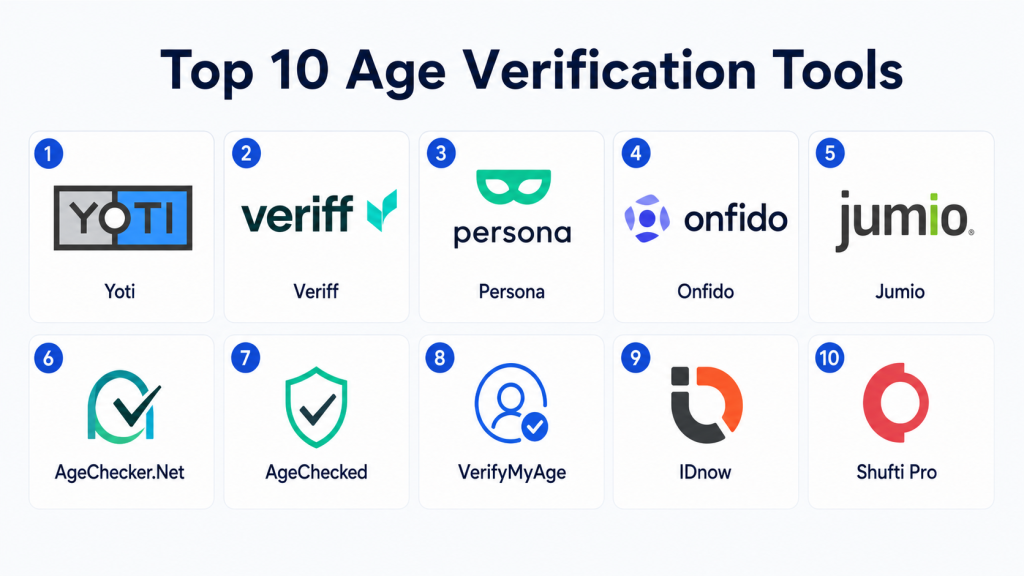
Top 10 Age Verification Tools
1. Yoti
Yoti is an identity and age verification platform known for digital identity, age estimation, document checks, and privacy-focused verification workflows. It is used by businesses that need to confirm age while reducing unnecessary data collection.
Key Features
- Age estimation technology
- Identity document verification
- Digital ID support
- Selfie and liveness checks
- Privacy-focused age checks
- Business verification workflows
- API and platform integrations
Pros
- Strong focus on privacy and data minimization
- Useful for age estimation without full identity sharing
- Good fit for platforms with user-safety requirements
Cons
- May require configuration for complex workflows
- Regional acceptance may vary by use case
- Some organizations may need additional compliance review
Platforms / Deployment
Cloud-based platform with web and API integration options.
Security & Compliance
Security controls and privacy-focused features are available. Exact compliance fit should be confirmed directly with the vendor based on region and use case.
Integrations & Ecosystem
Yoti supports API-based workflows for age checks, digital identity, document verification, and onboarding processes. Integration options vary by product setup.
Support & Community
Business support, documentation, and implementation guidance are available depending on customer requirements.
2. Veriff
Veriff is an identity verification platform that supports document verification, biometric checks, fraud detection, and age verification workflows. It is suitable for businesses that need strong identity assurance during onboarding or restricted access.
Key Features
- ID document verification
- Selfie and biometric checks
- Liveness detection
- Age verification workflows
- Fraud prevention signals
- Global document support
- API and SDK integrations
Pros
- Strong identity verification capabilities
- Good for regulated digital platforms
- Supports fraud detection and onboarding checks
Cons
- May be more than needed for simple age gates
- Pricing and workflow setup should be reviewed carefully
- Some users may experience friction during document checks
Platforms / Deployment
Cloud-based platform with API, web, and mobile SDK options.
Security & Compliance
Security and privacy controls are available. Specific compliance certifications and requirements should be validated directly with the vendor.
Integrations & Ecosystem
Veriff integrates with onboarding flows, apps, web platforms, financial services, marketplaces, and compliance systems through APIs and SDKs.
Support & Community
Support, documentation, onboarding guidance, and implementation resources are available depending on plan and contract.
3. Persona
Persona is an identity verification and compliance platform that supports identity checks, age verification, document verification, selfie verification, database checks, and risk-based workflows. It is useful for organizations that need flexible verification flows.
Key Features
- Identity document verification
- Age verification
- Selfie and liveness checks
- Database verification
- Risk-based workflows
- Case review tools
- API and workflow builder
Pros
- Highly configurable verification workflows
- Strong for businesses with layered risk checks
- Useful for marketplaces, fintech, and digital platforms
Cons
- Setup may require planning for complex logic
- May be too advanced for basic age gates
- Pricing may vary based on verification volume and modules
Platforms / Deployment
Cloud-based platform with API and workflow integration options.
Security & Compliance
Security controls, privacy features, and compliance-related workflow support are available. Exact certifications should be confirmed directly with the vendor.
Integrations & Ecosystem
Persona supports integrations with onboarding systems, risk tools, compliance workflows, CRM systems, and internal review operations.
Support & Community
Documentation, implementation support, and customer assistance are available depending on plan and agreement.
4. Onfido
Onfido is an identity verification platform used for document checks, biometric verification, fraud detection, and user onboarding. It can support age verification by validating identity documents and extracting date-of-birth details.
Key Features
- Document verification
- Biometric selfie checks
- Liveness detection
- Age and date-of-birth checks
- Fraud detection signals
- Identity workflow support
- API and SDK integrations
Pros
- Strong identity document verification
- Suitable for regulated onboarding flows
- Good fraud detection and automation capabilities
Cons
- May add friction for low-risk use cases
- Advanced configuration may need implementation support
- Costs can vary by verification volume and requirements
Platforms / Deployment
Cloud-based platform with API, web, and mobile SDK options.
Security & Compliance
Security controls and privacy-related features are available. Specific compliance fit should be verified with the vendor.
Integrations & Ecosystem
Onfido supports integrations across onboarding, compliance, marketplace, financial services, and user verification workflows.
Support & Community
Support, technical documentation, and customer implementation resources are available.
5. Jumio
Jumio is an identity verification and fraud prevention platform that supports document verification, biometric authentication, liveness checks, and age verification through identity validation. It is used by regulated industries and high-risk digital platforms.
Key Features
- Government ID verification
- Selfie and biometric verification
- Liveness detection
- Age and date-of-birth validation
- Fraud prevention tools
- Risk signals
- API and SDK support
Pros
- Strong enterprise identity verification features
- Good for regulated and high-risk businesses
- Supports broad document verification needs
Cons
- May be complex for small businesses
- Pricing and setup may require vendor consultation
- Document-based checks can create user friction
Platforms / Deployment
Cloud-based platform with API and SDK options.
Security & Compliance
Security features and compliance support are available. Specific certifications and regulatory fit should be confirmed directly with the vendor.
Integrations & Ecosystem
Jumio integrates with onboarding systems, fraud prevention workflows, compliance operations, fintech platforms, and customer verification processes.
Support & Community
Enterprise support, onboarding resources, and implementation guidance are available depending on agreement.
6. AgeChecker.Net
AgeChecker.Net is an age verification solution commonly used by online retailers that sell age-restricted products. It helps verify customers during checkout using identity data and document review when needed.
Key Features
- Online age verification
- Checkout verification workflows
- Customer identity matching
- Document upload fallback
- E-commerce integration support
- Manual review options
- Compliance reporting support
Pros
- Strong fit for age-restricted e-commerce
- Useful checkout-based verification
- Practical for retailers needing age checks
Cons
- Best suited for retail age verification use cases
- May not provide broader identity platform features
- Region and product-specific rules should be reviewed carefully
Platforms / Deployment
Cloud-based platform with e-commerce integration options.
Security & Compliance
Security and data handling practices should be verified directly with the vendor based on product category and region.
Integrations & Ecosystem
AgeChecker.Net supports e-commerce workflows and integrations with online stores and checkout processes.
Support & Community
Support resources and customer assistance are available for implementation and operational needs.
7. AgeChecked
AgeChecked is an age verification provider focused on helping businesses verify user age for restricted products, services, and online access. It supports different verification methods depending on business requirements and customer context.
Key Features
- Online age checks
- Identity data verification
- Document verification options
- Age-restricted product support
- E-commerce workflow support
- Verification records
- Compliance-focused reporting
Pros
- Designed specifically for age verification
- Good fit for restricted product businesses
- Supports flexible verification methods
Cons
- Feature depth may vary by region and product category
- May require configuration for different compliance needs
- Not a full identity management platform for all use cases
Platforms / Deployment
Cloud-based platform with integration options.
Security & Compliance
Security controls are available, but specific compliance details should be verified directly with the vendor.
Integrations & Ecosystem
AgeChecked supports online business workflows, e-commerce verification, and age-gated access processes.
Support & Community
Customer support and implementation guidance are available depending on business requirements.
8. VerifyMyAge
VerifyMyAge is an age verification solution designed for businesses that need to confirm user age for restricted online products and services. It supports e-commerce, digital services, and compliance-driven access control.
Key Features
- Age verification workflows
- E-commerce checkout support
- Identity and document checks
- Customer verification records
- Restricted product compliance support
- API integration
- Reporting and audit support
Pros
- Strong focus on age-restricted commerce
- Useful for checkout and access control
- Supports compliance-oriented verification flows
Cons
- May not suit broader identity verification needs
- User experience depends on verification method
- Regional rules should be carefully reviewed
Platforms / Deployment
Cloud-based platform with API and e-commerce integration options.
Security & Compliance
Security and compliance-related controls are available. Exact requirements should be confirmed with the vendor.
Integrations & Ecosystem
VerifyMyAge integrates with online storefronts, checkout flows, and restricted-access digital platforms.
Support & Community
Support resources and customer service options are available based on plan and business needs.
9. IDnow
IDnow is an identity verification platform that supports automated and assisted identity checks, document verification, biometric verification, and compliance workflows. It can support age verification through identity and date-of-birth validation.
Key Features
- Document verification
- Automated identity checks
- Assisted verification options
- Biometric and liveness checks
- Age validation
- Fraud prevention support
- API and SDK integration
Pros
- Strong identity verification capabilities
- Suitable for regulated industries
- Supports different verification models
Cons
- May be complex for simple age verification
- Implementation may require planning
- Pricing and feature availability can vary
Platforms / Deployment
Cloud-based platform with API, web, and mobile integration options.
Security & Compliance
Security and compliance features are available. Exact certifications and regional requirements should be confirmed directly with the vendor.
Integrations & Ecosystem
IDnow supports integrations with onboarding, compliance, financial services, marketplace, and regulated platform workflows.
Support & Community
Business support, implementation help, and documentation are available depending on agreement.
10. Shufti Pro
Shufti Pro is an identity verification platform that provides document verification, biometric checks, liveness detection, AML screening, and age verification support. It is used by businesses that need digital identity checks across multiple regions.
Key Features
- Document verification
- Face verification
- Liveness detection
- Age verification
- Address verification
- Risk and compliance checks
- API and SDK support
Pros
- Broad identity verification feature set
- Useful for global digital businesses
- Supports multiple verification workflows
Cons
- May be more advanced than basic age-gate needs
- Setup should be matched carefully to business risk
- Some compliance claims should be verified directly
Platforms / Deployment
Cloud-based platform with API and SDK integration options.
Security & Compliance
Security controls and compliance-related features are available. Specific certifications should be confirmed directly with the vendor.
Integrations & Ecosystem
Shufti Pro supports identity verification workflows for fintech, marketplaces, e-commerce, gaming, and digital platforms.
Support & Community
Customer support, documentation, and integration guidance are available depending on plan and use case.
Comparison Table
| Tool Name | Best For | Platform(s) Supported | Deployment | Standout Feature | Public Rating |
|---|---|---|---|---|---|
| Yoti | Privacy-focused age verification | Web / API / Mobile | Cloud | Age estimation and digital identity | Varies / N/A |
| Veriff | Strong identity-based age checks | Web / API / Mobile SDK | Cloud | Document and biometric verification | Varies / N/A |
| Persona | Flexible verification workflows | Web / API | Cloud | Configurable risk-based flows | Varies / N/A |
| Onfido | Regulated onboarding and age checks | Web / API / Mobile SDK | Cloud | ID and biometric verification | Varies / N/A |
| Jumio | Enterprise identity verification | Web / API / Mobile SDK | Cloud | Fraud-focused document verification | Varies / N/A |
| AgeChecker.Net | Age-restricted e-commerce | Web / E-commerce | Cloud | Checkout-based age verification | Varies / N/A |
| AgeChecked | Restricted product age checks | Web / API | Cloud | Dedicated age verification workflows | Varies / N/A |
| VerifyMyAge | Online restricted access control | Web / API / E-commerce | Cloud | Compliance-focused age checks | Varies / N/A |
| IDnow | Regulated identity verification | Web / API / Mobile SDK | Cloud | Automated and assisted verification | Varies / N/A |
| Shufti Pro | Global identity and age checks | Web / API / Mobile SDK | Cloud | Broad verification feature set | Varies / N/A |
Evaluation & Scoring Table
| Tool Name | Core Features 25% | Ease of Use 15% | Integrations 15% | Security 10% | Performance 10% | Support 10% | Value 15% | Weighted Total |
|---|---|---|---|---|---|---|---|---|
| Yoti | 9 | 8 | 8 | 8 | 8 | 8 | 8 | 8.25 |
| Veriff | 9 | 8 | 9 | 9 | 9 | 8 | 7 | 8.45 |
| Persona | 9 | 7 | 9 | 9 | 8 | 8 | 7 | 8.25 |
| Onfido | 9 | 7 | 9 | 9 | 9 | 8 | 7 | 8.35 |
| Jumio | 9 | 7 | 8 | 9 | 9 | 8 | 7 | 8.25 |
| AgeChecker.Net | 8 | 8 | 7 | 7 | 8 | 8 | 8 | 7.75 |
| AgeChecked | 8 | 8 | 7 | 7 | 8 | 7 | 8 | 7.65 |
| VerifyMyAge | 8 | 8 | 7 | 7 | 8 | 7 | 8 | 7.65 |
| IDnow | 9 | 7 | 8 | 9 | 8 | 8 | 7 | 8.10 |
| Shufti Pro | 8 | 7 | 8 | 8 | 8 | 8 | 8 | 7.85 |
Practical Decision Guide
Choose Yoti if:
You need privacy-focused age verification, age estimation, digital identity features, and a user-friendly verification experience.
Choose Veriff if:
You need strong document verification, biometric checks, fraud detection, and scalable identity-based age verification.
Choose Persona if:
You want flexible verification workflows that combine age checks, identity checks, database checks, and risk-based logic.
Choose Onfido if:
You need identity document verification, liveness checks, and reliable date-of-birth validation for regulated onboarding.
Choose Jumio if:
You are an enterprise or regulated business that needs fraud-focused identity verification and strong document checks.
Choose AgeChecker.Net if:
You sell age-restricted products online and need checkout-focused age verification for e-commerce.
Choose AgeChecked if:
You want a dedicated age verification provider for restricted products, online access, or compliance-driven user checks.
Choose VerifyMyAge if:
You need age verification for restricted e-commerce, online services, or access-controlled digital experiences.
Choose IDnow if:
You need identity verification with automated and assisted verification options for regulated environments.
Choose Shufti Pro if:
You need global identity verification with age checks, document checks, face verification, and compliance workflows.
Best Age Verification Tools by Use Case
| Use Case | Best-Fit Tools |
|---|---|
| Privacy-focused age estimation | Yoti |
| Identity-based age verification | Veriff, Onfido, Jumio |
| Flexible risk-based workflows | Persona |
| Age-restricted e-commerce | AgeChecker.Net, VerifyMyAge, AgeChecked |
| Enterprise identity verification | Jumio, Veriff, Onfido |
| Regulated onboarding | IDnow, Onfido, Jumio |
| Global verification coverage | Shufti Pro, Veriff, Jumio |
| Low-friction age checks | Yoti, AgeChecker.Net |
| Fraud-sensitive age checks | Veriff, Jumio, Persona |
| API-based verification | Persona, Veriff, Shufti Pro |
Key Features to Look For in Age Verification Tools
A good Age Verification Tool should balance compliance, accuracy, privacy, and user experience. The best platform depends on your industry, user risk level, product category, and regional requirements.
Important features include:
- Document verification
- Date-of-birth extraction
- Facial age estimation
- Selfie and liveness checks
- Fraud detection
- Fake ID detection
- Database verification
- Mobile-friendly verification
- API and SDK support
- E-commerce checkout integration
- Risk-based workflows
- Manual review options
- Consent management
- Audit logs
- Compliance reporting
- Data minimization controls
- User privacy settings
- Multiple verification methods
- Regional document support
- Admin dashboards
Common Mistakes to Avoid
Using only a checkbox age gate
A simple self-declaration checkbox may not be enough for restricted products, regulated services, or high-risk digital platforms.
Ignoring user privacy
Age verification should collect only the data required for the verification purpose whenever possible.
Choosing a tool without checking regional requirements
Age rules, data protection expectations, and verification standards can vary by location and product type.
Creating too much friction for low-risk users
Not every user journey needs the strictest identity check. Risk-based verification can reduce unnecessary drop-off.
Not testing mobile verification
Many users complete verification on mobile devices, so the process must be simple and responsive.
Failing to plan manual review
Some users may fail automated checks due to document quality, lighting, region, or name variations.
Not reviewing data retention policies
Businesses should understand how long verification data is stored and how it is protected.
Skipping fraud prevention checks
Fake IDs, reused documents, synthetic identities, and manipulated images can create compliance and safety risks.
Not documenting verification decisions
Audit logs and verification records help compliance teams respond to disputes, reviews, or regulatory questions.
Choosing a tool only by price
Low-cost tools may be attractive, but accuracy, security, privacy, integrations, and user experience matter more for restricted access workflows.
Frequently Asked Questions
1. What are Age Verification Tools?
Age Verification Tools are software solutions that help businesses confirm whether a user meets the required age limit before accessing restricted products, services, content, or transactions.
2. Who uses Age Verification Tools?
E-commerce stores, gaming platforms, social networks, marketplaces, financial services, dating apps, media platforms, and regulated digital businesses use Age Verification Tools.
3. How do Age Verification Tools work?
They may verify age through identity documents, date-of-birth checks, selfie verification, facial age estimation, database checks, payment information, or risk-based workflows.
4. Is a simple age checkbox enough?
For low-risk content, a checkbox may be used, but for regulated products or restricted services, stronger verification methods are often required.
5. Which Age Verification Tool is best for privacy-focused checks?
Yoti is a strong option for privacy-focused age verification and age estimation workflows.
6. Which tools are best for identity-based age verification?
Veriff, Onfido, Jumio, Persona, IDnow, and Shufti Pro are strong options for identity-based age verification.
7. Which tools are best for age-restricted e-commerce?
AgeChecker.Net, AgeChecked, VerifyMyAge, Donorbox-style checkout tools are not relevant here; for restricted commerce, dedicated tools like AgeChecker.Net, AgeChecked, and VerifyMyAge are stronger choices.
8. Can Age Verification Tools reduce fraud?
Yes. Many tools include document authenticity checks, liveness detection, selfie matching, fraud signals, and manual review workflows.
9. Do Age Verification Tools store user identity data?
Some tools may store verification records or identity data depending on configuration, legal requirements, and vendor policy. Businesses should review data retention and privacy settings carefully.
10. How should a business choose the right Age Verification Tool?
Businesses should compare verification accuracy, user experience, privacy controls, regional coverage, integrations, reporting, fraud detection, compliance fit, and total cost before choosing a tool.
Conclusion
Age Verification Tools help businesses protect minors, manage restricted access, reduce compliance risk, and build safer digital experiences. The right solution depends on the level of risk, industry requirements, user journey, privacy expectations, and technical integration needs. Yoti is strong for privacy-focused age estimation, while Veriff, Onfido, Jumio, Persona, IDnow, and Shufti Pro support deeper identity-based verification. AgeChecker.Net, AgeChecked, and VerifyMyAge are practical choices for restricted e-commerce and online access workflows. Before selecting a platform, businesses should define their verification rules, review regional obligations, test user experience, check data retention policies, confirm fraud controls, and ensure the solution integrates smoothly with onboarding, checkout, or access management systems.
