Introduction
Actuarial Modeling Software helps insurers and financial institutions analyze risk, forecast future outcomes, and make data-driven decisions. In simple terms, these tools allow actuaries to model scenarios, calculate probabilities, and estimate financial impacts across insurance portfolios.
In today’s data-driven environment, actuarial work has become more complex due to regulatory requirements, evolving risk factors, and the need for real-time insights. Modern actuarial platforms now include automation, advanced analytics, and integration with enterprise systems to improve accuracy and efficiency.
Real-world use cases include:
- Risk modeling and scenario analysis
- Pricing and reserving calculations
- Capital modeling and financial forecasting
- Regulatory reporting and compliance
- Product design and optimization
What buyers should evaluate:
- Modeling flexibility and capabilities
- Performance and scalability
- Integration with data and enterprise systems
- Automation and workflow features
- Reporting and visualization tools
- Ease of use
- Security and compliance
- Customization options
- Deployment flexibility
- Cost and ROI
Best for: Insurance companies, actuarial firms, financial institutions, and enterprises managing complex risk models.
Not ideal for: Small organizations with minimal actuarial requirements or basic financial modeling needs.
Key Trends in Actuarial Modeling Software
- AI-driven predictive modeling and analytics
- Cloud-based actuarial platforms
- Integration with big data and analytics tools
- Automation of actuarial workflows
- Real-time scenario analysis capabilities
- Advanced visualization and reporting tools
- API-first architecture for integrations
- Focus on regulatory compliance automation
- High-performance computing for complex models
- Enhanced security and audit capabilities
How We Evaluate Actuarial Modeling Software (Methodology)
- Market adoption and vendor credibility
- Depth of modeling and analytics capabilities
- Ease of use and configurability
- Integration with data and enterprise systems
- Security and compliance features
- Performance and scalability
- Reporting and visualization capabilities
- Vendor support and onboarding
- Flexibility and customization
- Value for cost
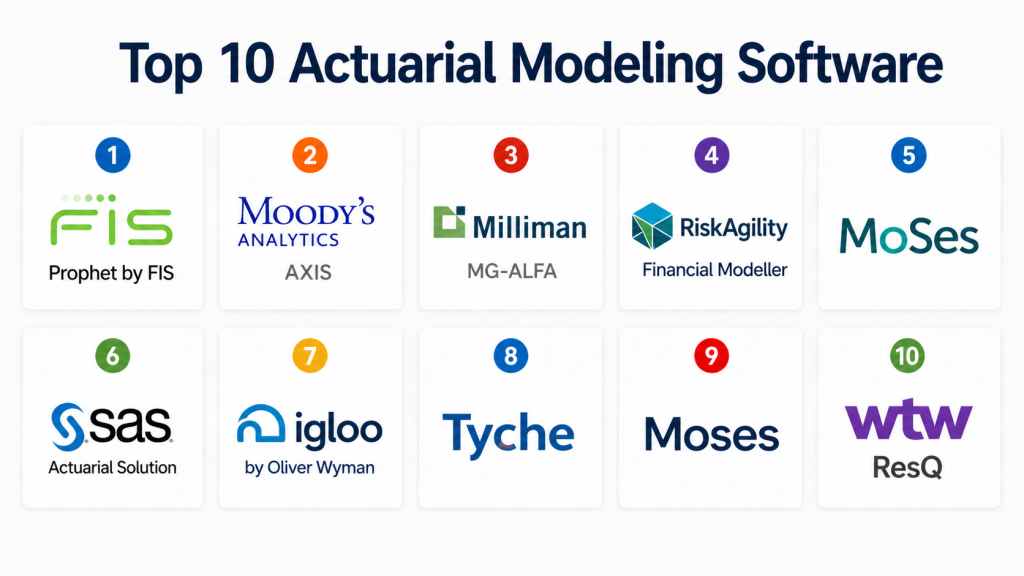
Top 10 Actuarial Modeling Software
#1 — Moody’s Analytics AXIS
Short description :
Moody’s Analytics AXIS is a leading actuarial modeling platform used by insurers globally. It offers advanced tools for risk modeling, pricing, and reserving. Known for high performance and scalability. Suitable for large insurance enterprises. Provides analytics and reporting capabilities. Helps manage complex actuarial models efficiently.
Key Features
- Risk modeling
- Scenario analysis
- High-performance computing
- Reporting dashboards
- Integration tools
- Automation
Pros
- Industry-leading performance
- Scalable platform
Cons
- Complex implementation
- High cost
Platforms / Deployment
Cloud / On-premise
Security & Compliance
SSO, MFA, encryption, RBAC
Integrations & Ecosystem
Integrates with enterprise and data systems.
- Data platforms
- APIs
- Analytics tools
Support & Community
Strong enterprise support.
#2 — Prophet by FIS
Short description :
Prophet is a widely used actuarial modeling software designed for life insurers. It supports risk modeling, financial projections, and regulatory reporting. Known for flexibility and strong analytics capabilities. Suitable for mid-market and enterprise organizations. Provides reporting tools. Helps improve actuarial efficiency.
Key Features
- Risk modeling
- Financial forecasting
- Regulatory reporting
- Analytics
- Reporting tools
Pros
- Flexible platform
- Strong analytics
Cons
- Learning curve
- Pricing varies
Platforms / Deployment
Cloud / On-premise
Security & Compliance
Encryption, access controls
Integrations & Ecosystem
- Data systems
- APIs
Support & Community
Good support available.
#3 — Milliman MG-ALFA
Short description :
MG-ALFA is an actuarial modeling platform designed for life insurance and financial modeling. It supports complex scenario analysis and forecasting. Known for accuracy and flexibility. Suitable for large organizations. Provides analytics and reporting tools. Helps manage actuarial workflows.
Key Features
- Scenario analysis
- Risk modeling
- Forecasting
- Reporting
- Analytics
Pros
- Accurate modeling
- Flexible platform
Cons
- Complex setup
- Enterprise pricing
Platforms / Deployment
On-premise / Cloud
Security & Compliance
Encryption, access controls
Integrations & Ecosystem
- Data tools
- APIs
Support & Community
Enterprise-level support.
#4 — Willis Towers Watson RAFM
Short description :
RAFM is a risk and financial modeling platform designed for insurers. It supports actuarial modeling and analytics. Known for integration capabilities and scalability. Suitable for enterprises. Provides reporting tools. Helps manage risk and financial models.
Key Features
- Risk modeling
- Financial modeling
- Analytics
- Reporting
- Integration tools
Pros
- Strong integration
- Scalable platform
Cons
- Complex interface
- Pricing
Platforms / Deployment
Cloud
Security & Compliance
SSO, encryption
Integrations & Ecosystem
- APIs
- Data systems
Support & Community
Enterprise support.
#5 — SAS Actuarial Solution
Short description :
SAS Actuarial Solution is part of the SAS analytics ecosystem. It provides tools for risk modeling, forecasting, and reporting. Known for advanced analytics capabilities. Suitable for large organizations. Offers integration with data platforms. Helps improve decision-making.
Key Features
- Risk modeling
- Analytics
- Forecasting
- Reporting
- Data integration
Pros
- Advanced analytics
- Strong ecosystem
Cons
- Complex setup
- High cost
Platforms / Deployment
Cloud / On-premise
Security & Compliance
SSO, MFA, encryption
Integrations & Ecosystem
- Data platforms
- APIs
Support & Community
Strong enterprise support.
#6 — Akur8
Short description :
Akur8 is a modern actuarial modeling platform focused on pricing optimization. It uses machine learning to improve accuracy. Known for ease of use and automation. Suitable for insurers of all sizes. Provides analytics and reporting tools. Helps improve pricing models.
Key Features
- Pricing optimization
- Machine learning models
- Analytics
- Reporting
- Automation
Pros
- Easy to use
- AI-driven insights
Cons
- Limited full actuarial scope
- Pricing
Platforms / Deployment
Cloud
Security & Compliance
Encryption, access controls
Integrations & Ecosystem
- APIs
- Data tools
Support & Community
Good support available.
#7 — Igloo by Oliver Wyman
Short description :
Igloo is an actuarial modeling platform focused on risk and financial modeling. It supports scenario analysis and forecasting. Known for flexibility and analytics. Suitable for enterprises. Provides reporting tools. Helps improve actuarial processes.
Key Features
- Risk modeling
- Scenario analysis
- Forecasting
- Analytics
- Reporting
Pros
- Flexible platform
- Strong analytics
Cons
- Limited market presence
- Pricing
Platforms / Deployment
Cloud
Security & Compliance
Encryption, access controls
Integrations & Ecosystem
- APIs
- Data tools
Support & Community
Moderate support.
#8 — Tyche
Short description :
Tyche is an actuarial modeling tool focused on stochastic modeling. It supports scenario analysis and forecasting. Known for flexibility and customization. Suitable for insurers and financial institutions. Provides reporting tools. Helps manage complex models.
Key Features
- Stochastic modeling
- Scenario analysis
- Reporting
- Analytics
- Customization
Pros
- Flexible modeling
- Customizable
Cons
- Smaller ecosystem
- Learning curve
Platforms / Deployment
Cloud
Security & Compliance
Not publicly stated
Integrations & Ecosystem
- APIs
- Data systems
Support & Community
Moderate support.
#9 — Moses by FIS
Short description :
Moses is an actuarial modeling platform designed for life insurance modeling. It supports risk analysis and forecasting. Known for reliability and performance. Suitable for enterprises. Provides reporting tools. Helps manage actuarial workflows.
Key Features
- Risk modeling
- Forecasting
- Reporting
- Analytics
- Workflow tools
Pros
- Reliable platform
- Strong performance
Cons
- Legacy system
- Complex interface
Platforms / Deployment
On-premise / Cloud
Security & Compliance
Encryption, access controls
Integrations & Ecosystem
- Data systems
- APIs
Support & Community
Enterprise support.
#10 — GGY AXIS
Short description :
GGY AXIS is an actuarial modeling platform designed for insurers. It supports risk modeling and scenario analysis. Known for scalability and performance. Suitable for enterprises. Provides reporting tools. Helps improve actuarial processes.
Key Features
- Risk modeling
- Scenario analysis
- Reporting
- Analytics
- Automation
Pros
- Scalable platform
- Strong performance
Cons
- Complex setup
- Pricing
Platforms / Deployment
Cloud / On-premise
Security & Compliance
SSO, MFA
Integrations & Ecosystem
- APIs
- Data systems
Support & Community
Enterprise support.
Comparison Table
| Tool Name | Best For | Platform(s) Supported | Deployment | Standout Feature | Public Rating |
|---|---|---|---|---|---|
| Moody’s AXIS | Enterprise | Web | Hybrid | Performance | N/A |
| Prophet | Enterprise | Web | Hybrid | Flexibility | N/A |
| MG-ALFA | Enterprise | Web | Hybrid | Accuracy | N/A |
| RAFM | Enterprise | Web | Cloud | Integration | N/A |
| SAS | Enterprise | Web | Hybrid | Analytics | N/A |
| Akur8 | SMB/Mid | Web | Cloud | AI pricing | N/A |
| Igloo | Enterprise | Web | Cloud | Flexibility | N/A |
| Tyche | Mid | Web | Cloud | Stochastic modeling | N/A |
| Moses | Enterprise | Web | Hybrid | Reliability | N/A |
| GGY AXIS | Enterprise | Web | Hybrid | Performance | N/A |
Evaluation & Scoring of Actuarial Modeling Software
| Tool Name | Core | Ease | Integrations | Security | Performance | Support | Value | Weighted Total |
|---|---|---|---|---|---|---|---|---|
| Moody’s AXIS | 9 | 6 | 9 | 9 | 9 | 9 | 7 | 8.4 |
| Prophet | 9 | 7 | 8 | 8 | 8 | 8 | 7 | 8.1 |
| MG-ALFA | 9 | 6 | 8 | 8 | 9 | 8 | 7 | 8.1 |
| RAFM | 8 | 7 | 9 | 8 | 8 | 8 | 7 | 8.0 |
| SAS | 9 | 6 | 9 | 9 | 9 | 9 | 7 | 8.4 |
| Akur8 | 8 | 9 | 7 | 7 | 8 | 8 | 8 | 8.0 |
| Igloo | 8 | 7 | 7 | 7 | 8 | 7 | 7 | 7.5 |
| Tyche | 7 | 7 | 7 | 6 | 8 | 7 | 7 | 7.2 |
| Moses | 8 | 6 | 8 | 7 | 8 | 8 | 7 | 7.7 |
| GGY AXIS | 9 | 6 | 8 | 8 | 9 | 8 | 7 | 8.1 |
Interpretation:
These scores provide a comparative view of platform strengths. Enterprise tools excel in performance and scalability, while newer tools offer better usability and innovation. Choose based on modeling complexity and business needs.
Which Actuarial Modeling Software Is Right for You?
Solo / Freelancer
- Not typically required
SMB
- Akur8
- Focus on ease of use and pricing
Mid-Market
- Prophet, Tyche
- Balanced features and scalability
Enterprise
- Moody’s AXIS, SAS, MG-ALFA
- Advanced modeling and performance
Budget vs Premium
- Budget: Akur8
- Premium: Moody’s AXIS
Feature Depth vs Ease of Use
- Deep features: SAS
- Easy to use: Akur8
Integrations & Scalability
- Strong: Enterprise tools
- Moderate: SMB tools
Security & Compliance Needs
- High: Enterprise platforms
- Moderate: SMB tools
Frequently Asked Questions (FAQs)
1. What is actuarial modeling software?
It is software used to analyze risk and forecast outcomes. It helps insurers make decisions. It supports pricing and reserving. It improves accuracy. It is essential for actuarial work.
2. How much does it cost?
Pricing varies based on features and scale. Enterprise tools use custom pricing. SMB tools may offer subscriptions. Implementation costs may apply. Evaluate total cost.
3. How long does implementation take?
Implementation can take months. SMB tools deploy faster. Integration adds complexity. Proper planning is important. Pilot testing is recommended.
4. Is it secure?
Most tools include encryption and access controls. Enterprise tools offer advanced security. Always review vendor policies. Ensure compliance. Security is critical.
5. Can it integrate with data systems?
Yes, most tools integrate with data platforms. APIs enable customization. Integration improves workflows. Enterprise tools offer strong integrations. Verify compatibility.
6. What industries use these tools?
Insurance and financial industries use them. They manage risk and forecasting. The tools improve decision-making. They support compliance. Many organizations rely on them.
7. What are common mistakes when choosing?
Choosing based only on price is a mistake. Ignoring scalability limits growth. Not considering integrations causes issues. Overlooking usability affects adoption. Evaluate carefully.
8. Can small firms use these tools?
Yes, some tools are designed for SMBs. They offer simpler features. These tools are easier to use. They help improve modeling. SMBs benefit.
9. How accurate are these models?
Accuracy depends on data quality and models. Advanced tools improve accuracy. AI enhances predictions. Continuous updates help. No model is perfect.
10. Is it easy to switch tools?
Switching tools can be complex. Data migration is challenging. Training is required. Vendor lock-in may occur. Plan carefully.
Conclusion
Actuarial Modeling Software plays a crucial role in enabling insurers and financial institutions to make accurate, data-driven decisions. By providing advanced modeling, forecasting, and analytics capabilities, these platforms help organizations better understand risk, optimize pricing, and ensure regulatory compliance. They are essential for managing complex financial and insurance operations in a rapidly evolving market.
However, the right tool depends on your organization’s size, modeling complexity, and technical capabilities. Large enterprises may benefit from powerful platforms like Moody’s AXIS or SAS, while smaller organizations may prefer modern, user-friendly solutions like Akur8. Choosing the right platform requires balancing performance, usability, and cost.
As a next step, shortlist a few tools that align with your requirements, run pilot models, and evaluate their performance in real-world scenarios. Focus on integration, scalability, and accuracy to ensure long-term success.
