Meta Description:
Master the DevOps Certified Professional system with a practical roadmap, skill breakdown, certification pathways, real-world use cases, and career guidance.
Introduction
Many learners enter DevOps with excitement, yet they quickly feel stuck because the field combines coding, operations, automation, cloud, security, monitoring, containers, and collaboration. Therefore, they need a clear roadmap, not random tool practice. The DevOps Certified Professional (DCP) path helps learners understand DevOps from a structured and practical point of view. It gives engineers a foundation to connect software delivery, infrastructure automation, CI/CD pipelines, containers, monitoring, and team culture. Moreover, it helps beginners, working engineers, system administrators, developers, testers, and cloud professionals move from confusion to clarity. Instead of treating DevOps as only Jenkins, Docker, or Kubernetes, this roadmap presents DevOps as a complete engineering discipline focused on faster releases, stable systems, and continuous improvement.
What Is a DevOps Certified Professional?
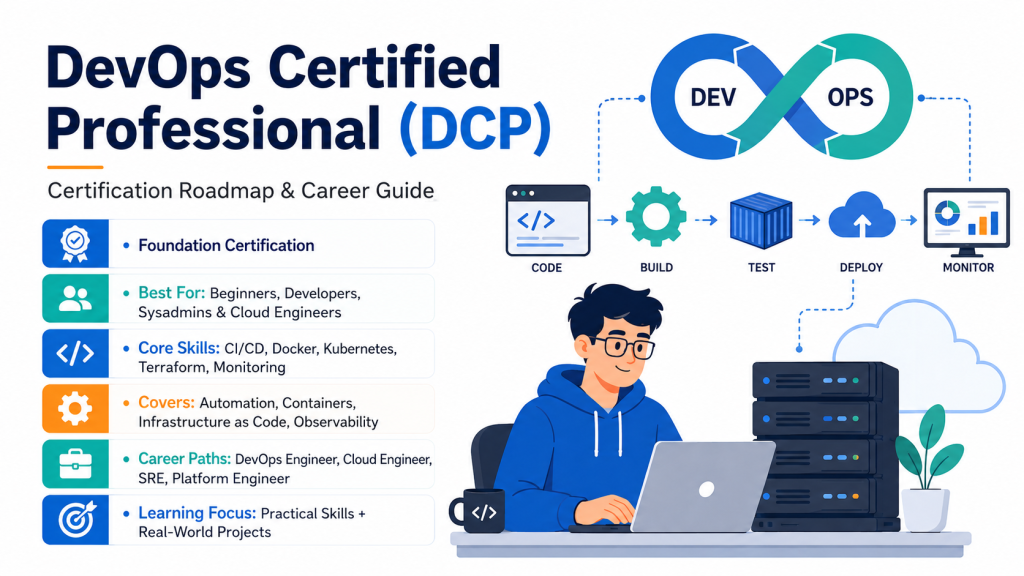
A DevOps Certified Professional is a technical learner or working professional who understands the core principles, tools, and workflows behind modern DevOps practices. This certification subject focuses on practical software delivery, automation, collaboration, continuous integration, continuous delivery, infrastructure management, containerization, and monitoring.
In simple words, DevOps Certified Professional helps learners understand how software moves from development to production in a reliable and repeatable way. Therefore, it builds the foundation for roles such as DevOps Engineer, Junior DevOps Engineer, Build and Release Engineer, Cloud Automation Engineer, Site Reliability Engineer, and Platform Engineering Associate.
The Core Purpose of DevOps Certified Professional
The core purpose of DevOps Certified Professional is to remove confusion from the DevOps learning journey. Many learners start with tools, but they do not understand the workflow behind those tools. As a result, they may learn commands without understanding why a pipeline fails, why a deployment breaks, or why monitoring matters.
Therefore, this certification path focuses on the full DevOps lifecycle. It helps learners understand planning, coding, building, testing, releasing, deploying, operating, and monitoring. Additionally, it teaches the value of automation, feedback loops, shared ownership, and faster recovery.
Because DevOps connects development and operations, the certification also helps professionals improve communication between teams. Developers learn deployment awareness. Operations teams learn automation. Testers learn quality gates. Cloud professionals learn delivery flow. Consequently, everyone understands the bigger engineering picture.
How the DevOps Certified Professional System Works
The DevOps Certified Professional system works through a layered learning approach. First, learners build a strong base in DevOps culture, Linux, Git, and software delivery concepts. Then, they move toward CI/CD pipelines, build automation, containers, configuration management, infrastructure as code, and monitoring.
After that, learners connect these skills through practical projects. For example, they may create a Git repository, trigger a Jenkins pipeline, build an application, create a Docker image, deploy the application, and monitor it through dashboards. This approach builds real confidence because learners do not study tools separately. Instead, they learn how tools work together in one delivery flow.
Moreover, this system helps learners understand both technical and process-level responsibilities. A DevOps professional must automate tasks, reduce errors, improve release quality, monitor systems, and support faster delivery without ignoring reliability.
Eligibility Standards vs. Selection Criteria
Eligibility standards usually describe who can start the certification journey. In most cases, learners do not need deep programming experience to begin DevOps learning. However, basic knowledge of Linux, networking, scripting, cloud, and software development lifecycle helps a lot.
Selection criteria work differently. Employers do not select DevOps professionals only because they know tool names. Instead, they evaluate practical ability. They check whether a learner can work with Git, understand CI/CD, troubleshoot failed deployments, write basic automation, understand containers, manage environments, and explain monitoring signals.
Therefore, beginners can start the certification path, but they must build projects. Similarly, experienced professionals can use this certification to organize their existing knowledge and move toward DevOps, SRE, DevSecOps, cloud DevOps, or platform engineering.
DevOps Certified Professional Components: The Building Blocks
A strong DevOps Certified Professional roadmap includes several building blocks. Each building block supports one part of the modern delivery lifecycle. Therefore, learners should follow a clear sequence instead of jumping randomly from one tool to another.
The main building blocks include Linux fundamentals, version control, continuous integration, continuous delivery, containerization, configuration management, infrastructure as code, cloud basics, monitoring, logging, alerting, security awareness, and troubleshooting.
Age Factors in DevOps Certified Professional
Age does not limit DevOps learning. Fresh graduates, working professionals, system administrators, developers, testers, support engineers, and managers can all learn DevOps if they follow a practical roadmap. However, the learning speed may differ based on previous experience.
For example, a fresher may need more time with Linux, Git, and scripting. Meanwhile, a system administrator may understand servers and logs quickly but may need more practice with CI/CD pipelines. Similarly, a developer may understand code flow easily but may need more exposure to infrastructure and monitoring.
Therefore, learners should not compare their journey with others. Instead, they should assess their current skill level and build a realistic plan.
Educational Evaluation for DevOps Certified Professional
Formal education can support DevOps learning, but it does not replace practical ability. A computer science degree, IT diploma, or engineering background can help learners understand technical concepts faster. However, many DevOps professionals come from system administration, QA, support, networking, development, and cloud backgrounds.
Therefore, learners should evaluate themselves on practical subjects. They should check their understanding of operating systems, command-line usage, networking basics, scripting, software builds, application deployment, cloud services, and troubleshooting.
In addition, learners should understand YAML, configuration files, ports, DNS, package managers, logs, permissions, services, and process management. These small technical areas often become very important during real DevOps work.
Performance Standards and Benchmarks
Performance standards help learners measure progress. A DevOps Certified Professional should not only define DevOps but also apply DevOps concepts in small real projects.
A learner should be able to create a Git repository, manage branches, write pipeline stages, run automated builds, create Docker images, deploy containers, understand Kubernetes basics, automate simple configuration tasks, provision infrastructure using code, and monitor application health.
Moreover, the learner should understand how to troubleshoot failed builds, missing dependencies, permission issues, port conflicts, failed containers, wrong environment variables, and alert noise. These benchmarks show real readiness because DevOps work often involves problem-solving under pressure.
Professional Experience Verification
Professional experience verification means proving that you can apply DevOps concepts in real or simulated environments. Beginners can build this proof through labs and portfolio projects. Experienced professionals can map their current work to DevOps skills.
For example, a system administrator can show automation scripts, server management tasks, monitoring experience, and troubleshooting cases. A developer can show CI/CD pipelines, test automation, containerized applications, and deployment workflows. A tester can show quality gates, automated testing, and release validation. A cloud engineer can show infrastructure provisioning and environment automation.
Therefore, experience does not depend only on job title. It depends on evidence, projects, and practical problem-solving.
Primary Frameworks Governing DevOps Certified Professional
A DevOps Certified Professional roadmap follows practical frameworks that help teams deliver software faster and safer. These frameworks guide learners beyond tool usage.
The first framework is the DevOps lifecycle, which covers planning, coding, building, testing, releasing, deploying, operating, and monitoring. The second framework is CI/CD, which automates build, test, and deployment workflows. The third framework is infrastructure as code, which manages infrastructure through reusable configuration. The fourth framework is observability, which uses metrics, logs, traces, dashboards, and alerts to understand system health.
Additionally, security and reliability frameworks support modern DevOps. DevSecOps adds security checks into pipelines. SRE adds reliability goals, incident response, and service-level thinking. Together, these frameworks help teams improve speed without sacrificing stability.
The Detailed Score Breakdown
| Score Area | Weight | Certification Pathway |
|---|---|---|
| DevOps fundamentals and culture | 5% | DevOps Certified Professional (DCP) |
| Security integration and pipeline safety | 5% | DevSecOps Certified Professional (DSOCP) |
| Reliability engineering and operations automation | 5% | Site Reliability Engineering (SRE) Certified Professional |
| Advanced DevOps engineering practices | 5% | Master in DevOps Engineering (MDE) |
| Azure DevOps workflows and cloud delivery | 5% | Master in Azure DevOps |
| AWS-based DevOps architecture and deployment | 5% | AWS Certified DevOps Professional |
| Programming and automation scripting | 5% | Master in Python Programming |
| Infrastructure as code and provisioning | 5% | Hashicorp Certified Terraform Associate |
| Kubernetes cluster administration | 5% | Certified Kubernetes Administrator (CKA) |
| Container runtime and image management | 5% | Docker Certified Associate (DCA) |
| Service mesh and traffic management | 5% | Envoy ISTIO Certification Training |
| Machine learning operations workflow | 5% | MLOps Certification Training Course |
| Google Cloud DevOps practices | 5% | Google Cloud Professional Cloud DevOps Engineer |
| Machine learning foundation and implementation | 5% | Master in Machine Learning |
| Artificial intelligence engineering awareness | 5% | Master in Artificial Intelligence |
| Application performance monitoring | 5% | Master in AppDynamics |
| Data analysis and data-driven engineering | 5% | Master in Data Science |
| Deep learning model concepts | 5% | Master in Deep Learning |
| Metrics, dashboards, and observability | 5% | Prometheus with Grafana |
| Git-driven deployment and platform workflows | 5% | GitOps Certified Professional (GOCP) |
This score breakdown helps learners view DevOps as a complete ecosystem. Therefore, they can start with the foundation path and then choose a specialization based on career goals.
Real-World Application Scenarios
DevOps Certified Professional skills apply directly to real business problems. For example, a company may face slow releases because teams deploy manually. DevOps practices solve this issue through CI/CD pipelines and automation.
Similarly, an organization may face environment mismatch between development, testing, and production. Infrastructure as code and configuration management reduce this gap. In another case, a SaaS team may face poor visibility after deployment. Monitoring and observability tools help teams detect issues early.
Therefore, DevOps certification knowledge gives learners a practical lens to solve release, reliability, automation, and collaboration problems.
International Pathways for DevOps Certified Professional
DevOps has global demand because software teams everywhere need faster delivery and stable systems. However, each region may value different skill combinations. Therefore, learners should understand international pathways before choosing an advanced certification.
Key Categories and Classes
| Category | Main Focus | Best For |
|---|---|---|
| Foundation DevOps | Core DevOps concepts, lifecycle, and tools | Beginners and career switchers |
| Cloud DevOps | Cloud delivery, automation, and deployment | Cloud engineers |
| DevSecOps | Security in CI/CD and automation workflows | Security-focused engineers |
| SRE | Reliability, incidents, monitoring, and automation | Operations and reliability teams |
| Kubernetes | Container orchestration and cluster operations | Platform engineers |
| Infrastructure as Code | Automated infrastructure provisioning | Cloud and infrastructure teams |
| Observability | Metrics, logs, dashboards, and alerts | SRE and operations teams |
| GitOps | Git-based delivery and declarative operations | Advanced DevOps teams |
Comparative Results Summary
| Pathway | Main Value | Career Direction |
|---|---|---|
| DevOps Certified Professional | Builds a strong DevOps foundation | DevOps Engineer |
| DevSecOps Certified Professional | Adds security into delivery flow | DevSecOps Engineer |
| SRE Certified Professional | Builds reliability thinking | Site Reliability Engineer |
| Kubernetes Certification | Builds container orchestration skill | Platform Engineer |
| Terraform Certification | Builds infrastructure automation skill | IaC Engineer |
| GitOps Certification | Builds modern deployment workflow skill | GitOps Engineer |
Advanced Regional Requirements for DevOps Certified Professional
DevOps does not usually require legal registration like regulated professions. However, regional job markets still create different expectations.
In India, employers often value practical tool experience, Linux skills, CI/CD knowledge, Docker, Kubernetes, Terraform, and cloud basics. Therefore, learners should build project portfolios and prepare for hands-on interviews.
In North America, employers often expect strong cloud automation, security awareness, production troubleshooting, and reliability practices. Therefore, learners should understand incident response, observability, and scalable deployment practices.
In Europe, companies may give strong attention to data protection, governance, security controls, and audit readiness. Therefore, learners should understand RBAC, access control, audit logs, encryption, and controlled release workflows.
In Asia-Pacific and Middle East markets, cloud migration, enterprise automation, and managed service delivery often drive DevOps demand. Therefore, learners should combine certification knowledge with cloud, scripting, automation, and monitoring.
The Global Landscape of DevOps Certified Professional
| Global Path | Primary Skill Area | Best Fit |
|---|---|---|
| Foundation DevOps | Lifecycle, culture, and core tools | New learners |
| Cloud DevOps | Cloud deployment and automation | Cloud engineers |
| DevSecOps | Security-first delivery | Security engineers |
| SRE | Reliability and incident management | Operations engineers |
| Kubernetes | Container orchestration | Platform teams |
| Terraform | Infrastructure as code | Infrastructure engineers |
| Docker | Container packaging | Developers and DevOps learners |
| Monitoring | Metrics and dashboards | Support and SRE teams |
| GitOps | Git-based operations | Advanced platform teams |
| MLOps | ML model delivery | Data and ML engineers |
Benefits of Utilizing a DevOps Certified Professional
A DevOps Certified Professional roadmap gives learners cost efficiency because it reduces random learning. Instead of buying unrelated courses or following scattered videos, learners can follow a structured path.
Additionally, it gives an instant reality check. Learners can compare their current skills with required DevOps building blocks. As a result, they can identify gaps in Linux, Git, CI/CD, containers, cloud, automation, monitoring, or troubleshooting.
Moreover, it supports long-term planning. A learner can start with DevOps basics and then move toward DevSecOps, SRE, Kubernetes, Terraform, GitOps, cloud DevOps, or MLOps. Therefore, the certification becomes a career roadmap rather than a single achievement.
Step-by-Step Guide to Mastering DevOps Certified Professional
Gathering Necessary Documents
Start by collecting your learning notes, project records, resume, previous work examples, tool practice details, and skill gap list. Then, write down your current knowledge in Linux, Git, CI/CD, containers, cloud, scripting, and monitoring.
This simple preparation helps you understand your starting point. Therefore, you can build a realistic plan instead of copying someone else’s roadmap.
Practicing the Core Assessments
Practice should begin with Linux and Git. First, learn basic commands, permissions, services, logs, and package management. Then, practice Git workflows such as clone, commit, branch, merge, pull, push, and pull requests.
After that, create a simple CI/CD pipeline. Build an application, run tests, create an artifact, and automate deployment steps. Then, containerize the application with Docker. Finally, deploy and monitor the application.
Checking Market Demand Lists
Before choosing advanced skills, review job descriptions. Most DevOps roles mention tools such as Git, Jenkins, Docker, Kubernetes, Ansible, Terraform, AWS, Azure, Prometheus, Grafana, and Linux.
Therefore, learners should focus on repeated market skills first. This method prevents tool overload and keeps learning practical.
Adding Secondary Factors
Secondary factors can strengthen your profile. These include scripting, cloud basics, security awareness, agile practices, documentation, communication, and troubleshooting.
Additionally, DevOps requires collaboration. A DevOps engineer often works with developers, testers, security teams, managers, and operations teams. Therefore, communication skills improve real workplace performance.
Calculating the Final Result
Calculate readiness through practical evidence. Ask yourself whether you can explain DevOps culture, create Git workflows, build pipelines, containerize applications, understand Kubernetes basics, write infrastructure code, monitor services, and troubleshoot common issues.
If you can do these tasks confidently, your DevOps Certified Professional readiness becomes strong.
Strategies to Optimize Your DevOps Certified Professional Score
The Performance Enhancement Strategy
To improve your score, practice through projects. Build a small application pipeline. Add automated build steps. Create a Docker image. Deploy the container. Add monitoring. Then, document the workflow.
Additionally, practice failure scenarios. Break a pipeline, change a port, remove access, or use a wrong environment variable. Then, troubleshoot the issue. This approach builds real confidence.
Bonus Qualification Advantages
Bonus qualifications can improve your profile. Cloud knowledge, Kubernetes practice, Terraform skills, Linux administration, Python scripting, and security awareness can all strengthen your DevOps career path.
Moreover, documentation creates an advantage. Teams value engineers who can write deployment guides, rollback steps, troubleshooting notes, and architecture explanations.
Specialized Opportunity Pathways
After completing the DevOps Certified Professional foundation, learners can choose specialized paths. Choose DevSecOps for security. Choose SRE for reliability. Choose Kubernetes for platform engineering. Choose Terraform for infrastructure automation. Choose GitOps for modern deployment workflows. Choose cloud DevOps for cloud-focused engineering roles.
Common Mistakes in the DevOps Certified Professional Process
Many learners overestimate their skills after watching tutorials. However, watching a pipeline does not equal building and troubleshooting one.
Another mistake involves wrong classification. Some learners call themselves DevOps engineers after learning only one tool. However, DevOps covers culture, CI/CD, automation, containers, infrastructure, monitoring, and reliability.
Some learners also ignore Linux and networking. As a result, they struggle with failed deployments, port issues, permissions, DNS, services, and logs.
Additionally, many learners skip documentation. In real teams, DevOps professionals must document processes, rollback plans, access steps, and troubleshooting guides.
Real-Life Case Scenarios Using DevOps Certified Professional
The Early Career Scenario
Rohan is a fresher with basic programming knowledge. He wants to enter DevOps but feels confused by too many tools. Therefore, he starts with Linux, Git, and CI/CD basics. Then, he builds a small pipeline and containerizes a sample application.
As he practices, he understands the connection between code, build, deployment, and monitoring. Consequently, he becomes more confident for junior DevOps interviews.
The Experienced Professional Scenario
Priya works as a system administrator. She already understands servers, services, logs, and troubleshooting. However, she wants to move into DevOps. Therefore, she learns Jenkins, Docker, Ansible, Terraform, and Kubernetes basics.
Because she already knows operations, she understands production risks faster. As a result, she can position herself for DevOps engineer roles by adding automation and pipeline skills.
The Specialized Hero Scenario
Aman works as a cloud engineer. He wants to grow into platform engineering. Therefore, he builds deeper skills in Kubernetes, Terraform, GitOps, and monitoring.
After that, he creates a portfolio with infrastructure scripts, container deployments, Git-based workflows, and dashboards. Consequently, he moves from cloud operations toward advanced platform work.
Frequently Asked Questions (FAQs)
- Is DevOps Certified Professional suitable for beginners?
Yes, beginners can start this certification path if they have basic interest in software delivery, Linux, cloud, or automation. However, they should learn fundamentals step by step and practice through small projects.
- Do I need coding knowledge for DevOps Certified Professional?
Basic scripting helps a lot, but advanced programming is not always required at the beginning. Still, learners should understand simple scripts, variables, commands, and automation logic.
- Which tools should I learn first?
Start with Linux, Git, GitHub, Jenkins, Docker, and basic cloud concepts. After that, move toward Kubernetes, Ansible, Terraform, Prometheus, and Grafana.
- Can a system administrator move into DevOps?
Yes, system administrators often have a strong advantage because they already understand servers, logs, users, permissions, and services. They mainly need to add CI/CD, automation, containers, and infrastructure as code.
- Can developers benefit from this certification?
Yes, developers can benefit because DevOps helps them understand build pipelines, deployment flow, containers, environments, and production feedback. Therefore, they can write code that moves better through delivery pipelines.
- Does this certification guarantee a job?
No certification guarantees a job by itself. However, it can improve your profile when you combine it with hands-on projects, practical knowledge, interview preparation, and clear communication.
- Which roles can this certification support?
This certification can support roles such as Junior DevOps Engineer, DevOps Engineer, Build and Release Engineer, Cloud Support Engineer, Automation Engineer, and Platform Engineering Associate.
- Should I learn Docker before Kubernetes?
Yes, Docker should usually come before Kubernetes because it teaches container basics. After you understand images, containers, ports, volumes, and registries, Kubernetes becomes easier.
- Is cloud knowledge required?
Cloud knowledge helps because many DevOps workflows run on cloud platforms. However, learners can first understand DevOps fundamentals locally and then move toward AWS, Azure, or Google Cloud.
- Which advanced path should I choose after DCP?
Choose based on your career goal. Select DevSecOps for security, SRE for reliability, Kubernetes for platform engineering, Terraform for infrastructure automation, and cloud DevOps for cloud-focused roles.
- How can I build a DevOps portfolio?
Create projects that show Git workflows, CI/CD pipelines, Docker images, Kubernetes deployments, Terraform scripts, monitoring dashboards, and troubleshooting documentation.
- What is the biggest mistake in DevOps preparation?
The biggest mistake is learning tools without understanding workflow. DevOps is not only Jenkins, Docker, or Kubernetes. It is a complete approach to faster, safer, and more reliable software delivery.
Conclusion
DevOps Certified Professional gives learners a clear foundation for modern engineering careers. It helps them understand culture, automation, CI/CD, containers, infrastructure, monitoring, and troubleshooting in one connected roadmap. Therefore, learners should treat this certification as a practical starting point, not just a badge. Start with fundamentals, build small projects, document your work, and then move toward specialized paths such as DevSecOps, SRE, Kubernetes, Terraform, cloud DevOps, GitOps, or MLOps. With consistent practice and the right roadmap, this certification path can help professionals build confidence, improve technical clarity, and move toward stronger DevOps career opportunities.
