Introduction
Many beginners enter the stock market with curiosity but very little understanding of how it actually works. They hear terms like shares, trading, investing, IPOs, and analysis, but often struggle to connect these concepts in a practical way.
Some people start investing based on tips, while others rely on social media advice or assumptions. Without proper stock market education, this often leads to confusion, emotional decisions, and avoidable losses.
The stock market is not a shortcut to quick money. It is a structured financial system where companies raise capital and investors participate in wealth creation through informed decisions.
This complete guide by StocksMantra.com is designed to simplify stock market learning for beginners and help you build a strong foundation in investing, trading, and market analysis.
What Is Stock Market Education?
Stock market education refers to learning how financial markets function and how investment decisions are made.
It includes understanding:
- How shares represent ownership in companies
- How stock exchanges like NSE and BSE operate
- How prices move based on demand and supply
- How investors evaluate businesses
- How risk and return are connected
- How economic factors influence markets
In simple terms, stock market education helps you understand the logic behind price movements instead of making random guesses.
Why Stock Market Education Is Important for Beginners
Without proper knowledge, beginners often make common mistakes such as following tips blindly or investing emotionally.
Stock market education helps you:
- Make informed investment decisions
- Avoid emotional buying and selling
- Understand long-term wealth creation
- Identify strong and weak businesses
- Reduce unnecessary financial risks
- Build disciplined investing habits
A well-educated investor is always more consistent than an emotional investor.
Stock Market for Beginners: Basic Concepts to Learn First
Before investing, beginners should understand these key concepts:
What is a Stock?
A stock represents partial ownership in a company.
What is a Share Market?
A marketplace where buyers and sellers trade company shares.
What is an Exchange?
Platforms like NSE and BSE where stocks are listed and traded.
What is a Demat Account?
A digital account used to store shares electronically.
What is Investing?
Buying stocks for long-term wealth creation.
What is Trading?
Buying and selling stocks for short-term profit.
What is Risk?
The possibility of losing money due to market fluctuations.
What is Diversification?
Spreading investments across multiple assets to reduce risk.
Share Market for Beginners: Investing vs Trading
| Feature | Investing | Trading |
|---|---|---|
| Time Horizon | Long-term (years) | Short-term (minutes to months) |
| Objective | Wealth creation | Quick profit |
| Risk Level | Lower | Higher |
| Analysis Type | Fundamental analysis | Technical analysis |
| Decision Style | Business-focused | Price-focused |
| Suitability | Beginners and long-term investors | Experienced traders |
Beginners are generally advised to start with investing before exploring trading.
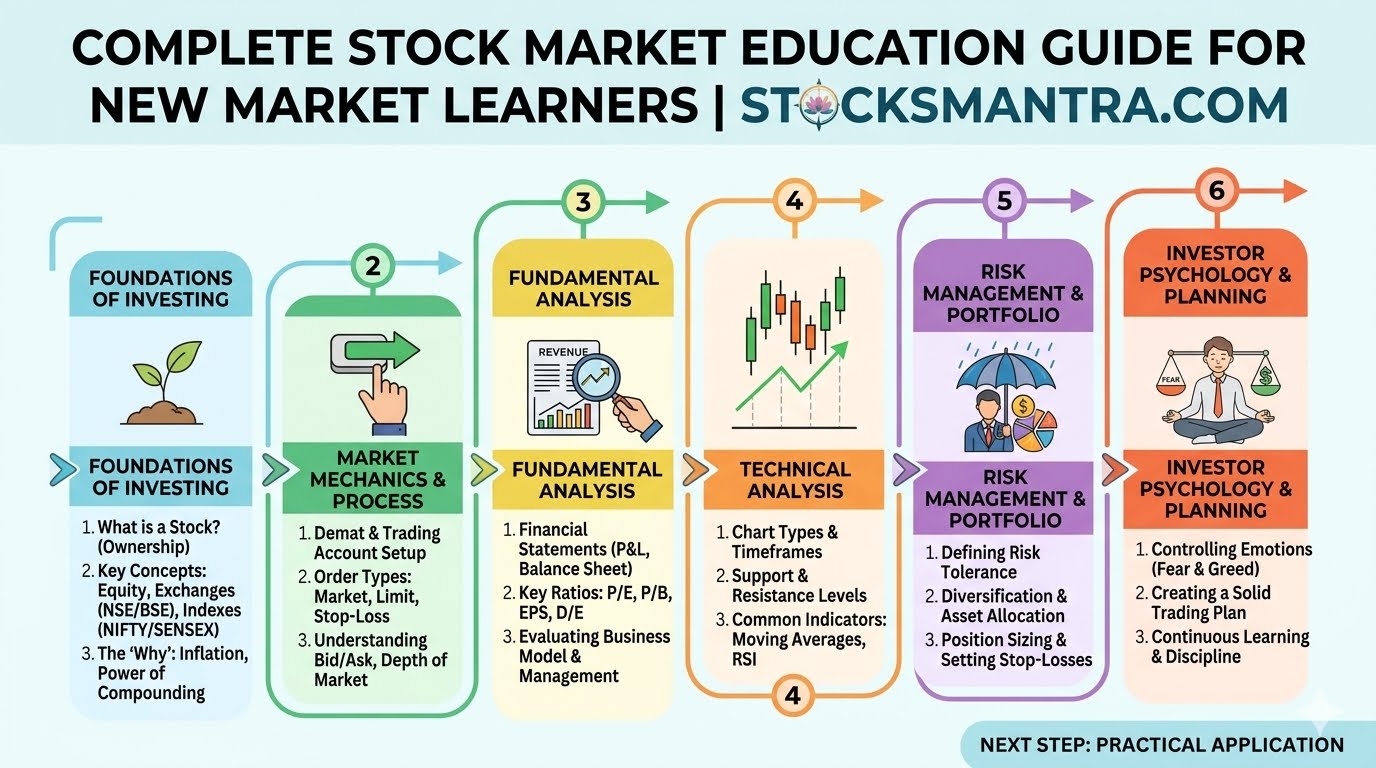
Learn Stock Market Step by Step (Beginner Roadmap)
A structured learning path helps beginners build confidence and avoid confusion.
Step 1: Learn Basic Terminology
Understand stock, shares, market, and exchanges.
Step 2: Understand Market Risk
Learn how volatility and losses work in real markets.
Step 3: Study Companies
Start with well-known and financially stable companies.
Step 4: Learn Financial Statements
Understand revenue, profit, expenses, and debt.
Step 5: Follow Market Sectors
Study sectors like banking, IT, pharma, and FMCG.
Step 6: Learn Fundamental Analysis
Evaluate company strength and long-term potential.
Step 7: Learn Technical Basics
Understand charts, trends, and price patterns.
Step 8: Track IPOs
Study new company listings before investing.
Step 9: Build Discipline
Avoid emotional and impulsive decisions.
Stock Market Investing for Beginners
Investing is a long-term approach focused on wealth creation over time.
Key principles include:
- Invest in strong and stable companies
- Focus on long-term growth instead of short-term movements
- Avoid reacting to market noise
- Study businesses, not just stock prices
- Reinvest returns to benefit from compounding
Successful investing depends on patience and consistency.
Stock Market Analysis Explained Simply
Stock market analysis helps investors make informed decisions.
It includes:
- Fundamental analysis
- Technical analysis
- Sector analysis
- IPO analysis
- Market sentiment analysis
Each type of analysis helps understand the market from a different perspective.
Fundamental Analysis of Stocks
Fundamental analysis focuses on evaluating a company’s actual business performance.
It includes studying:
- Revenue growth
- Profit margins
- Debt levels
- Management quality
- Business model strength
- Industry position
- Future growth potential
- Valuation levels
This helps investors identify strong long-term investment opportunities.
Technical Analysis for Beginners
Technical analysis focuses on price movement and chart patterns.
Key concepts include:
- Market trends (uptrend, downtrend)
- Support and resistance levels
- Trading volume
- Moving averages
- Candlestick patterns
It helps traders understand market behavior and timing.
Stock Market Research: How Beginners Should Study
Before investing, beginners should:
- Study company financial reports
- Compare competitors in the same industry
- Follow quarterly earnings updates
- Read business news and developments
- Analyze sector trends
- Understand risks associated with the company
Proper research reduces investment mistakes.
IPO Analysis for Beginners
An Initial Public Offering (IPO) is when a company offers its shares to the public for the first time.
Before investing in IPOs, beginners should evaluate:
- Business model and industry
- Financial performance history
- Growth potential
- Valuation and pricing
- Risk factors mentioned in documents
Investment decisions should not be based on hype or popularity.
Common Mistakes Beginners Should Avoid
Beginners often make avoidable mistakes such as:
- Following stock tips without research
- Investing emotionally
- Overtrading frequently
- Ignoring risk management
- Expecting quick profits
- Investing borrowed money
- Panic selling during market corrections
- Not understanding the company before investing
Avoiding these mistakes improves long-term success.
How StocksMantra.com Helps Market Learners
StocksMantra.com is designed to simplify stock market learning for beginners and investors.
It helps users understand:
- Stock market basics
- Investing concepts
- Trading fundamentals
- IPO learning
- Market analysis techniques
- Financial research methods
- Sector-based insights
The platform focuses on making stock market education simple, structured, and easy to understand.
Best Practices for Beginner Investors
- Start with small investments
- Focus on long-term goals
- Diversify your portfolio
- Always conduct your own research
- Avoid emotional decision-making
- Track investments regularly
- Keep learning continuously
Expert Tips
- Patience is more important than prediction
- Invest only in businesses you understand
- Focus on risk before returns
- Avoid market rumors and noise
- Build a long-term mindset
- Consistency is more powerful than timing
FAQs
1. What is stock market education?
It is the process of learning how markets work and how investment decisions are made.
2. How can beginners learn stock market basics?
By starting with fundamental concepts like shares, investing, and risk.
3. What is the difference between investing and trading?
Investing is long-term wealth creation, trading focuses on short-term gains.
4. What is fundamental analysis?
It is the study of a company’s financial performance and business strength.
5. What is technical analysis?
It is the study of price charts and patterns to understand market behavior.
6. Is stock market risky for beginners?
Yes, but proper education helps reduce risks significantly.
7. What is IPO analysis?
It is the evaluation of a company before investing in its IPO.
8. How should beginners start investing?
Start small, learn basics, and focus on long-term investing.
9. What are common beginner mistakes?
Following tips blindly, emotional investing, and lack of research.
10. Is learning stock market important before investing?
Yes, it helps build discipline and avoid financial mistakes.
Conclusion
Stock market success is not based on luck or speculation. It is built on knowledge, discipline, and patience.
A strong foundation in stock market education helps beginners understand how markets work, how companies grow, and how informed decisions are made.
Whether you are a student, salaried professional, or new investor, learning the basics before investing is the most important step.
To continue your learning journey, explore more educational content on StocksMantra.com and build a strong understanding of investing, trading, IPOs, and market research.
