Introduction
Root Cause Analysis (RCA) Tools help organizations identify the underlying causes of operational, technical, or process-related issues. Rather than just addressing symptoms, these tools allow IT, engineering, and operations teams to analyze incidents, track patterns, and implement corrective measures to prevent future occurrences. RCA tools are essential for improving reliability, reducing downtime, and driving continuous improvement.
RCA is especially critical in modern IT environments where incidents can cascade across multi-cloud infrastructure, complex applications, and interconnected systems. By using RCA tools, teams can systematically document incidents, visualize causal chains, and leverage automation or AI-assisted analysis to speed up resolution.
Real-world use cases include:
- Diagnosing recurring IT outages in hybrid cloud environments
- Identifying root causes of software bugs in development pipelines
- Analyzing network incidents or security breaches
- Supporting manufacturing or industrial process improvement initiatives
- Documenting incidents for compliance or audit reporting
What buyers should evaluate:
- Ease of incident data collection and integration
- Visualization of causal relationships (fishbone diagrams, timelines, dependency graphs)
- Automation of analysis and reporting
- Collaboration features for cross-functional teams
- AI/ML-powered insights for predictive RCA
- Scalability across enterprise environments
- Security and compliance capabilities
- Customizability and workflow flexibility
- Vendor support and community presence
- Cost and licensing structure
Best for: IT operations, DevOps, engineering teams, industrial process managers, and organizations handling complex systems where incident analysis is critical
Not ideal for: Small teams with simple systems, low incident frequency, or environments where basic manual tracking suffices
Key Trends in Root Cause Analysis Tools
- Integration with observability and monitoring platforms for automated incident capture
- AI/ML assistance for pattern recognition and predictive analysis
- Cloud-based and SaaS RCA tools enabling distributed team collaboration
- Automated report generation for compliance and audits
- Low-code/no-code workflows for mapping causal diagrams
- Visual and interactive dashboards replacing static RCA reports
- Integration with ITSM, ticketing, and workflow management tools
- Support for cross-functional team collaboration and annotations
- Historical incident data analytics for trend identification
- Emphasis on proactive prevention through predictive insights
How We Selected These Tools (Methodology)
- Evaluated market adoption and organizational mindshare
- Assessed completeness of features: incident capture, causal mapping, reporting
- Considered integration capabilities with monitoring, ITSM, and analytics systems
- Reviewed AI/ML features and predictive analytics support
- Verified security posture: authentication, data encryption, audit logs
- Checked ease of use, documentation, and onboarding workflows
- Examined collaboration and workflow support for multi-team environments
- Analyzed scalability for enterprise deployment
- Considered vendor support, community engagement, and customer references
- Balanced feature depth with usability and cost
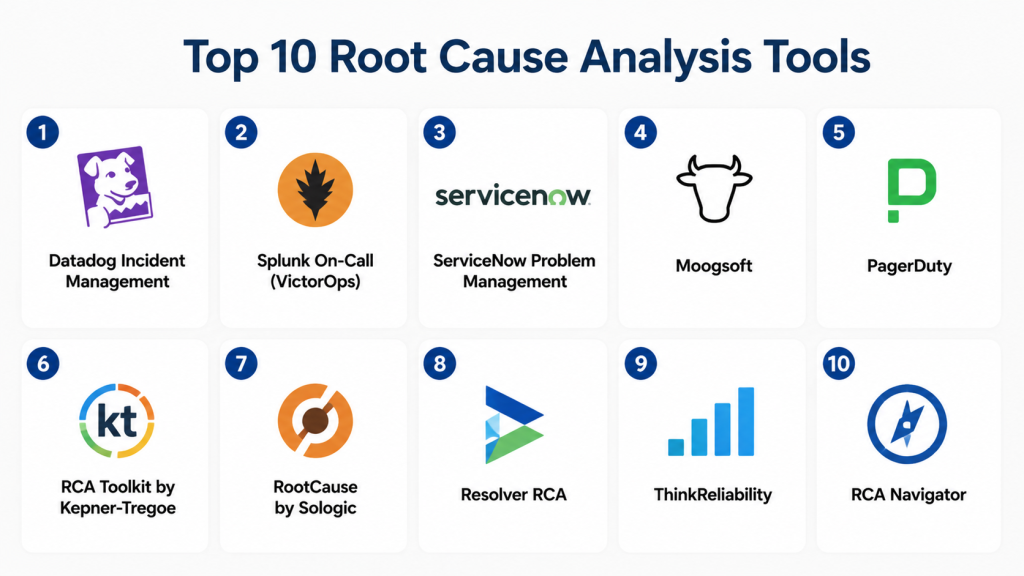
Top 10 Root Cause Analysis Tools
1- Datadog Incident Management
Short description: Datadog provides a unified platform to capture incidents and perform root cause analysis across cloud and on-prem infrastructure
Key Features
- Real-time incident detection and logging
- Timeline-based causal analysis
- AI-assisted anomaly detection
- Automated post-mortem reporting
- Integration with monitoring, logs, and alerts
Pros
- Unified IT observability and RCA in one platform
- AI-driven insights for faster root cause identification
Cons
- Pricing can escalate with scale
- Initial setup complexity
Platforms / Deployment
- Web, Windows, macOS, Linux, iOS, Android
- Cloud
Security & Compliance
- SSO/SAML, MFA, encryption, audit logs
- SOC 2, ISO 27001, GDPR
Integrations & Ecosystem
Supports broad ecosystem integrations for incident data aggregation
- AWS, Azure, GCP monitoring
- ITSM: ServiceNow, Jira
- CI/CD pipelines
- Log management platforms
Support & Community
- 24/7 support, community forums, extensive documentation
2- Splunk On-Call (VictorOps)
Short description: Splunk On-Call centralizes incident management and facilitates root cause analysis with timeline visualizations and team collaboration
Key Features
- Incident capture and alert consolidation
- Timeline and dependency visualization
- Post-incident analytics
- Team collaboration and notifications
- Integration with monitoring and logging systems
Pros
- Strong timeline visualization for RCA
- Seamless collaboration for distributed teams
Cons
- Complexity for smaller teams
- Premium pricing tiers
Platforms / Deployment
- Web, Windows, Linux, macOS
- Cloud / Hybrid
Security & Compliance
- SSO/SAML, MFA
- SOC 2, ISO 27001
Integrations & Ecosystem
- Cloud monitoring: AWS, Azure, GCP
- ITSM: Jira, ServiceNow
- CI/CD pipeline integration
- Logging systems
Support & Community
- Enterprise support, knowledge base, active user community
3- ServiceNow Problem Management
Short description: ServiceNow provides robust RCA capabilities integrated with ITSM workflows to identify and remediate incident root causes
Key Features
- Problem record creation and causal mapping
- Integration with incident and change management
- Knowledge base for recurring issues
- Analytics dashboards and trend reporting
- Collaboration across teams
Pros
- Enterprise-grade workflow integration
- Comprehensive incident documentation
Cons
- Requires investment in ServiceNow ecosystem
- Complexity for smaller teams
Platforms / Deployment
- Web, Windows, macOS
- Cloud
Security & Compliance
- SSO/SAML, MFA, encryption, RBAC
- SOC 2, ISO 27001, HIPAA
Integrations & Ecosystem
- ITSM and ITOM modules
- Cloud and on-prem system integration
- APIs for custom workflows
Support & Community
- Enterprise support, community forums, documentation
4- Moogsoft
Short description: Moogsoft offers AI-driven RCA for IT operations, reducing noise and identifying probable causes quickly
Key Features
- Event correlation and clustering
- AI-assisted root cause identification
- Automated alerts and notifications
- Interactive dashboards
- Integration with monitoring and logging systems
Pros
- Reduces alert fatigue with AI clustering
- Speeds up incident resolution
Cons
- Premium pricing
- Learning curve for full AI features
Platforms / Deployment
- Web
- Cloud / Hybrid
Security & Compliance
- SSO/SAML, MFA, encryption
- SOC 2
Integrations & Ecosystem
- Monitoring tools: Datadog, Dynatrace
- ITSM: ServiceNow, Jira
- Cloud services: AWS, Azure, GCP
Support & Community
- Documentation, support tiers, active community
5- PagerDuty
Short description: PagerDuty centralizes incidents and provides actionable insights for RCA and post-incident reviews
Key Features
- Real-time incident detection and routing
- Timeline-based analysis
- Post-mortem and RCA reporting
- Integration with monitoring systems
- Automated escalation workflows
Pros
- Quick deployment for IT teams
- Strong workflow automation
Cons
- Limited free-tier functionality
- Complex for non-technical teams
Platforms / Deployment
- Web, Windows, macOS, iOS, Android
- Cloud
Security & Compliance
- SSO/SAML, MFA
- SOC 2
Integrations & Ecosystem
- AWS, Azure, GCP
- ITSM: Jira, ServiceNow
- CI/CD pipelines
Support & Community
- 24/7 support, community forums, knowledge base
6- RCA Toolkit by Kepner-Tregoe
Short description: A specialized toolkit for structured root cause analysis using methodology-based workflows
Key Features
- Structured RCA methodology templates
- Fishbone and fault tree diagrams
- Collaborative workflows
- Incident documentation
- Reporting and trend analysis
Pros
- Methodology-focused for thorough RCA
- Supports multiple industries
Cons
- Manual-heavy compared to AI-driven tools
- Limited cloud integrations
Platforms / Deployment
- Web, Windows
- Cloud / Self-hosted
Security & Compliance
- Not publicly stated
Integrations & Ecosystem
- Microsoft Office, ITSM tools
- Custom integration via API
Support & Community
- Vendor support, training available
7- RootCause by Sologic
Short description: Sologic provides RCA software for incident management and process improvement with structured workflows
Key Features
- Fault tree and causal analysis
- Collaboration for cross-functional teams
- Audit trails and documentation
- Reporting dashboards
- Workflow automation
Pros
- Highly structured for industrial and IT use cases
- Supports compliance documentation
Cons
- Limited AI/ML capabilities
- Costly for small teams
Platforms / Deployment
- Web, Windows
- Cloud / Self-hosted
Security & Compliance
- Not publicly stated
Integrations & Ecosystem
- Integration with ITSM and ERP systems
- Export to Excel/Power BI
Support & Community
- Vendor support, documentation
8- Resolver RCA
Short description: Resolver provides incident and problem management with root cause analysis to identify systemic issues
Key Features
- Incident correlation
- Causal chain visualization
- Reporting and trend analysis
- Collaboration features
- Workflow automation
Pros
- Cloud-based with enterprise deployment
- Good reporting and audit trails
Cons
- Limited AI-assisted analysis
- Requires configuration
Platforms / Deployment
- Web
- Cloud
Security & Compliance
- SSO/SAML, MFA
- SOC 2
Integrations & Ecosystem
- ITSM tools: ServiceNow, Jira
- Monitoring integrations
Support & Community
- Vendor support, documentation
9- ThinkReliability
Short description: ThinkReliability offers RCA software with a focus on industrial and manufacturing process analysis
Key Features
- Root cause diagrams and templates
- Incident tracking
- Corrective and preventive action management
- Reporting dashboards
- Collaboration workflows
Pros
- Industry-focused with detailed process analysis
- Supports compliance audits
Cons
- Less suited for IT-centric environments
- Limited AI/ML insights
Platforms / Deployment
- Web, Windows
- Cloud / Self-hosted
Security & Compliance
- Not publicly stated
Integrations & Ecosystem
- ERP, CMMS, ITSM integration
- Excel export
Support & Community
- Vendor support, training
10- RCA Navigator
Short description: RCA Navigator is a lightweight cloud tool for structured root cause analysis and post-incident reporting
Key Features
- Incident logging and timeline
- Fishbone and causal diagrams
- Reporting and analytics
- Collaboration tools
- Workflow automation
Pros
- Easy to use and lightweight
- Cloud-based deployment
Cons
- Limited integrations with monitoring platforms
- Basic AI capabilities
Platforms / Deployment
- Web, Windows
- Cloud
Security & Compliance
- SSO/SAML
- Not publicly stated
Integrations & Ecosystem
- Export to Excel
- Some ITSM integration
Support & Community
- Vendor support, knowledge base
Comparison Table
| Tool Name | Best For | Platform(s) Supported | Deployment | Standout Feature | Public Rating |
|---|---|---|---|---|---|
| Datadog | Cloud IT Ops | Web, Windows, macOS, Linux, iOS, Android | Cloud | AI-assisted RCA | N/A |
| Splunk On-Call | Hybrid IT | Web, Windows, Linux | Cloud / Hybrid | Timeline visualization | N/A |
| ServiceNow | Enterprise IT | Web, Windows, macOS | Cloud | ITSM integration | N/A |
| Moogsoft | IT Ops AI | Web | Cloud / Hybrid | AI event correlation | N/A |
| PagerDuty | IT Ops | Web, Windows, macOS, iOS, Android | Cloud | Incident timeline | N/A |
| Kepner-Tregoe | Structured RCA | Web, Windows | Cloud / Self-hosted | Methodology templates | N/A |
| Sologic | Industrial/IT | Web, Windows | Cloud / Self-hosted | Workflow automation | N/A |
| Resolver | Enterprise Ops | Web | Cloud | Collaboration dashboards | N/A |
| ThinkReliability | Industrial | Web, Windows | Cloud / Self-hosted | Process-focused RCA | N/A |
| RCA Navigator | SMB / Cloud | Web, Windows | Cloud | Lightweight and easy | N/A |
Evaluation & Scoring
| Tool Name | Core (25%) | Ease (15%) | Integrations (15%) | Security (10%) | Performance (10%) | Support (10%) | Value (15%) | Weighted Total |
|---|---|---|---|---|---|---|---|---|
| Datadog | 9 | 8 | 9 | 9 | 9 | 8 | 7 | 8.7 |
| Splunk On-Call | 9 | 7 | 8 | 9 | 8 | 8 | 6 | 8.1 |
| ServiceNow | 8 | 7 | 8 | 9 | 8 | 8 | 6 | 8.0 |
| Moogsoft | 8 | 7 | 7 | 8 | 8 | 7 | 6 | 7.6 |
| PagerDuty | 8 | 8 | 7 | 8 | 8 | 7 | 7 | 7.8 |
| Kepner-Tregoe | 7 | 6 | 6 | 7 | 7 | 6 | 7 | 6.8 |
| Sologic | 7 | 6 | 6 | 7 | 7 | 6 | 6 | 6.6 |
| Resolver | 7 | 7 | 6 | 8 | 7 | 7 | 6 | 6.9 |
| ThinkReliability | 6 | 6 | 5 | 7 | 6 | 6 | 6 | 6.2 |
| RCA Navigator | 6 | 7 | 5 | 6 | 6 | 6 | 6 | 6.3 |
Weighted totals reflect comparative strengths across core features, ease of use, integration, security, performance, support, and value
Which Root Cause Analysis Tool Is Right for You?
Solo / Freelancer
RCA Navigator or Kepner-Tregoe offers structured but lightweight solutions suitable for individuals or consultants
SMB
Datadog, PagerDuty, and Splunk On-Call provide scalable cloud-based solutions for small to mid-sized IT teams
Mid-Market
Moogsoft, ServiceNow, and Resolver provide enterprise-grade RCA with collaboration, analytics, and AI-assisted insights
Enterprise
ServiceNow, Datadog, and Moogsoft are best for large-scale hybrid deployments with multiple teams and cross-platform integrations
Budget vs Premium
Open-source or methodology-based tools like Kepner-Tregoe are budget-friendly; Datadog, Moogsoft, and ServiceNow are premium options with AI and enterprise support
Feature Depth vs Ease of Use
ServiceNow and Moogsoft offer deep RCA capabilities but require onboarding; RCA Navigator prioritizes simplicity and ease of adoption
Integrations & Scalability
Datadog, Splunk, and ServiceNow integrate broadly across monitoring, logging, and ITSM systems for growing IT operations
Security & Compliance Needs
ServiceNow, Datadog, and PagerDuty provide audit logging, encryption, and enterprise-grade security for regulated industries
Frequently Asked Questions (FAQs)
1- What is a Root Cause Analysis (RCA) tool?
It is a software solution that helps identify the underlying cause of incidents, process failures, or system errors rather than just addressing symptoms
2- Can RCA tools integrate with monitoring systems?
Yes, most modern tools integrate with logs, alerts, cloud monitoring platforms, and ITSM tools to automatically gather incident data
3- Are RCA tools suitable for small teams?
Yes, lightweight tools like RCA Navigator or Kepner-Tregoe methodology-focused tools can meet small team requirements
4- Do RCA tools provide AI insights?
Leading solutions such as Datadog, Moogsoft, and Splunk On-Call include AI/ML features to detect patterns and suggest root causes
5- How long does it take to deploy an RCA tool?
Cloud-based solutions can be deployed in days, while on-premise or enterprise setups may take weeks
6- Can RCA tools generate reports for compliance?
Yes, most tools provide dashboards, audit trails, and exportable reports to support compliance and audit requirements
7- Are these tools useful for IT only?
No, RCA tools are used in IT, manufacturing, industrial processes, healthcare, and anywhere incident analysis and prevention is critical
8- Do RCA tools support collaboration?
Yes, most modern RCA platforms provide team collaboration features, annotations, and workflow assignments
9- How customizable are the causal diagrams?
Tools like Kepner-Tregoe, Sologic, and ServiceNow allow flexible fishbone, fault tree, and dependency mapping
10- Can I switch RCA tools if needed?
Yes, but migrating historical incident data and reconfiguring workflows is necessary; vendor support can assist
Conclusion
Root Cause Analysis tools are essential for preventing recurring incidents, improving system reliability, and enabling informed decision-making. The best tool depends on team size, environment complexity, and integration needs. pilot them in your workflows, validate integrations and security measures, then scale adoption across your organization
