Introduction
Kubernetes Policy Enforcement Tools are specialized platforms that help organizations define, enforce, and monitor policies across Kubernetes clusters. They ensure that deployments comply with security, operational, and regulatory standards, preventing misconfigurations, security breaches, and resource misuse. With Kubernetes being the backbone of modern cloud-native applications, policy enforcement has become essential to maintain cluster integrity and governance.
Real-world use cases include:
- Preventing deployment of insecure or non-compliant containers
- Enforcing resource quotas, labels, and naming conventions across clusters
- Automating compliance checks for regulatory standards like PCI DSS or GDPR
- Monitoring network policies and access controls for cluster security
- Integrating with CI/CD pipelines for automated policy validation
Evaluation criteria buyers should consider:
- Policy enforcement capabilities (security, resource, network)
- Ease of defining and managing policies
- Integration with Kubernetes clusters and CI/CD pipelines
- Reporting and audit capabilities
- Multi-cluster and multi-cloud support
- Extensibility and custom policy creation
- Runtime vs. admission-time enforcement
- Community support and documentation
- Cost and total ownership
Best for: DevOps and security teams managing multiple Kubernetes clusters in medium to large enterprises. Particularly useful for organizations with compliance or governance requirements.
Not ideal for: Small teams with single-cluster setups or those using fully managed Kubernetes services without complex policies.
Key Trends in Kubernetes Policy Enforcement
- AI-assisted policy validation for anomaly detection
- Integration with GitOps pipelines for automated policy-as-code enforcement
- Multi-cloud and hybrid cluster policy management
- Enhanced runtime enforcement for dynamic workloads
- Policy standardization using OPA (Open Policy Agent) and Rego
- Native integration with Kubernetes admission controllers
- Centralized dashboards for audit and compliance reporting
- Support for CI/CD policy enforcement pre-deployment
- Community-driven libraries of reusable policies
- Shift toward SaaS-first governance tools for SMBs
How We Selected These Tools (Methodology)
- Market adoption and recognition in Kubernetes governance ecosystems
- Feature completeness including security, compliance, and operational policies
- Ease of integration with clusters and CI/CD pipelines
- Performance and reliability across multi-cluster environments
- Security posture and audit capabilities
- Customization and policy extensibility
- Support and documentation quality
- Developer and DevOps usability
- Community activity and open-source contributions
- Scalability for enterprise and cloud-native architectures
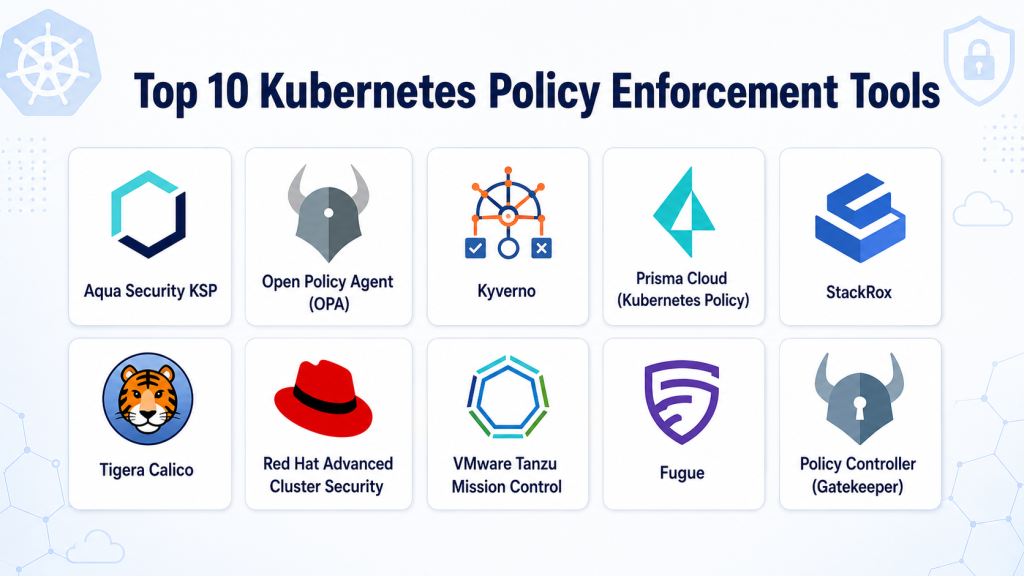
Top 10 Kubernetes Policy Enforcement Tools
1- Aqua Security KSP
Short description: Aqua Security KSP provides comprehensive Kubernetes policy enforcement with automated security and compliance controls for enterprise clusters.
Key Features
- Admission controller-based policy enforcement
- Network and namespace policies
- Compliance and audit reporting
- CI/CD integration
- Runtime policy validation
- Role-based access control enforcement
Pros
- Strong enterprise security coverage
- Centralized compliance dashboards
Cons
- Premium pricing for full enterprise features
- Setup complexity for large-scale clusters
Platforms / Deployment
- Linux
- Cloud / Self-hosted / Hybrid
Security & Compliance
- SOC 2, ISO 27001, GDPR
- MFA, audit logs, RBAC
Integrations & Ecosystem
Supports Kubernetes, OpenShift, GitOps pipelines
- CI/CD pipeline integration
- API automation
- Policy libraries
- Runtime monitoring
Support & Community
- Enterprise support tiers
- Comprehensive documentation
- Active community forums
2- Open Policy Agent (OPA)
Short description: OPA is an open-source general-purpose policy engine often used for Kubernetes admission control to enforce fine-grained policies.
Key Features
- Policy-as-code using Rego language
- Admission control integration
- Extensible for custom policies
- CI/CD and GitOps integration
- Multi-cluster enforcement
- Open-source libraries for common policies
Pros
- Flexible and extensible
- Large open-source community
Cons
- Requires learning Rego for complex policies
- No native GUI; relies on integrations
Platforms / Deployment
- Linux
- Cloud / Self-hosted
Security & Compliance
- Not publicly stated
Integrations & Ecosystem
- Kubernetes, CI/CD pipelines, GitOps
- APIs for policy automation
- Integration with dashboards
Support & Community
- Active open-source community
- Extensive documentation
- Community support
3- Kyverno
Short description: Kyverno is a Kubernetes-native policy engine that simplifies defining and enforcing cluster policies without additional languages.
Key Features
- Native Kubernetes CRDs for policy definitions
- Validation, mutation, and generation policies
- CI/CD integration
- Policy auditing and reporting
- Admission control enforcement
- Multi-cluster support
Pros
- Kubernetes-native and easy to adopt
- No separate policy language needed
Cons
- Limited runtime enforcement compared to some enterprise tools
- Smaller enterprise support options
Platforms / Deployment
- Linux
- Cloud / Self-hosted
Security & Compliance
- Not publicly stated
Integrations & Ecosystem
- GitOps and CI/CD pipelines
- Kubernetes native
- APIs for automation
Support & Community
- Community support
- Active GitHub repository
- Documentation
4- Prisma Cloud (Kubernetes Policy)
Short description: Prisma Cloud provides full Kubernetes policy enforcement along with runtime protection and compliance monitoring across multi-cloud clusters.
Key Features
- Vulnerability and configuration policy enforcement
- Network policy management
- CI/CD integration
- Multi-cluster policy enforcement
- Compliance dashboards and reporting
- Runtime security policies
Pros
- Enterprise-grade multi-cloud coverage
- Strong compliance and runtime enforcement
Cons
- Premium pricing
- Learning curve for full feature adoption
Platforms / Deployment
- Linux
- Cloud / Hybrid
Security & Compliance
- SOC 2, ISO 27001, GDPR
- RBAC, audit logs
Integrations & Ecosystem
Supports Kubernetes, OpenShift, AWS, Azure, GCP
- CI/CD and GitOps pipelines
- APIs for automation
Support & Community
- Enterprise support
- Comprehensive documentation
- Active community
5- StackRox
Short description: StackRox delivers Kubernetes policy enforcement integrated with Red Hat OpenShift, offering runtime security and compliance controls.
Key Features
- Admission controller-based enforcement
- Runtime threat detection
- Policy-as-code enforcement
- Multi-cluster support
- CI/CD integration
Pros
- Deep OpenShift integration
- Strong runtime enforcement
Cons
- Enterprise-focused, may be complex for SMBs
- Requires Red Hat ecosystem
Platforms / Deployment
- Linux
- Cloud / Hybrid / Self-hosted
Security & Compliance
- Not publicly stated
Integrations & Ecosystem
- OpenShift, Kubernetes
- CI/CD pipelines
- API policy automation
Support & Community
- Enterprise support
- Red Hat ecosystem
- Documentation
6- Tigera Calico
Short description: Calico provides Kubernetes network policy enforcement combined with security policies for pods and clusters.
Key Features
- Network policy enforcement
- Admission control integration
- Multi-cluster support
- CI/CD integration
- Security policy compliance
Pros
- Strong network security policies
- Open-source and scalable
Cons
- Focused mainly on network policies
- Limited GUI for policy management
Platforms / Deployment
- Linux
- Cloud / Self-hosted
Security & Compliance
- Not publicly stated
Integrations & Ecosystem
- Kubernetes, OpenShift
- CI/CD pipeline integration
- API automation
Support & Community
- Community support
- Documentation and tutorials
7- Red Hat Advanced Cluster Security
Short description: Red Hat ACS provides Kubernetes policy enforcement with runtime threat detection, compliance monitoring, and admission control.
Key Features
- Admission control enforcement
- Runtime threat detection
- Multi-cluster policy management
- CI/CD integration
- Compliance dashboards
Pros
- Enterprise-ready
- Integrated runtime monitoring
Cons
- Red Hat ecosystem required
- Premium pricing
Platforms / Deployment
- Linux
- Cloud / Hybrid / Self-hosted
Security & Compliance
- SOC 2, ISO 27001
- RBAC, audit logs
Integrations & Ecosystem
- OpenShift, Kubernetes
- CI/CD pipelines
- API automation
Support & Community
- Enterprise support
- Documentation
- Red Hat community
8- VMware Tanzu Mission Control
Short description: Tanzu Mission Control provides centralized Kubernetes policy management across multi-cloud and multi-cluster environments.
Key Features
- Centralized policy enforcement
- Admission controller policies
- Multi-cluster governance
- Compliance reporting
- CI/CD integration
Pros
- Multi-cloud cluster management
- Centralized policy view
Cons
- VMware ecosystem required
- Pricing may be high
Platforms / Deployment
- Linux
- Cloud / Hybrid
Security & Compliance
- Not publicly stated
Integrations & Ecosystem
- VMware Tanzu, Kubernetes
- CI/CD pipelines
- API access
Support & Community
- Enterprise support
- Documentation
- Community
9- Fugue
Short description: Fugue provides Kubernetes policy enforcement with compliance scanning and drift detection for cloud-native infrastructure.
Key Features
- Policy enforcement for Kubernetes and cloud resources
- Compliance checks
- CI/CD integration
- Drift detection
- Multi-cluster support
Pros
- Cloud-native compliance automation
- Supports multi-cluster policies
Cons
- Smaller ecosystem than larger tools
- Premium pricing
Platforms / Deployment
- Linux
- Cloud / Self-hosted
Security & Compliance
- Not publicly stated
Integrations & Ecosystem
- Kubernetes, AWS, Azure, GCP
- CI/CD pipelines
- API-driven policy automation
Support & Community
- Enterprise support
- Documentation
- Community
10- Policy Controller (Gatekeeper)
Short description: Gatekeeper enforces policies using OPA Rego in Kubernetes clusters with audit, validation, and mutation support.
Key Features
- Policy-as-code enforcement
- Admission control integration
- Validation, mutation, and audit
- Multi-cluster support
- CI/CD integration
Pros
- Open-source and extensible
- Strong Rego-based enforcement
Cons
- Requires learning Rego
- No native GUI
Platforms / Deployment
- Linux
- Self-hosted / Hybrid
Security & Compliance
- Not publicly stated
Integrations & Ecosystem
- Kubernetes, CI/CD pipelines
- APIs for automation
- GitOps pipelines
Support & Community
- Active open-source community
- Documentation
- Community support
Comparison Table
| Tool Name | Best For | Platform(s) Supported | Deployment | Standout Feature | Public Rating |
|---|---|---|---|---|---|
| Aqua Security KSP | Enterprises | Linux | Cloud / Self-hosted / Hybrid | Admission & runtime policies | N/A |
| OPA | Open-source | Linux | Cloud / Self-hosted | Flexible Rego policy engine | N/A |
| Kyverno | Developers | Linux | Cloud / Self-hosted | Kubernetes-native policies | N/A |
| Prisma Cloud | Enterprises | Linux | Cloud / Hybrid | Multi-cluster compliance & runtime | N/A |
| StackRox | OpenShift | Linux | Cloud / Hybrid / Self-hosted | OpenShift-native runtime security | N/A |
| Calico | Network policies | Linux | Cloud / Self-hosted | Network policy enforcement | N/A |
| Red Hat ACS | Enterprises | Linux | Cloud / Hybrid / Self-hosted | Runtime monitoring & compliance | N/A |
| Tanzu Mission Control | Multi-cloud | Linux | Cloud / Hybrid | Centralized policy management | N/A |
| Fugue | Cloud-native | Linux | Cloud / Self-hosted | Compliance automation & drift detection | N/A |
| Gatekeeper | Open-source | Linux | Self-hosted / Hybrid | OPA Rego admission enforcement | N/A |
Evaluation & Scoring
| Tool Name | Core | Ease | Integrations | Security | Performance | Support | Value | Weighted Total |
|---|---|---|---|---|---|---|---|---|
| Aqua Security KSP | 9 | 7 | 8 | 9 | 8 | 8 | 7 | 8.4 |
| OPA | 8 | 6 | 7 | 7 | 7 | 6 | 8 | 7.4 |
| Kyverno | 8 | 8 | 8 | 7 | 7 | 7 | 8 | 7.7 |
| Prisma Cloud | 9 | 6 | 8 | 8 | 8 | 7 | 6 | 7.7 |
| StackRox | 8 | 6 | 7 | 8 | 7 | 7 | 6 | 7.2 |
| Calico | 7 | 7 | 6 | 6 | 7 | 6 | 8 | 7.0 |
| Red Hat ACS | 8 | 6 | 7 | 8 | 7 | 7 | 6 | 7.2 |
| Tanzu Mission Control | 8 | 7 | 7 | 7 | 7 | 7 | 6 | 7.0 |
| Fugue | 8 | 7 | 7 | 7 | 7 | 6 | 6 | 6.9 |
| Gatekeeper | 7 | 7 | 6 | 6 | 7 | 6 | 8 | 7.0 |
Interpretation: Higher weighted totals indicate better overall balance of features, ease, security, and integration for Kubernetes policy enforcement.
Which Kubernetes Policy Enforcement Tool Is Right for You?
Solo / Freelancer
Kyverno or Gatekeeper for simple cluster policy enforcement.
SMB
OPA or Calico provide open-source policy and network management with automation.
Mid-Market
Prisma Cloud or Fugue deliver multi-cluster compliance and runtime monitoring.
Enterprise
Aqua Security KSP, StackRox, or Red Hat ACS provide comprehensive admission, runtime, and compliance enforcement.
Budget vs Premium
Open-source tools like OPA, Kyverno, Calico, Gatekeeper are cost-efficient; enterprise options provide full coverage, dashboards, and support.
Feature Depth vs Ease of Use
Kyverno and Prisma Cloud balance ease and depth; StackRox and Aqua Security KSP prioritize enterprise-level features.
Integrations & Scalability
Prisma Cloud, Aqua KSP, or StackRox for multi-cluster, multi-cloud; OPA and Gatekeeper for CI/CD and GitOps workflows.
Security & Compliance Needs
High compliance: Prisma Cloud, Aqua KSP, Red Hat ACS; lightweight enforcement: Kyverno, OPA, Gatekeeper.
Frequently Asked Questions (FAQs)
1- What is the typical pricing model for Kubernetes policy enforcement tools?
Most tools are subscription-based; open-source tools like OPA, Kyverno, and Gatekeeper are free, with enterprise add-ons for dashboards and support.
2- How easy is onboarding for new teams?
Tools like Kyverno and Gatekeeper are quick to deploy, while enterprise tools require cluster integration and policy configuration.
3- Can these tools enforce multi-cluster policies?
Yes, enterprise platforms like Prisma Cloud, Aqua KSP, and StackRox support multi-cluster governance; open-source tools rely on CI/CD pipelines for distribution.
4- Do these tools handle runtime policy enforcement?
Some, like StackRox and Aqua KSP, enforce policies at runtime; others focus on admission-time validation only.
5- Can I integrate these tools with CI/CD pipelines?
Yes. Most tools support GitOps, Jenkins, GitLab, or GitHub Actions for automated pre-deployment validation.
6- Are there open-source alternatives?
Yes. OPA, Kyverno, Calico, and Gatekeeper are fully open-source and widely adopted.
7- How often should policies be updated?
Policies should be reviewed regularly, aligned with compliance standards, and updated with cluster or workload changes.
8- Can these tools enforce custom policies?
Yes. OPA Rego, Kyverno CRDs, and Gatekeeper allow custom policies for specific security or operational requirements.
9- What are common mistakes when selecting a tool?
Ignoring multi-cluster enforcement, runtime needs, or integration with CI/CD; relying solely on open-source without enterprise support where needed.
10- Do these tools support cloud-native managed Kubernetes?
Yes, most integrate with EKS, GKE, AKS, and other managed services, though some enterprise features may require additional setup.
Conclusion
Kubernetes Policy Enforcement Tools are essential for securing, standardizing, and auditing cluster deployments. The right tool depends on your organization’s size, compliance needs, and complexity of Kubernetes environments. Open-source tools are effective for lightweight enforcement, while enterprise solutions offer comprehensive policy coverage, runtime enforcement, and multi-cluster management. Choosing the right platform ensures your Kubernetes workloads are secure, compliant, and scalable.
