Introduction
Cloud Spend Governance tools help organizations monitor, control, and optimize cloud expenditures across multi-cloud environments. These tools provide real-time visibility into cloud usage, enforce policies for cost allocation, and support budgeting and forecasting. By improving transparency and accountability, they help organizations avoid overspending, enforce compliance, and drive cost-efficient operations.
Real-World Use Cases Include:
- Enforcing budget and policy compliance for cloud teams.
- Monitoring cloud consumption across AWS, Azure, and Google Cloud.
- Automating alerts for overspending and unused resources.
- Generating dashboards and reports for finance and IT stakeholders.
- Integrating with FinOps practices to enable chargeback and showback.
Evaluation Criteria for Buyers:
- Policy Enforcement: Can the tool enforce budgets and cost allocation rules?
- Multi-Cloud Support: Does it handle multiple cloud providers seamlessly?
- Automation: Are cost alerts, compliance checks, and reporting automated?
- Analytics: Are dashboards actionable and customizable?
- Integration: Can it connect to ERP, FinOps platforms, and DevOps pipelines?
- Security & Compliance: Does it comply with SOC 2, ISO 27001, or internal governance standards?
Best For:
Organizations seeking proactive governance and cost control across complex, multi-cloud deployments.
Not Ideal For:
Teams with limited cloud usage or a single cloud provider where manual monitoring suffices.
Key Trends in Cloud Spend Governance
- Automated policy enforcement for budgets, tagging, and approvals.
- Integration with FinOps and chargeback frameworks.
- AI-driven anomaly detection for unexpected costs.
- Cloud-native dashboards and reporting for multiple stakeholders.
- Increased focus on multi-cloud optimization and resource efficiency.
Methodology
- Evaluated tools for core governance functionality, automation, integration, analytics, ease of use, security, and value.
- Included widely adopted and credible cloud spend governance platforms.
- Compared deployment options: SaaS and cloud-native.
- Reviewed vendor documentation, industry benchmarks, and user reviews.
- Weighted scores applied to identify enterprise, SMB, and developer best-fit tools.
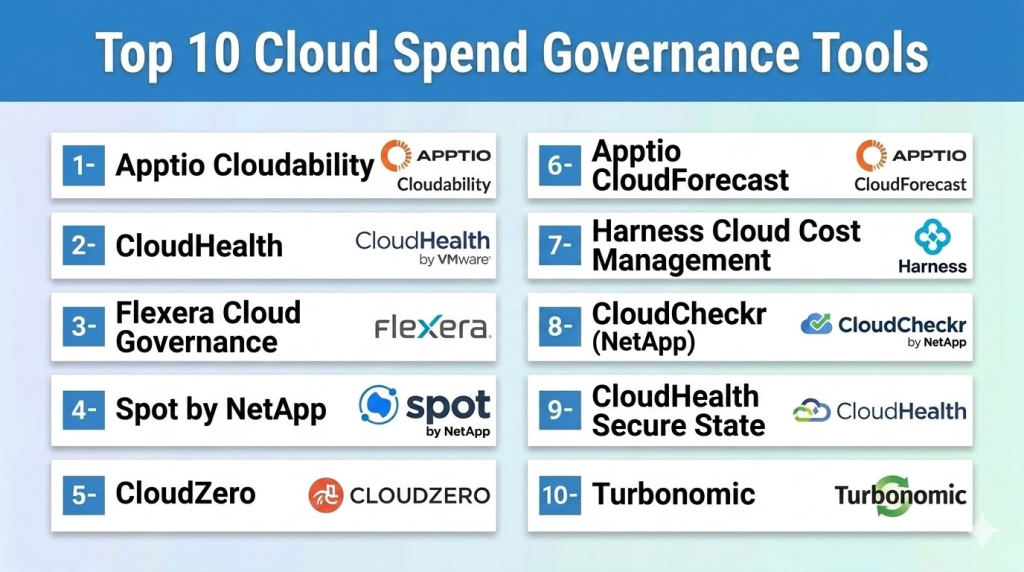
Top 10 Cloud Spend Governance Tools
1- Apptio Cloudability
Short Description: Cloudability enables enterprises to monitor, govern, and optimize cloud spend with automation and analytics.
Key Features:
- Policy-based cloud cost governance
- Multi-cloud cost visibility
- Automated alerts and budget enforcement
- Showback and chargeback reporting
- Predictive cost forecasting
Pros: - Enterprise-scale governance
- Strong analytics and reporting capabilities
Cons: - Complex setup for smaller teams
- Higher pricing for SMEs
Platforms / Deployment: Cloud
Security & Compliance: SOC 2, ISO 27001
Integrations & Ecosystem: AWS, Azure, Google Cloud, ERP
Support & Community: Vendor support, online forums, training resources
2- CloudHealth by VMware
Short Description: CloudHealth provides cloud governance, cost optimization, and policy enforcement across multiple cloud providers.
Key Features:
- Budgeting and policy automation
- Multi-cloud compliance monitoring
- Cost allocation and showback
- Governance dashboards for executives
- Integration with CI/CD pipelines
Pros: - Comprehensive multi-cloud governance
- Strong visualization and insights
Cons: - Advanced features may require technical expertise
- Premium pricing for smaller organizations
Platforms / Deployment: Cloud
Security & Compliance: SOC 2, ISO 27001
Integrations & Ecosystem: AWS, Azure, Google Cloud, Jira, Slack
Support & Community: Vendor support, knowledge base, community forums
3- Flexera Cloud Governance
Short Description: Flexera provides cloud spend governance and FinOps capabilities for enterprises seeking multi-cloud cost control.
Key Features:
- Policy enforcement for cloud budgets
- Automated alerts for overspending
- Reserved instance management
- Multi-cloud dashboards and reporting
- Cost optimization recommendations
Pros: - Strong enterprise-grade features
- Extensive cloud analytics
Cons: - Complexity in initial configuration
- May be overkill for small deployments
Platforms / Deployment: Cloud
Security & Compliance: SOC 2, ISO 27001
Integrations & Ecosystem: AWS, Azure, Google Cloud, ERP
Support & Community: Vendor support, online resources, training
4- Spot by NetApp
Short Description: Spot offers governance and automation tools to control cloud spend, optimize resources, and enforce policies.
Key Features:
- Automated policy enforcement for budgets
- Real-time usage tracking
- Reserved and spot instance optimization
- Multi-cloud dashboards
- CI/CD integration
Pros: - Automation reduces manual oversight
- Real-time cost insights
Cons: - Limited reporting for finance teams
- Best suited for cloud-heavy DevOps environments
Platforms / Deployment: Cloud
Security & Compliance: Varies / N/A
Integrations & Ecosystem: AWS, Azure, Google Cloud, CI/CD tools
Support & Community: Support portal, tutorials, forums
5- CloudZero
Short Description: CloudZero provides product-centric cost governance for engineering, finance, and product teams.
Key Features:
- Policy enforcement at product or team level
- Real-time cost monitoring
- Automated alerts for anomalies
- Showback and chargeback reporting
- API integrations for workflow automation
Pros: - Product-focused governance
- Intuitive dashboards
Cons: - Requires tagging strategy for accuracy
- Premium plans may be costly for small teams
Platforms / Deployment: Cloud
Security & Compliance: SOC 2, ISO 27001
Integrations & Ecosystem: AWS, Azure, Google Cloud, Slack, Jira
Support & Community: Vendor support, documentation, community forums
6- Apptio CloudForecast
Short Description: CloudForecast helps teams forecast cloud spend and enforce policies through alerts and automated dashboards.
Key Features:
- Predictive budgeting
- Automated policy enforcement
- Cost allocation per team or project
- Reserved instance monitoring
- Multi-cloud dashboards
Pros: - Simple and intuitive interface
- Focus on forecasting and compliance
Cons: - Limited advanced analytics
- Best suited for finance-focused teams
Platforms / Deployment: Cloud
Security & Compliance: Varies / N/A
Integrations & Ecosystem: AWS, Azure, Google Cloud
Support & Community: Support portal, documentation, webinars
7- Harness Cloud Cost Management
Short Description: Harness enables automated governance and spend management with real-time insights for DevOps and FinOps teams.
Key Features:
- Multi-cloud policy enforcement
- Automated alerts for budget overruns
- Showback and chargeback dashboards
- Optimization recommendations
- API access for integrations
Pros: - Automation reduces manual oversight
- Real-time governance insights
Cons: - Learning curve for advanced features
- Best for cloud-heavy organizations
Platforms / Deployment: Cloud
Security & Compliance: SOC 2, ISO 27001
Integrations & Ecosystem: AWS, Azure, Google Cloud, CI/CD pipelines
Support & Community: Vendor support, training, forums
8- CloudCheckr (NetApp)
Short Description: CloudCheckr provides cost governance, security, and compliance monitoring for multi-cloud environments.
Key Features:
- Policy enforcement and alerts
- Multi-cloud cost reporting
- Compliance and security monitoring
- Reserved instance optimization
- Showback dashboards
Pros: - Comprehensive governance and cost control
- Strong multi-cloud insights
Cons: - Learning curve for enterprise configurations
- Premium features require higher plans
Platforms / Deployment: Cloud
Security & Compliance: SOC 2, ISO 27001
Integrations & Ecosystem: AWS, Azure, Google Cloud, ERP systems
Support & Community: Vendor support, documentation, training
9- CloudHealth Secure State
Short Description: CloudHealth Secure State combines cost governance with cloud security and policy enforcement capabilities.
Key Features:
- Cloud spend governance and policy compliance
- Security posture monitoring
- Automated alerts for anomalies
- Multi-cloud dashboards
- Integration with CI/CD pipelines
Pros: - Combines governance and security
- Enterprise-scale insights
Cons: - Advanced security configuration required
- Cost may be high for smaller teams
Platforms / Deployment: Cloud
Security & Compliance: SOC 2, ISO 27001
Integrations & Ecosystem: AWS, Azure, GCP, CI/CD pipelines
Support & Community: Vendor support, knowledge base, forums
10- Turbonomic
Short Description: Turbonomic enforces cloud policies and automates resource allocation to optimize spend and ensure governance.
Key Features:
- Automated budget and policy enforcement
- Real-time cost monitoring
- Resource optimization and rightsizing
- Multi-cloud support
- Showback dashboards
Pros: - Strong automation capabilities
- Real-time spend visibility
Cons: - Requires enterprise-scale deployment
- Customization may need professional services
Platforms / Deployment: Cloud
Security & Compliance: SOC 2, ISO 27001
Integrations & Ecosystem: AWS, Azure, Google Cloud, ERP, ITSM
Support & Community: Vendor support, online resources, training
Comparison Table
| Tool Name | Best For | Platforms Supported | Deployment | Standout Feature | Public Rating |
|---|---|---|---|---|---|
| Apptio Cloudability | Enterprise cloud teams | AWS, Azure, GCP | Cloud | Automated policy enforcement | N/A |
| CloudHealth | Multi-cloud enterprises | AWS, Azure, GCP | Cloud | Policy-driven governance | N/A |
| Flexera | Enterprise FinOps | AWS, Azure, GCP | Cloud | Multi-cloud compliance | N/A |
| Spot | DevOps-heavy teams | AWS, Azure, GCP | Cloud | Automation-focused governance | N/A |
| CloudZero | Product/finance teams | AWS, Azure, GCP | Cloud | Product-level cost monitoring | N/A |
| CloudForecast | Finance-focused teams | AWS, Azure, GCP | Cloud | Predictive budgeting | N/A |
| Harness | Cloud-heavy organizations | AWS, Azure, GCP | Cloud | Real-time alerts and governance | N/A |
| CloudCheckr | Multi-cloud enterprises | AWS, Azure, GCP | Cloud | Cost and security governance | N/A |
| CloudHealth Secure State | Governance + security | AWS, Azure, GCP | Cloud | Combined governance & security | N/A |
| Turbonomic | Enterprise cloud optimization | AWS, Azure, GCP | Cloud | Automated policy & resource optimization | N/A |
Evaluation & Scoring Table
| Tool | Core 25% | Ease 15% | Integrations 15% | Security 10% | Performance 10% | Support 10% | Value 15% | Weighted Total |
|---|---|---|---|---|---|---|---|---|
| Apptio Cloudability | 9 | 7 | 9 | 9 | 9 | 8 | 7 | 8.3 |
| CloudHealth | 9 | 7 | 9 | 9 | 8 | 8 | 7 | 8.1 |
| Flexera | 8 | 7 | 8 | 8 | 8 | 7 | 7 | 7.6 |
| Spot | 8 | 8 | 7 | 7 | 8 | 7 | 7 | 7.4 |
| CloudZero | 8 | 8 | 7 | 8 | 7 | 7 | 7 | 7.5 |
| CloudForecast | 7 | 8 | 7 | 7 | 7 | 7 | 7 | 7.1 |
| Harness | 8 | 7 | 8 | 8 | 8 | 7 | 7 | 7.6 |
| CloudCheckr | 8 | 7 | 8 | 8 | 8 | 7 | 7 | 7.6 |
| CloudHealth Secure State | 8 | 7 | 8 | 8 | 8 | 7 | 7 | 7.6 |
| Turbonomic | 8 | 7 | 8 | 8 | 8 | 7 | 7 | 7.6 |
Which Cloud Spend Governance Tool Is Right for You?
- Solo / Small Teams: CloudForecast and CloudZero provide easy dashboards for small teams.
- SMBs: Spot and CloudHealth offer automation and multi-cloud insights.
- Mid-Market: Flexera or Harness provide strong governance, reporting, and integration capabilities.
- Enterprise: Apptio Cloudability, CloudCheckr, CloudHealth Secure State, and Turbonomic deliver enterprise-scale multi-cloud governance, policy enforcement, and predictive optimization.
FAQs
1- What is cloud spend governance?
It is the process of monitoring, controlling, and optimizing cloud costs across multiple environments to ensure policy compliance and cost efficiency.
2- Do these tools work across multiple clouds?
Yes, most top governance tools support AWS, Azure, and Google Cloud for accurate multi-cloud visibility.
3- Can they automate cost enforcement?
Yes, they enforce budgets, policies, and alerts automatically to prevent overspending.
4- What is policy enforcement in cloud governance?
Policy enforcement ensures cloud usage follows organizational rules, including budget limits, tagging, and resource allocation.
5- Are these tools secure?
Leading platforms comply with SOC 2, ISO 27001, and cloud security best practices.
6- Can small teams benefit?
Yes, tools like CloudForecast and CloudZero offer simple dashboards and automated alerts suitable for smaller organizations.
7- Do they provide forecasting?
Yes, predictive budgeting and cost forecasting help plan future cloud spending efficiently.
8- Can these tools integrate with FinOps and ERP?
Most support ERP, FinOps platforms, and DevOps workflows for seamless cloud cost governance.
9- How do dashboards help?
Dashboards provide real-time visibility into cloud costs, policy compliance, and alerts for potential overspending.
10- Do these tools support chargeback and showback?
Yes, they allow teams to allocate cloud costs to business units and visualize spending for accountability.
Conclusion
Cloud Spend Governance tools are essential for organizations managing multi-cloud environments with complex spending patterns. They enhance visibility, enforce policies, and prevent overspending. Small teams can start with CloudZero or CloudForecast, mid-market organizations benefit from Spot or Harness, and enterprise teams gain maximum control with Apptio Cloudability, CloudCheckr, and Turbonomic. Evaluate tools for automation, integration, analytics, and multi-cloud support, pilot your selection, validate results, and scale to enforce governance and optimize cloud spend organization-wide.
