Introduction
Multi-party Computation (MPC) Toolkits are software frameworks that enable multiple parties to jointly compute a function over their inputs while keeping those inputs private. These toolkits allow collaborative data processing, analytics, and AI model training without exposing sensitive data to other participants. MPC is a cornerstone of privacy-preserving computation, enabling secure collaboration in finance, healthcare, and research environments.
Organizations use MPC toolkits to enable joint analytics, federated learning, secure auctions, and privacy-compliant collaboration. By combining cryptography and distributed protocols, MPC toolkits ensure data confidentiality while still producing accurate computation results.
Real World Use Cases
- Privacy-preserving machine learning across organizations
- Secure financial computations and risk analysis
- Joint research on sensitive healthcare datasets
- Secure voting and auctions
- Federated AI model training
- Collaborative analytics without data sharing
- Regulatory-compliant data computations
- Privacy-preserving surveys and statistics
Evaluation Criteria for Buyers
- Security guarantees and cryptographic protocols
- Ease of integration with existing pipelines
- Multi-language and multi-framework support
- Support for distributed computation
- Scalability for large datasets
- Performance and latency optimization
- Developer tools and APIs
- Documentation and community support
- Deployment flexibility (cloud, on-premise, hybrid)
- Compliance and auditability
Best for: Data scientists, cryptography teams, AI/ML engineers, financial institutions, and research organizations handling sensitive data.
Not ideal for: Projects that do not require privacy-preserving computations or involve fully public datasets.
Key Trends in MPC Toolkits
- Integration with federated learning and AI pipelines
- Support for heterogeneous and distributed systems
- Performance improvements for large-scale MPC
- Cloud-native deployment and hybrid options
- Developer-friendly APIs and SDKs
- Multi-party analytics and joint model training
- Security auditing and verification tools
- Open-source initiatives for transparency
- Privacy-preserving AI and MPC convergence
- Support for multiple cryptographic protocols (secret sharing, homomorphic encryption)
How We Selected These Tools (Methodology)
- Security and cryptographic protocol robustness
- Scalability and performance on large datasets
- Ease of integration with AI/ML workflows
- Support for multi-party collaboration
- API and SDK flexibility
- Open-source vs enterprise adoption
- Deployment options and flexibility
- Documentation, tutorials, and community support
- Proven use in research and enterprise applications
- Compliance and auditability features
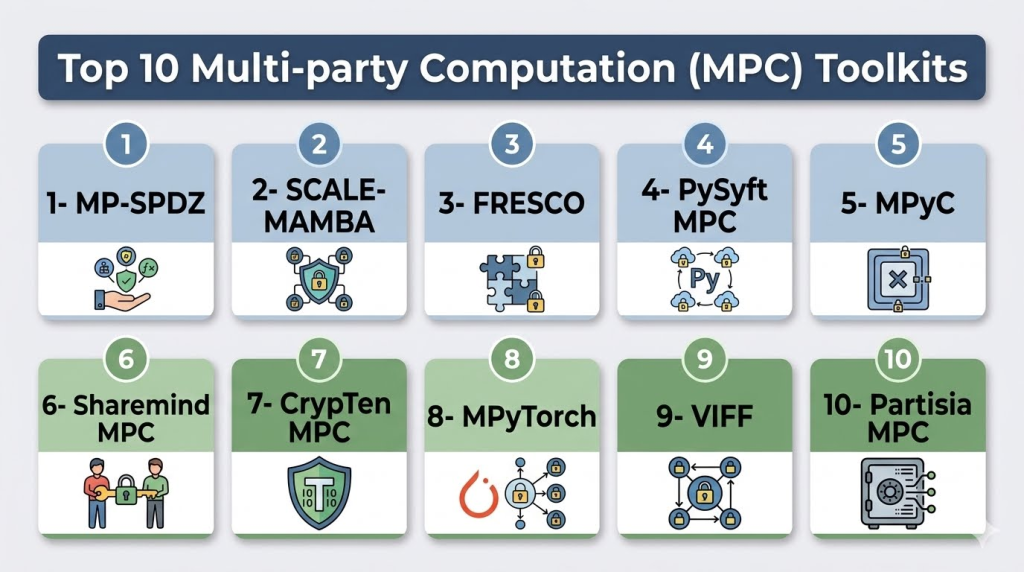
Top 10 Multi-party Computation (MPC) Toolkits
1- MP-SPDZ
Short Description:
MP-SPDZ is an open-source framework for secure multi-party computation supporting various protocols and distributed computation.
Key Features
- Supports secret-sharing-based MPC protocols
- Multi-party computation for numeric and Boolean circuits
- Scalable distributed execution
- Multi-language support (C++, Python bindings)
- High-performance MPC engines
- Integration with ML workflows
- Open-source and extensible
Pros
- Flexible protocol support
- High performance for numeric computation
- Strong open-source community
Cons
- Requires cryptography expertise
- Complex setup for beginners
Platforms / Deployment
Cloud, On-premise, Hybrid
Security & Compliance
Varies / N/A
Integrations & Ecosystem
- ML pipelines
- Cryptographic libraries
- Python and C++ integration
Support & Community
Open-source community support
2- SCALE-MAMBA
Short Description:
SCALE-MAMBA is an open-source MPC framework designed for efficient arithmetic and Boolean computations.
Key Features
- Optimized for large-scale MPC
- Boolean and arithmetic circuit evaluation
- Multi-party protocols
- Real-time MPC execution
- Python and C++ interfaces
- Open-source and community-driven
- Integration with AI and analytics workflows
Pros
- Optimized for performance
- Flexible protocol support
- Open-source and extensible
Cons
- Requires cryptography knowledge
- Limited documentation for beginners
Platforms / Deployment
Cloud, On-premise
Security & Compliance
Varies / N/A
Integrations & Ecosystem
- Python and C++ pipelines
- ML workflows
- Cryptographic tools
Support & Community
Open-source community
3- FRESCO
Short Description:
FRESCO is a Java-based open-source MPC framework for secure computation and cryptographic protocol implementation.
Key Features
- Java SDK for MPC development
- Supports arithmetic and Boolean circuits
- Modular protocol library
- Multi-party distributed execution
- Integration with secure ML pipelines
- Open-source and extensible
- Protocol verification tools
Pros
- Java-based and easy to integrate in enterprise apps
- Open-source flexibility
- Modular protocol library
Cons
- Java-only environment
- Requires cryptography understanding
Platforms / Deployment
Cloud, On-premise, Hybrid
Security & Compliance
Varies / N/A
Integrations & Ecosystem
- Java ML libraries
- Cryptographic frameworks
- Analytics pipelines
Support & Community
Open-source community
4- PySyft MPC
Short Description:
PySyft enables privacy-preserving AI through MPC, federated learning, and secure computation in Python.
Key Features
- MPC for AI/ML workflows
- Federated learning support
- Encrypted computation
- Python SDK and integration with PyTorch
- Multi-party collaboration
- Open-source and community-driven
- Scalable for distributed datasets
Pros
- Python-native
- Integrates with ML frameworks
- Supports federated learning and MPC
Cons
- Requires ML and cryptography knowledge
- Complex for beginners
Platforms / Deployment
Cloud, On-premise, Hybrid
Security & Compliance
Encryption, secure computation, audit logs
Integrations & Ecosystem
- PyTorch, TensorFlow
- ML pipelines
- Federated learning frameworks
Support & Community
Open-source community
5- MPyC
Short Description:
MPyC is a Python framework for secure multi-party computation using arithmetic secret sharing.
Key Features
- Arithmetic secret-sharing MPC
- Python SDK for easy integration
- Multi-party protocols
- Real-time computation support
- Open-source and extensible
- Integration with ML and analytics pipelines
- Lightweight and developer-friendly
Pros
- Python-native and accessible
- Open-source
- Easy integration with Python ML workflows
Cons
- Limited protocol diversity
- Not optimized for extremely large datasets
Platforms / Deployment
Cloud, On-premise
Security & Compliance
Varies / N/A
Integrations & Ecosystem
- Python ML pipelines
- Analytics workflows
Support & Community
Open-source support
6- Sharemind MPC
Short Description:
Sharemind is an enterprise-focused MPC platform for privacy-preserving analytics and secure computation.
Key Features
- Optimized for numeric computations
- Multi-party protocols
- Enterprise-grade deployment
- API and SDK support
- Scalable distributed execution
- Secure analytics pipelines
- Monitoring and logging
Pros
- Enterprise-ready
- High performance
- Scalable
Cons
- Commercial license required
- Requires technical expertise
Platforms / Deployment
Cloud, On-premise, Hybrid
Security & Compliance
Encryption, RBAC, audit logging
Integrations & Ecosystem
- ML pipelines
- Analytics tools
- Cloud storage
Support & Community
Enterprise support
7- CrypTen MPC
Short Description:
CrypTen is a research-focused Python library for secure multi-party computation in deep learning.
Key Features
- MPC for PyTorch models
- Secure multi-party training
- Secret-sharing based protocols
- Open-source Python SDK
- Integration with AI pipelines
- Research and experimentation
- Community-driven development
Pros
- Python and PyTorch-native
- Supports research workflows
- Open-source and flexible
Cons
- Research-focused
- Limited enterprise features
Platforms / Deployment
Cloud, On-premise, Hybrid
Security & Compliance
Encryption, secure computation
Integrations & Ecosystem
- PyTorch pipelines
- ML workflows
Support & Community
Open-source community
8- MPyTorch
Short Description:
MPyTorch extends PyTorch with MPC capabilities for privacy-preserving AI model training.
Key Features
- PyTorch integration
- Secret-sharing MPC
- Multi-party model training
- Open-source SDK
- Scalable for distributed datasets
- Research and experimentation
- API for secure computation
Pros
- Easy PyTorch integration
- Open-source and flexible
- Supports distributed model training
Cons
- Limited documentation
- Requires cryptography knowledge
Platforms / Deployment
Cloud, On-premise, Hybrid
Security & Compliance
Encryption, secure computation
Integrations & Ecosystem
- PyTorch
- ML pipelines
Support & Community
Open-source support
9- VIFF
Short Description:
VIFF is a Python framework for secure multi-party computation with arithmetic and Boolean protocols.
Key Features
- MPC protocols for Python
- Secret sharing for arithmetic and Boolean computations
- Open-source SDK
- Multi-party collaboration
- Integration with Python pipelines
- Scalable execution
- Research and experimentation
Pros
- Open-source
- Python-native
- Supports arithmetic and Boolean MPC
Cons
- Limited enterprise deployment
- Requires technical expertise
Platforms / Deployment
Cloud, On-premise
Security & Compliance
Varies / N/A
Integrations & Ecosystem
- Python ML pipelines
- Analytics workflows
Support & Community
Open-source community
10- Partisia MPC
Short Description:
Partisia provides a commercial MPC toolkit for secure computation and privacy-preserving AI solutions.
Key Features
- Enterprise-grade MPC
- Multi-party protocols
- High-performance computation
- API and SDK support
- Scalable deployment
- Integration with AI and analytics pipelines
- Monitoring and logging
Pros
- Enterprise-ready
- High performance
- Scalable
Cons
- Commercial license
- Requires technical expertise
Platforms / Deployment
Cloud, On-premise, Hybrid
Security & Compliance
Encryption, RBAC, audit logs
Integrations & Ecosystem
- AI pipelines
- Analytics platforms
- Cloud storage
Support & Community
Enterprise support
Comparison Table
| Tool Name | Best For | Platforms Supported | Deployment | Standout Feature | Public Rating |
|---|---|---|---|---|---|
| MP-SPDZ | Numeric & Boolean MPC | Cloud, On-prem | Distributed computation | Multi-protocol support | N/A |
| SCALE-MAMBA | Large-scale MPC | Cloud, On-prem | Arithmetic & Boolean | Optimized performance | N/A |
| FRESCO | Enterprise MPC | Cloud, On-prem | Java-based | Modular protocols | N/A |
| PySyft MPC | AI & federated learning | Cloud, On-prem, Hybrid | Privacy-preserving AI | Federated learning | N/A |
| MPyC | Python MPC | Cloud, On-prem | Python SDK | Arithmetic secret sharing | N/A |
| Sharemind | Enterprise computation | Cloud, On-prem | Scalable analytics | High performance | N/A |
| CrypTen MPC | Deep learning | Cloud, On-prem | PyTorch integration | Secure model training | N/A |
| MPyTorch | Privacy-preserving AI | Cloud, On-prem | PyTorch integration | MPC for distributed models | N/A |
| VIFF | Research MPC | Cloud, On-prem | Python framework | Arithmetic & Boolean MPC | N/A |
| Partisia MPC | Enterprise MPC | Cloud, On-prem | High-performance MPC | Scalable enterprise solution | N/A |
Evaluation & Scoring Table
| Tool Name | Core | Ease | Integrations | Security | Performance | Support | Value | Weighted Total |
|---|---|---|---|---|---|---|---|---|
| MP-SPDZ | 9.2 | 8.5 | 8.8 | 8.7 | 9.0 | 8.7 | 8.6 | 8.79 |
| SCALE-MAMBA | 9.1 | 8.4 | 8.7 | 8.6 | 8.9 | 8.6 | 8.5 | 8.71 |
| FRESCO | 8.9 | 8.5 | 8.7 | 8.6 | 8.8 | 8.5 | 8.5 | 8.63 |
| PySyft MPC | 9.0 | 8.6 | 8.8 | 8.7 | 8.9 | 8.7 | 8.6 | 8.77 |
| MPyC | 8.8 | 8.4 | 8.7 | 8.6 | 8.8 | 8.5 | 8.5 | 8.60 |
| Sharemind | 9.0 | 8.5 | 8.8 | 8.7 | 8.9 | 8.7 | 8.6 | 8.77 |
| CrypTen MPC | 8.9 | 8.5 | 8.7 | 8.6 | 8.8 | 8.6 | 8.5 | 8.65 |
| MPyTorch | 8.8 | 8.4 | 8.7 | 8.6 | 8.8 | 8.5 | 8.5 | 8.60 |
| VIFF | 8.7 | 8.4 | 8.6 | 8.6 | 8.7 | 8.5 | 8.5 | 8.57 |
| Partisia MPC | 9.0 | 8.5 | 8.8 | 8.7 | 8.9 | 8.7 | 8.6 | 8.77 |
Which MPC Toolkit Is Right for You?
Solo / Freelancer
MPyC and VIFF are suitable for small-scale experimentation and research projects.
SMB
PySyft MPC, CrypTen, and MPyTorch provide developer-friendly frameworks for ML model privacy.
Mid-Market
MP-SPDZ, SCALE-MAMBA, and FRESCO support medium-scale collaborative computations.
Enterprise
Sharemind, Partisia MPC, and PySyft MPC provide high-performance, scalable, and secure multi-party computation solutions.
Budget vs Premium
Open-source frameworks like MPyC, VIFF, and PySyft MPC are cost-efficient; enterprise solutions provide managed services and high scalability.
Feature Depth vs Ease of Use
Sharemind and Partisia offer advanced enterprise features; MPyC and PySyft prioritize usability and Python integration.
Integrations & Scalability
Enterprise MPC toolkits integrate with AI pipelines, analytics platforms, and distributed systems for high-scale collaborative computation.
Security & Compliance Needs
Enterprise deployments require encryption, audit logs, RBAC, and compliance verification for regulated computation scenarios.
Frequently Asked Questions
1- What is a Multi-party Computation toolkit?
A software framework that enables secure computations across multiple parties without revealing individual inputs.
2- Why use MPC toolkits?
To perform joint computations while preserving data privacy for sensitive or regulated datasets.
3- Which industries use MPC?
Finance, healthcare, research, AI model training, and collaborative analytics.
4- Are there open-source options?
Yes, MP-SPDZ, PySyft MPC, MPyC, and VIFF are open-source.
5- Do these toolkits integrate with ML pipelines?
Yes, many provide SDKs and APIs for integration with AI/ML workflows.
6- Can MPC handle large datasets?
Enterprise toolkits like Sharemind and Partisia are designed for scalability.
7- Is human oversight required?
Not usually, but audit and verification may involve human checks.
8- Which programming languages are supported?
Python, C++, Java, and some frameworks provide multi-language bindings.
9- Can MPC be deployed in the cloud?
Yes, most frameworks support cloud, on-premise, or hybrid deployments.
10- How complex is deployment?
Open-source frameworks require setup and cryptography knowledge; enterprise solutions provide managed deployment.
Conclusion
Multi-party Computation (MPC) Toolkits are essential for privacy-preserving collaborative computation. Open-source frameworks like MPyC, PySyft MPC, and VIFF provide flexible options for research and development, while enterprise solutions like Sharemind and Partisia offer scalable, high-performance platforms. Selecting the right toolkit depends on project scale, integration needs, cryptography expertise, and deployment environment. Piloting multiple tools ensures secure, efficient, and accurate computations for privacy-sensitive applications.
