Introduction
Differential Privacy Toolkits are software solutions designed to enable the secure analysis of sensitive data while ensuring individual privacy. They apply mathematical techniques to add controlled noise to datasets or query results, preventing the identification of individuals while maintaining overall data utility. These toolkits are critical in industries where sensitive personal information is processed, such as healthcare, finance, and public sector analytics.
Organizations use differential privacy toolkits to safely share data, train machine learning models on sensitive datasets, and comply with privacy regulations like GDPR and HIPAA. Toolkits often include APIs, libraries, and frameworks to implement privacy-preserving algorithms in analytics pipelines and AI models.
Real World Use Cases
- Privacy-preserving data sharing and analytics
- Training machine learning models on sensitive data
- Protecting healthcare and financial datasets
- Synthetic data generation with privacy guarantees
- Conducting surveys and statistical research securely
- Compliance with GDPR, HIPAA, and other privacy regulations
- AI model evaluation and benchmarking without exposing PII
- Monitoring and auditing differential privacy guarantees
Evaluation Criteria for Buyers
- Accuracy of differential privacy mechanisms
- Support for multiple data types and ML workflows
- Ease of integration with analytics and AI pipelines
- Scalability for large datasets
- Pre-built privacy-preserving algorithms and models
- Documentation and developer support
- Configurability of privacy parameters
- Compatibility with cloud and on-premise systems
- Open-source vs enterprise deployment options
- Compliance and reporting capabilities
Best for: Data scientists, AI/ML engineers, privacy officers, and organizations handling sensitive or regulated datasets.
Not ideal for: Teams working on non-sensitive or fully anonymized datasets that do not require formal privacy guarantees.
Key Trends in Differential Privacy Toolkits
- Increasing adoption for ML model training on sensitive datasets
- Integration with AI pipelines and MLOps platforms
- Cloud-native deployment for scalable privacy-preserving analytics
- Support for synthetic data generation
- Multi-language and multi-framework libraries
- Configurable privacy parameters (epsilon, delta)
- Pre-built algorithms for aggregation, machine learning, and statistical analysis
- Open-source initiatives for transparency and reproducibility
- Differential privacy auditing and reporting features
- Expansion to multi-modal and federated data environments
How We Selected These Tools (Methodology)
- Accuracy and robustness of differential privacy implementation
- Compatibility with AI and ML workflows
- Support for multiple data types and formats
- Integration with cloud, on-premise, and hybrid pipelines
- Availability of pre-built algorithms and libraries
- Ease of use and developer documentation
- Scalability for large-scale analytics
- Open-source vs commercial adoption
- Community support and enterprise reliability
- Compliance features and auditability
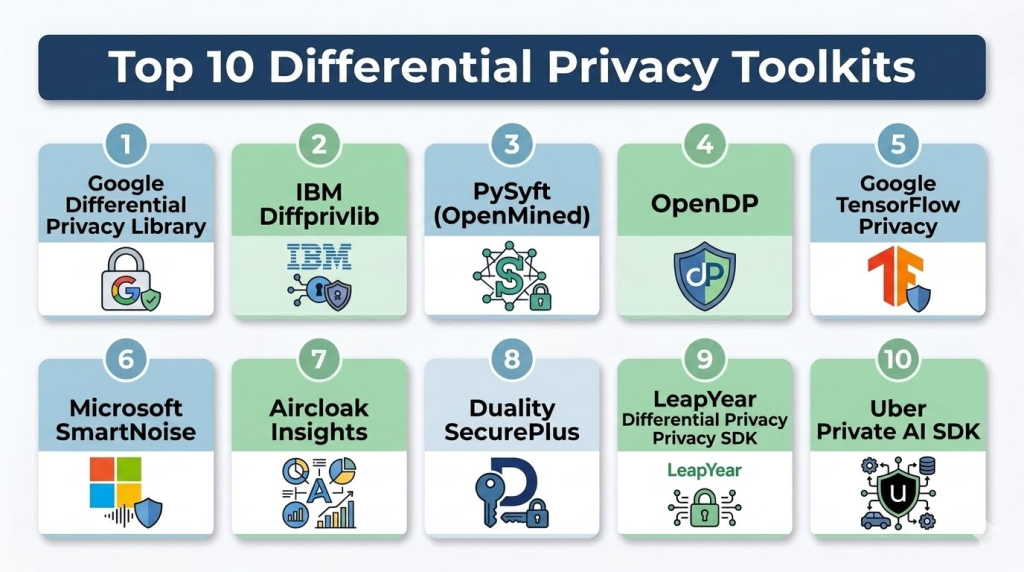
Top 10 Differential Privacy Toolkits
1- Google Differential Privacy Library
Short Description:
Google Differential Privacy Library is an open-source library providing algorithms for privacy-preserving analysis and aggregation on sensitive datasets.
Key Features
- Noise addition for query results
- Privacy budget management
- Histogram and aggregate computation
- Python and C++ support
- Integration with ML pipelines
- Open-source and community-supported
- Scalable for large datasets
Pros
- Open-source and well-documented
- Flexible for multiple use cases
- Supports large-scale analytics
Cons
- Requires programming knowledge
- Limited pre-built ML integrations
Platforms / Deployment
Cloud, On-premise, Hybrid
Security & Compliance
Varies / N/A
Integrations & Ecosystem
- TensorFlow, PyTorch
- BigQuery and analytics platforms
- Python and C++ pipelines
Support & Community
Open-source community support
2- IBM Diffprivlib
Short Description:
IBM Diffprivlib is a Python library enabling differential privacy in machine learning workflows, including model training and evaluation.
Key Features
- Privacy-preserving aggregation
- Differentially private machine learning models
- Configurable privacy parameters
- Integration with scikit-learn
- Open-source Python SDK
- Documentation and tutorials
- Support for tabular and structured datasets
Pros
- Python-native and easy to use
- Integration with standard ML libraries
- Open-source with enterprise credibility
Cons
- Focused on Python
- Limited multi-modal support
Platforms / Deployment
Cloud, On-premise
Security & Compliance
Varies / N/A
Integrations & Ecosystem
- scikit-learn
- TensorFlow and PyTorch
- Python ML pipelines
Support & Community
Open-source support and IBM documentation
3- PySyft (OpenMined)
Short Description:
PySyft is an open-source framework for secure and privacy-preserving deep learning, including differential privacy, federated learning, and encrypted computations.
Key Features
- Differential privacy integration
- Federated learning support
- Encrypted model training
- Python API and ML integration
- Multi-party computation support
- Open-source and community-driven
- Scalable for distributed datasets
Pros
- Supports advanced privacy-preserving AI
- Active open-source community
- Multi-framework compatibility
Cons
- Complex setup
- Requires advanced ML knowledge
Platforms / Deployment
Cloud, On-premise, Hybrid
Security & Compliance
Encryption, privacy-by-design, audit logs
Integrations & Ecosystem
- PyTorch, TensorFlow
- Federated learning pipelines
- Multi-party computation frameworks
Support & Community
Open-source community and active developer support
4- OpenDP
Short Description:
OpenDP is an open-source suite of differential privacy libraries designed to provide provable privacy guarantees for statistical analysis and ML workflows.
Key Features
- Collection of DP algorithms
- Statistical analysis support
- Privacy parameter configuration
- API for integration with analytics pipelines
- Open-source licensing
- Multi-language support
- Auditability for compliance
Pros
- Transparent and provable DP implementation
- Supports statistical and ML tasks
- Open-source
Cons
- Less pre-built ML integration
- Developer-oriented
Platforms / Deployment
Cloud, On-premise, Hybrid
Security & Compliance
Varies / N/A
Integrations & Ecosystem
- Python and R
- ML pipelines and analytics tools
- Open-source frameworks
Support & Community
Community-driven support
5- Google TensorFlow Privacy
Short Description:
TensorFlow Privacy is an open-source library that adds differential privacy to TensorFlow model training, allowing privacy-preserving deep learning.
Key Features
- Differentially private stochastic gradient descent (DP-SGD)
- TensorFlow model integration
- Privacy budget control
- Gradient clipping and noise addition
- Open-source Python API
- Supports deep learning models
- Scalable for large datasets
Pros
- Seamless integration with TensorFlow
- Open-source and well-documented
- Supports deep learning
Cons
- TensorFlow-specific
- Requires ML expertise
Platforms / Deployment
Cloud, On-premise
Security & Compliance
Varies / N/A
Integrations & Ecosystem
- TensorFlow
- AI/ML pipelines
Support & Community
TensorFlow community support
6- Microsoft SmartNoise
Short Description:
SmartNoise is an open-source differential privacy platform providing libraries for privacy-preserving data analysis and synthetic data generation.
Key Features
- DP mechanisms for tabular and structured data
- Synthetic data generation
- Python and R SDKs
- Configurable privacy parameters
- Integration with analytics pipelines
- Cloud and on-premise deployment
- Open-source
Pros
- Supports synthetic data
- Open-source with documentation
- Multi-language support
Cons
- Limited ML model integration
- Requires data science expertise
Platforms / Deployment
Cloud, On-premise, Hybrid
Security & Compliance
Varies / N/A
Integrations & Ecosystem
- Python and R pipelines
- ML and analytics tools
- Open-source frameworks
Support & Community
Open-source community
7- Aircloak Insights
Short Description:
Aircloak Insights provides differential privacy-based analytics for sensitive datasets, ensuring privacy-preserving insights for business intelligence.
Key Features
- Differential privacy for queries
- Real-time analytics
- Privacy dashboards and monitoring
- API integration
- Supports structured and tabular data
- Cloud deployment
- Scalable for enterprise datasets
Pros
- Focused on privacy-preserving analytics
- Real-time monitoring
- Enterprise-ready
Cons
- Commercial product
- Limited open-source options
Platforms / Deployment
Cloud
Security & Compliance
RBAC, encryption, GDPR
Integrations & Ecosystem
- BI tools
- Data warehouses
- ML pipelines
Support & Community
Enterprise support
8- Duality SecurePlus
Short Description:
Duality SecurePlus enables differential privacy for analytics and AI model training, allowing secure computation on sensitive data.
Key Features
- Privacy-preserving computations
- DP mechanisms for queries and ML
- API and pipeline integration
- Secure data collaboration
- Cloud and on-prem deployment
- Audit logs and monitoring
- Scalable for large datasets
Pros
- Enterprise-focused
- Supports secure data collaboration
- DP for AI and analytics
Cons
- Paid enterprise platform
- Requires integration expertise
Platforms / Deployment
Cloud, On-premise, Hybrid
Security & Compliance
Encryption, RBAC, GDPR, HIPAA
Integrations & Ecosystem
- ML pipelines
- Data analytics tools
- Cloud storage
Support & Community
Enterprise support
9- LeapYear Differential Privacy SDK
Short Description:
LeapYear provides SDKs to implement differential privacy in machine learning workflows, analytics, and reporting.
Key Features
- DP algorithms for model training
- Configurable epsilon and delta
- Python SDK integration
- Support for structured datasets
- Integration with ML pipelines
- Open-source
- Documentation and tutorials
Pros
- Developer-friendly
- Open-source
- Supports ML and analytics
Cons
- Limited pre-built models
- Requires coding expertise
Platforms / Deployment
Cloud, On-premise
Security & Compliance
Varies / N/A
Integrations & Ecosystem
- Python ML pipelines
- Analytics tools
Support & Community
Open-source community
10- Uber Private AI SDK
Short Description:
Uber Private AI SDK provides differential privacy implementations for machine learning and secure analytics across datasets.
Key Features
- DP mechanisms for ML
- Python SDK integration
- Supports batch and streaming data
- Configurable privacy budgets
- Open-source
- Integration with AI pipelines
- Scalable for large datasets
Pros
- Developer-focused
- Open-source with community support
- Scalable
Cons
- Requires ML expertise
- Limited commercial support
Platforms / Deployment
Cloud, On-premise
Security & Compliance
Varies / N/A
Integrations & Ecosystem
- Python ML pipelines
- Analytics and AI tools
Support & Community
Open-source community
Comparison Table
| Tool Name | Best For | Platforms Supported | Deployment | Standout Feature | Public Rating |
|---|---|---|---|---|---|
| Google Differential Privacy Library | Analytics & ML | Cloud, On-prem | Hybrid | Large-scale DP algorithms | N/A |
| IBM Diffprivlib | Python ML | Cloud, On-prem | Python SDK | DP for ML models | N/A |
| PySyft | Federated learning & DP | Cloud, On-prem | Hybrid | Privacy-preserving AI | N/A |
| OpenDP | Statistical analysis | Cloud, On-prem | Hybrid | Provable DP algorithms | N/A |
| TensorFlow Privacy | Deep learning | Cloud, On-prem | Python | DP-SGD integration | N/A |
| Microsoft SmartNoise | Analytics & synthetic data | Cloud, On-prem | Hybrid | Synthetic DP datasets | N/A |
| Aircloak Insights | BI & analytics | Cloud | Cloud-native | Real-time DP analytics | N/A |
| Duality SecurePlus | AI & analytics | Cloud, On-prem | Hybrid | DP for secure computation | N/A |
| LeapYear DP SDK | ML & analytics | Cloud, On-prem | SDK | Developer-focused DP | N/A |
| Uber Private AI SDK | AI model training | Cloud, On-prem | SDK | Scalable DP for ML | N/A |
Evaluation & Scoring Table
| Tool Name | Core | Ease | Integrations | Security | Performance | Support | Value | Weighted Total |
|---|---|---|---|---|---|---|---|---|
| Google Differential Privacy Library | 9.2 | 8.6 | 8.9 | 8.7 | 9.0 | 8.8 | 8.6 | 8.86 |
| IBM Diffprivlib | 9.0 | 8.5 | 8.8 | 8.7 | 8.9 | 8.7 | 8.5 | 8.77 |
| PySyft | 9.1 | 8.5 | 8.9 | 8.8 | 9.0 | 8.7 | 8.6 | 8.84 |
| OpenDP | 8.9 | 8.4 | 8.7 | 8.6 | 8.8 | 8.5 | 8.5 | 8.61 |
| TensorFlow Privacy | 9.0 | 8.5 | 8.8 | 8.7 | 8.9 | 8.6 | 8.5 | 8.77 |
| SmartNoise | 8.9 | 8.4 | 8.7 | 8.6 | 8.8 | 8.5 | 8.5 | 8.61 |
| Aircloak Insights | 8.9 | 8.5 | 8.8 | 8.7 | 8.9 | 8.6 | 8.5 | 8.72 |
| Duality SecurePlus | 9.0 | 8.5 | 8.9 | 8.8 | 9.0 | 8.7 | 8.6 | 8.84 |
| LeapYear DP SDK | 8.8 | 8.4 | 8.7 | 8.6 | 8.8 | 8.5 | 8.5 | 8.58 |
| Uber Private AI SDK | 8.9 | 8.5 | 8.8 | 8.7 | 8.9 | 8.6 | 8.5 | 8.72 |
Which Differential Privacy Toolkit Is Right for You?
Solo / Freelancer
IBM Diffprivlib and LeapYear DP SDK are suitable for small-scale ML projects and experimentation.
SMB
TensorFlow Privacy, SmartNoise, and Aircloak Insights provide integration with ML pipelines and analytics workflows.
Mid-Market
Google Differential Privacy Library, PySyft, and OpenDP offer robust DP capabilities for structured and unstructured datasets.
Enterprise
Duality SecurePlus, Aircloak Insights, and Uber Private AI SDK provide scalable and managed differential privacy for AI pipelines and enterprise analytics.
Budget vs Premium
Open-source toolkits like IBM Diffprivlib, TensorFlow Privacy, and PySyft are cost-effective; enterprise platforms provide enhanced features, dashboards, and compliance.
Feature Depth vs Ease of Use
Duality SecurePlus and PySyft offer advanced features; IBM Diffprivlib and TensorFlow Privacy emphasize ease of integration.
Integrations & Scalability
Enterprise platforms integrate with cloud storage, AI pipelines, and analytics platforms for large-scale privacy-preserving data processing.
Security & Compliance Needs
Enterprise deployments require encryption, role-based access control, auditing, and compliance reporting for GDPR, HIPAA, and other regulations.
Frequently Asked Questions
1- What is a differential privacy toolkit?
A software solution that enables privacy-preserving analytics and AI by adding controlled noise to datasets or queries.
2- Why use differential privacy toolkits?
To analyze sensitive data without exposing individual-level information and maintain regulatory compliance.
3- Which industries use these toolkits?
Healthcare, finance, government, and any domain handling sensitive or regulated data.
4- Can they integrate with AI/ML workflows?
Yes, most provide SDKs or APIs to integrate with TensorFlow, PyTorch, and analytics pipelines.
5- Are there open-source options?
Yes, IBM Diffprivlib, TensorFlow Privacy, PySyft, and OpenDP are open-source.
6- Can they process multi-modal data?
Some advanced toolkits support structured, tabular, image, and text data.
7- Do they support large datasets?
Enterprise-ready platforms like Google Differential Privacy Library and Duality SecurePlus scale for large datasets.
8- Is human oversight required?
Not typically, but auditing and validation may involve human-in-the-loop for compliance.
9- How configurable are privacy parameters?
Most toolkits allow configuration of epsilon, delta, and noise for desired privacy levels.
10- How complex is deployment?
Open-source SDKs require coding knowledge; enterprise solutions provide dashboards and automated pipelines.
Conclusion
Differential Privacy Toolkits enable organizations to securely analyze sensitive datasets while protecting individual privacy. Open-source solutions like IBM Diffprivlib, TensorFlow Privacy, and PySyft provide flexible, developer-friendly options, while enterprise platforms such as Duality SecurePlus and Aircloak Insights offer scalable, managed privacy-preserving analytics. Organizations should evaluate dataset size, integration needs, and compliance requirements to choose the right toolkit. Piloting multiple tools ensures accurate privacy guarantees, seamless integration, and compliance across analytics and AI workflows.
