Introduction
Partner Relationship Management PRM software helps companies manage, enable, track, and grow their partner ecosystem from one structured platform. In simple words, PRM gives vendors, SaaS companies, technology providers, manufacturers, distributors, and service businesses a central place to onboard partners, share sales resources, manage deal registration, track partner performance, handle training, and improve partner-led revenue.
PRM matters because many companies grow through indirect sales channels such as resellers, affiliates, referral partners, distributors, agencies, system integrators, marketplaces, and strategic alliances. Without a proper PRM system, partner data often becomes scattered across emails, spreadsheets, CRM notes, shared drives, and disconnected portals. This creates confusion, duplicate deals, poor partner communication, delayed approvals, and weak channel visibility.
Real-world use cases include:
- Partner onboarding for new resellers, affiliates, agencies, and channel partners
- Deal registration to avoid channel conflict and track partner-sourced revenue
- Partner training and certification to improve product knowledge
- Marketing development fund management for co-marketing programs
- Partner portal management for resources, content, pricing, and enablement materials
- Channel performance tracking for partner revenue, pipeline, engagement, and activity
- Referral and affiliate management for SaaS, technology, and service companies
Evaluation Criteria for Buyers:
- Partner onboarding workflow
- Deal registration and lead distribution
- Partner portal experience
- Training and certification support
- CRM integration
- Marketing content management
- Partner performance analytics
- Incentive and MDF management
- Ease of use for partners and channel teams
- Security, permissions, and governance
Best for: Partner Relationship Management PRM software is best for SaaS companies, technology vendors, manufacturers, distributors, B2B service providers, channel sales teams, partner operations teams, alliances teams, affiliate managers, and enterprises that rely on indirect revenue through external partners.
Not ideal for: PRM software may not be ideal for companies with no partner program, very small teams managing only one or two informal referral relationships, or businesses that sell entirely through direct sales without partner onboarding, deal registration, training, or performance tracking needs. In those cases, CRM tasks, spreadsheets, or simple referral tools may be enough.
Key Trends in Partner Relationship Management PRM
- Partner ecosystem management is expanding beyond traditional resellers to include affiliates, agencies, marketplaces, consultants, systems integrators, referral partners, and technology alliances.
- AI-assisted partner recommendations are starting to help channel teams identify the right partners, prioritize opportunities, and improve partner engagement.
- Partner portal personalization is becoming important because different partner types need different content, training, incentives, and workflows.
- Deal registration automation is reducing channel conflict by improving visibility into partner-sourced pipeline and ownership.
- Partner enablement analytics are helping companies understand which training, content, and certifications actually improve revenue results.
- CRM-native partner workflows are becoming a major buyer requirement because partner deals must sync with sales pipeline and forecasting.
- Marketplace and co-sell workflows are growing as software companies partner with cloud marketplaces, technology alliances, and ecosystem-led growth programs.
- Partner marketing automation is becoming more connected with PRM so vendors can support co-branded campaigns and partner-led demand generation.
- Incentive and MDF governance is becoming more structured as companies need better control over partner funds, claims, approvals, and ROI tracking.
- Security and permission control is becoming more important because partner portals often contain sales content, customer data, pricing, training, and deal information.
How We Selected These Tools
The tools in this list were selected based on their relevance to partner relationship management, channel sales, partner onboarding, deal registration, partner portals, partner enablement, referral management, co-selling, and channel performance tracking. The goal is not to declare one universal winner, but to help buyers compare credible PRM platforms by use case and business fit.
Selection factors include:
- Market recognition in PRM, channel management, or partner ecosystem software
- Support for partner onboarding, enablement, and portal management
- Deal registration, lead distribution, and pipeline tracking capabilities
- CRM integration and sales workflow alignment
- Partner training, certification, and content management support
- Marketing development fund and co-marketing workflow capabilities
- Analytics for partner performance, engagement, and revenue contribution
- Suitability for SaaS, B2B technology, manufacturing, services, and enterprise partner programs
- Security, permissions, governance, and auditability signals
- Implementation support, documentation, partner ecosystem maturity, and usability
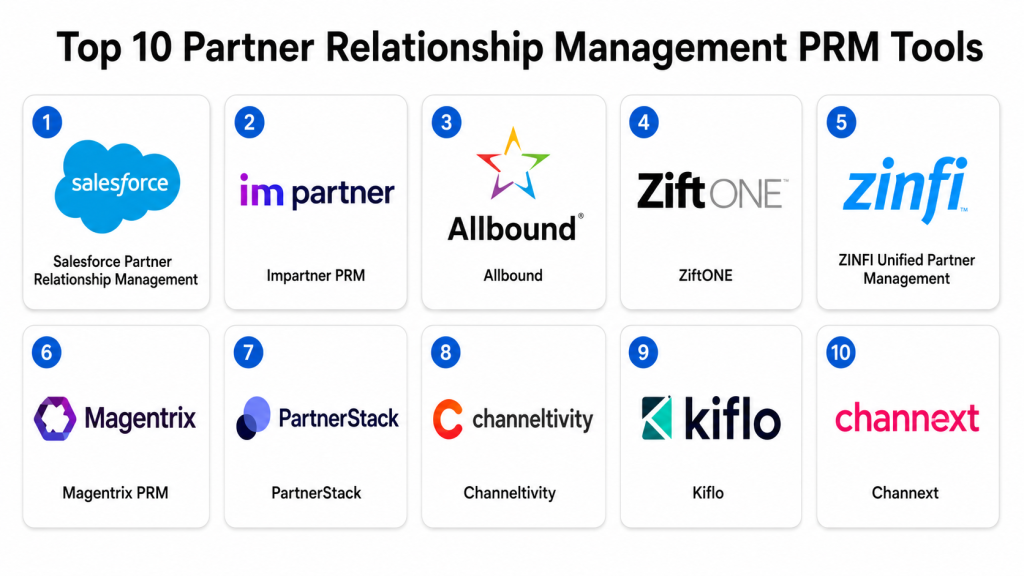
Top 10 Partner Relationship Management PRM Tools
1- Salesforce Partner Relationship Management
Short description: Salesforce Partner Relationship Management helps companies manage partner portals, partner selling, lead sharing, deal tracking, and channel collaboration within the Salesforce ecosystem. It is especially useful for companies that already use Salesforce as their main CRM.
Key Features
- Partner portal and community experience
- Lead distribution and opportunity collaboration
- Deal registration and partner pipeline tracking
- Partner performance dashboards
- Knowledge sharing and enablement content
- CRM-native reporting and forecasting
- Role-based access and partner permissions
Pros
- Strong fit for Salesforce-centered sales organizations
- Keeps partner activity close to CRM pipeline and forecasting
- Large ecosystem of apps, partners, and implementation resources
Cons
- May require Salesforce administration and customization
- Partner experience quality depends on portal design and setup
- Smaller teams may find it more complex than needed
Platforms / Deployment
Web / Cloud
Security & Compliance
Salesforce enterprise products commonly support SSO, MFA, role-based access, permissions, audit features, encryption options, and administrative controls depending on edition and configuration. Specific compliance coverage should be verified directly with Salesforce. Not publicly stated for every configuration.
Integrations & Ecosystem
Salesforce Partner Relationship Management works best when partner sales activity should connect directly with Salesforce CRM, sales operations, forecasting, and customer data. It can also connect with marketing, service, analytics, and revenue systems through Salesforce ecosystem tools.
Common integration areas include:
- Salesforce CRM
- Marketing automation platforms
- Partner portals
- Sales analytics
- Contract and quote tools
- Customer service systems
Support & Community
Salesforce provides documentation, enterprise support, training resources, implementation partners, and a large global community. Support levels depend on contract, edition, and implementation scope.
2- Impartner PRM
Short description: Impartner PRM is a dedicated partner relationship management platform for companies that need structured partner onboarding, training, deal registration, portal management, marketing automation, and channel performance tracking. It is well suited for organizations with mature or growing partner programs.
Key Features
- Partner onboarding and lifecycle management
- Deal registration and pipeline management
- Partner portal and content access
- Partner training and certification
- MDF and co-marketing workflow support
- Partner performance analytics
- Partner marketing automation capabilities
Pros
- Strong dedicated PRM feature depth
- Useful for large and complex partner networks
- Covers multiple stages of the partner lifecycle
Cons
- May require setup effort for complex partner programs
- Best value comes when partner operations are already strategic
- Smaller partner programs may not need the full platform depth
Platforms / Deployment
Web / Cloud
Security & Compliance
Impartner supports enterprise partner management environments where secure access, role-based permissions, and partner data governance are important. Specific security controls such as SSO, MFA, encryption, audit logs, and certifications should be verified directly with the vendor. Not publicly stated for every configuration.
Integrations & Ecosystem
Impartner PRM connects partner workflows with CRM, marketing automation, learning, portal, and reporting systems. It is useful when companies need partner onboarding, enablement, marketing, and pipeline management in one structured environment.
Common integration areas include:
- CRM systems
- Marketing automation platforms
- Learning and certification tools
- Partner portals
- Deal registration workflows
- Reporting and analytics systems
Support & Community
Impartner provides customer support, onboarding assistance, documentation, implementation guidance, and partner program expertise. Support depth varies by customer agreement and implementation scope.
3- Allbound
Short description: Allbound is a PRM platform focused on partner onboarding, enablement, content sharing, deal registration, and channel sales collaboration. It is useful for B2B companies that want a partner-friendly portal and structured channel sales workflows.
Key Features
- Partner onboarding workflows
- Deal registration and opportunity tracking
- Partner portal and resource library
- Training and enablement content
- Partner engagement analytics
- Channel sales collaboration
- CRM integration support
Pros
- User-friendly partner portal experience
- Strong fit for growing B2B partner programs
- Helps centralize content, training, and deal activity
Cons
- Advanced enterprise customization should be validated
- MDF or complex incentive needs may require review
- Best results depend on content and enablement quality
Platforms / Deployment
Web / Cloud
Security & Compliance
Allbound supports partner portal and channel management workflows where permissions and secure access are important. Specific details such as SSO, MFA, encryption, audit logs, role-based access, and certifications should be verified directly with the vendor. Not publicly stated for every configuration.
Integrations & Ecosystem
Allbound integrates with CRM, marketing, sales, and partner enablement systems. It is useful for companies that want to connect partner learning, content engagement, and deal registration with sales pipeline visibility.
Common integration areas include:
- CRM systems
- Marketing automation tools
- Content libraries
- Learning resources
- Partner communication tools
- Analytics dashboards
Support & Community
Allbound provides onboarding, support, documentation, and partner program guidance. Support levels vary by plan, customer size, and implementation requirements.
4- ZiftONE
Short description: ZiftONE by Zift Solutions is a partner management and through-channel marketing platform that helps companies manage partner portals, marketing campaigns, content distribution, deal workflows, and partner performance. It is useful for vendors that want PRM and partner marketing automation together.
Key Features
- Partner portal management
- Through-channel marketing automation
- Co-branded campaign support
- Lead distribution and deal workflows
- Partner performance analytics
- Content and resource management
- Channel program reporting
Pros
- Strong fit for partner marketing and channel enablement
- Useful for co-branded campaigns and partner demand generation
- Combines PRM and marketing automation capabilities
Cons
- Sales-only partner teams may not need all marketing features
- Setup depends on campaign structure and partner content strategy
- Buyers should validate CRM and campaign workflow requirements
Platforms / Deployment
Web / Cloud
Security & Compliance
ZiftONE supports partner and channel marketing environments where permissions, partner access, and content governance matter. Specific controls such as SSO, MFA, encryption, audit logs, and certifications should be verified directly with the vendor. Not publicly stated for every configuration.
Integrations & Ecosystem
ZiftONE is useful when partner relationship management needs to connect with partner marketing, lead generation, campaign execution, and sales pipeline reporting. It helps vendors distribute content and campaigns to partners more consistently.
Common integration areas include:
- CRM systems
- Marketing automation platforms
- Partner portals
- Campaign tools
- Lead management workflows
- Analytics dashboards
Support & Community
Zift Solutions provides customer support, onboarding resources, documentation, and channel marketing expertise. Support depth depends on package, implementation scope, and customer agreement.
5- ZINFI Unified Partner Management
Short description: ZINFI Unified Partner Management helps companies manage partner recruitment, onboarding, enablement, sales collaboration, marketing programs, incentives, and partner performance from a unified platform. It is suitable for organizations that want broad partner lifecycle coverage.
Key Features
- Partner recruitment and onboarding
- Partner portal and lifecycle management
- Partner sales management
- Partner marketing management
- MDF and incentive workflows
- Training and certification support
- Partner analytics and reporting
Pros
- Broad partner lifecycle coverage
- Useful for organizations managing multiple partner types
- Combines sales, marketing, and partner operations capabilities
Cons
- Breadth may require careful implementation planning
- Smaller teams may not use all modules
- Configuration needs should be reviewed based on partner program maturity
Platforms / Deployment
Web / Cloud
Security & Compliance
ZINFI supports partner management environments where user permissions, access controls, workflow governance, and data security are important. Specific details such as SSO, MFA, encryption, audit logs, and certifications should be verified directly with the vendor. Not publicly stated for every configuration.
Integrations & Ecosystem
ZINFI connects partner workflows across recruitment, onboarding, enablement, marketing, sales, and incentives. It is useful for companies that want a modular partner platform rather than separate point solutions.
Common integration areas include:
- CRM systems
- Marketing automation platforms
- Learning and certification tools
- Partner portals
- Incentive workflows
- Reporting platforms
Support & Community
ZINFI provides documentation, support, onboarding assistance, implementation services, and channel program guidance. Support levels vary by customer agreement and platform scope.
6- Magentrix PRM
Short description: Magentrix PRM helps companies build partner portals, manage deal registration, distribute content, onboard partners, and support collaboration across partner networks. It is useful for companies that need a flexible partner portal experience connected with CRM and business systems.
Key Features
- Partner portal creation
- Deal registration and lead management
- Partner onboarding workflows
- Content and document sharing
- Training and learning support
- CRM integration
- Partner analytics and reporting
Pros
- Flexible partner portal capabilities
- Useful for partner communication and collaboration
- Can fit companies needing structured partner access to resources
Cons
- Advanced partner program workflows should be validated
- Implementation may require portal design and configuration work
- Incentive or MDF depth may vary by setup
Platforms / Deployment
Web / Cloud
Security & Compliance
Magentrix supports partner portals and external collaboration where access control, permissions, and secure information sharing are important. Specific controls such as SSO, MFA, encryption, audit logs, and certifications should be verified directly with the vendor. Not publicly stated for every configuration.
Integrations & Ecosystem
Magentrix PRM integrates partner portals with CRM, content systems, learning resources, and business workflows. It is useful for organizations that need partners to access sales, training, and deal information from one portal.
Common integration areas include:
- CRM systems
- Partner portals
- Content repositories
- Learning systems
- Deal registration workflows
- Reporting dashboards
Support & Community
Magentrix provides customer support, documentation, onboarding assistance, and partner portal implementation guidance. Support depth depends on customer plan and deployment requirements.
7- PartnerStack
Short description: PartnerStack is a partner ecosystem platform often used by SaaS companies to manage affiliate, referral, reseller, and marketplace partner programs. It is useful for companies that want partner recruitment, onboarding, tracking, payouts, and performance management in one platform.
Key Features
- Affiliate, referral, and reseller program management
- Partner onboarding and activation
- Partner marketplace exposure
- Partner tracking and attribution
- Rewards and payout workflows
- Performance dashboards
- SaaS-focused partner ecosystem support
Pros
- Strong fit for SaaS partner programs
- Useful for affiliate, referral, and reseller motions
- Helps manage partner payouts and attribution
Cons
- Traditional enterprise channel programs may need deeper PRM workflows
- Best suited for SaaS and partner-led growth models
- Complex MDF and distributor programs should be validated
Platforms / Deployment
Web / Cloud
Security & Compliance
PartnerStack handles partner data, tracking, and payout-related workflows, so buyers should verify SSO, MFA, encryption, role-based access, audit logs, and compliance documentation directly with the vendor. Not publicly stated for every configuration.
Integrations & Ecosystem
PartnerStack connects with CRM, payment, referral tracking, affiliate, and SaaS growth workflows. It is especially useful for SaaS companies that want to recruit and manage partner programs with attribution and rewards.
Common integration areas include:
- CRM systems
- Payment and payout tools
- Affiliate tracking workflows
- Referral management systems
- SaaS product workflows
- Marketing analytics
Support & Community
PartnerStack provides customer support, documentation, onboarding resources, and SaaS partner ecosystem guidance. Support scope varies by package and customer size.
8- Channeltivity
Short description: Channeltivity is a PRM platform designed for channel sales teams that need deal registration, partner portals, partner training, lead distribution, MDF management, and channel analytics. It is useful for companies that want practical PRM functionality without unnecessary complexity.
Key Features
- Deal registration management
- Partner portal and content sharing
- Lead distribution workflows
- Partner training and certification tracking
- MDF request and claim management
- Channel analytics and dashboards
- CRM integration support
Pros
- Practical PRM features for channel sales teams
- Useful for deal registration and partner training
- Good fit for growing channel programs
Cons
- Very complex enterprise ecosystem programs may require deeper customization
- Partner marketing automation depth should be validated
- Best results depend on CRM and channel process setup
Platforms / Deployment
Web / Cloud
Security & Compliance
Channeltivity supports channel management workflows where secure partner access, permissions, and data control are important. Specific details such as SSO, MFA, encryption, audit logs, and certifications should be verified directly with the vendor. Not publicly stated for every configuration.
Integrations & Ecosystem
Channeltivity integrates with CRM systems and supports key channel workflows like deal registration, lead distribution, partner training, MDF management, and reporting.
Common integration areas include:
- CRM systems
- Partner portals
- Training and certification workflows
- MDF workflows
- Lead distribution systems
- Channel analytics dashboards
Support & Community
Channeltivity provides support, onboarding resources, documentation, and channel management guidance. Support levels vary by package and customer requirements.
9- Kiflo
Short description: Kiflo is a partner management platform designed for companies managing referral, reseller, affiliate, and strategic partner programs. It is especially useful for smaller and mid-sized B2B companies that want to organize partner activity without heavy enterprise complexity.
Key Features
- Partner onboarding
- Referral and reseller program management
- Deal and lead tracking
- Partner portal support
- Commission and reward visibility
- Partner activity dashboards
- CRM and workflow integrations
Pros
- Good fit for SMB and mid-market partner programs
- Easier to adopt than some heavy enterprise PRM systems
- Useful for referral and reseller partner tracking
Cons
- May not cover very complex global channel programs
- Advanced MDF and enterprise governance should be validated
- Best suited for simpler partner program structures
Platforms / Deployment
Web / Cloud
Security & Compliance
Kiflo supports partner program workflows that involve partner data, lead information, and program tracking. Buyers should verify SSO, MFA, encryption, audit logs, role-based access, and compliance documentation directly with the vendor. Not publicly stated for every configuration.
Integrations & Ecosystem
Kiflo can connect with CRM, sales, referral, and partner workflows. It is useful for companies that want to manage partner activity, referrals, and basic channel operations from one simple environment.
Common integration areas include:
- CRM systems
- Referral tracking workflows
- Partner portals
- Commission workflows
- Sales pipeline tools
- Reporting dashboards
Support & Community
Kiflo provides support, onboarding assistance, documentation, and partner program guidance. Support depth depends on package, customer size, and implementation needs.
10- Channext
Short description: Channext is a partner marketing and channel automation platform that helps vendors activate partners with campaigns, content, lead generation, and partner engagement. It is useful for companies that want to support partners with scalable marketing enablement and channel growth programs.
Key Features
- Partner marketing automation
- Campaign and content distribution
- Partner activation workflows
- Lead generation support
- Co-branded marketing assets
- Partner engagement tracking
- Channel performance reporting
Pros
- Strong fit for partner marketing and campaign activation
- Helps vendors support partners with ready-to-use content
- Useful for improving partner engagement and demand generation
Cons
- Not always a full replacement for deep PRM or deal registration systems
- Best suited when partner marketing is a major priority
- Buyers should validate sales workflow and CRM integration depth
Platforms / Deployment
Web / Cloud
Security & Compliance
Channext supports partner marketing and external partner workflows where secure access and permission control are important. Specific controls such as SSO, MFA, encryption, audit logs, and certifications should be verified directly with the vendor. Not publicly stated for every configuration.
Integrations & Ecosystem
Channext connects partner marketing campaigns with partner engagement, lead generation, and channel reporting. It is useful when vendors want to activate many partners with consistent marketing resources.
Common integration areas include:
- CRM systems
- Marketing automation platforms
- Partner portals
- Campaign tools
- Lead management workflows
- Reporting dashboards
Support & Community
Channext provides onboarding, documentation, support, and partner marketing guidance. Support depth varies by customer agreement and campaign program complexity.
Comparison Table
| Tool Name | Best For | Platform Supported | Deployment | Standout Feature | Public Rating |
|---|---|---|---|---|---|
| Salesforce Partner Relationship Management | Salesforce-based partner programs | Web | Cloud | CRM-native partner portal and pipeline tracking | N/A |
| Impartner PRM | Enterprise partner lifecycle management | Web | Cloud | End-to-end partner onboarding and enablement | N/A |
| Allbound | Growing B2B partner programs | Web | Cloud | Partner-friendly portal and enablement workflows | N/A |
| ZiftONE | Partner marketing and channel enablement | Web | Cloud | PRM with through-channel marketing automation | N/A |
| ZINFI Unified Partner Management | Broad partner lifecycle automation | Web | Cloud | Unified partner sales and marketing management | N/A |
| Magentrix PRM | Flexible partner portal programs | Web | Cloud | Customizable partner portals and collaboration | N/A |
| PartnerStack | SaaS affiliate, referral, and reseller programs | Web | Cloud | Partner marketplace, tracking, and payouts | N/A |
| Channeltivity | Channel sales and deal registration | Web | Cloud | Practical PRM for deal registration and MDF | N/A |
| Kiflo | SMB and mid-market partner programs | Web | Cloud | Simple referral and reseller partner management | N/A |
| Channext | Partner marketing activation | Web | Cloud | Co-branded campaigns and partner activation | N/A |
Evaluation & Scoring of Partner Relationship Management PRM
The scoring below is comparative and buyer-oriented. It should be used as a shortlisting guide, not as a final purchasing decision. A platform with a lower weighted total may still be the best choice if it matches your partner type, sales process, channel maturity, CRM stack, and partner growth strategy.
| Tool Name | Core 25% | Ease 15% | Integrations 15% | Security 10% | Performance 10% | Support 10% | Value 15% | Weighted Total |
| Salesforce Partner Relationship Management | 8 | 7 | 9 | 8 | 8 | 9 | 7 | 8.05 |
| Impartner PRM | 9 | 7 | 8 | 8 | 8 | 8 | 7 | 8.00 |
| Allbound | 8 | 8 | 8 | 7 | 8 | 8 | 8 | 7.90 |
| ZiftONE | 8 | 7 | 8 | 7 | 8 | 8 | 7 | 7.60 |
| ZINFI Unified Partner Management | 9 | 7 | 8 | 7 | 8 | 8 | 7 | 7.85 |
| Magentrix PRM | 8 | 7 | 8 | 7 | 8 | 7 | 8 | 7.65 |
| PartnerStack | 8 | 8 | 8 | 7 | 8 | 8 | 8 | 7.90 |
| Channeltivity | 8 | 8 | 8 | 7 | 8 | 8 | 8 | 7.90 |
| Kiflo | 7 | 9 | 7 | 7 | 7 | 8 | 8 | 7.65 |
| Channext | 7 | 8 | 7 | 7 | 7 | 7 | 8 | 7.35 |
How to interpret the scores:
- Core score reflects PRM depth, partner onboarding, deal registration, portal management, enablement, and partner analytics.
- Ease score reflects usability for internal channel teams and external partners.
- Integration score reflects fit with CRM, marketing automation, sales tools, learning systems, and reporting platforms.
- Security score reflects visible governance signals and expected controls, not unverified certifications.
- Performance score reflects suitability for partner network scale, workflow complexity, and channel data volume.
- Value score reflects practical buyer fit relative to capability, implementation effort, and expected partner program impact.
Which Partner Relationship Management PRM Tool Is Right for You?
Solo / Freelancer
Solo consultants and independent partner program advisors usually do not need a full PRM platform for themselves. Instead, they often help clients design partner journeys, define partner tiers, create onboarding workflows, build enablement plans, and prepare PRM requirements.
For advisory work, it is useful to understand tools such as Salesforce Partner Relationship Management, Impartner, Allbound, PartnerStack, Channeltivity, and Kiflo because these platforms appear often across SaaS, B2B, and channel programs. A solo advisor should focus on solutions that provide clear partner workflows, practical reporting, and good CRM alignment.
SMB
Small and mid-sized companies should prioritize ease of setup, partner adoption, simple onboarding, referral tracking, and clear deal registration. Kiflo, PartnerStack, Channeltivity, and Allbound can be strong options depending on whether the partner program is referral-led, reseller-led, affiliate-led, or channel-sales-led.
SMBs should avoid overbuilding the partner program too early. The first goal should be to recruit the right partners, give them clear resources, track partner-sourced opportunities, and measure which partners are actually contributing pipeline.
Mid-Market
Mid-market companies often need more structured partner portals, training, content management, deal registration, CRM sync, partner segmentation, and performance analytics. Allbound, Impartner, Channeltivity, ZiftONE, Magentrix, and PartnerStack can be strong candidates depending on partner program type.
Mid-market buyers should test partner onboarding, deal registration, lead sharing, content access, co-marketing workflows, and reporting. A strong PRM should improve both partner experience and internal channel visibility.
Enterprise
Large enterprises need scalable PRM platforms that support multiple partner types, regions, tiers, business units, partner portals, advanced permissions, MDF workflows, certifications, analytics, and CRM integration. Salesforce Partner Relationship Management, Impartner, ZINFI, ZiftONE, and Magentrix are strong enterprise candidates depending on program complexity.
Enterprise buyers should prioritize governance, security, CRM integration, partner segmentation, workflow automation, reporting depth, and implementation partner availability. The best enterprise platform is usually the one that fits the company’s channel operating model and existing sales technology stack.
Budget vs Premium
Budget-conscious teams should start by identifying the biggest partner program problem. If the issue is simple referral tracking, a lighter partner tool may be enough. If the issue is enterprise channel management, partner portals, deal registration, MDF, training, and analytics, a more premium PRM platform may deliver better value.
Premium PRM tools are more useful when companies need complex partner tiers, multi-region programs, partner marketing automation, advanced reporting, CRM integration, and channel governance.
Feature Depth vs Ease of Use
Impartner, Salesforce Partner Relationship Management, and ZINFI offer strong depth for larger partner programs. Allbound, Channeltivity, and Magentrix can be strong for practical PRM workflows and partner portals. PartnerStack is strong for SaaS affiliate, referral, and reseller programs.
Kiflo is useful for smaller partner teams that want simplicity, while ZiftONE and Channext are stronger when partner marketing activation is a major requirement. Buyers should choose based on partner type and workflow complexity rather than the longest feature list.
Integrations & Scalability
PRM becomes much more valuable when it integrates with CRM, marketing automation, learning systems, contract tools, billing platforms, support systems, and analytics dashboards. Without integration, partner deals and activities can remain disconnected from revenue reporting.
Buyers should test how partner-sourced leads, registered deals, training completion, partner tiers, MDF requests, and campaign engagement flow across systems. CRM integration is especially important because partner revenue must be visible in pipeline and forecasting.
Security & Compliance Needs
PRM platforms often store partner contact data, opportunity information, pricing content, training materials, sales resources, contracts, and deal details. Buyers should evaluate SSO, MFA, encryption, audit logs, role-based access, partner permissions, data residency, and administrative controls.
Companies with multiple partner tiers should carefully review content access rules, deal visibility, regional permissions, and partner user management. Security review should include sales operations, IT, legal, compliance, and partner operations teams.
Frequently Asked Questions
1- What is Partner Relationship Management PRM software?
Partner Relationship Management PRM software helps companies manage partner onboarding, enablement, deal registration, partner portals, training, marketing resources, and partner performance. It gives partner teams a structured system for managing indirect sales relationships.
2- Why do companies need PRM software?
Companies need PRM software when partner programs become too complex for spreadsheets, email, and shared folders. PRM improves partner visibility, reduces manual work, supports deal tracking, and helps partners access the right resources faster.
3- What is the difference between CRM and PRM?
CRM manages direct customer and sales relationships, while PRM manages external partner relationships. A PRM often connects with CRM so partner-sourced leads, registered deals, and channel revenue can be tracked inside the broader sales pipeline.
4- Who uses PRM software?
PRM software is used by channel sales teams, partner operations teams, alliances teams, reseller managers, affiliate managers, referral program managers, marketing teams, and SaaS partner ecosystem teams. It is most useful for businesses that rely on indirect sales.
5- What are the most important PRM features?
Important PRM features include partner onboarding, partner portals, deal registration, lead distribution, training and certification, content management, MDF workflows, partner analytics, CRM integration, and permission controls.
6- How much does PRM software cost?
Pricing varies based on vendor, number of partners, users, modules, integrations, support level, and implementation scope. Many platforms use custom pricing. Buyers should compare license cost, onboarding, training, support, and long-term administration.
7- Can PRM software help with deal registration?
Yes, most PRM platforms support deal registration so partners can submit opportunities, request approval, and avoid channel conflict. Deal registration also helps vendors track partner-sourced pipeline and partner contribution to revenue.
8- Can PRM software support partner training?
Yes, many PRM tools support training content, certification tracking, learning paths, partner enablement resources, and knowledge libraries. Training features help partners understand products, messaging, pricing, and sales processes.
9- What are common mistakes when choosing PRM software?
Common mistakes include choosing a tool without defining partner workflows, ignoring CRM integration, underestimating content needs, and failing to involve partners in the evaluation. Another mistake is selecting a platform that is too complex for the current program stage.
10- Is PRM software useful for SaaS companies?
Yes, PRM software is very useful for SaaS companies with affiliate, referral, reseller, integration, marketplace, or strategic alliance programs. SaaS companies often use PRM to track partner-sourced leads, manage partner onboarding, and measure ecosystem revenue.
Conclusion
Partner Relationship Management PRM software helps companies build stronger, more organized, and more measurable partner programs. The right platform depends on partner type, company size, CRM stack, channel complexity, and partner growth strategy. Salesforce Partner Relationship Management is strong for Salesforce-centered teams, while Impartner and ZINFI fit larger partner lifecycle programs. Allbound, Channeltivity, and Magentrix are practical options for structured partner portals and deal registration. PartnerStack is strong for SaaS affiliate, referral, and reseller motions, while ZiftONE and Channext are useful when partner marketing activation is a priority. Buyers should shortlist two or three platforms, test partner onboarding and deal registration workflows, validate CRM integration, review security controls, and confirm that the chosen platform improves both partner experience and channel revenue visibility.
