Introduction
Model Risk Management Software helps organizations identify, assess, validate, monitor, document, and govern the risks connected with analytical models, statistical models, machine learning models, AI models, credit risk models, pricing models, fraud models, forecasting models, and regulatory models. In simple terms, it gives companies a structured way to understand whether their models are accurate, explainable, compliant, secure, and reliable enough for business use.
This category matters because organizations now depend heavily on models for lending decisions, insurance pricing, fraud detection, financial forecasting, capital planning, marketing decisions, operational planning, and AI-driven automation. A poorly governed model can create financial loss, regulatory issues, biased decisions, reputational damage, and operational failure. Model Risk Management Software helps teams build a repeatable lifecycle around model inventory, validation workflows, approvals, documentation, monitoring, audit trails, ownership, and compliance reporting.
Real-world use cases include:
- Banking model governance for credit risk, capital models, liquidity models, and stress testing.
- Insurance model oversight for pricing, underwriting, claims prediction, and reserving.
- AI and machine learning governance for explainability, bias checks, drift monitoring, and approval workflows.
- Regulatory compliance management for audit evidence, validation records, and model documentation.
- Enterprise risk reporting for boards, risk committees, compliance teams, and internal audit.
Evaluation Criteria for Buyers:
- Model inventory management and centralized model registry.
- Validation workflow support for independent review and approval.
- Documentation and evidence capture for audit readiness.
- AI governance capabilities such as explainability, fairness, drift, and bias monitoring.
- Integration support with data science, analytics, GRC, and reporting systems.
- Security controls such as RBAC, audit logs, SSO, and encryption.
- Regulatory alignment for financial services, insurance, and enterprise risk teams.
- Scalability for multiple business units, geographies, and model types.
- Reporting and dashboards for risk leaders and audit teams.
- Ease of implementation for business, risk, compliance, and data science users.
Best for: Model Risk Management Software is best for banks, financial institutions, insurance companies, fintech firms, large enterprises, AI governance teams, risk managers, compliance leaders, data science teams, internal audit teams, and regulated organizations that depend on models for important business decisions.
Not ideal for: Very small teams with only a few low-risk models may not need a full enterprise-grade model risk platform. In such cases, lightweight documentation tools, spreadsheets, data science platforms, or general governance tools may be enough until model complexity, regulatory pressure, or audit requirements increase.
Key Trends in Model Risk Management Software
- AI model governance is becoming a core requirement as organizations deploy machine learning and generative AI models across regulated workflows.
- Model inventory platforms are moving beyond traditional financial models and now include AI, ML, decision engines, third-party models, and vendor models.
- Explainability and transparency are becoming essential because business teams, regulators, and auditors need to understand how model decisions are produced.
- Continuous monitoring is replacing one-time validation as teams need to track drift, performance degradation, bias, and changing data patterns.
- Integration with data science platforms is becoming more important so validation, documentation, and deployment workflows can connect smoothly.
- Regulatory teams want stronger audit evidence including approval history, model changes, validation reports, ownership records, and control testing.
- Workflow automation is improving productivity by reducing manual handoffs between model owners, validators, compliance teams, and audit teams.
- Enterprise GRC alignment is increasing because model risk is now connected with operational risk, compliance risk, AI risk, and third-party risk.
- Cloud and hybrid deployment options are growing as large organizations balance scalability with strict data control requirements.
- Vendor and third-party model risk management is gaining attention as companies use more external models, embedded AI tools, and outsourced analytics.
How We Selected These Tools
The following tools were selected based on practical relevance for model risk, AI governance, enterprise risk management, financial services governance, validation workflows, and model lifecycle oversight. The selection includes enterprise platforms, specialist model risk tools, AI governance platforms, and analytics environments that support model governance needs.
Evaluation logic included:
- Category relevance for model inventory, model validation, monitoring, documentation, and governance.
- Market recognition among financial services, insurance, enterprise risk, and AI governance teams.
- Feature completeness across lifecycle management, workflow, reporting, controls, and audit readiness.
- Support for regulated environments where model oversight, documentation, and accountability are important.
- Integration potential with data science, analytics, GRC, reporting, and enterprise systems.
- Scalability for large teams, complex portfolios, and multi-department governance.
- Security posture signals such as access control, audit trails, authentication options, and enterprise administration.
- Usability for different stakeholders including model developers, validators, compliance teams, risk committees, and auditors.
- AI governance direction for fairness, explainability, monitoring, and responsible AI workflows.
- Practical fit across enterprise, mid-market, and specialized regulated organizations.
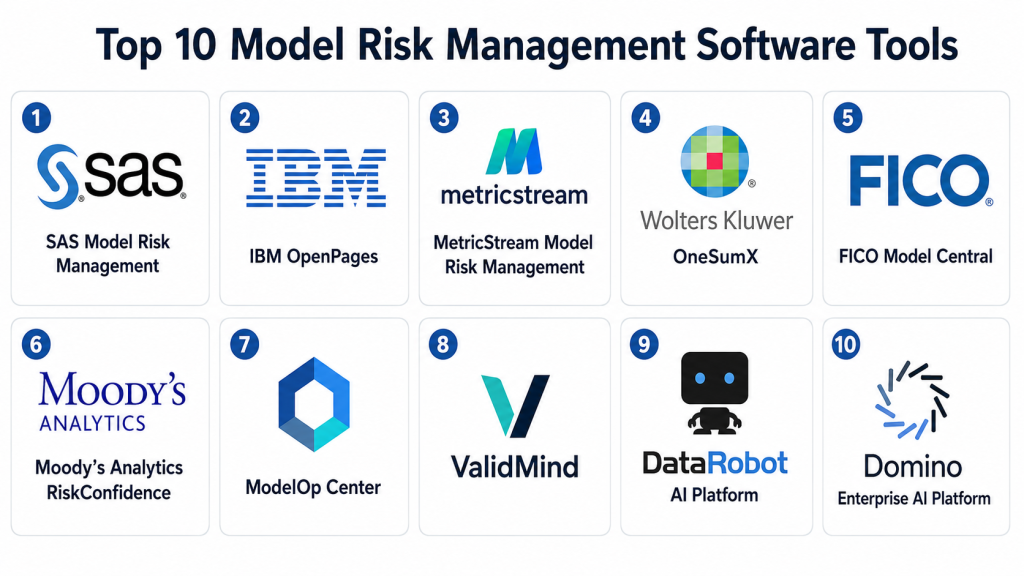
Top 10 Model Risk Management Software Tools
1- SAS Model Risk Management
Short description: SAS Model Risk Management is an enterprise-grade platform designed to help organizations manage model inventory, validation, governance, documentation, and regulatory reporting. It is especially relevant for banks, financial institutions, insurance companies, and enterprises already using SAS analytics.
Key Features
- Centralized model inventory and model lifecycle tracking.
- Model validation workflow and approval management.
- Documentation management for model methodology, assumptions, limitations, and validation results.
- Governance controls for ownership, review cycles, and model classification.
- Reporting dashboards for risk committees, audit teams, and compliance leaders.
- Integration with broader SAS analytics and risk management ecosystem.
- Support for regulated model risk management programs.
Pros
- Strong fit for financial institutions with mature risk and analytics teams.
- Deep alignment with statistical modeling, risk analytics, and governance workflows.
- Suitable for complex enterprise model portfolios.
Cons
- May require significant implementation planning and expert configuration.
- Best suited for larger organizations rather than small teams.
- Cost and deployment complexity can vary based on enterprise requirements.
Platforms / Deployment
Cloud / Hybrid / Enterprise deployment options may vary based on customer setup.
Security & Compliance
SAS enterprise products commonly support role-based access, auditability, authentication controls, and enterprise security configurations. Specific certifications and compliance coverage should be confirmed directly during procurement.
Integrations & Ecosystem
SAS Model Risk Management fits well inside organizations that already use SAS analytics, SAS risk tools, data warehouses, reporting platforms, and enterprise governance processes.
Common integration areas include:
- SAS analytics and modeling tools.
- Enterprise data warehouses.
- Risk reporting systems.
- Business intelligence tools.
- Governance and audit workflows.
- Regulatory reporting processes.
Support & Community
SAS offers enterprise documentation, customer support, implementation services, training resources, and consulting support. Community strength is strongest among analytics, banking, insurance, and risk management professionals.
2- IBM OpenPages
Short description: IBM OpenPages is an enterprise governance, risk, and compliance platform with capabilities that can support model risk management, operational risk, compliance, audit, policy, and AI governance workflows. It is suitable for large organizations that want model risk connected with broader enterprise risk.
Key Features
- Centralized governance and risk management framework.
- Model risk workflow support through configurable risk and control processes.
- Policy, audit, compliance, and issue management capabilities.
- Dashboarding and reporting for executives and risk teams.
- Flexible workflow configuration for complex governance environments.
- AI governance alignment through IBM’s broader governance ecosystem.
- Enterprise access control and audit trail capabilities.
Pros
- Strong fit for organizations that want model risk connected with enterprise GRC.
- Highly configurable for different risk frameworks and approval workflows.
- Suitable for large regulated enterprises with multiple risk functions.
Cons
- Can require careful configuration and implementation planning.
- May feel broader than needed for teams seeking only model inventory and validation.
- Best value is usually achieved in enterprise risk environments.
Platforms / Deployment
Cloud / Enterprise deployment options vary based on implementation.
Security & Compliance
IBM enterprise platforms commonly support RBAC, audit logs, SSO options, encryption, and administrative controls. Specific certifications and regulatory alignment should be validated during procurement.
Integrations & Ecosystem
IBM OpenPages can integrate with risk, compliance, reporting, audit, workflow, analytics, and enterprise data environments.
Common integration areas include:
- Enterprise GRC workflows.
- Data and analytics platforms.
- Business intelligence tools.
- Audit management systems.
- Policy and control libraries.
- AI governance and risk frameworks.
Support & Community
IBM provides enterprise support, documentation, partner services, and implementation guidance. Community strength is strongest in enterprise risk, governance, compliance, audit, and financial services environments.
3- MetricStream Model Risk Management
Short description: MetricStream offers GRC capabilities that include model risk management use cases for regulated organizations. It helps teams manage model governance, assessments, controls, issues, workflows, reporting, and audit readiness.
Key Features
- Model inventory and governance workflow support.
- Risk assessment and control management capabilities.
- Issue tracking, remediation, and approval workflows.
- Audit-ready documentation and evidence management.
- Dashboards for risk visibility and executive reporting.
- Integration with broader enterprise GRC programs.
- Configurable workflows for regulated environments.
Pros
- Strong option for organizations already using MetricStream GRC.
- Useful for connecting model risk with operational risk and compliance.
- Good fit for large teams needing workflow governance and reporting.
Cons
- May require configuration effort for model-specific use cases.
- Can be broader than needed for smaller data science teams.
- Advanced analytics monitoring may require integration with other tools.
Platforms / Deployment
Cloud / Enterprise deployment options vary by customer environment.
Security & Compliance
MetricStream commonly supports enterprise security features such as access controls, audit trails, workflow controls, and administrative governance. Specific certifications should be confirmed directly.
Integrations & Ecosystem
MetricStream fits well into enterprise risk, audit, compliance, control testing, and regulatory reporting workflows.
Common integration areas include:
- GRC systems.
- Audit platforms.
- Policy management tools.
- Reporting dashboards.
- Enterprise identity systems.
- Risk and compliance data sources.
Support & Community
MetricStream provides enterprise support, implementation services, documentation, and customer success resources. Community strength is strongest among GRC, compliance, audit, and enterprise risk professionals.
4- Wolters Kluwer OneSumX
Short description: Wolters Kluwer OneSumX is a risk, finance, regulatory reporting, and compliance platform used by financial institutions. It can support model risk related processes where financial risk, regulatory reporting, governance, and compliance are closely connected.
Key Features
- Risk and regulatory reporting capabilities.
- Financial services governance and compliance support.
- Data management and reporting workflows.
- Support for risk control and regulatory oversight.
- Enterprise reporting and audit evidence capabilities.
- Alignment with banking and financial institution requirements.
- Integration with broader risk and finance operations.
Pros
- Strong fit for financial institutions with complex regulatory needs.
- Useful when model risk is connected with finance, risk, and regulatory reporting.
- Enterprise-grade platform orientation.
Cons
- May not be the best fit for general AI governance outside financial services.
- Implementation may require domain expertise.
- Model-specific capabilities may vary by module and configuration.
Platforms / Deployment
Cloud / Enterprise deployment options vary based on solution scope.
Security & Compliance
Wolters Kluwer enterprise platforms typically support controlled access, governance workflows, and auditability. Specific security certifications and compliance claims should be confirmed during vendor review.
Integrations & Ecosystem
OneSumX is often relevant where risk, finance, compliance, and regulatory reporting need to work together.
Common integration areas include:
- Banking systems.
- Risk data platforms.
- Finance systems.
- Regulatory reporting workflows.
- Data warehouses.
- Governance and compliance processes.
Support & Community
Wolters Kluwer provides enterprise support, regulatory expertise, documentation, and implementation assistance. Community strength is strongest in banking, finance, risk, and compliance teams.
5- FICO Model Central
Short description: FICO Model Central supports model management, monitoring, governance, and operational oversight for organizations using decision models and analytics. It is especially relevant for credit risk, fraud, customer decisions, and regulated decisioning environments.
Key Features
- Centralized model management and inventory.
- Model monitoring and performance tracking.
- Governance workflows for model oversight.
- Support for decision models and analytical assets.
- Reporting for model performance and business impact.
- Integration with decisioning and analytics workflows.
- Useful for risk, fraud, credit, and customer decision teams.
Pros
- Strong fit for organizations using decision models in financial services.
- Practical focus on model operations and monitoring.
- Useful for connecting governance with decision outcomes.
Cons
- Best fit may be within FICO-centered analytics and decisioning environments.
- May require integration work for broader enterprise model portfolios.
- Some advanced governance needs may require complementary tools.
Platforms / Deployment
Cloud / Enterprise deployment options may vary.
Security & Compliance
Enterprise security controls may include role-based permissions, auditability, and access governance. Specific certifications and controls should be confirmed with the vendor.
Integrations & Ecosystem
FICO Model Central connects well with analytics, decisioning, fraud, credit risk, and model monitoring environments.
Common integration areas include:
- FICO decisioning platforms.
- Credit risk systems.
- Fraud detection systems.
- Data warehouses.
- Reporting tools.
- Model performance monitoring workflows.
Support & Community
FICO provides enterprise support, documentation, domain expertise, and implementation services. Community strength is strongest in financial services, credit, fraud, and decision analytics.
6- Moody’s Analytics RiskConfidence
Short description: Moody’s Analytics RiskConfidence supports model risk management processes for financial institutions, including model inventory, validation tracking, governance workflows, and reporting. It is designed for teams that need structured oversight of model risk across portfolios.
Key Features
- Model inventory and lifecycle tracking.
- Validation workflow and review management.
- Governance documentation and audit support.
- Risk assessment and classification support.
- Reporting dashboards for model risk oversight.
- Financial services model risk alignment.
- Support for centralized model governance programs.
Pros
- Strong fit for banking and financial risk management environments.
- Useful for formal model validation and governance workflows.
- Supports structured model risk documentation.
Cons
- May be more specialized for financial services than general enterprise AI governance.
- Implementation needs may vary depending on model portfolio complexity.
- Publicly available feature depth may vary by product configuration.
Platforms / Deployment
Cloud / Enterprise deployment options may vary.
Security & Compliance
Security and compliance details should be verified during vendor evaluation. Enterprise controls may vary based on deployment and customer configuration.
Integrations & Ecosystem
RiskConfidence fits into financial risk, model validation, governance, and regulatory oversight workflows.
Common integration areas include:
- Model inventory systems.
- Risk management platforms.
- Data repositories.
- Reporting dashboards.
- Governance workflows.
- Validation documentation processes.
Support & Community
Moody’s Analytics provides enterprise support, risk expertise, documentation, and advisory services. Community strength is strongest in financial risk, banking, credit, and regulatory environments.
7- ModelOp Center
Short description: ModelOp Center is designed for AI and model governance, helping organizations manage model inventory, governance workflows, validation, monitoring, and lifecycle controls. It is relevant for teams managing both traditional models and AI models at enterprise scale.
Key Features
- Model inventory and lifecycle governance.
- AI and machine learning model oversight.
- Workflow automation for approvals and reviews.
- Monitoring support for model performance and risk indicators.
- Policy-based governance and control alignment.
- Reporting and audit evidence capture.
- Integration with model development and deployment ecosystems.
Pros
- Strong focus on operationalizing model governance.
- Useful for AI governance and enterprise model lifecycle management.
- Suitable for organizations with many models across teams.
Cons
- May require integration planning with existing MLOps and analytics tools.
- Best fit is for mature teams with active model governance needs.
- Pricing and implementation details may vary.
Platforms / Deployment
Cloud / Hybrid / Enterprise deployment options may vary.
Security & Compliance
Security features may include enterprise access controls, audit trails, governance workflows, and administrative permissions. Specific certifications should be verified directly.
Integrations & Ecosystem
ModelOp Center is built to connect with the broader model development, deployment, monitoring, and governance stack.
Common integration areas include:
- Data science platforms.
- MLOps platforms.
- Model monitoring tools.
- Enterprise data systems.
- Governance workflows.
- Reporting and audit systems.
Support & Community
ModelOp provides product documentation, enterprise onboarding, and customer support. Community strength is strongest among AI governance, model operations, and enterprise risk teams.
8- ValidMind
Short description: ValidMind focuses on model risk management, validation automation, documentation, testing, and governance for AI and machine learning models. It is useful for teams that want to speed up validation and improve consistency in model documentation.
Key Features
- Model validation workflow support.
- Automated documentation and evidence capture.
- Testing support for model quality, risk, and controls.
- Governance workflows for review and approval.
- Support for AI and machine learning model lifecycle governance.
- Collaboration between model developers, validators, and risk teams.
- Reporting for audit and compliance readiness.
Pros
- Strong fit for teams looking to modernize model validation workflows.
- Useful for AI and machine learning governance.
- Can reduce manual documentation burden.
Cons
- May need integration with existing data science and model deployment tools.
- Enterprise fit depends on governance maturity and internal processes.
- Some compliance details should be confirmed directly.
Platforms / Deployment
Cloud / Enterprise deployment options may vary.
Security & Compliance
Security and compliance details should be validated with the vendor. Enterprise governance controls may vary depending on deployment and configuration.
Integrations & Ecosystem
ValidMind is relevant for model validation, AI governance, testing, and documentation workflows.
Common integration areas include:
- Data science notebooks.
- Model development workflows.
- Model documentation processes.
- Validation testing workflows.
- Governance and approval systems.
- Reporting and audit evidence repositories.
Support & Community
ValidMind provides documentation, onboarding, and customer support. Community strength is growing among AI governance, validation, model risk, and regulated analytics teams.
9- DataRobot AI Platform
Short description: DataRobot AI Platform helps organizations build, deploy, monitor, and govern machine learning and AI models. While it is broader than model risk management alone, its governance, monitoring, documentation, and model lifecycle capabilities are useful for AI risk programs.
Key Features
- End-to-end AI and machine learning lifecycle management.
- Model monitoring for performance and drift.
- Explainability and transparency capabilities.
- Governance workflows for AI model oversight.
- Deployment and operational monitoring support.
- Collaboration features for data science and business teams.
- Integration with enterprise data and AI workflows.
Pros
- Strong fit for organizations building and deploying AI models at scale.
- Useful combination of model development, deployment, and governance.
- Helps connect data science productivity with responsible AI controls.
Cons
- Broader AI platform may be more than needed for pure model risk teams.
- Traditional regulatory model validation may require additional governance processes.
- Cost and implementation scope can vary by enterprise needs.
Platforms / Deployment
Cloud / Hybrid / Enterprise deployment options may vary.
Security & Compliance
DataRobot enterprise deployments commonly support access controls, auditability, and enterprise security features. Specific certifications and compliance coverage should be confirmed during procurement.
Integrations & Ecosystem
DataRobot integrates with data sources, cloud platforms, analytics systems, development workflows, and model deployment environments.
Common integration areas include:
- Cloud data platforms.
- Data warehouses.
- BI tools.
- MLOps workflows.
- APIs and model deployment pipelines.
- Enterprise identity systems.
Support & Community
DataRobot provides enterprise documentation, training, support, onboarding, and partner services. Community strength is strongest among data science, AI, analytics, and enterprise AI teams.
10- Domino Enterprise AI Platform
Short description: Domino Enterprise AI Platform supports data science, machine learning operations, model governance, reproducibility, collaboration, and deployment. It is not only a model risk platform, but it can support model governance and auditability for teams managing advanced analytics at scale.
Key Features
- Collaborative data science workspace.
- Model development, experiment tracking, and reproducibility support.
- Model deployment and monitoring workflows.
- Governance support through project tracking and auditability.
- Integration with enterprise data and compute environments.
- Support for open-source and enterprise analytics tools.
- Scalable platform for regulated analytics teams.
Pros
- Strong fit for enterprise data science teams.
- Useful for reproducibility, collaboration, and lifecycle governance.
- Supports diverse tools, languages, and model workflows.
Cons
- Not a dedicated model risk management platform by itself.
- Formal validation and regulatory workflow may require process configuration.
- Best suited for technical teams with mature analytics operations.
Platforms / Deployment
Cloud / Hybrid / Enterprise deployment options may vary.
Security & Compliance
Domino enterprise deployments commonly support administrative controls, access management, auditability, and enterprise security configuration. Specific certifications should be confirmed directly.
Integrations & Ecosystem
Domino works well with open-source analytics, cloud infrastructure, data platforms, MLOps workflows, and enterprise development environments.
Common integration areas include:
- Python and R ecosystems.
- Data warehouses.
- Cloud infrastructure.
- Git repositories.
- Containerized environments.
- Model deployment pipelines.
Support & Community
Domino provides enterprise documentation, support, onboarding, and customer success resources. Community strength is strongest among data science, machine learning, analytics engineering, and enterprise AI teams.
Comparison Table
| Tool Name | Best For | Platform Supported | Deployment | Standout Feature | Public Rating |
|---|---|---|---|---|---|
| SAS Model Risk Management | Large banks and regulated analytics teams | Web / Enterprise | Cloud / Hybrid | Strong model lifecycle governance | N/A |
| IBM OpenPages | Enterprise GRC and model risk alignment | Web / Enterprise | Cloud / Enterprise | Broader governance and risk framework | N/A |
| MetricStream Model Risk Management | GRC-led model risk programs | Web / Enterprise | Cloud / Enterprise | Risk, control, and workflow governance | N/A |
| Wolters Kluwer OneSumX | Financial services risk and regulatory teams | Web / Enterprise | Cloud / Enterprise | Risk and regulatory reporting alignment | N/A |
| FICO Model Central | Decision model and credit risk teams | Web / Enterprise | Cloud / Enterprise | Decision model monitoring and governance | N/A |
| Moody’s Analytics RiskConfidence | Banking model risk teams | Web / Enterprise | Cloud / Enterprise | Model inventory and validation governance | N/A |
| ModelOp Center | AI and model governance teams | Web / Enterprise | Cloud / Hybrid | Model operations and governance automation | N/A |
| ValidMind | AI model validation and documentation teams | Web / Enterprise | Cloud / Enterprise | Validation automation and documentation | N/A |
| DataRobot AI Platform | AI development and governance teams | Web / Enterprise | Cloud / Hybrid | AI lifecycle and model monitoring | N/A |
| Domino Enterprise AI Platform | Enterprise data science teams | Web / Enterprise | Cloud / Hybrid | Reproducibility and collaborative model operations | N/A |
Evaluation & Scoring of Model Risk Management Software
| Tool Name | Core 25% | Ease 15% | Integrations 15% | Security 10% | Performance 10% | Support 10% | Value 15% | Weighted Total |
| SAS Model Risk Management | 9 | 7 | 8 | 9 | 9 | 9 | 7 | 8.25 |
| IBM OpenPages | 8 | 7 | 8 | 9 | 8 | 9 | 7 | 7.95 |
| MetricStream Model Risk Management | 8 | 7 | 8 | 8 | 8 | 8 | 7 | 7.70 |
| Wolters Kluwer OneSumX | 8 | 7 | 7 | 8 | 8 | 8 | 7 | 7.55 |
| FICO Model Central | 8 | 7 | 8 | 8 | 8 | 8 | 7 | 7.70 |
| Moody’s Analytics RiskConfidence | 8 | 7 | 7 | 8 | 8 | 8 | 7 | 7.55 |
| ModelOp Center | 8 | 8 | 8 | 8 | 8 | 7 | 8 | 7.90 |
| ValidMind | 8 | 8 | 7 | 7 | 8 | 7 | 8 | 7.65 |
| DataRobot AI Platform | 8 | 8 | 9 | 8 | 9 | 8 | 7 | 8.10 |
| Domino Enterprise AI Platform | 7 | 8 | 9 | 8 | 9 | 8 | 7 | 7.90 |
The scoring is comparative, not absolute. A higher score does not automatically mean the tool is the best fit for every organization. Enterprise banks may value regulatory workflow depth more than ease of use, while AI teams may prioritize deployment monitoring and integration flexibility. Buyers should treat the scores as a starting point and validate each platform against their own model inventory, compliance needs, data architecture, budget, and implementation capacity.
Which Model Risk Management Software Tool Is Right for You?
Solo / Freelancer
Solo consultants, independent model validators, and freelance risk advisors usually do not need a heavy enterprise platform. A full model risk system may be too complex unless they support regulated clients or manage many model validation projects. For this scenario, ValidMind may be useful if the focus is AI model validation and documentation. DataRobot or Domino may also help when the consultant works directly on model development and monitoring.
For very small projects, structured documentation, version control, and basic model monitoring may be enough. A dedicated platform becomes more useful when client expectations include formal audit trails, validation evidence, and model lifecycle workflows.
SMB
Small and mid-sized businesses should look for tools that are easy to implement, practical to operate, and flexible enough to support growing model governance needs. ValidMind, ModelOp Center, DataRobot, and Domino can be strong options depending on whether the company needs validation automation, AI governance, model monitoring, or data science lifecycle control.
SMBs should avoid overbuying. The best starting point is usually a platform that supports model inventory, ownership, documentation, performance monitoring, and approval workflows without requiring a large governance department.
Mid-Market
Mid-market organizations often need stronger governance because they manage more models, more stakeholders, and more audit expectations. ModelOp Center, ValidMind, DataRobot, Domino, MetricStream, and FICO Model Central can be useful depending on the use case.
Financial services mid-market firms may prefer FICO, Moody’s Analytics, SAS, or MetricStream if credit risk, fraud, regulatory reporting, and validation workflows are central. AI-driven mid-market companies may prefer ModelOp Center, ValidMind, DataRobot, or Domino because they offer stronger fit for modern AI and ML lifecycle needs.
Enterprise
Large enterprises need scalability, auditability, integration depth, security controls, and governance consistency across multiple departments and regions. SAS Model Risk Management, IBM OpenPages, MetricStream, Wolters Kluwer OneSumX, Moody’s Analytics RiskConfidence, and ModelOp Center are strong candidates for enterprise-grade model risk programs.
Enterprises should focus on workflow customization, role-based access, audit trails, integration with GRC systems, reporting flexibility, model classification, regulatory alignment, and support for both traditional statistical models and AI models.
Budget vs Premium
Budget-sensitive teams should avoid choosing a large enterprise platform before confirming model risk maturity. For early-stage governance, ValidMind, ModelOp Center, DataRobot, or Domino may offer practical starting points depending on scope.
Premium buyers should focus on enterprise platforms such as SAS, IBM OpenPages, MetricStream, Wolters Kluwer OneSumX, Moody’s Analytics, or FICO when regulatory reporting, audit readiness, complex approval workflows, and enterprise risk alignment are critical.
Feature Depth vs Ease of Use
SAS, IBM OpenPages, MetricStream, and Wolters Kluwer OneSumX offer strong enterprise depth but may require more implementation planning. ValidMind and ModelOp Center may feel more focused for teams modernizing validation and AI governance workflows. DataRobot and Domino are strong when model development, deployment, monitoring, and governance need to stay connected.
Buyers should choose feature depth when governance complexity is high. Choose ease of use when adoption speed, team collaboration, and quick workflow setup are more important.
Integrations & Scalability
Integration-heavy organizations should evaluate how each tool connects with data warehouses, data science platforms, BI tools, GRC systems, identity providers, workflow systems, and model deployment pipelines. DataRobot and Domino are strong for data science ecosystem integration, while IBM OpenPages, MetricStream, SAS, and Wolters Kluwer are stronger in enterprise risk and compliance environments.
Scalability matters when the organization manages hundreds or thousands of models, multiple risk owners, different validation teams, and complex reporting requirements.
Security & Compliance Needs
Security-focused organizations should carefully validate SSO, MFA, RBAC, audit logs, encryption, access reviews, data residency, administrative controls, and compliance documentation before choosing a tool. Regulated industries should also check whether the platform supports model documentation, approval history, validation evidence, independent review, and issue remediation.
For strict compliance environments, SAS, IBM OpenPages, MetricStream, Wolters Kluwer OneSumX, Moody’s Analytics, and FICO are often better aligned with formal enterprise risk operations. For AI governance and model operations, ModelOp Center, ValidMind, DataRobot, and Domino may provide stronger operational alignment.
Frequently Asked Questions
1- What is Model Risk Management Software?
Model Risk Management Software is a platform that helps organizations manage the risks created by analytical models, machine learning models, AI models, and decision models. It supports model inventory, validation, documentation, monitoring, approvals, issue tracking, and audit readiness.
2- Who needs Model Risk Management Software?
Banks, insurance companies, fintech firms, investment firms, large enterprises, AI teams, risk teams, and compliance departments benefit most from this software. Any organization using models for high-impact decisions should consider structured model risk governance.
3- Is Model Risk Management Software only for banks?
No. Banks are major users because of regulatory pressure, but the software is also useful for insurance, healthcare, telecom, retail, fintech, manufacturing, and any enterprise using AI or analytics for important decisions.
4- What features should buyers look for first?
Buyers should look for model inventory, validation workflows, documentation, ownership tracking, approval management, model monitoring, audit trails, reporting dashboards, integration support, and strong access controls. These features create the foundation for a reliable model risk program.
5- How much does Model Risk Management Software cost?
Pricing varies by vendor, deployment model, number of users, number of models, required modules, support level, and enterprise configuration. Many vendors use custom pricing, so buyers should request detailed quotes based on real usage needs.
6- How long does implementation usually take?
Implementation depends on model portfolio size, workflow complexity, integration needs, documentation maturity, and internal stakeholder readiness. A small team may start faster, while enterprise deployments often require phased rollout, data migration, workflow design, training, and governance alignment.
7- What are common mistakes when choosing a model risk tool?
Common mistakes include choosing a tool without mapping internal workflows, ignoring validator needs, underestimating integration work, relying only on model inventory, skipping security review, and failing to define ownership. Buyers should evaluate process fit before final selection.
8- Can Model Risk Management Software support AI governance?
Yes, many modern platforms support AI governance needs such as model documentation, explainability, validation workflows, monitoring, risk classification, and approval tracking. However, AI-specific depth varies, so buyers should validate fairness, drift, bias, and explainability capabilities carefully.
9- Does this software replace data science platforms?
No. Model Risk Management Software usually complements data science platforms rather than replacing them. Data science tools help teams build and deploy models, while model risk tools help govern, validate, document, monitor, and audit those models.
10- What integrations are important for model risk teams?
Important integrations include data warehouses, cloud platforms, BI tools, model development environments, MLOps platforms, GRC systems, audit tools, identity providers, ticketing systems, and reporting platforms. Integration quality affects adoption and long-term scalability.
Conclusion
Model Risk Management Software is becoming essential for organizations that rely on models to make important business decisions. The right platform helps teams manage model inventory, validation, documentation, monitoring, approval workflows, and audit evidence in a more structured way. SAS, IBM OpenPages, MetricStream, Wolters Kluwer OneSumX, FICO, and Moody’s Analytics are strong options for regulated enterprise risk environments, while ModelOp Center, ValidMind, DataRobot, and Domino are highly relevant for AI, ML, and modern model lifecycle governance. The best choice depends on your industry, model complexity, compliance pressure, internal skills, and integration needs. Start by shortlisting two or three tools, run a focused pilot with real models, validate security and integration requirements, and then scale the platform across teams once the workflow is proven.
