Introduction
Data Contract Management Tools help data teams define, enforce, monitor, and govern agreements between data producers and data consumers. In simple terms, a data contract describes what a dataset, table, stream, or data product should look like, what quality rules it must follow, who owns it, how fresh it should be, and what happens when expectations are broken. These tools reduce unexpected schema changes, broken dashboards, failed machine learning pipelines, reporting errors, and trust issues between engineering, analytics, and business teams.
Data contract management matters because modern organizations depend on data products, analytics platforms, AI systems, event streams, and cloud data warehouses. When upstream teams change fields, formats, names, freshness levels, or business definitions without coordination, downstream teams face broken reports, wrong metrics, and delayed decisions. A strong data contract workflow creates clear ownership, automated validation, version control, and accountability across the data lifecycle.
Real-world use cases include:
- Preventing broken dashboards when upstream teams change schema, column names, or data types
- Protecting machine learning pipelines from unexpected data drift, missing values, or invalid formats
- Managing data products in data mesh and decentralized data ownership models
- Improving data quality governance with explicit rules for freshness, completeness, uniqueness, and validity
- Supporting compliance and auditability by documenting ownership, lineage, expectations, and change history
Evaluation Criteria for Buyers:
- Contract definition support: schema, semantics, quality rules, freshness, ownership, SLAs, and governance metadata
- Validation and enforcement: CI checks, pipeline checks, schema testing, quality testing, and failure handling
- Integration depth: data warehouses, lakehouses, catalogs, orchestration tools, dbt, CI/CD, streaming platforms, and observability tools
- Version control: contract versioning, approval workflows, change history, and backward compatibility checks
- Data quality coverage: null checks, uniqueness, accepted values, type checks, volume checks, freshness checks, and custom rules
- Lineage and ownership: visibility into producers, consumers, impacted assets, and downstream dependencies
- Developer experience: CLI, API, YAML support, Git workflows, documentation, and automation-friendly setup
- Collaboration: shared contract reviews, approval workflows, ownership mapping, and business glossary alignment
- Security and governance: RBAC, SSO, audit logs, encryption, metadata controls, and compliance support
- Scalability: support for multiple domains, teams, data products, environments, and high-volume pipelines
Best for: Data Contract Management Tools are best for data engineering teams, analytics engineering teams, platform teams, data governance leaders, AI teams, data product owners, and enterprises that depend on reliable datasets, event streams, lakehouse tables, and analytics pipelines. They are especially useful for organizations moving toward data mesh, data products, governed AI, or self-service analytics.
Not ideal for: These tools may not be necessary for very small teams with only a few simple dashboards and stable data sources. Basic schema checks, manual documentation, or lightweight data quality tests may be enough when data volume, team complexity, and downstream dependency risk are low.
Key Trends in Data Contract Management Tools
- Shift-left data quality: Teams are moving validation closer to data producers so schema and quality issues are caught before they break downstream workflows.
- Data contracts for AI readiness: AI and machine learning teams need reliable features, stable schemas, and trusted data products to reduce model risk.
- Data mesh adoption: Decentralized data ownership is increasing the need for explicit contracts between domains, producers, and consumers.
- Contract-as-code workflows: YAML, Git, CI/CD, CLI tools, and automated checks are becoming common for managing data contracts.
- Integration with data catalogs: Contracts are increasingly linked with metadata, ownership, lineage, glossary terms, and governance workflows.
- Observability and contract convergence: Data contracts define expectations, while observability tools monitor freshness, volume, distribution, anomalies, and incidents.
- Streaming data contracts: Event-driven architectures need contract enforcement for Kafka topics, schemas, messages, and real-time pipelines.
- Governed self-service analytics: Business users expect reliable datasets, while data teams need automated controls to prevent silent breaking changes.
- Schema registry and compatibility checks: More teams are using schema registries and compatibility rules to control breaking changes in event streams.
- Automated impact analysis: Buyers want to know which reports, models, tables, or applications will be affected when a contract changes.
How We Selected These Tools
The tools in this list were selected using a practical SaaS and data platform evaluation approach. Data contract management is still an evolving category, so the list includes dedicated data contract tools, data quality platforms, data observability platforms, catalogs, open-source governance platforms, analytics engineering tools, and schema registry systems.
Selection logic included:
- Category relevance for defining, validating, enforcing, or governing data contracts
- Market adoption and mindshare across data engineering, analytics engineering, governance, and observability teams
- Feature completeness across schema expectations, quality rules, freshness, ownership, lineage, and workflow automation
- Developer experience including CLI, YAML, APIs, Git workflows, CI/CD compatibility, and documentation
- Integration ecosystem with warehouses, lakehouses, streaming systems, orchestrators, BI tools, and catalogs
- Security posture signals such as RBAC, SSO, audit logs, enterprise controls, and metadata governance
- Scalability for multi-team, multi-domain, and enterprise-grade data operations
- Support for modern data architectures including data mesh, data products, cloud warehouses, lakehouses, and streaming data
- Practical buyer fit across startups, SMBs, mid-market teams, enterprises, and open-source users
- Operational value based on reducing pipeline breakages, improving trust, and creating clearer accountability
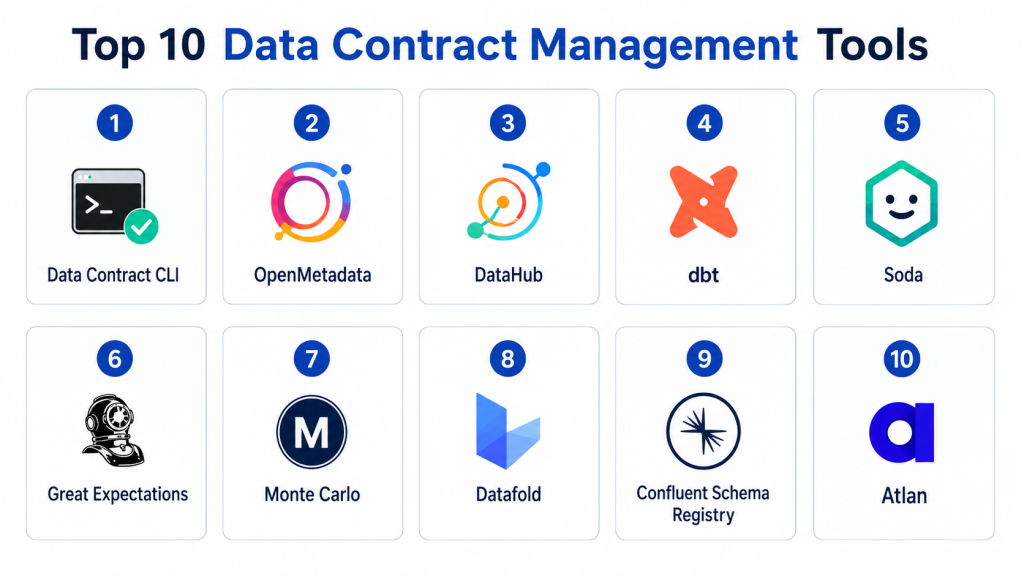
Top 10 Data Contract Management Tools
1- Data Contract CLI
Short description: Data Contract CLI is an open-source command-line tool for defining, testing, and working with data contracts as code. It is useful for data engineers, analytics engineers, and platform teams that want a lightweight, developer-friendly way to manage contracts in Git and CI/CD workflows.
Key Features
- Contract-as-code workflow for data contracts
- CLI-based validation and testing
- YAML-based contract definitions
- Support for schema and quality expectations
- Integration-friendly approach for CI/CD pipelines
- Export support for related data quality and schema tools
- Useful for open-source and developer-first teams
Pros
- Strong fit for teams that prefer Git-based workflows
- Lightweight and flexible for early data contract adoption
- Good option for engineering-led data quality governance
Cons
- Requires technical users comfortable with CLI and code-based workflows
- May need additional tools for catalogs, lineage, observability, and governance
- Enterprise support and managed service options may be limited compared with commercial platforms
Platforms / Deployment
Linux / macOS / Windows / CLI
Open-source / Self-managed
Security & Compliance
Not publicly stated. Since it is typically used as a CLI and self-managed workflow, security depends on the organization’s own environment, repository permissions, CI/CD setup, secrets management, and data access controls.
Integrations & Ecosystem
Data Contract CLI fits well into modern engineering workflows where data contracts are versioned, reviewed, and validated like software code. It is useful when teams want to connect contract definitions with testing, schema validation, and pipeline checks.
Common integration patterns include:
- Git repositories
- CI/CD pipelines
- Data quality frameworks
- Schema validation workflows
- Analytics engineering workflows
- Data warehouse and lakehouse validation pipelines
Support & Community
Support is generally community-driven and documentation-based. Teams that need enterprise onboarding, guaranteed support, or managed governance may need to combine it with internal platform ownership or commercial data governance tools.
2- OpenMetadata
Short description: OpenMetadata is an open-source metadata, data catalog, governance, and observability platform that supports data contracts as part of broader data asset management. It is useful for teams that want contracts connected with ownership, lineage, quality rules, documentation, and governance workflows.
Key Features
- Data contract support connected to data assets
- Metadata catalog for tables, dashboards, pipelines, and services
- Ownership, lineage, glossary, and governance workflows
- Data quality checks and profiling capabilities
- Collaboration around data assets and documentation
- Open-source foundation with extensibility
- Useful for data product and data governance programs
Pros
- Strong fit for teams that want contracts linked to catalog and governance
- Open-source option with broad metadata management capabilities
- Useful for organizations building data product ownership models
Cons
- Implementation requires planning and platform ownership
- May be broader than needed for teams that only want simple contract validation
- Operational maturity depends on how well metadata ownership is maintained
Platforms / Deployment
Web / API
Self-hosted / Cloud options may vary by offering
Security & Compliance
Security features vary by deployment and configuration. Buyers should verify SSO, RBAC, audit logs, encryption, authentication, authorization, and compliance needs based on their chosen deployment model.
Integrations & Ecosystem
OpenMetadata is designed to connect with data infrastructure and metadata sources across the modern data stack. It works well when contracts need to sit beside lineage, ownership, quality, and governance information.
Common integration patterns include:
- Cloud data warehouses
- Lakehouse platforms
- BI and dashboard tools
- Data pipelines and orchestrators
- Data quality checks
- Glossary and metadata workflows
Support & Community
OpenMetadata has an open-source community and documentation ecosystem. Support options may vary depending on whether teams use a community deployment, internal platform team, or commercial support path.
3- DataHub
Short description: DataHub is an open-source metadata platform that helps teams manage data discovery, lineage, ownership, governance, and data contracts. It is useful for organizations that want data contracts connected to metadata, impact analysis, domains, and data product ownership.
Key Features
- Metadata platform for data discovery and governance
- Data contract concepts connected with assets and ownership
- Lineage and impact analysis capabilities
- Support for data products, domains, and business metadata
- APIs and extensibility for modern data platforms
- Useful for governance and platform engineering teams
- Open-source foundation with enterprise ecosystem options
Pros
- Strong fit for metadata-driven data contract programs
- Useful for understanding downstream impact of data changes
- Good option for organizations building data governance at scale
Cons
- Requires implementation effort and metadata strategy
- Data contract enforcement may require integration with quality, CI/CD, or pipeline tools
- Smaller teams may find it broader than necessary
Platforms / Deployment
Web / API
Self-hosted / Cloud options may vary by offering
Security & Compliance
Security and compliance features vary by deployment and commercial offering. Buyers should verify SSO, RBAC, audit logs, encryption, authentication, authorization, and data governance controls.
Integrations & Ecosystem
DataHub fits into environments where metadata, ownership, contracts, and lineage are core parts of the data platform. It can help teams understand who owns data, who consumes it, and what may break when data changes.
Common integration patterns include:
- Data warehouses and lakehouses
- BI and analytics tools
- Orchestration systems
- Data quality tools
- Streaming platforms
- Governance and metadata workflows
Support & Community
DataHub has a strong open-source ecosystem and active adoption among modern data teams. Support depends on whether the organization uses community resources, internal platform support, or commercial options.
4- dbt
Short description: dbt is an analytics engineering platform used to transform, test, document, and manage data models. Its contract-style model definitions, schema testing, documentation, and CI workflows make it useful for teams that want data contracts around analytics tables and modeled datasets.
Key Features
- Model definitions and schema configuration
- Data tests for uniqueness, nulls, relationships, and accepted values
- Documentation and lineage for analytics models
- CI/CD-friendly analytics engineering workflows
- Version-controlled project structure
- Support for data quality rules around modeled data
- Strong ecosystem across modern analytics teams
Pros
- Strong fit for analytics engineering teams
- Helps bring contract discipline into transformation workflows
- Works well with Git, testing, documentation, and CI processes
Cons
- Primarily focused on transformed analytics models, not every data asset type
- May need additional observability or catalog tools for full contract lifecycle
- Contract enforcement depth depends on project design and team discipline
Platforms / Deployment
Web / CLI / API
Cloud / Self-managed options vary by edition
Security & Compliance
Security features vary by product edition and deployment model. Buyers should verify SSO, RBAC, audit logs, encryption, access controls, and compliance requirements directly.
Integrations & Ecosystem
dbt fits well into cloud data warehouse and analytics workflows. It is especially useful when data contracts are tied to transformation models, tests, documentation, and deployment pipelines.
Common integration patterns include:
- Cloud data warehouses
- Git repositories
- CI/CD systems
- BI tools
- Data catalogs
- Orchestration platforms
Support & Community
dbt has a large community, strong documentation, training resources, and a mature ecosystem. Support options vary between open-source usage, cloud product plans, and enterprise agreements.
5- Soda
Short description: Soda is a data quality and observability platform that helps teams define, monitor, and enforce data quality expectations. It is useful for data contract workflows where contracts need practical validation through checks, monitoring, alerts, and quality rules.
Key Features
- Data quality checks for freshness, completeness, validity, and consistency
- Contract-aligned quality validation workflows
- Monitoring and alerting for data quality failures
- Integration with pipelines and data platforms
- Rules and checks that can support producer-consumer expectations
- Dashboard visibility into data quality status
- Useful for engineering and governance teams
Pros
- Strong fit for quality-driven data contract enforcement
- Helps teams detect and prevent data quality failures
- Works well alongside catalogs and transformation tools
Cons
- May need another tool for full metadata catalog and ownership management
- Requires thoughtful rule design to avoid noisy alerts
- Contract governance workflows may depend on implementation approach
Platforms / Deployment
Web / CLI / API
Cloud / Self-managed options may vary by product
Security & Compliance
Security features vary by product and plan. Buyers should verify SSO, RBAC, audit logs, encryption, data handling, SOC 2, GDPR, and other compliance needs directly.
Integrations & Ecosystem
Soda is commonly used with modern data platforms to monitor and validate data quality. It can support data contract programs by turning expectations into automated checks.
Common integration patterns include:
- Cloud data warehouses
- Data lakehouses
- Orchestration tools
- CI/CD pipelines
- Data catalogs
- Alerting and incident workflows
Support & Community
Soda provides documentation, product resources, and community or commercial support options depending on the offering. Teams should confirm support levels for production-grade monitoring.
6- Great Expectations
Short description: Great Expectations is an open-source data quality framework that helps teams define expectations, validate datasets, and document data quality rules. It is useful for data contract programs where quality expectations need to be tested and documented across pipelines.
Key Features
- Declarative data quality expectations
- Validation for schema, nulls, ranges, uniqueness, and custom rules
- Data documentation for test results and expectations
- Integration with pipelines and orchestration workflows
- Open-source framework for engineering-led data quality
- Useful for contract-aligned validation
- Flexible rule creation for multiple data platforms
Pros
- Strong open-source option for data quality validation
- Flexible for technical teams building custom workflows
- Good fit for contract testing in pipelines
Cons
- Requires engineering effort for setup and maintenance
- May need additional tools for catalog, lineage, ownership, and governance
- Non-technical business users may find it less approachable
Platforms / Deployment
Python / CLI / API
Self-managed / Cloud options may vary by offering
Security & Compliance
Not publicly stated in a way that should be generalized for all deployments. Security depends heavily on deployment architecture, data access controls, credentials, repository permissions, and infrastructure governance.
Integrations & Ecosystem
Great Expectations fits into technical data engineering workflows where tests and validations are part of pipelines. It can be paired with catalogs, orchestration tools, and CI/CD systems to support contract enforcement.
Common integration patterns include:
- Data warehouses
- Data lakes and lakehouses
- Orchestration platforms
- CI/CD pipelines
- Python workflows
- Data documentation systems
Support & Community
Great Expectations has an open-source community, documentation, and ecosystem resources. Production support and enterprise guidance may vary depending on chosen product path and internal team maturity.
7- Monte Carlo
Short description: Monte Carlo is a data observability platform that helps teams monitor data freshness, volume, schema, lineage, and anomalies. It is useful for data contract management when organizations need to detect contract-breaking changes and understand downstream impact.
Key Features
- Data observability across freshness, volume, schema, and quality signals
- Schema change detection and anomaly monitoring
- Lineage and impact visibility
- Incident management workflows for data reliability issues
- Integration with warehouses, BI tools, and communication tools
- Useful for production-grade data reliability programs
- Helps detect issues that formal contracts may not fully capture
Pros
- Strong fit for enterprise data reliability and observability
- Helps identify and troubleshoot contract-breaking changes
- Useful for monitoring complex data environments at scale
Cons
- Not primarily a contract authoring tool
- May be more expensive or advanced than small teams need
- Contract governance may require pairing with catalog or definition tools
Platforms / Deployment
Web / API
Cloud / Varies by product
Security & Compliance
Security features vary by product and contract. Buyers should verify SSO, RBAC, audit logs, encryption, SOC 2, GDPR, HIPAA-related needs, and data access architecture directly.
Integrations & Ecosystem
Monte Carlo is designed to monitor modern data stacks and alert teams when data reliability issues occur. It works well when contracts need ongoing observability and incident response.
Common integration patterns include:
- Cloud data warehouses
- Data lakehouses
- BI tools
- Orchestration platforms
- Incident management tools
- Collaboration and alerting tools
Support & Community
Monte Carlo is commonly used by enterprise and data-mature organizations. Support, onboarding, and customer success options may vary by contract and deployment complexity.
8- Datafold
Short description: Datafold is a data reliability platform focused on preventing data quality issues through data diffing, testing, lineage, and change impact analysis. It is useful for teams that want to catch breaking changes before they reach production data consumers.
Key Features
- Data diffing to compare datasets before and after changes
- CI/CD support for data pipeline validation
- Column-level lineage and impact analysis capabilities
- Data quality checks and change validation workflows
- Useful for analytics engineering and data engineering teams
- Helps prevent breaking schema or logic changes
- Supports pull-request-style data review workflows
Pros
- Strong fit for preventing breaking data changes before deployment
- Useful for CI/CD-driven analytics and engineering teams
- Helps teams review data impact before production release
Cons
- Not a full data catalog replacement
- May require integration with existing development workflows
- Best value comes when teams already use disciplined change management
Platforms / Deployment
Web / API
Cloud / Varies by product
Security & Compliance
Security features vary by plan and deployment. Buyers should verify SSO, RBAC, audit logs, encryption, SOC 2, data access controls, and compliance requirements directly.
Integrations & Ecosystem
Datafold fits best where data changes are reviewed like software changes. It is useful for teams that want data contract validation to happen before pipeline changes reach production.
Common integration patterns include:
- Git workflows
- CI/CD systems
- Data warehouses
- dbt projects
- BI tools
- Lineage and impact analysis workflows
Support & Community
Datafold provides product resources and customer support options depending on plan and use case. Teams should validate onboarding, technical support, and integration support for production workflows.
9- Confluent Schema Registry
Short description: Confluent Schema Registry helps teams manage schemas for event streams and enforce compatibility rules across Kafka-based systems. It is useful for streaming data contracts where producers and consumers need stable message formats and controlled schema evolution.
Key Features
- Centralized schema management for streaming data
- Schema compatibility checks
- Support for common serialization formats
- Producer and consumer schema validation workflows
- Integration with Kafka and streaming ecosystems
- Version control for event schemas
- Useful for event-driven architecture and real-time data contracts
Pros
- Strong fit for Kafka and streaming data contracts
- Helps prevent breaking changes in event messages
- Mature option for schema governance in real-time systems
Cons
- Focused on schemas, not full data quality, ownership, or business semantics
- Best suited for streaming environments rather than general data warehouse use cases
- May require additional tools for lineage, observability, and governance
Platforms / Deployment
Web / API / Kafka ecosystem
Cloud / Self-managed / Hybrid options may vary by product
Security & Compliance
Security depends on deployment and Confluent product configuration. Buyers should verify authentication, authorization, encryption, RBAC, audit logs, private networking, SOC 2, ISO 27001, and compliance requirements directly.
Integrations & Ecosystem
Confluent Schema Registry is strongest in event-driven architectures where producers and consumers depend on compatible schemas. It is commonly used to enforce streaming data contracts.
Common integration patterns include:
- Apache Kafka
- Kafka producers and consumers
- Stream processing applications
- Event-driven microservices
- Real-time analytics pipelines
- Schema governance workflows
Support & Community
Confluent has broad enterprise adoption and documentation around Kafka ecosystems. Support options depend on whether teams use open-source components, self-managed deployments, or commercial cloud offerings.
10- Atlan
Short description: Atlan is a modern data catalog and governance platform that helps teams manage metadata, ownership, lineage, collaboration, and data product context. It is useful for data contract programs where contracts need to be connected with business context, owners, consumers, and governance workflows.
Key Features
- Data catalog and metadata management
- Ownership, lineage, glossary, and collaboration workflows
- Support for data product and governance operating models
- Contextual documentation around data assets
- Integration with modern data stack tools
- Useful for aligning producers and consumers
- Helps teams manage trust, discovery, and accountability
Pros
- Strong fit for governance-led data contract programs
- Helps connect technical metadata with business ownership
- Useful for organizations building self-service data culture
Cons
- Not primarily a contract validation engine
- May need quality, CI/CD, or observability tools for enforcement
- Enterprise implementation requires governance process maturity
Platforms / Deployment
Web / API
Cloud / Varies by product
Security & Compliance
Security and compliance capabilities vary by contract and deployment. Buyers should verify SSO, SAML, MFA, RBAC, audit logs, encryption, SOC 2, GDPR, data residency, and enterprise governance requirements directly.
Integrations & Ecosystem
Atlan is useful when data contracts need to be supported by metadata, ownership, documentation, lineage, and collaboration. It helps teams understand what data means, who owns it, and who depends on it.
Common integration patterns include:
- Data warehouses and lakehouses
- BI and analytics tools
- Orchestration systems
- Data quality tools
- Governance and glossary workflows
- Collaboration tools
Support & Community
Atlan is enterprise and modern-data-stack oriented, with onboarding and customer success options depending on contract and use case. Buyers should validate support depth, implementation assistance, and governance rollout guidance.
Comparison Table
| Tool Name | Best For | Platform(s) Supported | Deployment | Standout Feature | Public Rating |
|---|---|---|---|---|---|
| Data Contract CLI | Contract-as-code workflows | CLI / Windows / macOS / Linux | Self-managed | Lightweight open-source data contract validation | N/A |
| OpenMetadata | Catalog-linked data contracts | Web / API | Self-hosted / Varies | Contracts connected with metadata and governance | N/A |
| DataHub | Metadata-driven contract governance | Web / API | Self-hosted / Varies | Lineage, ownership, and data contract context | N/A |
| dbt | Analytics model contracts | Web / CLI / API | Cloud / Self-managed | Tests and model contracts for analytics engineering | N/A |
| Soda | Quality-based contract enforcement | Web / CLI / API | Cloud / Self-managed varies | Data quality checks aligned with contracts | N/A |
| Great Expectations | Open-source data quality validation | Python / CLI / API | Self-managed / Varies | Declarative expectations for contract testing | N/A |
| Monte Carlo | Data observability and reliability | Web / API | Cloud / Varies | Detects schema, freshness, and reliability issues | N/A |
| Datafold | Pre-production data change validation | Web / API | Cloud / Varies | Data diffing and CI impact analysis | N/A |
| Confluent Schema Registry | Streaming data contracts | Web / API / Kafka ecosystem | Cloud / Self-managed / Hybrid varies | Schema compatibility for event streams | N/A |
| Atlan | Governance and catalog context | Web / API | Cloud / Varies | Ownership, lineage, and data product context | N/A |
Evaluation & Scoring of Data Contract Management Tools
The scoring below is comparative and based on common buyer needs. It does not mean one tool is the best for every organization. A streaming team, analytics engineering team, governance team, and AI platform team may all need different data contract capabilities.
| Tool Name | Core (25%) | Ease (15%) | Integrations (15%) | Security (10%) | Performance (10%) | Support (10%) | Value (15%) | Weighted Total (0–10) |
| OpenMetadata | 9 | 7 | 8 | 7 | 8 | 7 | 9 | 8.00 |
| DataHub | 9 | 7 | 8 | 7 | 8 | 7 | 9 | 8.00 |
| dbt | 8 | 8 | 9 | 7 | 8 | 9 | 8 | 8.10 |
| Soda | 8 | 8 | 8 | 7 | 8 | 8 | 8 | 7.90 |
| Great Expectations | 8 | 7 | 8 | 6 | 8 | 7 | 9 | 7.55 |
| Monte Carlo | 8 | 8 | 9 | 8 | 9 | 9 | 7 | 8.25 |
| Datafold | 8 | 8 | 8 | 7 | 8 | 8 | 8 | 7.90 |
| Confluent Schema Registry | 8 | 7 | 9 | 8 | 9 | 8 | 8 | 8.10 |
| Atlan | 8 | 8 | 9 | 8 | 8 | 9 | 7 | 8.10 |
| Data Contract CLI | 7 | 7 | 7 | 6 | 8 | 6 | 10 | 7.25 |
Scores should be interpreted as a structured comparison, not a final buying decision. Tools like Data Contract CLI and Great Expectations are strong for technical teams that want open-source control. OpenMetadata, DataHub, and Atlan are stronger when contracts need metadata, ownership, and governance. Soda, Monte Carlo, and Datafold are strong when enforcement, monitoring, and prevention matter. Confluent Schema Registry is strongest for streaming data contracts.
Which Data Contract Management Tool Is Right for You?
Solo / Freelancer
Solo data consultants, freelancers, and small technical teams usually need lightweight tools that are easy to adopt without enterprise overhead. They may be building pipelines, validating analytics models, or setting up basic quality expectations for clients.
Recommended options:
- Data Contract CLI for contract-as-code workflows
- Great Expectations for open-source validation
- dbt for analytics model testing and documentation
For solo users, simplicity, documentation, and low operating cost are usually more important than enterprise governance features.
SMB
Small and medium businesses often need practical data reliability without building a large data platform team. They may have dashboards, CRM data, product analytics, and cloud warehouse pipelines that need basic contracts and quality checks.
Recommended options:
- dbt for analytics engineering workflows
- Soda for data quality checks and monitoring
- Great Expectations for open-source validation
- Data Contract CLI for lightweight contract definitions
SMBs should prioritize ease of setup, integration with existing pipelines, clear alerting, and manageable maintenance.
Mid-Market
Mid-market organizations usually have multiple teams producing and consuming data. They need stronger ownership, metadata, quality rules, CI validation, and observability to prevent recurring data issues.
Recommended options:
- OpenMetadata for catalog-linked contracts and governance
- DataHub for metadata-driven ownership and lineage
- Soda for quality enforcement
- Datafold for change validation before production
- dbt for analytics model contracts
Mid-market buyers should focus on workflow adoption, team accountability, integration depth, and data product ownership.
Enterprise
Enterprises need scalable governance, security controls, lineage, metadata ownership, impact analysis, and production-grade reliability. Data contracts may need to support hundreds of datasets, many domains, regulated workflows, AI pipelines, and real-time data products.
Recommended options:
- Atlan for governance, catalog, and data product context
- Monte Carlo for data observability and reliability monitoring
- OpenMetadata or DataHub for metadata-driven contract governance
- Confluent Schema Registry for streaming contracts
- Datafold for pre-production change validation
- Soda for quality enforcement
Enterprise buyers should run pilots across real pipelines, validate security controls, test integration coverage, and define clear producer-consumer ownership rules.
Budget vs Premium
Budget-conscious teams should start with Data Contract CLI, Great Expectations, dbt, or open-source deployments of metadata tools. These options provide strong foundations but require internal ownership and technical maturity.
Premium buyers should evaluate Monte Carlo, Atlan, Soda, Datafold, and enterprise offerings around OpenMetadata, DataHub, or Confluent when support, scalability, governance, and production reliability are more important than lowest cost.
Feature Depth vs Ease of Use
For ease of use, dbt, Soda, Atlan, and Monte Carlo are strong choices depending on the use case. They provide clearer user experiences for analytics, quality, governance, or observability workflows.
For feature depth, OpenMetadata, DataHub, Confluent Schema Registry, Datafold, and Great Expectations offer strong technical flexibility, especially when teams have platform engineering support.
Integrations & Scalability
If warehouse and analytics workflow integration is most important, evaluate dbt, Soda, Great Expectations, and Datafold. If metadata, lineage, and ownership integration are priorities, evaluate OpenMetadata, DataHub, and Atlan. If streaming data contracts matter, evaluate Confluent Schema Registry.
Scalability depends on the number of data products, producer teams, consumer teams, pipelines, environments, and governance rules. Buyers should test real data contract workflows before scaling across the organization.
Security & Compliance Needs
Security-focused teams should verify SSO, RBAC, audit logs, encryption, authentication, authorization, data retention, access controls, private networking, and compliance documentation. This is especially important for financial services, healthcare, insurance, government, and AI governance use cases.
Recommended tools to evaluate for stronger governance needs include:
- Atlan for enterprise governance and catalog context
- OpenMetadata for metadata-driven contract management
- DataHub for lineage and ownership workflows
- Monte Carlo for reliability monitoring and incident workflows
- Confluent Schema Registry for streaming schema governance
Do not assume compliance readiness without reviewing vendor security documentation and deployment architecture.
Frequently Asked Questions
1. What are Data Contract Management Tools?
Data Contract Management Tools help teams define, validate, monitor, and govern expectations between data producers and data consumers. They usually cover schema, data quality, freshness, ownership, SLAs, and change control.
2. Why are data contracts important?
Data contracts prevent unexpected upstream changes from breaking downstream dashboards, pipelines, reports, and AI models. They create clear rules, ownership, and accountability around important data assets.
3. How are Data Contract Management Tools priced?
Pricing varies by product type. Open-source tools may be free to use but require internal support, while commercial platforms may charge by users, data assets, data volume, connectors, or enterprise features.
4. Are data contracts only for data mesh?
No. Data contracts are useful in data mesh, but they also help traditional data warehouses, lakehouses, streaming platforms, analytics teams, and AI pipelines. Any team with producer-consumer data dependencies can benefit.
5. What is the difference between data contracts and data quality tests?
Data contracts define expectations between producers and consumers. Data quality tests validate whether those expectations are being met. In practice, both are often used together.
6. Can data contracts work with dbt?
Yes, dbt can support contract-like workflows through model definitions, tests, documentation, and CI checks. Many analytics teams use dbt as part of their data contract approach.
7. What mistakes should buyers avoid?
Common mistakes include starting without clear ownership, writing too many rules at once, ignoring consumer needs, skipping CI/CD validation, and treating contracts as documentation only. Contracts should be enforced, monitored, and maintained.
8. Do data contracts support streaming data?
Yes, streaming data contracts are commonly managed through schema registries and compatibility checks. Tools like Confluent Schema Registry are especially relevant for Kafka-based event streams.
9. How long does implementation take?
A lightweight contract-as-code setup can start quickly for a few key datasets. Enterprise rollout may take longer because teams need ownership models, metadata integration, governance workflows, and training.
10. Can data contracts improve AI reliability?
Yes. AI systems depend on stable, trusted, and well-documented data. Data contracts help protect model inputs, feature pipelines, and analytics datasets from unexpected schema or quality changes.
Conclusion
Data Contract Management Tools help organizations make data more reliable by turning informal assumptions into clear, testable, and governed agreements. They reduce broken dashboards, failed pipelines, unexpected schema changes, poor data quality, and trust issues between data producers and consumers. The best tool depends on your architecture and team maturity: Data Contract CLI and Great Expectations are strong for technical open-source workflows, dbt is strong for analytics engineering, Soda and Datafold help with validation and prevention, Monte Carlo supports observability, Confluent Schema Registry protects streaming schemas, and OpenMetadata, DataHub, and Atlan connect contracts with metadata, ownership, and governance. Buyers should not choose based only on tool popularity. The practical next step is to shortlist two or three tools, test them on high-value datasets, define producer-consumer ownership, validate integrations and security controls, and then scale the contract model across the most business-critical data products first.
