Introduction
Content Moderation Platforms help digital businesses review, filter, detect, and manage user-generated content across websites, apps, marketplaces, social communities, gaming platforms, forums, ecommerce platforms, media networks, and creator communities. These platforms help identify harmful, unsafe, illegal, abusive, spammy, misleading, or policy-violating content before it damages user trust or brand reputation.
Content moderation is important because online communities can grow quickly, and manual review alone becomes difficult when users upload posts, comments, images, videos, reviews, messages, listings, and profile details every day. A good moderation platform combines automation, AI models, human review workflows, policy rules, reporting, escalation, audit logs, and analytics to keep online spaces safer and more trustworthy.
Common use cases include comment moderation, image review, video moderation, profanity filtering, spam detection, fake profile review, marketplace listing moderation, live chat safety, user report handling, and policy enforcement.
Buyers should evaluate accuracy, media coverage, review workflow, AI detection quality, human moderation options, multilingual support, scalability, integration flexibility, audit trails, security, privacy, pricing, and support quality.
Best for: social platforms, marketplaces, gaming apps, dating apps, ecommerce sites, forums, review platforms, media companies, creator communities, edtech platforms, and SaaS products with user-generated content.
Not ideal for: static business websites, private internal portals with no user-generated content, or very small communities that only need basic manual approval.
Key Trends in Content Moderation Platforms
- AI-powered moderation is becoming essential for handling large volumes of text, images, videos, and audio.
- Human review remains important for sensitive, unclear, or context-heavy moderation decisions.
- Multimodal moderation is growing because platforms now manage text, images, video, livestreams, voice, links, and profile data together.
- Real-time moderation is becoming important for live chat, gaming, livestreaming, and fast-moving communities.
- Platforms are focusing more on policy customization instead of using only generic moderation categories.
- User reporting, appeals, and enforcement history are becoming important parts of mature moderation operations.
- Marketplace platforms are using moderation tools to detect scams, prohibited items, fake listings, and misleading descriptions.
- Multilingual moderation is becoming more important for global communities and regional platforms.
- Moderator wellness, workload balancing, and review queue design are gaining more attention.
- Security, auditability, privacy controls, and data retention policies are now major buying factors.
How We Selected These Tools
The platforms below were selected based on content moderation relevance, practical use cases, market recognition, feature depth, and suitability for different organization sizes.
- Platforms with strong text, image, video, or audio moderation capabilities were prioritized.
- Tools supporting AI-based detection and human review workflows were considered stronger.
- Solutions suitable for marketplaces, social apps, gaming, dating, forums, and ecommerce platforms were included.
- Policy customization, queue management, reporting, and moderation workflow support were reviewed.
- API-first platforms were included for developer teams building moderation into products.
- Managed moderation providers were included for teams that need human review support.
- Security, privacy, access controls, and audit features were considered where clearly available.
- Integration flexibility with product systems, support tools, data pipelines, and dashboards was considered important.
- Public ratings were not guessed; “N/A” is used where confidence is not clear.
- The list balances AI moderation platforms, cloud moderation APIs, and managed moderation services.
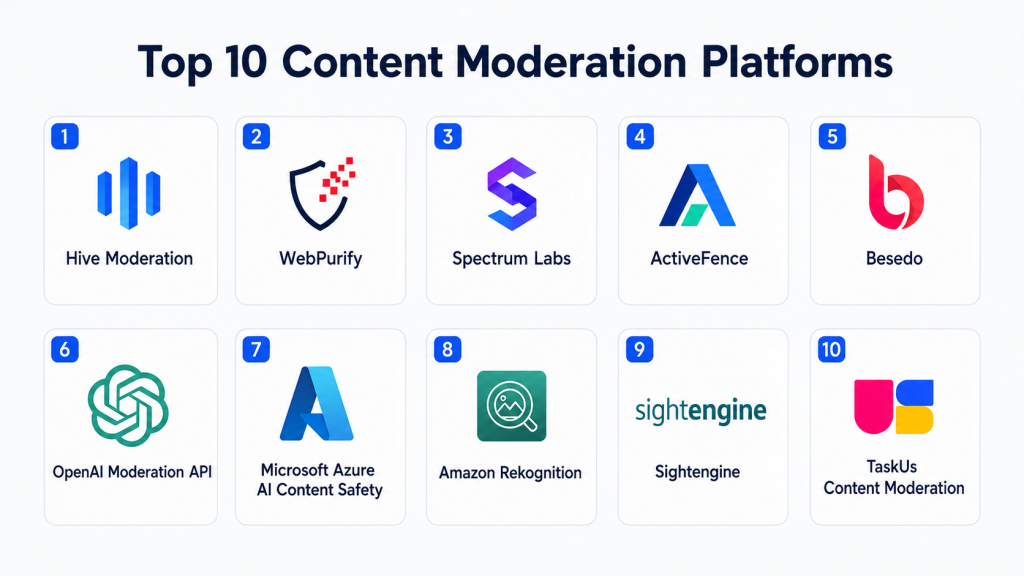
Top 10 Content Moderation Platforms
1 — Hive Moderation
Overview: Hive Moderation is an AI-powered content moderation platform that helps businesses review text, images, videos, audio, and livestream content. It is useful for social platforms, marketplaces, dating apps, gaming communities, and media-heavy products that need scalable content classification.
Key Features
- Image moderation for unsafe and policy-sensitive visuals.
- Video moderation for uploaded and streamed content.
- Text moderation for harmful or abusive language.
- Audio moderation support.
- Livestream moderation capabilities.
- API-based integration for product workflows.
- Custom moderation categories and threshold tuning.
Pros
- Strong coverage across multiple content formats.
- Useful for platforms with large volumes of media uploads.
- API-first design supports scalable product integration.
Cons
- Human review may still be required for edge cases.
- Teams need clear policies to tune moderation thresholds.
- May require technical implementation support.
Platforms / Deployment
Web, API
Cloud
Security & Compliance
Security details should be verified directly. Specific certifications such as SOC 2, ISO 27001, GDPR, or HIPAA should not be assumed unless confirmed. If uncertain: Not publicly stated.
Integrations & Ecosystem
Hive Moderation works well inside product content pipelines where user uploads need to be checked before or after publishing.
- Social media platforms.
- Dating and community apps.
- Gaming platforms.
- Marketplace listing systems.
- Media upload workflows.
- API and webhook-based moderation pipelines.
Support & Community
Hive provides product documentation and business support. Support depth may depend on usage volume, implementation complexity, and service plan.
2 — WebPurify
Overview: WebPurify provides profanity filtering, image moderation, video moderation, and human moderation services for digital platforms. It is useful for companies that want a combination of automated filters and human review without building everything internally.
Key Features
- Profanity filtering.
- Text moderation.
- Image moderation.
- Video moderation.
- Human moderation services.
- Custom blocklists and allowlists.
- API-based moderation workflows.
Pros
- Practical for quick moderation implementation.
- Offers both automated and human moderation options.
- Good fit for communities, marketplaces, and family-friendly platforms.
Cons
- May not provide deep trust and safety investigation workflows.
- Advanced behavioral detection may require additional tools.
- Human review costs can scale with content volume.
Platforms / Deployment
Web, API, managed moderation service
Cloud
Security & Compliance
Security practices should be verified directly. Specific compliance certifications are not publicly stated unless confirmed by the vendor.
Integrations & Ecosystem
WebPurify can be integrated into many types of user-generated content systems.
- Comment systems.
- Image upload workflows.
- Video review workflows.
- Community platforms.
- Ecommerce and marketplace listings.
- Custom product moderation dashboards.
Support & Community
WebPurify provides support and moderation service assistance. It is suitable for teams that need accessible moderation coverage without a large internal safety team.
3 — Spectrum Labs
Overview: Spectrum Labs is a trust and safety moderation platform focused on harmful behavior detection, abusive language, harassment, hate speech, grooming, spam, and community safety risks. It is useful for platforms that need stronger safety intelligence beyond basic content filtering.
Key Features
- AI-based harmful behavior detection.
- Toxicity, harassment, hate speech, and abuse detection.
- Real-time moderation signals.
- Policy-based enforcement workflows.
- Customizable safety models and rules.
- Review queue and escalation support.
- Reporting and moderation insights.
Pros
- Strong focus on community safety and behavior risk.
- Useful for high-volume user interaction platforms.
- Helps teams detect harmful patterns early.
Cons
- May be more advanced than needed for small communities.
- Requires clear community policies for best results.
- Pricing and implementation may vary by use case.
Platforms / Deployment
Web, API
Cloud
Security & Compliance
Security features may include access controls and data protection practices. Specific certifications should be verified directly. If uncertain: Not publicly stated.
Integrations & Ecosystem
Spectrum Labs fits platforms where user interaction, messaging, and behavioral safety are important.
- Online communities.
- Gaming platforms.
- Marketplaces.
- Social apps.
- User messaging systems.
- Safety reporting dashboards.
Support & Community
Support is business-focused and may include implementation assistance, onboarding, and moderation strategy guidance depending on customer needs.
4 — ActiveFence
Overview: ActiveFence is a trust and safety platform that helps organizations detect harmful content, dangerous activity, online abuse, fraud signals, misinformation risks, and coordinated platform abuse. It is best suited for platforms with complex safety needs and high-risk user-generated content.
Key Features
- Harmful content detection.
- Threat intelligence for online safety risks.
- Abuse and policy violation monitoring.
- Risk detection across content and behavior.
- Investigation and review workflows.
- Reporting and safety insights.
- Custom policy frameworks.
Pros
- Strong for mature trust and safety operations.
- Useful for proactive risk detection and investigation.
- Helps manage complex content and behavior risks.
Cons
- May be too advanced for basic comment moderation.
- Implementation may require safety operations expertise.
- Pricing and deployment needs may vary by organization.
Platforms / Deployment
Web, API
Cloud
Security & Compliance
Security features may include enterprise access controls and secure data handling. Specific certifications should be verified directly. If uncertain: Not publicly stated.
Integrations & Ecosystem
ActiveFence supports complex content safety and platform risk workflows.
- Content moderation.
- Abuse detection.
- Investigation workflows.
- Marketplace risk review.
- Social platform safety.
- Dashboard and API-based operations.
Support & Community
ActiveFence provides business support and trust and safety expertise. It is best suited for organizations with structured safety teams and higher-risk digital environments.
5 — Besedo
Overview: Besedo provides content moderation services and technology for online marketplaces, classifieds, dating platforms, and digital communities. It combines automated moderation with human review to help platforms manage listings, profiles, images, text, and policy violations.
Key Features
- Text moderation.
- Image moderation.
- Marketplace listing review.
- Human moderation services.
- Multilingual moderation support.
- Scam and fraud signal support.
- Quality control and reporting.
Pros
- Strong fit for marketplaces and classified platforms.
- Combines automation with trained human moderation.
- Useful for multilingual and region-specific moderation needs.
Cons
- May be less self-serve than pure API tools.
- Human moderation costs can grow with volume.
- Strong policy documentation is needed for best results.
Platforms / Deployment
Web, managed service, API options may vary
Cloud
Security & Compliance
Security and privacy practices should be verified directly. Specific certifications are not publicly stated unless confirmed by the vendor.
Integrations & Ecosystem
Besedo works well for platforms that need moderation operations and service support.
- Marketplace listings.
- Classified ads.
- Dating profiles.
- Community posts.
- Image and text review.
- Human moderation queues.
Support & Community
Besedo offers managed moderation support, operational expertise, and customer service. It is useful for businesses that want moderation technology plus human review coverage.
6 — OpenAI Moderation API
Overview: OpenAI Moderation API helps developers classify and detect potentially harmful content in applications, chat systems, AI products, user comments, and prompt workflows. It is useful for teams that want to add moderation checks into custom applications through API integration.
Key Features
- API-based harmful content classification.
- Text moderation for user-generated and AI-generated content.
- Useful for chat, prompt, and comment workflows.
- Developer-friendly implementation.
- Scalable cloud-based moderation.
- Can be used before publishing or responding.
- Fits custom safety pipelines.
Pros
- Strong fit for developer teams and AI application builders.
- Easy to integrate into custom content workflows.
- Useful for real-time moderation checks.
Cons
- Not a full moderation operations platform by itself.
- Human review workflows must be built separately.
- Teams need their own policy and escalation process.
Platforms / Deployment
API
Cloud
Security & Compliance
Security and data handling depend on implementation and service configuration. Specific compliance needs should be verified directly for the selected usage. If uncertain: Not publicly stated.
Integrations & Ecosystem
OpenAI Moderation API is useful as a moderation layer inside custom products.
- AI chat applications.
- Community comment systems.
- Prompt review workflows.
- Content publishing systems.
- Support automation workflows.
- Developer-built moderation dashboards.
Support & Community
Documentation and developer resources are available. Support depth depends on account type, implementation needs, and service usage.
7 — Microsoft Azure AI Content Safety
Overview: Microsoft Azure AI Content Safety helps detect harmful content across text and images. It is useful for enterprises, developers, and product teams that want to build moderation into applications, user-generated content workflows, and AI systems.
Key Features
- Text safety detection.
- Image safety detection.
- Harm category classification.
- API-based content moderation.
- Configurable safety thresholds.
- Enterprise cloud integration.
- Useful for AI and community safety workflows.
Pros
- Good fit for teams already using Microsoft cloud services.
- Useful for both user-generated and AI-generated content moderation.
- Scalable API-based approach.
Cons
- Requires engineering and workflow design.
- Not a complete human moderation platform by itself.
- Appeals, case management, and policy workflows may need separate systems.
Platforms / Deployment
API
Cloud
Security & Compliance
Azure provides enterprise cloud security controls depending on configuration. Specific compliance requirements should be verified based on deployment, region, and use case.
Integrations & Ecosystem
Azure AI Content Safety fits well into Microsoft-based product and enterprise environments.
- AI applications.
- Community platforms.
- User-generated content workflows.
- Data and analytics systems.
- Enterprise apps.
- Custom moderation dashboards.
Support & Community
Microsoft provides documentation, developer resources, cloud support, and enterprise assistance depending on account type and service plan.
8 — Amazon Rekognition
Overview: Amazon Rekognition is an image and video analysis service that can support content moderation workflows for visual media. It is useful for platforms that need to review images and videos for unsafe, explicit, violent, or policy-sensitive content.
Key Features
- Image moderation.
- Video analysis.
- Object and label detection.
- Visual content classification.
- API-based integration.
- Scalable content processing.
- Useful for upload review pipelines.
Pros
- Strong for visual content moderation.
- Useful for platforms with image and video uploads.
- Fits cloud-native product architectures.
Cons
- Not a full moderation operations platform.
- Teams must build policy logic and review workflows.
- Text and behavior moderation require additional tools.
Platforms / Deployment
API
Cloud
Security & Compliance
Cloud security controls may be available depending on configuration. Specific compliance requirements should be verified for the exact use case and region.
Integrations & Ecosystem
Amazon Rekognition fits visual moderation pipelines and product review systems.
- Image upload moderation.
- Video review workflows.
- Marketplace image checks.
- Media platform review.
- Data pipeline processing.
- Custom admin dashboards.
Support & Community
Documentation, developer resources, and cloud support options are available. It is best suited for engineering teams building moderation workflows into larger systems.
9 — Sightengine
Overview: Sightengine is a content moderation API platform for detecting unsafe images, videos, text, and user-generated content. It is useful for developers and platforms that need configurable moderation checks for visual and textual content.
Key Features
- Image moderation.
- Video moderation.
- Text moderation.
- Nudity, violence, and unsafe content detection.
- Profanity and abuse detection.
- API-based integration.
- Customizable moderation rules.
Pros
- Good developer-friendly moderation option.
- Covers both media and text use cases.
- Useful for products needing flexible API moderation.
Cons
- Human moderation workflows may need separate setup.
- Complex policy enforcement may require custom development.
- Enterprise features should be verified directly.
Platforms / Deployment
API
Cloud
Security & Compliance
Security and compliance details should be verified directly. Specific certifications are not publicly stated unless confirmed by the vendor.
Integrations & Ecosystem
Sightengine fits digital products that need moderation checks inside upload or publishing workflows.
- Social apps.
- Marketplaces.
- Community platforms.
- Dating apps.
- Media upload systems.
- Custom moderation dashboards.
Support & Community
Sightengine provides documentation and support resources. It is suitable for developer teams that want API-based moderation without building models from scratch.
10 — TaskUs Content Moderation
Overview: TaskUs provides outsourced content moderation and trust and safety operations services for digital platforms. It is useful for companies that need trained human moderation teams, queue management, escalation support, and operational scale.
Key Features
- Human content moderation services.
- Trust and safety operations support.
- Review queue management.
- Policy enforcement support.
- Multilingual moderation options may vary.
- Escalation and quality workflows.
- Operational reporting and workforce support.
Pros
- Strong fit for companies needing human review at scale.
- Useful for sensitive or complex moderation decisions.
- Helps reduce internal operational burden.
Cons
- Not a pure software-only platform.
- Requires clear policies, training, and quality control.
- Costs can increase with volume and coverage needs.
Platforms / Deployment
Managed service, web-based operational workflows may vary
Cloud / Managed service
Security & Compliance
Security and compliance details should be verified directly based on service agreement, region, and operational setup. If uncertain: Not publicly stated.
Integrations & Ecosystem
TaskUs supports content moderation as an operational service layer.
- Human review queues.
- Social platform moderation.
- Marketplace moderation.
- Gaming and community review.
- Escalation workflows.
- Trust and safety operations.
Support & Community
TaskUs provides business support, operational management, training, and service delivery teams. It is suitable for organizations that need scalable human moderation capacity.
Comparison Table
| Tool Name | Best For | Platform(s) Supported | Deployment | Standout Feature | Public Rating |
|---|---|---|---|---|---|
| Hive Moderation | Multimodal AI moderation | Web, API | Cloud | Text, image, video, audio, and livestream moderation | N/A |
| WebPurify | Profanity filtering and managed moderation | Web, API, managed service | Cloud | Automated plus human moderation support | N/A |
| Spectrum Labs | Community safety and harmful behavior detection | Web, API | Cloud | AI-based behavior and toxicity detection | N/A |
| ActiveFence | Complex trust and safety operations | Web, API | Cloud | Safety intelligence and risk detection | N/A |
| Besedo | Marketplace and classified moderation | Web, managed service, API options vary | Cloud | Human and automated marketplace moderation | N/A |
| OpenAI Moderation API | Developer-built text moderation | API | Cloud | API-based harmful content classification | N/A |
| Microsoft Azure AI Content Safety | Enterprise content safety APIs | API | Cloud | Text and image safety detection | N/A |
| Amazon Rekognition | Image and video moderation | API | Cloud | Visual content analysis | N/A |
| Sightengine | Developer-friendly media and text moderation | API | Cloud | Configurable moderation APIs | N/A |
| TaskUs Content Moderation | Human moderation operations | Managed service | Cloud / Managed service | Scalable human review teams | N/A |
Evaluation & Scoring of Content Moderation Platforms
| Tool Name | Core (25%) | Ease (15%) | Integrations (15%) | Security (10%) | Performance (10%) | Support (10%) | Value (15%) | Weighted Total |
|---|---|---|---|---|---|---|---|---|
| Hive Moderation | 9 | 8 | 9 | 7 | 8 | 8 | 8 | 8.20 |
| WebPurify | 7 | 8 | 8 | 6 | 7 | 8 | 8 | 7.45 |
| Spectrum Labs | 9 | 7 | 8 | 7 | 8 | 8 | 7 | 7.85 |
| ActiveFence | 9 | 7 | 8 | 8 | 8 | 8 | 7 | 7.95 |
| Besedo | 8 | 8 | 7 | 7 | 8 | 8 | 7 | 7.65 |
| OpenAI Moderation API | 8 | 8 | 9 | 7 | 8 | 7 | 8 | 8.00 |
| Microsoft Azure AI Content Safety | 8 | 8 | 9 | 8 | 8 | 8 | 7 | 8.05 |
| Amazon Rekognition | 8 | 7 | 9 | 8 | 8 | 8 | 7 | 7.90 |
| Sightengine | 8 | 8 | 8 | 6 | 8 | 7 | 8 | 7.65 |
| TaskUs Content Moderation | 8 | 7 | 6 | 7 | 8 | 9 | 7 | 7.40 |
The scores are comparative and should be used as a practical selection guide, not as a universal ranking. A media-heavy platform may value image and video moderation more than text review. A social community may need behavior detection and human escalation. A developer team may prefer API-first tools, while a large platform may need managed human moderation. The best choice depends on content type, risk level, review volume, internal policy maturity, and technical capacity.
Which Content Moderation Platform Is Right for You?
Solo / Small Community
Small communities, forums, creator groups, and early-stage products usually need basic profanity filtering, simple user report handling, and lightweight automated moderation. WebPurify, Sightengine, and OpenAI Moderation API can be practical starting points because they are easier to integrate than large trust and safety platforms.
Best fit: WebPurify, Sightengine, OpenAI Moderation API.
SMB
Small and mid-sized platforms often need stronger moderation across comments, images, user profiles, and marketplace listings. Hive Moderation, WebPurify, Sightengine, and Microsoft Azure AI Content Safety are suitable options depending on content type and engineering resources.
Best fit: Hive Moderation, WebPurify, Sightengine, Microsoft Azure AI Content Safety.
Mid-Market
Mid-market platforms usually need review queues, policy controls, escalation workflows, media moderation, multilingual support, and safety reporting. Spectrum Labs, Hive Moderation, Besedo, ActiveFence, and TaskUs Content Moderation can support more mature moderation operations.
Best fit: Spectrum Labs, Hive Moderation, Besedo, ActiveFence, TaskUs Content Moderation.
Enterprise
Large platforms need reliable moderation at scale, auditability, policy enforcement, human review workflows, media coverage, integration flexibility, and strong privacy controls. ActiveFence, Hive Moderation, Spectrum Labs, Microsoft Azure AI Content Safety, Amazon Rekognition, and TaskUs Content Moderation are strong candidates depending on moderation strategy.
Best fit: ActiveFence, Hive Moderation, Spectrum Labs, Microsoft Azure AI Content Safety, Amazon Rekognition, TaskUs Content Moderation.
Budget vs Premium
Budget-conscious teams may start with API-based moderation tools such as OpenAI Moderation API, Sightengine, WebPurify, Microsoft Azure AI Content Safety, or Amazon Rekognition. Premium or high-risk platforms may need specialized solutions such as ActiveFence, Spectrum Labs, Hive Moderation, Besedo, or TaskUs Content Moderation.
Feature Depth vs Ease of Use
WebPurify is easier for profanity filtering and basic human moderation support. OpenAI Moderation API, Sightengine, Azure AI Content Safety, and Amazon Rekognition are flexible but need engineering work. Hive Moderation, Spectrum Labs, ActiveFence, Besedo, and TaskUs provide deeper moderation coverage for platforms with complex trust and safety needs.
Integrations & Scalability
Platforms with high content volume should evaluate API reliability, latency, webhook support, dashboard workflows, review queues, data exports, and policy rule flexibility. Engineering teams should also test how moderation decisions flow into product actions such as blocking, hiding, flagging, warning, escalating, or suspending users.
Security & Compliance Needs
Content moderation platforms may process sensitive messages, images, videos, reports, profile data, enforcement actions, and user behavior signals. Buyers should review access controls, encryption, audit logs, data retention, privacy policies, regional data handling, user permissions, and vendor security documentation before selecting a platform.
Frequently Asked Questions
1. What is a Content Moderation Platform?
A Content Moderation Platform helps detect, review, filter, and manage user-generated content such as comments, images, videos, messages, listings, and profiles. It helps enforce platform rules and protect users.
2. Who needs content moderation software?
Social platforms, marketplaces, gaming apps, dating apps, forums, ecommerce sites, review platforms, media companies, and creator communities can benefit from content moderation software.
3. What types of content can be moderated?
Many platforms can moderate text, images, videos, audio, livestreams, usernames, profile descriptions, comments, links, reviews, and marketplace listings. Coverage varies by tool.
4. Can AI moderation replace human moderators?
No, AI moderation can reduce workload and detect common risks quickly, but human moderators are still needed for context, appeals, sensitive issues, and complex policy decisions.
5. What is the difference between automated and human moderation?
Automated moderation uses rules or AI to detect risky content quickly. Human moderation uses trained reviewers to make judgment-based decisions, especially when context matters.
6. Are content moderation platforms suitable for small websites?
Yes, but small websites should choose lightweight tools. A simple profanity filter, report button, and basic review workflow may be enough for low-volume communities.
7. How do platforms reduce false positives?
They reduce false positives by tuning thresholds, testing real content samples, adding human review, customizing policies, and reviewing moderation decisions regularly.
8. Do content moderation tools support multiple languages?
Some tools support multiple languages, while others are stronger in specific languages or content types. Global platforms should verify language coverage before purchase.
9. What mistakes should companies avoid when choosing moderation software?
Common mistakes include relying only on AI, skipping policy design, ignoring appeals, not testing real content, overlooking privacy, and failing to train moderation teams.
10. What are alternatives to content moderation platforms?
Alternatives include manual review, community moderators, keyword filters, support desk workflows, custom AI models, forum plugins, and general cloud AI services. These may work for simple needs but can become difficult as volume grows.
Conclusion
Content Moderation Platforms help digital businesses create safer, cleaner, and more trustworthy online experiences. They reduce the burden of manual review, detect harmful content faster, support policy enforcement, and help protect users from abuse, spam, scams, explicit content, and unsafe interactions. Hive Moderation is strong for multimodal AI moderation, while WebPurify and Sightengine are practical for simpler API-based moderation needs. Spectrum Labs and ActiveFence are better for deeper trust and safety operations. Besedo and TaskUs Content Moderation are useful when human review and managed services are important. OpenAI Moderation API, Microsoft Azure AI Content Safety, and Amazon Rekognition are strong choices for developer teams building custom moderation systems. The best platform depends on your content type, moderation volume, risk profile, policy maturity, and internal resources. Start by shortlisting two or three platforms, testing them with real content samples, reviewing false positives, checking integration effort, and confirming security before making a final decision.
