Introduction
Mindfulness and meditation apps help people build calmer, healthier daily habits through guided meditation, breathing exercises, sleep stories, focus sessions, emotional check-ins, and stress-management programs. Instead of learning meditation only through books or offline classes, users can now access structured wellness practices directly from their phone, tablet, or web browser.
These apps matter because stress, distraction, burnout, poor sleep, and emotional fatigue are now common challenges for students, working professionals, founders, parents, and teams. A good mindfulness app can support better focus, calmer thinking, healthier sleep routines, and more consistent self-care.
Common use cases include daily guided meditation, sleep support, anxiety management, breathing exercises, workplace wellness, habit tracking, and beginner-friendly mindfulness learning.
Before choosing an app, buyers should evaluate content quality, ease of use, teacher credibility, personalization, sleep tools, progress tracking, offline access, family or team plans, pricing, privacy practices, and platform support.
Best for: individuals, students, professionals, remote workers, wellness-focused teams, HR leaders, therapists, coaches, and people looking for structured self-care support.
Not ideal for: users needing urgent medical care, clinical therapy, crisis support, or a full replacement for a licensed mental health professional. In such cases, professional support is more suitable.
Key Trends in Mindfulness & Meditation Apps
- Personalized meditation journeys are becoming more important, where apps recommend sessions based on mood, stress level, sleep quality, and user goals.
- AI-assisted recommendations are helping users discover relevant meditation, sleep, focus, and breathing content faster.
- Sleep wellness is now a core feature, not just an add-on. Many apps include sleep stories, soundscapes, bedtime meditations, and wind-down programs.
- Workplace wellness adoption is growing, with companies using mindfulness apps to support employee stress management and focus.
- Short-form meditation is in demand, especially for busy professionals who prefer sessions of a few minutes.
- Mental fitness positioning is increasing, where apps focus on long-term emotional resilience, not only relaxation.
- Teacher-led content remains a trust factor, especially when apps feature experienced meditation teachers, psychologists, authors, or wellness educators.
- Privacy and data handling are becoming stronger buyer criteria, especially for users sharing mood, stress, sleep, and emotional wellness information.
- Multi-platform access matters, with users expecting mobile apps, web access, offline listening, and wearable compatibility.
- Freemium models remain common, but users are becoming more selective about paid subscriptions and content value.
How We Selected These Tools
The tools in this list were selected using a practical product-analysis approach. The focus is not only popularity, but also usability, content depth, accessibility, and overall fit for different user types.
Selection factors included:
- Market recognition and general user awareness
- Quality and variety of guided meditation content
- Sleep, breathing, focus, and stress-management features
- Beginner-friendly onboarding and daily habit-building support
- Platform availability across mobile and web
- Suitability for individuals, families, teams, and wellness programs
- Pricing flexibility, free access, or trial availability where commonly known
- Teacher quality, content structure, and learning depth
- Privacy and security transparency where available
- Overall usefulness for real-world mindfulness routines
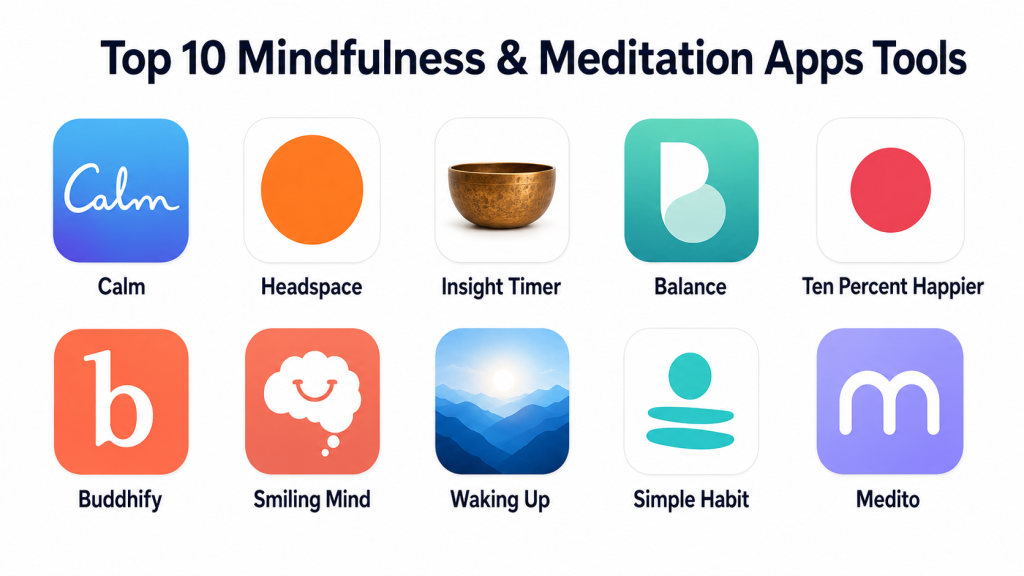
Top 10 Mindfulness & Meditation Apps Tools
1 — Calm
Short description: Calm is one of the most widely recognized mindfulness and sleep apps. It is designed for users who want guided meditation, sleep stories, breathing exercises, music, and relaxation content in one simple app.
Key Features
- Guided meditations for stress, anxiety, focus, gratitude, and relaxation
- Sleep stories and bedtime audio content
- Breathing exercises for quick calming sessions
- Music and soundscapes for focus and rest
- Beginner-friendly meditation programs
- Daily mindfulness sessions
- Content for individuals and workplace wellness users
Pros
- Strong sleep and relaxation content library
- Easy interface for beginners
- Good variety of meditation lengths and topics
Cons
- Many useful features require a paid subscription
- Content volume may feel overwhelming for new users
- Not a replacement for therapy or clinical care
Platforms / Deployment
iOS / Android / Web
Cloud-based app delivery
Security & Compliance
General account security and privacy controls are available, but detailed enterprise-level compliance details are not publicly stated for all plans. SOC 2, ISO 27001, HIPAA, audit logs, and RBAC are not publicly stated.
Integrations & Ecosystem
Calm works mainly as a consumer wellness app, with additional workplace wellness use cases. Its ecosystem is focused on content access, mobile usage, and wellness engagement.
- Mobile app access
- Web access
- Workplace wellness availability
- Sleep and relaxation audio library
- Possible wearable and platform-level health integrations may vary
Support & Community
Calm provides help resources, app support, and guided onboarding through its product experience. Community strength is mostly brand-led rather than open-community based.
2 — Headspace
Short description: Headspace is a popular mindfulness app known for structured meditation courses, simple explanations, and beginner-friendly design. It is suitable for individuals, families, and workplace wellness programs.
Key Features
- Guided meditation courses for beginners and experienced users
- Sleepcasts, wind-down exercises, and sleep music
- Focus music and productivity support
- Breathing and stress relief exercises
- Mindfulness programs for work and daily life
- Friendly visual design and simple learning flow
- Team and organization-focused wellness options
Pros
- Excellent for beginners
- Strong structured learning experience
- Good mix of meditation, sleep, and focus tools
Cons
- Premium content is subscription-based
- Some users may prefer deeper traditional meditation teachings
- Business features may not be necessary for casual users
Platforms / Deployment
iOS / Android / Web
Cloud-based app delivery
Security & Compliance
Privacy practices are available through the app’s policy, but detailed technical controls such as SOC 2, ISO 27001, HIPAA, SSO/SAML, audit logs, and RBAC are not publicly stated for all users.
Integrations & Ecosystem
Headspace has a strong ecosystem around personal wellness, workplace wellbeing, and guided learning. It is often used by individuals and organizations seeking structured mindfulness content.
- Mobile and web access
- Workplace wellness options
- Sleep and focus content
- Guided courses
- Possible health platform integrations may vary
Support & Community
Headspace offers user support, onboarding guidance, help articles, and a strong brand-led community presence. Business users may receive more structured support depending on plan.
3 — Insight Timer
Short description: Insight Timer is a meditation app known for its large free library, teacher-led sessions, music, talks, and community features. It is ideal for users who want content variety and access to many meditation styles.
Key Features
- Large library of guided meditations
- Meditation timer with customizable bells
- Teacher talks and mindfulness courses
- Sleep music and sound healing content
- Community groups and live sessions
- Free content availability
- Wide range of meditation traditions and styles
Pros
- Strong free content library
- Great for users who want variety
- Community and teacher ecosystem is a major advantage
Cons
- Content quality may vary by teacher
- Interface can feel busy due to large content volume
- Beginners may need time to find the right path
Platforms / Deployment
iOS / Android / Web
Cloud-based app delivery
Security & Compliance
Basic account and privacy practices are available, but detailed compliance such as SOC 2, ISO 27001, HIPAA, SSO/SAML, audit logs, and RBAC are not publicly stated.
Integrations & Ecosystem
Insight Timer has a strong creator and teacher ecosystem. Users can explore meditation through different traditions, instructors, and wellness communities.
- Teacher-led content
- Live sessions
- Community groups
- Meditation timer
- Courses and audio library
- Web and mobile access
Support & Community
Community strength is one of Insight Timer’s key advantages. Support is available through help resources, while the wider ecosystem includes teachers, groups, and live content.
4 — Balance
Short description: Balance is a meditation app focused on personalization. It asks users about goals, experience level, and mood to create guided meditation plans that feel more tailored.
Key Features
- Personalized meditation plans
- Guided sessions for stress, sleep, focus, and anxiety
- Audio coaching style experience
- Progress-based recommendations
- Breathing and relaxation tools
- Beginner-friendly structure
- Short and practical meditation sessions
Pros
- Strong personalization experience
- Simple and clean interface
- Good for users who want guided structure
Cons
- Smaller content ecosystem than some larger apps
- Some features may require paid access
- Less community-driven than apps like Insight Timer
Platforms / Deployment
iOS / Android
Web availability may vary
Cloud-based app delivery
Security & Compliance
Detailed enterprise-grade security and compliance information such as SOC 2, ISO 27001, HIPAA, SSO/SAML, RBAC, and audit logs is not publicly stated.
Integrations & Ecosystem
Balance is more focused on personalized meditation delivery than a broad integration marketplace. Its ecosystem is centered on guided plans and adaptive content.
- Personalized plans
- Mobile app experience
- Progress tracking
- Sleep and stress programs
- Mood and goal-based recommendations
Support & Community
Support is available through app help channels. Community depth is limited compared with larger teacher-marketplace meditation apps.
5 — Ten Percent Happier
Short description: Ten Percent Happier is a meditation app designed for practical, skeptical, and learning-focused users. It combines meditation instruction with teachers, courses, and real-world mindfulness explanations.
Key Features
- Guided meditations from experienced teachers
- Practical mindfulness courses
- Content for stress, focus, anxiety, and emotional balance
- Clear explanations for beginners
- Talks and lessons alongside meditation sessions
- Teacher-led learning paths
- Good fit for users who prefer grounded guidance
Pros
- Strong practical teaching style
- Good for users who want depth without spiritual confusion
- Helpful for beginners who are unsure about meditation
Cons
- Less focused on sleep entertainment than Calm
- Paid access may be needed for full value
- Interface may feel more learning-focused than casual
Platforms / Deployment
iOS / Android / Web
Cloud-based app delivery
Security & Compliance
Privacy information is available, but detailed security and compliance controls such as SOC 2, ISO 27001, HIPAA, SSO/SAML, audit logs, and RBAC are not publicly stated.
Integrations & Ecosystem
The app’s ecosystem is based on teacher-led mindfulness learning and practical courses. It is suitable for users who want education plus practice.
- Teacher-led courses
- Guided meditations
- Practical mindfulness lessons
- Mobile and web access
- Topic-based programs
Support & Community
Ten Percent Happier provides support resources and a strong educational content base. Community is more content-driven than social-network driven.
6 — Buddhify
Short description: Buddhify is a mindfulness app built around meditation for everyday situations. It is useful for people who want simple guided practices for travel, work, sleep, stress, and daily routines.
Key Features
- Situation-based meditation categories
- Guided sessions for travel, work, sleep, and stress
- Simple app design
- Short meditations for busy users
- Beginner-friendly content
- Offline-friendly listening options may vary by platform
- Practical mindfulness approach
Pros
- Very practical for daily situations
- Simple and less distracting interface
- Good for quick meditation sessions
Cons
- Content library may be smaller than larger platforms
- Fewer enterprise or team features
- Less advanced personalization than some newer apps
Platforms / Deployment
iOS / Android
Cloud-based app delivery
Web support may vary
Security & Compliance
Detailed security and compliance information such as SOC 2, ISO 27001, HIPAA, SSO/SAML, RBAC, and audit logs is not publicly stated.
Integrations & Ecosystem
Buddhify is mainly focused on mobile mindfulness use rather than large integration ecosystems. It is best viewed as a personal meditation companion.
- Mobile app access
- Situation-based content
- Guided audio sessions
- Offline use may vary
- Personal wellness focus
Support & Community
Support is generally app-based. Community and enterprise support are not as strong as larger meditation platforms.
7 — Smiling Mind
Short description: Smiling Mind is a mindfulness app known for accessible programs for individuals, children, families, schools, and workplaces. It is especially useful where structured mental wellbeing education is important.
Key Features
- Mindfulness programs for different age groups
- Content for children, families, schools, and workplaces
- Guided meditations and wellbeing exercises
- Simple and educational approach
- Stress and emotional regulation support
- Beginner-friendly design
- Strong fit for learning environments
Pros
- Good for families and education-focused users
- Simple and accessible structure
- Useful for group wellbeing programs
Cons
- May feel less premium or entertainment-focused than Calm
- Advanced personalization may be limited
- Business-grade compliance details are not fully clear
Platforms / Deployment
iOS / Android / Web
Cloud-based app delivery
Security & Compliance
Privacy practices are available, but detailed controls such as SOC 2, ISO 27001, HIPAA, SSO/SAML, audit logs, and RBAC are not publicly stated.
Integrations & Ecosystem
Smiling Mind has a strong education and wellbeing ecosystem. It is useful for users who want structured programs rather than only standalone meditation tracks.
- School-friendly programs
- Family mindfulness content
- Workplace wellbeing content
- Mobile and web access
- Guided learning paths
Support & Community
Support includes help resources and educational guidance. Community strength is linked to schools, families, and wellbeing-focused users.
8 — Waking Up
Short description: Waking Up is a meditation and philosophy app focused on deeper mindfulness practice, self-inquiry, and theory. It is best for users who want serious meditation learning beyond basic relaxation.
Key Features
- Guided meditations for awareness and mindfulness
- Theory lessons and conversations
- Structured introductory course
- Content from meditation teachers and thinkers
- Focus on deeper practice and self-understanding
- Audio-based learning experience
- Strong fit for reflective users
Pros
- Excellent for deeper mindfulness learning
- Strong educational and philosophical content
- Good for users who want more than stress relief
Cons
- May feel too deep for casual users
- Less focused on sleep stories and entertainment
- Not the simplest choice for very young users
Platforms / Deployment
iOS / Android / Web
Cloud-based app delivery
Security & Compliance
Detailed enterprise-level security and compliance information such as SOC 2, ISO 27001, HIPAA, SSO/SAML, audit logs, and RBAC is not publicly stated.
Integrations & Ecosystem
Waking Up is focused on learning, meditation practice, and deeper conversations rather than external integrations.
- Guided courses
- Audio lessons
- Teacher conversations
- Mobile and web access
- Structured learning paths
Support & Community
Support is available through app channels. Community is more learning-focused and audience-driven than open social-community based.
9 — Simple Habit
Short description: Simple Habit is a meditation app designed for busy people who want quick sessions for stress, sleep, focus, and emotional balance. It is suitable for professionals who prefer short guided practices.
Key Features
- Quick meditation sessions
- Stress, sleep, focus, and anxiety topics
- Guided content from teachers
- Simple category-based discovery
- Practical sessions for work and daily life
- Mobile-first experience
- Beginner-friendly content
Pros
- Good for busy professionals
- Easy to start with short sessions
- Practical everyday meditation topics
Cons
- Content depth may vary by teacher
- Some users may outgrow short-form structure
- Detailed security and compliance visibility is limited
Platforms / Deployment
iOS / Android
Web availability may vary
Cloud-based app delivery
Security & Compliance
Detailed security and compliance controls such as SOC 2, ISO 27001, HIPAA, SSO/SAML, RBAC, and audit logs are not publicly stated.
Integrations & Ecosystem
Simple Habit focuses on quick meditation and daily stress support. Its ecosystem is mainly content-based rather than integration-heavy.
- Mobile app access
- Teacher-led sessions
- Topic-based meditation
- Sleep and focus content
- Short-form wellness library
Support & Community
Support is available through app resources. Community and enterprise support depth are not publicly stated.
10 — Medito
Short description: Medito is a mindfulness and meditation app focused on accessible meditation learning. It is suitable for users who want a simple, low-barrier way to start meditation without heavy commercial pressure.
Key Features
- Guided meditations for beginners
- Sleep and relaxation content
- Breathing and calming exercises
- Simple interface
- Course-style meditation learning
- Accessible approach to mindfulness
- Useful for users seeking a lightweight option
Pros
- Easy for beginners
- Simple and low-friction experience
- Good alternative for users avoiding expensive subscriptions
Cons
- Smaller content library than major paid apps
- Fewer advanced personalization features
- Enterprise features are limited or not publicly stated
Platforms / Deployment
iOS / Android
Cloud-based app delivery
Web availability may vary
Security & Compliance
Detailed security and compliance information such as SOC 2, ISO 27001, HIPAA, SSO/SAML, RBAC, and audit logs is not publicly stated.
Integrations & Ecosystem
Medito is focused on simple meditation access rather than a broad integration ecosystem.
- Mobile app access
- Guided courses
- Sleep content
- Breathing practices
- Beginner meditation programs
Support & Community
Support and community resources are more limited than larger commercial platforms. It remains useful for users who want a simple meditation starting point.
Comparison Table
| Tool Name | Best For | Platform(s) Supported | Deployment | Standout Feature | Public Rating |
|---|---|---|---|---|---|
| Calm | Sleep, relaxation, daily meditation | iOS, Android, Web | Cloud | Sleep stories and relaxation library | N/A |
| Headspace | Beginners, families, workplace wellness | iOS, Android, Web | Cloud | Structured beginner-friendly meditation courses | N/A |
| Insight Timer | Free content, community, teacher variety | iOS, Android, Web | Cloud | Large teacher-led meditation library | N/A |
| Balance | Personalized meditation plans | iOS, Android | Cloud | Adaptive guided meditation experience | N/A |
| Ten Percent Happier | Practical meditation learning | iOS, Android, Web | Cloud | Teacher-led practical mindfulness courses | N/A |
| Buddhify | Everyday situation-based meditation | iOS, Android | Cloud | Meditation by daily life situation | N/A |
| Smiling Mind | Families, schools, wellbeing programs | iOS, Android, Web | Cloud | Age-group and education-friendly programs | N/A |
| Waking Up | Deep mindfulness and philosophy | iOS, Android, Web | Cloud | Meditation plus theory and self-inquiry | N/A |
| Simple Habit | Busy professionals | iOS, Android | Cloud | Short meditation sessions for daily stress | N/A |
| Medito | Beginners seeking accessible meditation | iOS, Android | Cloud | Simple guided meditation without heavy complexity | N/A |
Evaluation & Scoring of Mindfulness & Meditation Apps
| Tool Name | Core (25%) | Ease (15%) | Integrations (15%) | Security (10%) | Performance (10%) | Support (10%) | Value (15%) | Weighted Total (0–10) |
|---|---|---|---|---|---|---|---|---|
| Calm | 9 | 9 | 7 | 6 | 9 | 8 | 7 | 8.05 |
| Headspace | 9 | 9 | 7 | 6 | 9 | 8 | 7 | 8.05 |
| Insight Timer | 9 | 7 | 8 | 6 | 8 | 8 | 9 | 8.05 |
| Balance | 8 | 9 | 6 | 5 | 8 | 7 | 8 | 7.45 |
| Ten Percent Happier | 8 | 8 | 6 | 5 | 8 | 8 | 7 | 7.30 |
| Buddhify | 7 | 8 | 5 | 5 | 8 | 6 | 8 | 6.95 |
| Smiling Mind | 7 | 8 | 6 | 5 | 8 | 7 | 9 | 7.30 |
| Waking Up | 8 | 7 | 6 | 5 | 8 | 7 | 7 | 7.05 |
| Simple Habit | 7 | 8 | 5 | 5 | 8 | 6 | 7 | 6.80 |
| Medito | 6 | 8 | 5 | 5 | 7 | 6 | 9 | 6.85 |
These scores are comparative, not absolute. A higher score means the app performs strongly across multiple buyer criteria, but it may not be the best fit for every user. For example, Calm scores well for sleep and relaxation, while Waking Up may be better for deeper mindfulness study. Security scores are conservative because detailed compliance information is not publicly stated for many consumer wellness apps. Buyers should validate privacy, pricing, and platform needs before selecting a paid plan.
Which Mindfulness & Meditation App Is Right for You?
Solo / Freelancer
Solo users usually need simplicity, affordability, and daily consistency. If you want better sleep and relaxation, Calm is a strong choice. If you are new to meditation and want structured learning, Headspace is easy to start with. If budget matters, Insight Timer and Medito are practical options because they provide accessible meditation content without forcing a complex buying process.
For freelancers dealing with stress, focus issues, or irregular schedules, Simple Habit and Buddhify can also work well because they offer short sessions for daily situations.
SMB
Small businesses should look for apps that are easy to introduce without heavy implementation. Headspace and Calm are strong choices for wellness initiatives because they are familiar, polished, and easy for employees to understand.
Smiling Mind can be useful for organizations that want simple wellbeing education. Insight Timer may be helpful if employees prefer variety and teacher choice, although it may require more self-direction.
Mid-Market
Mid-market organizations usually need better onboarding, employee engagement, and wellness reporting. Calm and Headspace are often better suited because they have stronger brand recognition and broader content libraries.
For teams that want deeper emotional resilience and practical mindfulness education, Ten Percent Happier can be a good fit. The key is to choose an app that employees will actually use, not just one with the longest feature list.
Enterprise
Enterprises should evaluate privacy, support, user management, engagement reporting, contract options, and employee accessibility. Headspace and Calm are usually the most relevant starting points for larger wellness programs.
However, enterprise buyers should not rely only on app popularity. They should validate security documentation, data handling, admin features, employee adoption support, and whether the content fits different cultures, roles, and stress patterns.
Budget vs Premium
For budget-conscious users, Medito and Insight Timer are strong starting points. They provide useful meditation access without requiring every user to begin with a premium subscription.
For premium experiences, Calm, Headspace, Balance, and Ten Percent Happier offer more polished journeys, structured programs, and deeper content organization. The right choice depends on whether you value sleep content, beginner education, personalization, or teacher-led learning.
Feature Depth vs Ease of Use
Calm and Headspace offer a good balance between depth and ease of use. Insight Timer provides excellent depth but may feel less guided for beginners due to its large library.
Balance is strong for users who want guided personalization. Waking Up offers depth, but it may require more interest in philosophy and deeper meditation concepts.
Integrations & Scalability
For individuals, integrations may not matter much. For teams, scalability matters more. Buyers should check whether the app supports organization plans, onboarding, engagement tools, user management, and reporting.
Calm and Headspace are generally stronger candidates for broader organizational use. Most other apps are better suited for individual wellness or small-group adoption.
Security & Compliance Needs
Mindfulness apps may collect sensitive wellness-related information, including mood, sleep, stress, and usage behavior. Users and organizations should review privacy practices carefully.
For personal use, basic privacy awareness may be enough. For workplace use, teams should validate data handling, admin permissions, access controls, compliance documentation, retention policies, and whether employee usage data is visible to employers.
Frequently Asked Questions
1. What are mindfulness and meditation apps used for?
They are used for guided meditation, stress relief, sleep support, breathing exercises, focus improvement, and emotional balance. Many users also use them to build a daily self-care routine.
2. Are mindfulness apps suitable for beginners?
Yes, many apps are designed for beginners. Headspace, Calm, Balance, Smiling Mind, and Medito are especially beginner-friendly because they offer guided sessions and simple learning paths.
3. Can meditation apps replace therapy?
No. Meditation apps can support general wellbeing, but they are not a replacement for licensed therapy, medical care, or crisis support. Users with serious mental health concerns should seek professional help.
4. Which app is best for sleep?
Calm is a strong choice for sleep because of its sleep stories, relaxing audio, and bedtime content. Headspace also offers useful sleepcasts and wind-down exercises.
5. Which app is best for free meditation content?
Insight Timer and Medito are strong options for users who want accessible meditation content. Insight Timer is especially known for a large library of teacher-led sessions.
6. What pricing models do these apps usually use?
Most apps use freemium or subscription-based pricing. Some offer limited free content, while premium plans unlock larger libraries, courses, sleep tools, or personalization features.
7. What is the most common mistake when choosing a meditation app?
The biggest mistake is choosing based only on popularity. The best app depends on your goal, such as sleep, stress relief, focus, beginner learning, deep practice, or workplace wellness.
8. Are mindfulness apps secure?
Most apps provide basic account and privacy controls, but detailed security and compliance information is not always publicly stated. Organizations should review privacy and compliance documents before buying team plans.
9. Can businesses use meditation apps for employee wellness?
Yes, many organizations use mindfulness apps to support employee wellbeing. Calm and Headspace are common options for workplace wellness, but buyers should validate admin, privacy, and reporting needs.
10. How long does onboarding usually take?
For individuals, onboarding can be very quick because most apps guide users through goals and recommended sessions. For teams or enterprises, onboarding depends on plan type, employee count, communication, and adoption strategy.
Conclusion
Mindfulness and meditation apps can be very useful when they match the user’s real needs. Calm and Headspace are strong all-round options for sleep, stress, and beginner meditation. Insight Timer is excellent for users who want variety and free content. Balance is helpful for personalization, while Ten Percent Happier and Waking Up are better for people who want deeper learning and practical mindfulness education. Buddhify, Simple Habit, Smiling Mind, and Medito are also valuable depending on budget, lifestyle, and use case.
There is no single best app for everyone. The right choice depends on your goal, comfort level, budget, preferred teaching style, and whether you are buying for yourself, your family, or your organization. A smart next step is to shortlist two or three apps, test them for a few days, compare content quality, check pricing, and review privacy details before committing to a paid plan.
