Introduction
Infrastructure monitoring tools are software solutions that track, analyze, and alert IT teams about the performance, health, and availability of servers, networks, databases, and cloud services. They provide real-time insights that help prevent downtime, optimize resources, and improve overall IT reliability.
In modern IT environments, including hybrid cloud, containers, and distributed systems, continuous monitoring is critical. Infrastructure monitoring tools allow businesses to detect anomalies, troubleshoot quickly, and ensure consistent service delivery.
Real-world use cases
- Monitoring CPU, memory, disk, and network usage
- Tracking performance metrics for cloud and on-prem systems
- Alerting teams to outages or degraded performance
- Observing containerized applications and microservices
- Capacity planning and predictive resource management
Evaluation criteria for buyers
- Multi-platform support for cloud, hybrid, and on-premises
- Real-time alerting and anomaly detection
- Integration with DevOps and IT operations workflows
- Custom dashboards and reporting
- Scalability for large infrastructures
- Ease of deployment and agent configuration
- Security and compliance capabilities
- API and automation support
- Pricing and licensing models
Best for: IT managers, DevOps engineers, SREs, network administrators, and enterprises with complex infrastructure
Not ideal for: Small organizations with minimal infrastructure or static systems
Key Trends in Infrastructure Monitoring Tools
- AI-driven predictive analytics for anomaly detection and root cause analysis
- Cloud-native monitoring for containers and serverless environments
- Automated remediation and self-healing integration
- Unified dashboards for hybrid and multi-cloud environments
- Security and compliance monitoring built-in
- Real-time alerting integrated with incident response platforms
- API-first design for DevOps integration
- Open-source and SaaS offerings gaining popularity
- Scalability for large distributed systems and IoT
- Flexible subscription and usage-based pricing models
How We Selected These Tools
- Evaluated market adoption and customer base
- Reviewed feature completeness including alerting, visualization, and automation
- Assessed reliability and performance in production
- Considered security posture and compliance features
- Analyzed integrations with DevOps, ITSM, and cloud platforms
- Evaluated scalability for large hybrid environments
- Balanced open-source and commercial solutions
- Reviewed documentation, onboarding, and community support
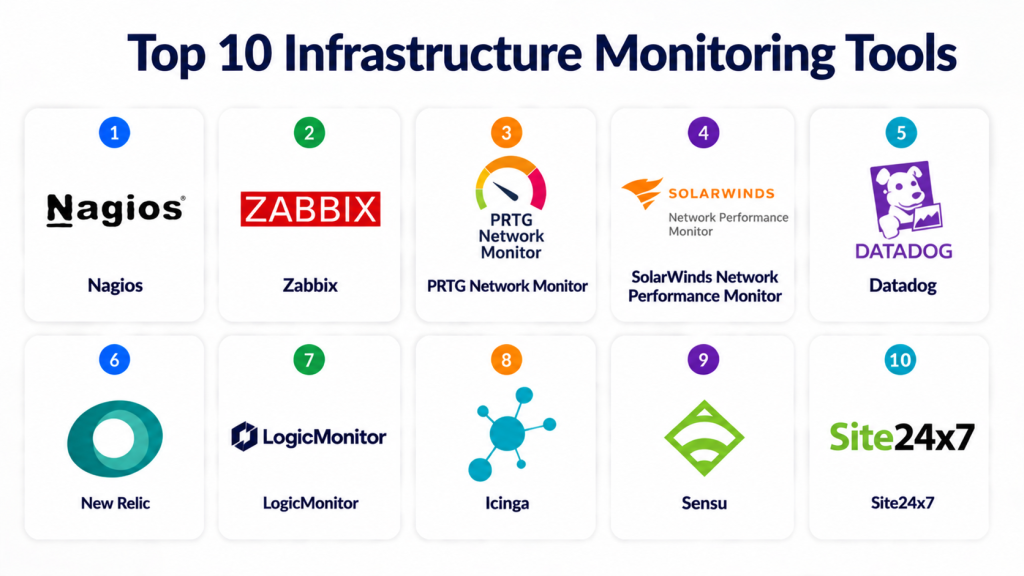
Top 10 Infrastructure Monitoring Tools
#1 — Nagios
Short description: Open-source monitoring tool for servers, networks, and applications suitable for small to large IT environments
Key Features
- Server, network, and application monitoring
- Real-time alerts and notifications
- Plugin-based extensibility
- Web-based dashboards
- Customizable alert thresholds
- Event handling and automation
Pros
- Highly flexible and extensible
- Strong open-source community
- Scales from small to large environments
Cons
- Configuration complexity for large deployments
- Limited native cloud support
Platforms / Deployment
Linux / Windows
Self-hosted / Hybrid
Security & Compliance
SSL/TLS for web interface
Not publicly stated
Integrations & Ecosystem
- Plugin integrations for apps
- APIs for automation
- ITSM tool compatibility
Support & Community
Community support
Commercial support available
Comprehensive documentation
#2 — Zabbix
Short description: Enterprise-grade platform for servers, networks, applications, and cloud services
Key Features
- Auto-discovery of network devices and hosts
- Real-time performance monitoring
- Advanced alerting and notifications
- Historical data storage and trending
- Custom dashboards and reports
- API and automation support
Pros
- Open-source with enterprise-grade features
- Scales for large infrastructures
- Strong visualization capabilities
Cons
- Initial setup and configuration can be complex
- Advanced features require expertise
Platforms / Deployment
Linux / Windows
Self-hosted / Hybrid
Security & Compliance
SSL/TLS, user authentication
Not publicly stated
Integrations & Ecosystem
- Cloud platforms
- REST API for automation
- Third-party tool compatibility
Support & Community
Active community
Enterprise support plans
#3 — PRTG Network Monitor
Short description: Comprehensive monitoring tool for networks and infrastructure for SMBs and enterprises
Key Features
- Network, server, and application monitoring
- Sensor-based architecture
- Real-time alerts and notifications
- Custom dashboards and reports
- Bandwidth and usage analytics
- API and scripting support
Pros
- Easy to deploy and configure
- Detailed analytics
- Scalable across environments
Cons
- Sensor limits require licensing upgrades
- Advanced features increase complexity
Platforms / Deployment
Windows / Web
Self-hosted / Cloud
Security & Compliance
SSL/TLS, user permissions
Not publicly stated
Integrations & Ecosystem
- Cloud monitoring
- REST API
- Alerts via email or messaging
Support & Community
Enterprise support
Documentation and forums
#4 — SolarWinds Network Performance Monitor
Short description: Commercial solution for large-scale network and infrastructure monitoring
Key Features
- Network topology mapping
- Real-time performance monitoring
- Intelligent alerting and root cause analysis
- Automated network discovery
- Custom dashboards
- ITSM and collaboration integration
Pros
- Comprehensive feature set
- Strong reporting and analytics
- Enterprise scalability
Cons
- Expensive for small deployments
- Windows-based installation required
Platforms / Deployment
Windows / Web
Self-hosted / Hybrid
Security & Compliance
Role-based access control
Not publicly stated
Integrations & Ecosystem
- ITSM platforms
- Cloud monitoring
- API automation
Support & Community
Commercial support
Documentation and community forums
#5 — Datadog
Short description: Cloud-based platform for infrastructure, applications, and logs monitoring
Key Features
- Real-time metrics collection
- Cloud and hybrid monitoring
- Dashboards and analytics
- Alerts and incident management
- API and automation support
- Container and microservices monitoring
Pros
- Cloud-native and scalable
- Unified monitoring
- Extensive integrations
Cons
- Subscription pricing for large environments
- Internet connectivity required
Platforms / Deployment
Web / Linux / Windows / macOS
Cloud
Security & Compliance
TLS encryption, SSO
SOC 2 / Not publicly stated
Integrations & Ecosystem
- Cloud providers
- CI/CD tools
- API for automation
Support & Community
Commercial support
Active documentation and community
#6 — New Relic
Short description: Observability platform for infrastructure and application monitoring with AI insights
Key Features
- Infrastructure monitoring
- Application performance monitoring
- Alerts and anomaly detection
- AI-powered root cause analysis
- Custom dashboards and reporting
- DevOps pipeline integration
Pros
- Cloud-native
- Advanced analytics and AI insights
- Unified monitoring
Cons
- High subscription costs
- Learning curve for advanced features
Platforms / Deployment
Web / Linux / Windows / macOS
Cloud
Security & Compliance
SSO, TLS encryption
SOC 2 / Not publicly stated
Integrations & Ecosystem
- Cloud services
- CI/CD tools
- API automation
Support & Community
Commercial support
Active documentation
#7 — LogicMonitor
Short description: SaaS monitoring platform for servers, networks, and cloud resources
Key Features
- Automated device discovery
- Cloud and hybrid monitoring
- Real-time alerts
- Dashboards and reporting
- API and integrations
Pros
- Rapid deployment
- Strong automation features
- Cloud and hybrid support
Cons
- SaaS-only
- Subscription costs can be high
Platforms / Deployment
Web / Linux / Windows
Cloud
Security & Compliance
TLS encryption, role-based access
Not publicly stated
Integrations & Ecosystem
- Cloud platforms
- ITSM and DevOps tools
- REST API automation
Support & Community
Commercial support
Documentation and community
#8 — Icinga
Short description: Open-source platform for monitoring servers, networks, and applications
Key Features
- Real-time monitoring and alerts
- Web-based dashboards
- Historical data and trends
- Plugin extensibility
- API support
Pros
- Flexible and open-source
- Strong community
- Custom dashboards and alerting
Cons
- Setup requires expertise
- Advanced features need plugins
Platforms / Deployment
Linux / Windows
Self-hosted / Hybrid
Security & Compliance
TLS encryption, authentication
Not publicly stated
Integrations & Ecosystem
- Plugins and APIs
- Cloud and on-prem monitoring
Support & Community
Community support
Documentation available
#9 — Sensu
Short description: Monitoring tool for hybrid infrastructure with event-driven alerts
Key Features
- Infrastructure and cloud monitoring
- Event-driven alerting
- Observability integrations
- Custom dashboards
- API-driven automation
- Multi-cloud support
Pros
- Scalable
- Flexible alerting
- Supports hybrid/cloud-native
Cons
- Custom configuration learning curve
- Enterprise features require subscription
Platforms / Deployment
Linux / Windows / macOS
Cloud / Self-hosted / Hybrid
Security & Compliance
TLS, SSO, RBAC
Not publicly stated
Integrations & Ecosystem
- Cloud providers
- CI/CD tools
- Observability integrations
Support & Community
Commercial support
Documentation
#10 — Site24x7
Short description: Cloud-based infrastructure monitoring platform with real-time analytics
Key Features
- Server, network, and cloud monitoring
- Real-time alerts
- Custom dashboards
- SLA reporting
- Application monitoring integration
- API support
Pros
- Quick cloud deployment
- Unified monitoring
- Easy dashboards
Cons
- Limited offline monitoring
- Subscription pricing
Platforms / Deployment
Web / Linux / Windows / macOS
Cloud
Security & Compliance
TLS, role-based access
Not publicly stated
Integrations & Ecosystem
- Cloud services
- ITSM and DevOps tools
- API automation
Support & Community
Commercial support
Documentation
Comparison Table
| Tool Name | Best For | Platform(s) Supported | Deployment | Standout Feature | Public Rating |
|---|---|---|---|---|---|
| Nagios | Servers and networks | Linux / Windows | Self-hosted / Hybrid | Plugin extensibility | N/A |
| Zabbix | Enterprise monitoring | Linux / Windows | Self-hosted / Hybrid | Auto-discovery | N/A |
| PRTG | SMB and enterprise | Windows / Web | Self-hosted / Cloud | Sensor-based architecture | N/A |
| SolarWinds NPM | Large-scale networks | Windows / Web | Self-hosted / Hybrid | Topology mapping | N/A |
| Datadog | Cloud-native monitoring | Web / Linux / Windows / macOS | Cloud | Unified monitoring | N/A |
| New Relic | Observability | Web / Linux / Windows / macOS | Cloud | AI insights | N/A |
| LogicMonitor | SaaS hybrid monitoring | Web / Linux / Windows | Cloud | Automated device discovery | N/A |
| Icinga | Open-source monitoring | Linux / Windows | Self-hosted / Hybrid | Alerts and reporting | N/A |
| Sensu | Hybrid and cloud-native | Linux / Windows / macOS | Cloud / Self-hosted / Hybrid | Event-driven alerts | N/A |
| Site24x7 | Cloud monitoring | Web / Linux / Windows / macOS | Cloud | Real-time analytics | N/A |
Evaluation & Scoring
| Tool Name | Core | Ease | Integrations | Security | Performance | Support | Value | Weighted Total |
|---|---|---|---|---|---|---|---|---|
| Nagios | 8 | 7 | 7 | 7 | 8 | 7 | 8 | 7.5 |
| Zabbix | 9 | 7 | 8 | 7 | 9 | 7 | 8 | 8.0 |
| PRTG | 8 | 8 | 8 | 7 | 8 | 8 | 8 | 7.9 |
| SolarWinds NPM | 9 | 7 | 8 | 8 | 9 | 8 | 7 | 8.1 |
| Datadog | 9 | 9 | 9 | 8 | 9 | 8 | 7 | 8.5 |
| New Relic | 9 | 8 | 8 | 8 | 9 | 8 | 7 | 8.3 |
| LogicMonitor | 8 | 8 | 8 | 8 | 8 | 7 | 8 | 7.9 |
| Icinga | 7 | 7 | 7 | 7 | 7 | 7 | 7 | 7.0 |
| Sensu | 8 | 7 | 8 | 8 | 8 | 7 | 7 | 7.7 |
| Site24x7 | 8 | 8 | 8 | 7 | 8 | 7 | 7 | 7.7 |
Which Infrastructure Monitoring Tool Is Right for You?
Solo / Freelancer
- PRTG or Icinga for simple deployment and monitoring small setups
SMB
- Nagios or Zabbix for comprehensive monitoring
Mid-Market
- Datadog or LogicMonitor for hybrid and cloud environments
Enterprise
- SolarWinds NPM, New Relic, or Datadog for large-scale infrastructures
Budget vs Premium
- Budget: Icinga, Nagios, Sensu
- Premium: Datadog, New Relic, SolarWinds
Feature Depth vs Ease of Use
- Feature-heavy: New Relic, Datadog, SolarWinds
- Ease of use: PRTG, LogicMonitor
Integrations & Scalability
- Datadog, SolarWinds, LogicMonitor for multi-cloud or hybrid
Security & Compliance Needs
- New Relic, Datadog, SolarWinds for encryption, access control, and audit reporting
Frequently Asked Questions
1. What pricing models do infrastructure monitoring tools use?
Open-source tools are free, while enterprise editions and SaaS solutions are subscription or usage-based.
2. How complex is onboarding?
PRTG and LogicMonitor are beginner-friendly, while New Relic and SolarWinds require more expertise.
3. Can these tools improve reliability?
Yes, real-time monitoring and alerts reduce downtime and improve system performance.
4. Are they compatible with cloud platforms?
Most support AWS, Azure, GCP, and hybrid infrastructures.
5. Can they scale to large environments?
Yes, Datadog, SolarWinds, and Zabbix can handle hundreds to thousands of nodes.
6. How do they enhance security?
Through encryption, role-based access control, and secure alerting mechanisms.
7. What are common configuration mistakes?
Incorrect thresholds, missing monitoring agents, and inadequate alert settings.
8. How easy is switching between tools?
Migration requires careful planning, configuration translation, and testing.
9. Do they integrate with DevOps workflows?
Yes, most offer CI/CD integration, API automation, and alerting in collaboration tools.
10. Can these tools monitor containers and microservices?
Yes, Datadog, New Relic, and LogicMonitor provide container-level and microservices observability.
Conclusion
Infrastructure monitoring tools are critical for availability, performance, and security. Solo users may prefer PRTG or Icinga for simplicity, while enterprises benefit from Datadog, New Relic, or SolarWinds. Shortlist 2–3 tools, run a pilot, and validate integration, alerting, and scalability before deployment.
