Introduction
Database replication tools are software solutions that allow organizations to duplicate data from one database to another, ensuring consistency, availability, and fault tolerance. These tools are essential for maintaining high-availability systems, disaster recovery, and distributed database architectures. Modern enterprises rely on real-time replication to support analytics, cloud migration, and mission-critical applications.
Efficient replication tools help businesses maintain system uptime, reduce latency, and ensure compliance with industry standards. With hybrid and multi-cloud deployments, replication solutions that can seamlessly operate across diverse environments are increasingly valuable.
Real-world use cases include replicating transactional databases to reporting systems, synchronizing distributed applications across regions, supporting high-availability architectures, enabling disaster recovery, and ensuring real-time analytics for business intelligence.
Buyers should evaluate replication type support, performance, scalability, conflict resolution, security, ease of configuration, monitoring capabilities, integration support, compliance adherence, and vendor support.
Best for: Database administrators, cloud engineers, IT managers, and organizations of all sizes requiring high availability, disaster recovery, or multi-region database replication.
Not ideal for: Small businesses with static databases or minimal uptime requirements where simpler backup strategies may suffice.
Key Trends in Database Replication Tools for the Future
- Real-time replication for zero-downtime data synchronization
- AI-assisted conflict resolution and anomaly detection
- Hybrid-cloud and multi-cloud replication support
- Low-latency replication for high-frequency transaction systems
- Automation and low-code setup for complex replication workflows
- Enhanced security with encryption, RBAC, MFA, and audit logging
- Integration with cloud-native analytics and monitoring platforms
- Cost-effective subscription and consumption-based pricing
- Compliance support for GDPR, HIPAA, and industry-specific regulations
- API-centric architectures for extensibility and third-party integrations
How We Selected These Tools
- Evaluated market adoption and enterprise mindshare
- Assessed feature completeness for replication types, conflict resolution, and monitoring
- Analyzed performance and reliability in high-volume scenarios
- Reviewed security posture, encryption, RBAC, and compliance adherence
- Considered integrations with major databases, SaaS applications, and cloud platforms
- Studied suitability across segments from SMBs to enterprise environments
- Prioritized automation capabilities and ease of use
- Checked vendor documentation, training, and support offerings
- Weighed scalability, hybrid-cloud compatibility, and future readiness
- Evaluated vendor stability and ongoing development roadmap
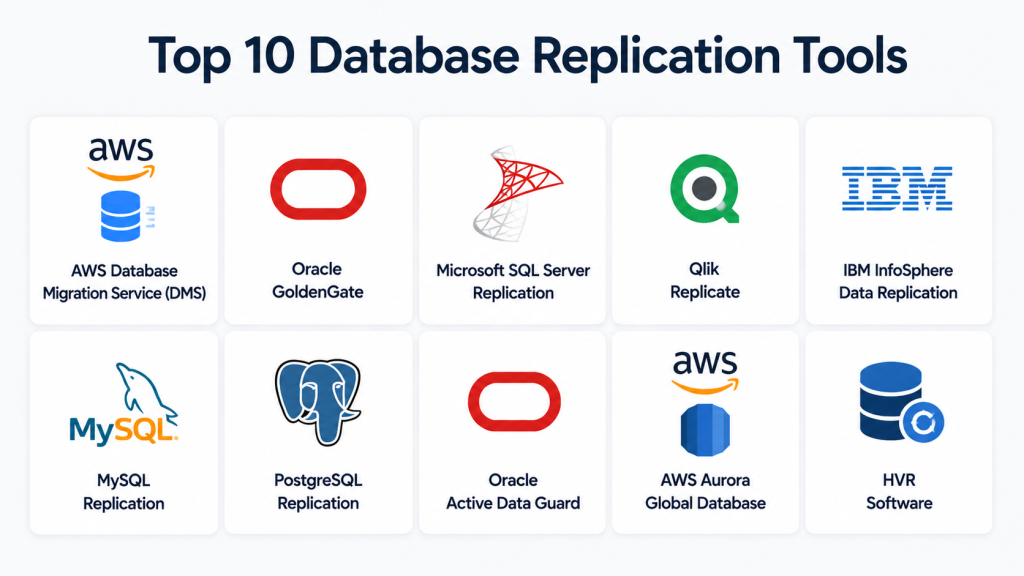
Top 10 Database Replication Tools
#1 — AWS Database Migration Service (DMS)
Short description: Managed service for replicating databases from on-premises or cloud to AWS with minimal downtime, suitable for enterprises migrating large workloads.
Key Features
- Continuous replication with low downtime
- Schema and code conversion support
- Multi-database engine compatibility
- Real-time monitoring dashboards
- Automated error handling and recovery
- Encryption for data in transit and at rest
Pros
- Minimal downtime migrations
- Fully managed, reducing operational overhead
Cons
- AWS-centric; less suitable for multi-cloud replication
- Limited legacy system support
Platforms / Deployment
Web / Windows / Linux
Cloud
Security & Compliance
Supports SSL/TLS, IAM-based access control
Not publicly stated: SOC 2, ISO 27001, HIPAA
Integrations & Ecosystem
Integrates with AWS S3, Redshift, EC2
- CloudWatch monitoring
- Lambda triggers
- API automation
Support & Community
Comprehensive documentation and forums
Enterprise support tiers available
Active user community
#2 — Oracle GoldenGate
Short description: High-performance replication solution for real-time database synchronization across heterogeneous environments, aimed at large enterprises.
Key Features
- Continuous low-latency replication
- Heterogeneous database support
- Conflict detection and resolution
- High availability and disaster recovery
- Real-time monitoring dashboards
Pros
- Ensures minimal downtime
- Reliable for mission-critical systems
Cons
- Complex setup and administration
- Best for Oracle-heavy environments
Platforms / Deployment
Windows / Linux
Cloud / Self-hosted / Hybrid
Security & Compliance
Supports encryption and RBAC
Not publicly stated: SOC 2, HIPAA
Integrations & Ecosystem
Oracle database ecosystem, middleware connectors
- Cloud connectors
- Automation APIs
Support & Community
Oracle enterprise support available
Detailed documentation and best practices
Professional services offered
#3 — Microsoft SQL Server Replication
Short description: Built-in SQL Server feature for replicating transactional, merge, and snapshot data across SQL Server instances.
Key Features
- Supports transactional, merge, and snapshot replication
- Real-time or scheduled replication
- Built-in monitoring tools
- Conflict detection mechanisms
- Integration with Microsoft ecosystem
Pros
- Native to SQL Server; no additional licensing required
- Reliable for on-premises SQL deployments
Cons
- Limited cross-database engine support
- Configuration complexity for complex topologies
Platforms / Deployment
Windows
Self-hosted / Hybrid
Security & Compliance
SSO/SAML, encryption supported
Not publicly stated: SOC 2, ISO 27001
Integrations & Ecosystem
Connects with SQL Server, Azure SQL, and reporting services
- API support for automation
- Compatible with Power BI
Support & Community
Microsoft documentation and forums
Enterprise support plans
Active community network
#4 — Qlik Replicate
Short description: Real-time replication tool for heterogeneous databases with change data capture, aimed at enterprise-scale migrations.
Key Features
- CDC for minimal downtime
- Supports multiple database engines and cloud platforms
- GUI-based mapping and monitoring
- Validation and error handling
- Real-time reporting dashboards
Pros
- Continuous replication
- Flexible cross-platform support
Cons
- Licensing required for full features
- Setup complexity for advanced workflows
Platforms / Deployment
Windows / Linux
Cloud / Self-hosted / Hybrid
Security & Compliance
Supports encryption and SSO
Not publicly stated: ISO 27001, HIPAA
Integrations & Ecosystem
Connectors for major DBs, cloud platforms
- APIs for orchestration
- SDK extensibility
Support & Community
Vendor documentation and technical support
Active user forums
Training resources available
#5 — IBM InfoSphere Data Replication
Short description: Enterprise-grade replication tool for high-volume, low-latency data movement across heterogeneous databases.
Key Features
- Real-time replication
- Conflict detection and resolution
- Supports batch and streaming replication
- Metadata-driven monitoring
- High availability features
Pros
- Scales for large enterprises
- Reliable for mission-critical applications
Cons
- High cost and complexity
- Requires specialized expertise
Platforms / Deployment
Windows / Linux
Cloud / Self-hosted / Hybrid
Security & Compliance
Encryption, RBAC supported
Not publicly stated: SOC 2, ISO 27001
Integrations & Ecosystem
Integrates with IBM DB2, Oracle, SQL Server, cloud platforms
- APIs for automation
- Monitoring dashboards
Support & Community
Enterprise support available
Detailed documentation
Professional services for complex deployments
#6 — MySQL Replication
Short description: Native MySQL feature supporting master-slave and group replication for high-availability MySQL deployments.
Key Features
- Master-slave replication
- Group replication for fault tolerance
- Real-time synchronization
- Automated failover support
- Performance monitoring
Pros
- Built into MySQL; open-source
- Suitable for web-scale deployments
Cons
- Limited cross-engine replication
- Manual configuration required for complex setups
Platforms / Deployment
Linux / Windows / macOS
Self-hosted / Hybrid
Security & Compliance
Supports SSL/TLS
Not publicly stated: SOC 2, HIPAA
Integrations & Ecosystem
Integrates with MySQL, Percona, MariaDB
- API hooks for automation
- Compatible with monitoring tools
Support & Community
Strong open-source community
Documentation extensive
Professional support available via vendors
#7 — PostgreSQL Replication
Short description: Built-in PostgreSQL streaming replication and logical replication for high-availability and read scaling.
Key Features
- Synchronous and asynchronous replication
- Logical replication for selective table replication
- Automated failover support
- Monitoring and logging
- Supports multi-node clusters
Pros
- Open-source and free
- Scales well for read-heavy workloads
Cons
- Cross-engine replication limited
- Setup complexity for multi-node clusters
Platforms / Deployment
Linux / Windows / macOS
Self-hosted / Hybrid
Security & Compliance
Supports SSL encryption, role-based access
Not publicly stated: SOC 2, HIPAA
Integrations & Ecosystem
Connects with PostgreSQL clusters, cloud DBs
- APIs for automation
- Compatible with monitoring dashboards
Support & Community
Open-source community strong
Vendor support available for managed services
Documentation extensive
#8 — Oracle Active Data Guard
Short description: High-availability and disaster recovery replication solution for Oracle databases, enabling real-time standby databases.
Key Features
- Real-time standby replication
- Automated failover and switchover
- Synchronous and asynchronous modes
- Monitoring and alerting
- Integration with Oracle RAC
Pros
- Ensures continuous availability
- Reduces downtime risk
Cons
- Oracle-specific; high licensing costs
- Requires specialized expertise
Platforms / Deployment
Windows / Linux
Cloud / Self-hosted / Hybrid
Security & Compliance
Encryption and RBAC supported
Not publicly stated: SOC 2, ISO 27001
Integrations & Ecosystem
Oracle databases and RAC environments
- API support for automation
- Monitoring dashboards
Support & Community
Oracle enterprise support
Documentation detailed
Professional services available
#9 — AWS Aurora Global Database
Short description: Multi-region database replication for AWS Aurora, providing low-latency global reads and high availability.
Key Features
- Cross-region replication
- Low-latency read replicas
- Automated failover
- Integrated monitoring
- Cloud-native scalability
Pros
- Simplifies multi-region replication
- Managed AWS service reduces operational overhead
Cons
- AWS Aurora-specific
- Not suitable for on-premises workloads
Platforms / Deployment
Web / Linux
Cloud
Security & Compliance
Supports encryption, IAM-based access
Not publicly stated: SOC 2, HIPAA
Integrations & Ecosystem
Integrates with Aurora, RDS, AWS monitoring
- APIs for orchestration
- Compatible with analytics services
Support & Community
AWS support tiers available
Documentation and forums active
Community solutions and guides
#10 — HVR Software
Short description: Real-time replication platform for heterogeneous databases, designed for low-latency, high-volume replication.
Key Features
- Change data capture (CDC)
- Supports cloud and on-premises databases
- Automated conflict detection
- Monitoring dashboards
- Multi-node replication
Pros
- Flexible for heterogeneous environments
- Continuous replication with minimal downtime
Cons
- Licensing costs can be high
- Setup requires trained personnel
Platforms / Deployment
Windows / Linux
Cloud / Self-hosted / Hybrid
Security & Compliance
Supports encryption, RBAC
Not publicly stated: SOC 2, ISO 27001
Integrations & Ecosystem
Connects with Oracle, SQL Server, MySQL, PostgreSQL, cloud DBs
- APIs for orchestration
- Extensible via SDK
Support & Community
Vendor support and documentation
Training available
Active professional user community
Comparison Table
| Tool Name | Best For | Platform(s) Supported | Deployment | Standout Feature | Public Rating |
|---|---|---|---|---|---|
| AWS DMS | Enterprise cloud migrations | Web / Windows / Linux | Cloud | Continuous replication | N/A |
| Oracle GoldenGate | Real-time heterogeneous replication | Windows / Linux | Cloud / Hybrid | Low-latency replication | N/A |
| SQL Server Replication | Microsoft SQL environments | Windows | Self-hosted / Hybrid | Built-in replication types | N/A |
| Qlik Replicate | Enterprise multi-DB replication | Windows / Linux | Cloud / Hybrid | CDC replication | N/A |
| IBM InfoSphere DR | High-volume enterprise replication | Windows / Linux | Cloud / Hybrid | Real-time replication | N/A |
| MySQL Replication | Web-scale MySQL deployments | Windows / Linux / macOS | Self-hosted / Hybrid | Master-slave & group replication | N/A |
| PostgreSQL Replication | Open-source multi-node PostgreSQL | Linux / Windows / macOS | Self-hosted / Hybrid | Streaming & logical replication | N/A |
| Oracle Active Data Guard | Oracle high availability | Windows / Linux | Cloud / Hybrid | Real-time standby DB | N/A |
| AWS Aurora Global DB | Multi-region Aurora replication | Web / Linux | Cloud | Low-latency global reads | N/A |
| HVR Software | Heterogeneous replication | Windows / Linux | Cloud / Hybrid | CDC & multi-node replication | N/A |
Evaluation & Scoring
| Tool Name | Core (25%) | Ease (15%) | Integrations (15%) | Security (10%) | Performance (10%) | Support (10%) | Value (15%) | Weighted Total |
|---|---|---|---|---|---|---|---|---|
| AWS DMS | 9 | 8 | 8 | 8 | 9 | 8 | 8 | 8.5 |
| Oracle GoldenGate | 8 | 6 | 7 | 8 | 9 | 7 | 7 | 7.5 |
| SQL Server Replication | 7 | 8 | 7 | 7 | 8 | 7 | 8 | 7.5 |
| Qlik Replicate | 8 | 7 | 8 | 7 | 8 | 7 | 7 | 7.5 |
| IBM InfoSphere DR | 9 | 6 | 8 | 8 | 9 | 7 | 6 | 7.9 |
| MySQL Replication | 7 | 8 | 7 | 7 | 7 | 7 | 8 | 7.3 |
| PostgreSQL Replication | 7 | 8 | 7 | 7 | 7 | 7 | 8 | 7.3 |
| Oracle Active Data Guard | 8 | 6 | 7 | 8 | 9 | 7 | 6 | 7.5 |
| AWS Aurora Global DB | 7 | 8 | 7 | 8 | 8 | 7 | 8 | 7.6 |
| HVR Software | 8 | 7 | 8 | 7 | 8 | 7 | 7 | 7.5 |
Which Tool Is Right for You?
Solo / Freelancer
Open-source or native solutions like MySQL or PostgreSQL replication provide cost efficiency and simplicity.
SMB
Cloud-native options like AWS DMS or Qlik Replicate balance cost and features for smaller deployments.
Mid-Market
Hybrid tools such as Oracle GoldenGate or IBM InfoSphere DR handle medium-scale workloads with real-time replication.
Enterprise
High-volume mission-critical replication requires Oracle Active Data Guard, HVR Software, or AWS Aurora Global DB with security and compliance support.
Budget vs Premium
Open-source or native replication for cost efficiency; enterprise-grade tools for full features and support.
Feature Depth vs Ease of Use
Low-code and native solutions simplify setup; enterprise-grade platforms offer extensive features but require trained staff.
Integrations & Scalability
Select tools supporting multiple engines and cloud providers for future growth and cross-region replication.
Security & Compliance Needs
Encryption, RBAC, audit logging, and compliance certifications are critical for regulated environments.
Frequently Asked Questions
1. What pricing models are used?
Subscription-based, consumption-based, or included in enterprise licenses. Open-source tools are usually free.
2. How long does replication setup take?
Depends on database size, complexity, and infrastructure; small setups may take hours, large setups days.
3. Can I replicate without downtime?
Many tools support real-time or incremental replication to minimize interruptions.
4. How secure are replication tools?
Most provide encryption, RBAC, and audit logging. Some enterprise tools have SOC 2 or ISO certifications.
5. Is cross-platform replication possible?
Yes, modern tools support multiple database engines and hybrid deployments.
6. What are common mistakes to avoid?
- Failing to validate replication
- Ignoring schema conflicts
- Skipping monitoring
- Underestimating latency
7. Can small businesses use these tools?
Yes, MySQL and PostgreSQL replication work well for smaller databases.
8. How is replication monitored?
Dashboards, logs, and alerts help track performance and errors in real time.
9. What happens if replication fails?
Rollback, retries, and automated conflict resolution maintain data integrity.
10. Are managed replication services worth it?
Managed services reduce operational overhead and ensure continuous availability for cloud or hybrid setups.
Conclusion
Database replication tools are essential for high availability, disaster recovery, and distributed data systems. The best choice depends on workload size, complexity, and compliance requirements. Evaluate tools based on core features, integrations, security, and scalability. Shortlist 2–3 options, run pilots, and validate performance and security before full deployment.
