Introduction
eBPF observability and runtime security tools help teams understand what is happening inside Linux systems, Kubernetes clusters, containers, networks, and cloud-native workloads. In simple words, eBPF allows teams to collect deep system-level signals from the Linux kernel without depending only on traditional logs, heavy agents, or manual code instrumentation.
These tools are becoming important because modern applications are distributed, container-based, and often difficult to troubleshoot with older monitoring methods. DevOps teams need faster debugging, SRE teams need better performance visibility, and security teams need runtime threat detection before small issues become serious incidents.
Common use cases include Kubernetes troubleshooting, container runtime security, network visibility, service dependency mapping, performance profiling, workload behavior analysis, and incident investigation.
Buyers should evaluate:
- Kernel-level visibility
- Kubernetes and container support
- Runtime threat detection
- Runtime policy enforcement
- Performance overhead
- Ease of deployment
- Alert quality
- SIEM and observability integrations
- Documentation and community support
- Pricing and operational effort
Best for: DevOps engineers, SREs, platform teams, cloud security teams, SOC analysts, Kubernetes administrators, and enterprises running Linux-based cloud-native workloads.
Not ideal for: Very small teams with simple applications, teams not using Linux or Kubernetes, or businesses that only need basic uptime monitoring.
Key Trends in eBPF Observability & Runtime Security Tools
- Runtime visibility is becoming more important: Teams now want to see live workload behavior instead of depending only on logs after an issue happens.
- Kubernetes-native monitoring is now a strong requirement: Tools that can connect kernel events with pods, namespaces, nodes, and services are more useful for modern teams.
- Security and observability are coming together: Many teams want one view for performance, network activity, workload behavior, and suspicious actions.
- Low-overhead monitoring is a major need: eBPF is valued because it can collect deep system signals without creating heavy performance impact.
- Policy-based runtime protection is growing: Teams want tools that can detect and also restrict risky behavior inside workloads.
- AI-assisted investigation is becoming useful: Some platforms are adding intelligent alert grouping, anomaly detection, and faster root cause suggestions.
- OpenTelemetry compatibility matters: Buyers prefer tools that work with common telemetry pipelines and do not lock data into one system.
- Hybrid deployment support is important: Many organizations run workloads across cloud, private cloud, and on-premises systems.
- Compliance evidence is becoming part of runtime security: Teams want audit logs, event history, access control, and clear workload activity records.
- Developer-friendly debugging is improving: eBPF tools are becoming easier for application teams, not only kernel or security experts.
How We Selected These Tools
The tools in this list were selected using practical evaluation logic for cloud-native teams, security teams, and platform engineering teams.
- Strong recognition in the eBPF, Kubernetes, runtime security, or observability ecosystem.
- Clear relevance to Linux, containers, Kubernetes, or cloud-native workloads.
- Practical value for monitoring, debugging, threat detection, enforcement, or performance profiling.
- Feature completeness across visibility, alerting, policies, integrations, and investigation workflows.
- Adoption by DevOps, SRE, security, and platform engineering teams.
- Open-source maturity, enterprise availability, or strong ecosystem support.
- Ability to integrate with SIEM, observability, incident response, and DevOps workflows.
- Fit for different team sizes, from developer-first teams to large enterprises.
- Clear documentation, community activity, or vendor support.
- Real-world usefulness beyond basic monitoring.
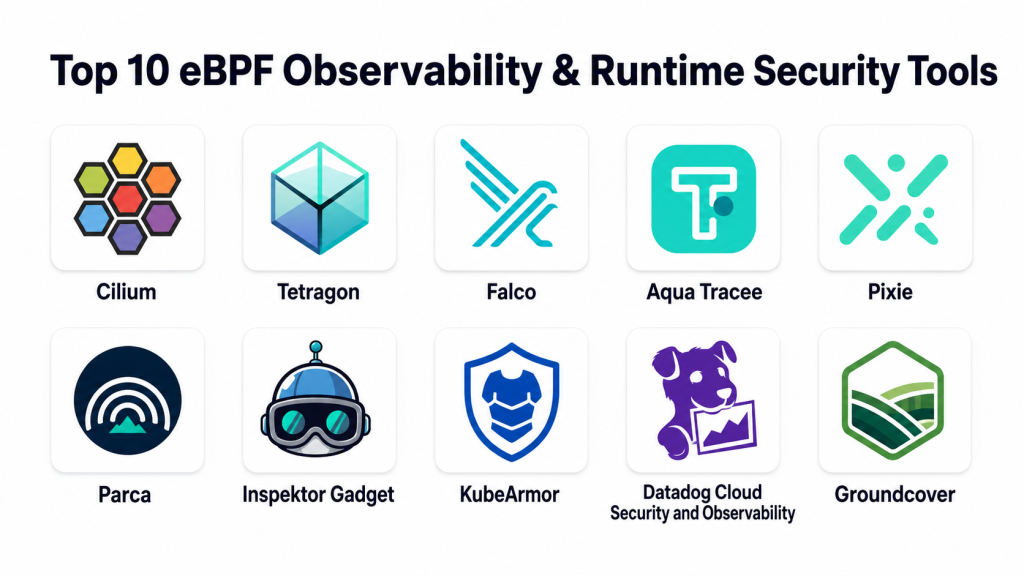
Top 10 eBPF Observability & Runtime Security Tools
#1 — Cilium
Short description: Cilium is an eBPF-powered networking, security, and observability platform for Kubernetes and cloud-native environments. It is best for platform teams that need service connectivity, network policy, visibility, and workload security in one ecosystem.
Key Features
- eBPF-based networking for Kubernetes workloads.
- Kubernetes network policy support.
- Identity-aware traffic control.
- Hubble integration for flow visibility and service maps.
- Observability across pods, services, nodes, and clusters.
- Strong fit for cloud-native networking.
- Useful for reducing dependency on older network inspection methods.
Pros
- Strong Kubernetes networking and visibility features.
- Good fit for large cloud-native environments.
- Strong community and ecosystem support.
Cons
- Can be complex for teams new to Kubernetes networking.
- Requires careful planning before replacing an existing CNI.
- Best value is seen in Kubernetes-heavy environments.
Platforms / Deployment
Linux / Kubernetes
Cloud / Self-hosted / Hybrid
Security & Compliance
Cilium supports network policy, workload identity, traffic visibility, and security controls. Enterprise access control, audit features, and compliance documentation may vary by commercial provider. Formal compliance certifications are Not publicly stated for the open-source project.
Integrations & Ecosystem
Cilium fits well in Kubernetes-first environments and works strongly with cloud-native networking and observability workflows.
- Kubernetes
- Hubble
- Prometheus
- Grafana
- OpenTelemetry-compatible workflows depending on setup
- Cloud-native platform engineering workflows
Support & Community
Cilium has strong community adoption and detailed documentation. Advanced use cases may require experienced platform engineers. Commercial support depends on the provider or enterprise distribution selected.
#2 — Tetragon
Short description: Tetragon is an eBPF-based runtime security observability and enforcement tool. It helps teams monitor process execution, file access, network activity, and suspicious workload behavior with Kubernetes context.
Key Features
- Runtime visibility for Linux and Kubernetes workloads.
- Process, network, file, and system event monitoring.
- Kubernetes-aware context for pods and namespaces.
- Runtime policy enforcement.
- Workload behavior analysis.
- Useful for threat detection and incident investigation.
- Strong fit with Cilium-based environments.
Pros
- Strong runtime security visibility.
- Good Kubernetes workload context.
- Useful for both detection and enforcement.
Cons
- Requires policy tuning to avoid noisy alerts.
- Needs Linux and Kubernetes security knowledge.
- Some enterprise features may depend on commercial packaging.
Platforms / Deployment
Linux / Kubernetes
Cloud / Self-hosted / Hybrid
Security & Compliance
Tetragon supports runtime security observability and policy-based enforcement. RBAC, audit logs, and compliance features depend on deployment and surrounding platform configuration. Formal compliance certifications are Not publicly stated for the open-source project.
Integrations & Ecosystem
Tetragon works well with cloud-native security pipelines and can forward runtime events into investigation and alerting workflows.
- Kubernetes
- Cilium ecosystem
- Prometheus-style monitoring workflows
- SIEM tools through event forwarding
- Security automation pipelines
- Policy-as-code workflows
Support & Community
Tetragon benefits from the broader Cilium ecosystem. Documentation is useful for cloud-native teams, but advanced enforcement requires careful testing and policy design.
#3 — Falco
Short description: Falco is a runtime security tool used to detect suspicious activity in containers, Kubernetes, cloud, and Linux environments. It is well suited for security teams that need rules-based runtime threat detection.
Key Features
- Runtime threat detection for Linux, containers, and Kubernetes.
- Rules-based detection model.
- Monitoring for suspicious process, file, and network behavior.
- Alerts for abnormal workload activity.
- Flexible rule customization.
- Strong open-source security community.
- Works well with security alerting and SIEM workflows.
Pros
- Mature and widely recognized runtime security tool.
- Strong rule-based detection approach.
- Good fit for Kubernetes and container security teams.
Cons
- Rules need tuning to reduce alert noise.
- Detection quality depends on rule design.
- Enforcement is not its strongest area compared with policy-first tools.
Platforms / Deployment
Linux / Kubernetes / Containers
Cloud / Self-hosted / Hybrid
Security & Compliance
Falco supports runtime detection and alerting. Compliance certifications are Not publicly stated for the open-source project. Enterprise governance features depend on the platform or vendor distribution used.
Integrations & Ecosystem
Falco has a strong ecosystem for runtime alerting and security monitoring.
- Kubernetes
- Helm
- Prometheus
- Grafana
- SIEM tools
- Webhooks and alert routing tools
Support & Community
Falco has strong open-source community support, useful documentation, and broad recognition in container security. Commercial support may be available through vendors that package or extend Falco.
#4 — Aqua Tracee
Short description: Aqua Tracee is an eBPF-based runtime security and forensics tool for Linux workloads. It helps teams observe system behavior and detect suspicious runtime activity.
Key Features
- eBPF-based runtime event collection.
- Linux workload behavior monitoring.
- Process, file, network, and syscall-related visibility.
- Detection of suspicious activity patterns.
- Useful for container security investigations.
- Supports forensic analysis workflows.
- Can work as part of a broader cloud-native security program.
Pros
- Strong focus on runtime security and forensics.
- Useful for Linux and container investigation.
- Good fit for teams using Aqua security products.
Cons
- Requires security knowledge to interpret signals.
- May need tuning for different environments.
- Enterprise capabilities depend on the broader Aqua platform.
Platforms / Deployment
Linux / Containers / Kubernetes
Cloud / Self-hosted / Hybrid
Security & Compliance
Tracee provides runtime detection and forensic visibility. Enterprise governance, RBAC, audit logs, and compliance features depend on the Aqua platform edition. Formal compliance certifications are Not publicly stated for the standalone open-source tool.
Integrations & Ecosystem
Tracee supports runtime event collection and investigation workflows.
- Kubernetes
- Container security workflows
- SIEM tools through event export
- Aqua Security ecosystem
- CI/CD security workflows
- Incident response pipelines
Support & Community
Tracee has open-source documentation and community visibility. Enterprise onboarding and support depend on Aqua’s commercial offerings.
#5 — Pixie
Short description: Pixie is an eBPF-based observability tool for Kubernetes environments. It helps developers and SREs inspect service behavior, latency, errors, resource usage, and workload communication without heavy manual instrumentation.
Key Features
- Automatic Kubernetes observability using eBPF.
- Service maps and workload visibility.
- Request-level inspection.
- Useful for debugging latency and performance issues.
- Reduces manual instrumentation needs.
- Scriptable observability workflows.
- Developer-friendly troubleshooting experience.
Pros
- Easy for developers and SREs to use for Kubernetes debugging.
- Useful for fast incident investigation.
- Reduces the need for deep manual instrumentation.
Cons
- Best suited for Kubernetes environments.
- Not a full runtime security enforcement platform.
- Advanced customization may require learning its query model.
Platforms / Deployment
Linux / Kubernetes
Cloud / Self-hosted / Hybrid depending on setup
Security & Compliance
Pixie focuses mainly on observability and debugging. Security controls, compliance documentation, and governance features depend on deployment model and vendor-supported platform. Formal certifications are Not publicly stated for the open-source project.
Integrations & Ecosystem
Pixie is useful for teams that need fast Kubernetes visibility and developer-friendly troubleshooting.
- Kubernetes
- Cloud-native observability workflows
- Developer debugging workflows
- Metrics and tracing pipelines depending on setup
- API-driven analysis
- Platform engineering workflows
Support & Community
Pixie has strong recognition in the Kubernetes observability space. Documentation is useful, but support depends on deployment model and vendor ecosystem.
#6 — Parca
Short description: Parca is a continuous profiling tool that helps teams understand CPU usage and performance behavior in production systems. It is useful for engineering teams focused on performance optimization and cost reduction.
Key Features
- Continuous profiling for production workloads.
- Helps identify CPU bottlenecks.
- Supports performance optimization across services.
- Useful for cost-saving and resource efficiency.
- Fits into Kubernetes and cloud-native observability workflows.
- Helps engineering teams go beyond logs and metrics.
- Open-source-friendly profiling approach.
Pros
- Strong fit for performance-focused teams.
- Helps find inefficient code paths.
- Useful complement to metrics, logs, and traces.
Cons
- Focused on profiling, not full runtime security.
- Requires engineering maturity to act on profiling data.
- Does not replace a full observability platform.
Platforms / Deployment
Linux / Kubernetes
Cloud / Self-hosted / Hybrid depending on setup
Security & Compliance
Parca is mainly a profiling and observability tool. Compliance certifications, advanced RBAC, and audit controls are Not publicly stated for the open-source project.
Integrations & Ecosystem
Parca fits well into performance engineering and cloud-native observability stacks.
- Kubernetes
- Prometheus-style ecosystems
- Grafana workflows
- Cloud-native observability pipelines
- Developer optimization processes
- Performance engineering workflows
Support & Community
Parca has open-source documentation and community support. Commercial support may depend on related vendors or service providers.
#7 — Inspektor Gadget
Short description: Inspektor Gadget is an eBPF-based toolset for inspecting and debugging Kubernetes clusters and Linux systems. It is useful for SREs and platform engineers who need low-level visibility mapped to cloud-native resources.
Key Features
- Collection of eBPF-based inspection tools.
- Kubernetes-aware debugging.
- Process, file, network, and system-level visibility.
- Linux and Kubernetes support.
- Helps troubleshoot container and cluster behavior.
- Maps low-level events to Kubernetes context.
- Practical for hands-on infrastructure investigation.
Pros
- Useful for Kubernetes troubleshooting.
- Strong fit for SRE and platform engineering workflows.
- Bridges Linux kernel events with Kubernetes resources.
Cons
- More of a debugging toolset than a full enterprise platform.
- Requires technical knowledge.
- May need extra work for centralized dashboards and governance.
Platforms / Deployment
Linux / Kubernetes
Self-hosted / Hybrid
Security & Compliance
Inspektor Gadget provides inspection and observability capabilities. Formal compliance features such as SOC 2, ISO 27001, or HIPAA are Not publicly stated for the open-source project.
Integrations & Ecosystem
Inspektor Gadget works well in engineering workflows where teams need deep workload inspection.
- Kubernetes
- Linux hosts
- OCI-based gadget workflows
- Platform engineering toolchains
- Debugging workflows
- Incident response workflows
Support & Community
Inspektor Gadget has open-source documentation and community momentum. Support is strongest for technical teams comfortable with hands-on debugging.
#8 — KubeArmor
Short description: KubeArmor is a cloud-native runtime security tool that helps enforce security policies for Kubernetes and container workloads. It focuses on restricting unwanted runtime behavior through policy-based controls.
Key Features
- Runtime policy enforcement.
- Kubernetes-native workload protection.
- File, process, and network access control.
- Container behavior restriction.
- Policy-driven workload hardening.
- Useful for zero-trust runtime security.
- Complements detection-focused tools.
Pros
- Strong focus on enforcement.
- Useful for hardening Kubernetes workloads.
- Good fit for runtime security policy programs.
Cons
- Requires careful policy planning.
- Incorrect policies can block valid workload behavior.
- Less focused on broad observability dashboards.
Platforms / Deployment
Linux / Kubernetes / Containers
Cloud / Self-hosted / Hybrid
Security & Compliance
KubeArmor supports runtime policy enforcement and workload hardening. Formal compliance certifications are Not publicly stated unless used through a specific commercial service or distribution.
Integrations & Ecosystem
KubeArmor fits well into cloud-native security and policy workflows.
- Kubernetes
- Container runtime environments
- Policy-as-code workflows
- CI/CD security processes
- SIEM tools through event forwarding
- Runtime hardening programs
Support & Community
KubeArmor has open-source documentation and community support. Commercial support and onboarding depend on vendor or managed service availability.
#9 — Datadog Cloud Security and Observability
Short description: Datadog provides cloud observability, infrastructure monitoring, application monitoring, and cloud security capabilities. It uses modern workload visibility methods, including eBPF in supported areas, to help teams monitor and secure cloud-native systems.
Key Features
- Unified infrastructure, application, log, and security monitoring.
- Cloud workload visibility.
- Runtime workload protection features in supported environments.
- Dashboards, alerts, and incident workflows.
- Strong integration ecosystem.
- Cloud security posture and threat detection capabilities.
- Useful for teams wanting one SaaS platform for observability and security.
Pros
- Broad coverage beyond eBPF alone.
- Strong SaaS dashboards and alerting.
- Good for mid-market and enterprise teams.
Cons
- Cost can grow if telemetry volume is not controlled.
- Less open-source-native than standalone tools.
- Advanced features depend on selected modules and plans.
Platforms / Deployment
Web / Linux / Kubernetes / Cloud environments
Cloud / Hybrid
Security & Compliance
Datadog commonly supports enterprise access controls such as SSO, RBAC, audit-related capabilities, and encryption features depending on plan and configuration. Specific compliance coverage varies by product and contract, so buyers should validate directly.
Integrations & Ecosystem
Datadog has a large integration ecosystem and is often used as a central platform for observability and security workflows.
- Kubernetes
- AWS, Azure, and Google Cloud
- CI/CD tools
- Incident management tools
- Security workflows
- OpenTelemetry and agent-based telemetry pipelines
Support & Community
Datadog provides commercial documentation, onboarding resources, support tiers, and training materials. It has strong adoption among DevOps and cloud teams, but buyers should review pricing and module requirements carefully.
#10 — Groundcover
Short description: Groundcover is an observability platform that uses eBPF-based telemetry collection for Kubernetes and cloud-native workloads. It is designed for teams that want deep visibility with less manual instrumentation.
Key Features
- eBPF-based observability for Kubernetes workloads.
- Application, infrastructure, and service-level visibility.
- Reduced need for manual instrumentation.
- Supports logs, metrics, traces, and workload insights depending on setup.
- Focuses on cost-aware observability.
- Useful for DevOps and SRE teams.
- Designed to simplify cloud-native visibility.
Pros
- Good Kubernetes observability with reduced setup effort.
- Helps collect deep telemetry without heavy manual work.
- Useful for teams concerned about observability cost and complexity.
Cons
- Less focused on runtime enforcement.
- Best value is in Kubernetes-heavy environments.
- Enterprise security details should be validated during procurement.
Platforms / Deployment
Web / Linux / Kubernetes
Cloud / Hybrid / Self-hosted options may vary
Security & Compliance
Security controls such as access management, encryption, and audit capabilities may vary by plan. Formal certifications and compliance details should be treated as Not publicly stated unless confirmed during vendor review.
Integrations & Ecosystem
Groundcover fits into Kubernetes observability stacks and modern DevOps workflows.
- Kubernetes
- Cloud-native monitoring workflows
- Alerting tools
- Incident response tools
- Logs, metrics, and traces pipelines
- OpenTelemetry-related workflows depending on configuration
Support & Community
Groundcover provides vendor documentation and commercial support options. Community strength is more vendor-led than large open-source projects, so buyers should evaluate onboarding and support quality during trial.
Comparison Table
| Tool Name | Best For | Platform(s) Supported | Deployment | Standout Feature | Public Rating |
|---|---|---|---|---|---|
| Cilium | Kubernetes networking, security, and observability | Linux, Kubernetes | Cloud / Self-hosted / Hybrid | eBPF-powered networking with Hubble visibility | N/A |
| Tetragon | Kubernetes runtime security and enforcement | Linux, Kubernetes | Cloud / Self-hosted / Hybrid | Runtime enforcement with Kubernetes context | N/A |
| Falco | Runtime threat detection | Linux, Kubernetes, Containers | Cloud / Self-hosted / Hybrid | Rules-based runtime detection | N/A |
| Aqua Tracee | Runtime security and forensics | Linux, Containers, Kubernetes | Cloud / Self-hosted / Hybrid | eBPF-based behavioral event detection | N/A |
| Pixie | Kubernetes observability and debugging | Linux, Kubernetes | Cloud / Self-hosted / Hybrid | Automatic workload visibility | N/A |
| Parca | Continuous profiling and performance optimization | Linux, Kubernetes | Cloud / Self-hosted / Hybrid | Production profiling | N/A |
| Inspektor Gadget | Kubernetes and Linux debugging | Linux, Kubernetes | Self-hosted / Hybrid | eBPF inspection tools | N/A |
| KubeArmor | Runtime policy enforcement | Linux, Kubernetes, Containers | Cloud / Self-hosted / Hybrid | Policy-based workload hardening | N/A |
| Datadog Cloud Security and Observability | Enterprise observability and security | Web, Linux, Kubernetes, Cloud | Cloud / Hybrid | Unified SaaS observability and security | N/A |
| Groundcover | Kubernetes observability | Web, Linux, Kubernetes | Cloud / Hybrid / Varies | eBPF-based Kubernetes telemetry | N/A |
Evaluation & Scoring of eBPF Observability & Runtime Security Tools
| Tool Name | Core (25%) | Ease (15%) | Integrations (15%) | Security (10%) | Performance (10%) | Support (10%) | Value (15%) | Weighted Total (0–10) |
|---|---|---|---|---|---|---|---|---|
| Cilium | 9 | 7 | 9 | 9 | 9 | 8 | 8 | 8.45 |
| Tetragon | 9 | 7 | 8 | 9 | 9 | 8 | 8 | 8.35 |
| Falco | 8 | 8 | 8 | 8 | 8 | 8 | 9 | 8.15 |
| Aqua Tracee | 8 | 7 | 7 | 8 | 8 | 7 | 8 | 7.60 |
| Pixie | 8 | 8 | 7 | 6 | 8 | 7 | 8 | 7.50 |
| Parca | 7 | 7 | 7 | 5 | 9 | 7 | 8 | 7.20 |
| Inspektor Gadget | 7 | 7 | 7 | 6 | 8 | 7 | 8 | 7.20 |
| KubeArmor | 8 | 7 | 7 | 9 | 8 | 7 | 8 | 7.75 |
| Datadog Cloud Security and Observability | 9 | 8 | 10 | 9 | 8 | 9 | 6 | 8.45 |
| Groundcover | 8 | 8 | 8 | 7 | 8 | 8 | 7 | 7.75 |
The scores are comparative and should be used as a practical guide, not as a final buying decision. A higher score means the tool performs strongly across the selected evaluation areas.
Security-focused teams may give more weight to Falco, Tetragon, Aqua Tracee, KubeArmor, and Cilium. Observability-focused teams may prefer Pixie, Groundcover, Datadog, Parca, or Inspektor Gadget. Enterprise teams should also consider governance, support, audit needs, and integration depth before choosing.
Which eBPF Observability & Runtime Security Tool Is Right for You?
Solo / Freelancer
Solo engineers and freelancers usually need tools that are easy to test and low-cost. Falco, Pixie, Parca, and Inspektor Gadget are good starting points.
If the goal is Kubernetes debugging, Pixie or Inspektor Gadget can help quickly. If the goal is runtime threat detection, Falco is a practical option.
SMB
Small and growing businesses need useful visibility without too much operational effort. Groundcover, Falco, Pixie, and Datadog can be suitable depending on budget and team skills.
If the team has strong Kubernetes knowledge, open-source tools can provide strong value. If the team wants less maintenance, a managed observability platform may be better.
Mid-Market
Mid-market teams often need better integrations, alert workflows, multi-cluster visibility, and stronger runtime detection. Cilium, Tetragon, Falco, KubeArmor, Groundcover, and Datadog are strong options.
A practical setup may include Cilium for networking and visibility, Falco or Tetragon for runtime detection, and a central platform for dashboards and alerts.
Enterprise
Enterprises need scale, governance, access control, support, auditability, and integration with existing security tools. Datadog, Cilium, Tetragon, Falco, Aqua Tracee, and KubeArmor are strong candidates.
Enterprise buyers should validate SSO, RBAC, audit logs, data retention, SIEM integration, support response, compliance requirements, and deployment flexibility.
Budget vs Premium
Open-source tools such as Falco, Cilium, Tetragon, Tracee, Parca, and Inspektor Gadget can be cost-effective, but they require internal knowledge and maintenance.
Premium platforms may reduce setup effort and provide better support, polished dashboards, and enterprise workflows. However, teams should watch telemetry costs and licensing models carefully.
Feature Depth vs Ease of Use
If feature depth matters most, Cilium, Tetragon, Falco, and Datadog are strong choices. If ease of use matters more, Pixie and Groundcover may be more approachable.
For runtime enforcement, KubeArmor and Tetragon are more relevant. For performance profiling, Parca is a focused and useful choice.
Integrations & Scalability
Teams should look for integrations with Kubernetes, Prometheus, Grafana, OpenTelemetry, SIEM platforms, CI/CD tools, and incident response systems.
Datadog is strong for broad SaaS integrations. Cilium, Falco, and Tetragon fit well into open cloud-native environments. Groundcover and Pixie are practical for Kubernetes observability.
Security & Compliance Needs
Security-focused teams should shortlist Falco, Tetragon, Aqua Tracee, KubeArmor, and Cilium. These tools are more relevant for runtime detection, enforcement, investigation, and workload protection.
Compliance-heavy buyers should validate audit logs, access control, data retention, encryption, SSO, policy reporting, and documentation before making a final decision.
Frequently Asked Questions
1. What are eBPF observability and runtime security tools?
eBPF observability and runtime security tools collect deep system, network, process, and workload signals from Linux environments. They help teams monitor, debug, detect threats, and sometimes enforce runtime policies.
2. Are eBPF tools only useful for Kubernetes?
No. Many eBPF tools work with Linux hosts, containers, and Kubernetes clusters. However, they are especially useful in Kubernetes because they can connect system-level events with pods, namespaces, services, and workloads.
3. Are eBPF tools difficult to implement?
Some tools are easy to test, while others need deeper Linux, Kubernetes, or security knowledge. Teams should start with a small pilot before using any tool across production environments.
4. How are eBPF tools priced?
Open-source tools may be free to use but require internal skills and maintenance. Commercial tools may charge based on nodes, hosts, workloads, users, telemetry volume, or selected platform modules.
5. Can eBPF tools replace traditional monitoring tools?
Not always. eBPF adds deep kernel and runtime visibility, but many teams still use logs, metrics, traces, dashboards, and incident management tools alongside it.
6. What is the biggest mistake when adopting eBPF tools?
The biggest mistake is adopting a tool without a clear use case. Teams should first decide whether they need networking visibility, runtime detection, enforcement, profiling, or application observability.
7. Are eBPF tools safe for production environments?
Many eBPF tools are designed for production use, but teams should test performance impact, kernel compatibility, permissions, data collection scope, and operational risk before full rollout.
8. Which eBPF tools are best for runtime security?
Falco, Tetragon, Aqua Tracee, KubeArmor, and Cilium are strong options for runtime security. The right tool depends on whether the team needs detection, enforcement, network security, or investigation.
9. Which eBPF tools are best for observability?
Cilium with Hubble, Pixie, Groundcover, Parca, Datadog, and Inspektor Gadget are strong observability-focused options. Parca is especially useful for continuous profiling and performance analysis.
10. Do eBPF tools integrate with SIEM platforms?
Many tools can send events, alerts, or logs into SIEM workflows through APIs, webhooks, log pipelines, or event forwarding. Buyers should confirm the exact integration method before choosing.
Conclusion
eBPF observability and runtime security tools are powerful for teams running Linux, Kubernetes, containers, and cloud-native systems. They provide deeper visibility than many traditional tools and help teams understand what is happening at the process, network, file, syscall, and workload level.
There is no single best tool for every organization. Cilium is strong for Kubernetes networking and visibility. Tetragon, Falco, Aqua Tracee, and KubeArmor are strong for runtime security. Pixie, Groundcover, Parca, and Inspektor Gadget are useful for debugging, observability, and performance investigation. Datadog is a strong option for teams that want a broader SaaS platform with observability and security workflows together.
The best next step is to shortlist two or three tools based on your main use case, run a small pilot, measure performance impact, validate integrations, review security controls, and confirm whether your team can operate the tool comfortably at scale.
