Introduction
WebAssembly, commonly called WASM, is a lightweight binary instruction format that allows applications written in languages like Rust, C, C++, Go, and AssemblyScript to run safely and efficiently across browsers, servers, edge systems, and embedded environments. It helps developers create portable applications with strong performance and secure sandboxing.
WASM runtimes and toolchains are becoming more important because organizations want faster startup times, lightweight deployments, secure plugin execution, edge computing support, and portable workloads across different environments. Modern development teams are increasingly using WASM for serverless workloads, browser applications, cloud-native computing, edge AI inference, and embedded systems.
Common use cases include:
- Running secure plugins in SaaS platforms
- Deploying lightweight serverless applications
- Running applications at the edge
- Migrating C/C++ applications to browsers
- Building embedded and IoT workloads
Things buyers should evaluate before selecting a WASM runtime or toolchain:
- Runtime performance
- Startup speed
- WASI support
- Security isolation
- Language compatibility
- Kubernetes integration
- Developer experience
- Ecosystem maturity
- Deployment flexibility
- Documentation quality
Best for: developers, platform engineering teams, cloud-native architects, SaaS companies, IoT developers, and organizations building portable applications.
Not ideal for: teams building very simple web applications, organizations with no portability requirements, or projects that already work efficiently with traditional deployment models.
Key Trends in WebAssembly (WASM) Runtimes & Toolchains
- Edge computing adoption is increasing rapidly for WASM workloads
- Lightweight serverless execution is becoming a major use case
- WASI compatibility is becoming a key buying factor
- AI inference at the edge is growing in popularity
- More enterprises are exploring secure plugin architectures using WASM
- Kubernetes integration for WASM workloads is improving
- Component-based architectures are becoming more common
- Multi-language support continues to expand
- Runtime security and sandboxing remain major priorities
- Embedded and IoT adoption is increasing due to smaller runtime footprints
How We Selected These Tools
The following tools were selected using practical engineering and product evaluation criteria:
- Market adoption and ecosystem popularity
- Runtime reliability and performance
- Feature completeness
- Security-focused architecture
- Language compatibility
- Cloud-native readiness
- Documentation and onboarding quality
- Community strength
- Integration capabilities
- Suitability across SMB, enterprise, and developer-focused use cases
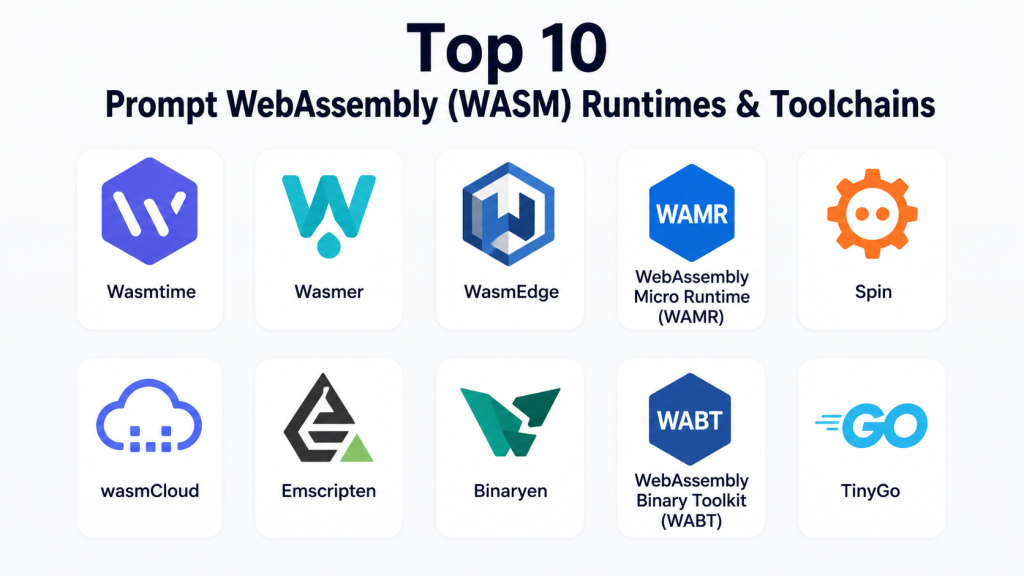
Top 10 WebAssembly (WASM) Runtimes & Toolchains Tools
1. Wasmtime
Short description: Wasmtime is a secure and high-performance WebAssembly runtime designed for server-side and cloud-native workloads. It is widely used for sandboxed execution and standards-aligned WASM deployments.
Key Features
- Strong WASI support
- Secure sandboxed execution
- High-performance runtime
- Multi-language integrations
- Server-side deployment support
- Embeddable architecture
- Standards-focused design
Pros
- Strong runtime security model
- Excellent ecosystem credibility
- Good performance for cloud-native workloads
Cons
- Requires WASM knowledge for advanced usage
- Some deployment setups can be complex
- Not a complete application platform
Platforms / Deployment
Windows / macOS / Linux
Self-hosted / Cloud / Hybrid
Security & Compliance
Supports sandboxed execution and capability-based security models. Formal compliance certifications are not publicly stated.
Integrations & Ecosystem
Wasmtime integrates well with server-side and cloud-native development workflows.
- Rust integrations
- Go integrations
- Python integrations
- Plugin systems
- Cloud-native platforms
- WASI ecosystem
Support & Community
Strong documentation and active open-source community support.
2. Wasmer
Short description: Wasmer is a portable WebAssembly runtime that allows developers to run WASM applications across multiple environments with a developer-friendly experience.
Key Features
- Cross-platform runtime
- Lightweight execution
- Multiple compiler backends
- Portable deployment support
- CLI tooling
- Broad language support
- Flexible runtime architecture
Pros
- Easy onboarding for developers
- Good portability
- Useful for experimentation and production
Cons
- Advanced features may require extra configuration
- Enterprise governance depends on deployment approach
- Ecosystem maturity varies by workload type
Platforms / Deployment
Windows / macOS / Linux
Cloud / Self-hosted / Hybrid / Edge
Security & Compliance
Supports sandboxed execution. Formal compliance certifications are not publicly stated.
Integrations & Ecosystem
Wasmer supports multiple developer and cloud-native workflows.
- Language SDKs
- CLI workflows
- Server applications
- Edge computing
- Plugin systems
- Development tooling
Support & Community
Active documentation and growing community ecosystem.
3. WasmEdge
Short description: WasmEdge is a lightweight and high-performance runtime optimized for cloud-native, edge, and serverless workloads.
Key Features
- Edge-focused runtime
- Fast startup performance
- Serverless workload support
- Plugin architecture
- AI and ML support
- Cloud-native integration
- Lightweight deployment
Pros
- Excellent edge performance
- Good cloud-native support
- Useful for distributed environments
Cons
- Advanced deployments require engineering expertise
- Ecosystem still evolving
- Some plugins require additional setup
Platforms / Deployment
Windows / macOS / Linux
Cloud / Edge / Hybrid / Self-hosted
Security & Compliance
Supports secure sandboxed execution. Formal certifications are not publicly stated.
Integrations & Ecosystem
Designed for modern distributed computing environments.
- Kubernetes workflows
- Edge computing
- AI inference
- Cloud-native deployment
- Plugin ecosystems
- Serverless environments
Support & Community
Growing community with improving documentation and developer support.
4. WebAssembly Micro Runtime (WAMR)
Short description: WAMR is a lightweight runtime designed for embedded devices, IoT systems, and resource-constrained environments.
Key Features
- Small runtime footprint
- Embedded system optimization
- IoT deployment support
- Ahead-of-time compilation
- Lightweight execution
- Resource-efficient design
- WASI compatibility
Pros
- Excellent for embedded systems
- Low memory usage
- Practical for IoT deployments
Cons
- Less beginner-friendly
- Limited for browser-focused projects
- Embedded expertise may be required
Platforms / Deployment
Linux / Embedded platforms / RTOS
Self-hosted / Embedded / Edge
Security & Compliance
Supports secure execution models. Compliance certifications are not publicly stated.
Integrations & Ecosystem
Strong fit for constrained and embedded environments.
- IoT systems
- Device firmware
- Industrial systems
- Embedded operating systems
- Edge devices
- C/C++ workflows
Support & Community
Good technical documentation for embedded-focused developers.
5. Spin
Short description: Spin is a framework for building WebAssembly-based serverless and microservice applications using modern cloud-native patterns.
Key Features
- Serverless application framework
- HTTP workload support
- Developer-friendly templates
- Fast startup
- Event-driven architecture
- Local development support
- Cloud-native workflows
Pros
- Easy developer experience
- Good for APIs and microservices
- Useful for lightweight services
Cons
- More opinionated architecture
- Better suited for specific use cases
- Some enterprise features depend on deployment
Platforms / Deployment
Windows / macOS / Linux
Cloud / Hybrid / Self-hosted
Security & Compliance
Uses sandboxed WebAssembly execution. Formal certifications are not publicly stated.
Integrations & Ecosystem
Works well with modern application delivery pipelines.
- HTTP services
- CI/CD pipelines
- Cloud-native systems
- Local development tooling
- Serverless workflows
- WASI support
Support & Community
Good documentation and developer onboarding experience.
6. wasmCloud
Short description: wasmCloud is a distributed application platform for building portable and secure WebAssembly applications.
Key Features
- Distributed application architecture
- Component-based workloads
- Capability-based security
- Cloud-native integration
- Edge deployment support
- Multi-cloud portability
- Scalable runtime orchestration
Pros
- Strong portability
- Good distributed architecture support
- Security-focused design
Cons
- Higher learning curve
- More complex than basic runtimes
- Requires platform engineering maturity
Platforms / Deployment
Linux / Kubernetes / Cloud
Cloud / Hybrid / Self-hosted / Edge
Security & Compliance
Supports capability-based security models. Formal certifications are not publicly stated.
Integrations & Ecosystem
Designed for distributed and cloud-native application environments.
- Kubernetes
- Cloud-native workflows
- Distributed systems
- Edge platforms
- Message-driven applications
- Platform engineering
Support & Community
Active technical community and good platform-focused documentation.
7. Emscripten
Short description: Emscripten is a mature compiler toolchain for converting C and C++ applications into WebAssembly for browser execution.
Key Features
- C/C++ to WASM compilation
- Browser-focused tooling
- JavaScript interoperability
- LLVM integration
- Graphics API support
- Native application migration
- Performance optimization support
Pros
- Mature ecosystem
- Excellent for browser migration projects
- Good performance-focused tooling
Cons
- Complex build configurations
- Requires optimization work
- Less focused on server-side use cases
Platforms / Deployment
Web / Windows / macOS / Linux
Web / Hybrid / Self-hosted
Security & Compliance
Security depends on deployment and browser sandboxing. Compliance certifications are not publicly stated.
Integrations & Ecosystem
Strong integration with browser-based workflows and native code migration.
- LLVM ecosystem
- Browser APIs
- JavaScript interoperability
- Game engines
- Graphics libraries
- Web applications
Support & Community
Very mature documentation and strong developer ecosystem.
8. Binaryen
Short description: Binaryen is a compiler and optimization toolkit designed to improve WebAssembly binaries and support advanced build workflows.
Key Features
- WASM optimization
- Binary transformation tools
- Compiler infrastructure
- Code size optimization
- Performance tuning
- Build pipeline integration
- Advanced analysis tooling
Pros
- Powerful optimization capabilities
- Useful for advanced build workflows
- Improves WASM performance
Cons
- Advanced technical learning curve
- Not a runtime platform
- Best for compiler-focused teams
Platforms / Deployment
Windows / macOS / Linux
Self-hosted / Build pipelines
Security & Compliance
Not primarily a compliance platform. Certifications are not publicly stated.
Integrations & Ecosystem
Useful for advanced compiler and optimization workflows.
- Build pipelines
- Compiler systems
- CI/CD workflows
- WASM optimization
- Development tooling
- Binary analysis
Support & Community
Strong technical documentation for compiler-focused developers.
9. WebAssembly Binary Toolkit (WABT)
Short description: WABT is a collection of command-line tools for inspecting, validating, converting, and debugging WebAssembly modules.
Key Features
- WASM validation
- WAT conversion support
- Debugging utilities
- Binary inspection tools
- Command-line workflows
- Development support
- Testing integrations
Pros
- Useful debugging toolkit
- Lightweight utilities
- Helpful for learning WASM internals
Cons
- Not a runtime platform
- Requires technical expertise
- Limited business-focused functionality
Platforms / Deployment
Windows / macOS / Linux
Self-hosted / Developer tooling
Security & Compliance
Compliance certifications are not publicly stated.
Integrations & Ecosystem
Useful for testing and debugging workflows.
- Command-line tooling
- Validation workflows
- CI testing
- WASM debugging
- Development pipelines
- Educational environments
Support & Community
Well-known open-source developer toolkit with active community support.
10. TinyGo
Short description: TinyGo is a lightweight Go compiler designed for WebAssembly, embedded systems, and constrained computing environments.
Key Features
- Go to WASM compilation
- Lightweight binaries
- Embedded system support
- IoT compatibility
- Browser support
- Edge deployment
- Small memory footprint
Pros
- Good for Go developers
- Lightweight runtime output
- Useful for IoT projects
Cons
- Some compatibility limitations
- Requires testing for production use
- Not a standalone runtime platform
Platforms / Deployment
Windows / macOS / Linux / Embedded systems
Self-hosted / Hybrid / Edge / Embedded
Security & Compliance
Security depends on deployment environment and runtime usage. Certifications are not publicly stated.
Integrations & Ecosystem
Useful for Go-based WASM and embedded projects.
- Go development workflows
- Browser WASM
- Embedded devices
- IoT systems
- CI/CD workflows
- Edge computing
Support & Community
Growing Go-focused developer community with practical documentation.
Comparison Table
| Tool Name | Best For | Platforms Supported | Deployment | Standout Feature | Public Rating |
|---|---|---|---|---|---|
| Wasmtime | Secure server-side WASM | Windows, macOS, Linux | Self-hosted / Cloud / Hybrid | Strong WASI support | N/A |
| Wasmer | Portable WASM execution | Windows, macOS, Linux | Cloud / Self-hosted / Edge | Cross-platform runtime | N/A |
| WasmEdge | Edge workloads | Windows, macOS, Linux | Cloud / Edge / Hybrid | Edge optimization | N/A |
| WAMR | Embedded systems | Linux, RTOS, Embedded | Embedded / Edge | Small footprint | N/A |
| Spin | Serverless applications | Windows, macOS, Linux | Cloud / Hybrid | Developer-friendly framework | N/A |
| wasmCloud | Distributed applications | Linux, Kubernetes | Cloud / Hybrid | Component architecture | N/A |
| Emscripten | Browser migration | Web, Windows, macOS, Linux | Web / Hybrid | C/C++ compilation | N/A |
| Binaryen | WASM optimization | Windows, macOS, Linux | Self-hosted | Optimization tooling | N/A |
| WABT | WASM debugging | Windows, macOS, Linux | Self-hosted | Validation utilities | N/A |
| TinyGo | Go-based WASM | Windows, macOS, Linux | Edge / Embedded | Lightweight Go binaries | N/A |
Evaluation & Scoring of WebAssembly (WASM) Runtimes & Toolchains
| Tool Name | Core (25%) | Ease (15%) | Integrations (15%) | Security (10%) | Performance (10%) | Support (10%) | Value (15%) | Weighted Total |
|---|---|---|---|---|---|---|---|---|
| Wasmtime | 9 | 7 | 8 | 9 | 9 | 9 | 8 | 8.4 |
| Wasmer | 8 | 8 | 8 | 8 | 8 | 8 | 8 | 8.0 |
| WasmEdge | 8 | 7 | 8 | 8 | 9 | 8 | 8 | 8.0 |
| WAMR | 7 | 6 | 6 | 8 | 8 | 7 | 8 | 7.1 |
| Spin | 8 | 9 | 8 | 8 | 8 | 8 | 8 | 8.1 |
| wasmCloud | 8 | 6 | 8 | 9 | 8 | 8 | 7 | 7.7 |
| Emscripten | 8 | 6 | 8 | 7 | 8 | 9 | 9 | 7.8 |
| Binaryen | 7 | 5 | 7 | 6 | 8 | 8 | 8 | 6.9 |
| WABT | 6 | 6 | 6 | 6 | 7 | 8 | 8 | 6.6 |
| TinyGo | 7 | 8 | 7 | 7 | 7 | 7 | 8 | 7.3 |
These scores are comparative and should be used as guidance rather than absolute rankings. Some tools are designed for runtime execution while others focus on debugging, optimization, or compilation workflows. The best option depends on workload type, deployment goals, team expertise, and operational requirements.
Which WebAssembly (WASM) Runtimes & Toolchains Tool Is Right for You?
Solo / Freelancer
Wasmer, TinyGo, and Spin are good choices for developers who want easy onboarding and lightweight experimentation.
SMB
Spin, Wasmtime, and Wasmer work well for SMB teams that want practical cloud-native or serverless deployment options.
Mid-Market
WasmEdge and wasmCloud are strong options for distributed systems and scalable cloud-native environments.
Enterprise
Wasmtime, wasmCloud, and WAMR are strong candidates for enterprises requiring security, portability, and controlled execution environments.
Budget vs Premium
Most WASM tools are open-source, but operational complexity and engineering expertise can increase long-term costs.
Feature Depth vs Ease of Use
Wasmtime and WasmEdge provide deeper runtime flexibility, while Spin and Wasmer provide easier developer experiences.
Integrations & Scalability
wasmCloud and WasmEdge are stronger choices for distributed and scalable architectures.
Security & Compliance Needs
Wasmtime and wasmCloud are strong choices for organizations prioritizing sandboxing and capability-based security.
Frequently Asked Questions (FAQs)
1. What is WebAssembly?
WebAssembly is a portable binary instruction format that allows applications to run efficiently across browsers, servers, and edge environments.
2. What is a WASM runtime?
A WASM runtime executes WebAssembly modules securely outside or inside browser environments.
3. What is WASI?
WASI stands for WebAssembly System Interface. It helps WebAssembly applications interact safely with operating system resources.
4. Which language works best with WebAssembly?
Rust, C, C++, Go, and AssemblyScript are commonly used with WebAssembly workflows.
5. Is WebAssembly replacing containers?
Not completely. WASM is useful for lightweight workloads, but containers remain important for many enterprise applications.
6. Which WASM runtime is best for edge computing?
WasmEdge and Wasmer are strong options for edge-focused workloads.
7. Which tool is best for browser-based WASM projects?
Emscripten is widely used for browser-focused C and C++ application migration.
8. Is WebAssembly secure?
WebAssembly provides sandboxed execution, but security also depends on runtime configuration and deployment practices.
9. Can WebAssembly run AI workloads?
Yes, lightweight AI inference and edge AI workloads are increasingly being tested with WASM runtimes.
10. What is the biggest challenge when adopting WASM?
The biggest challenges are ecosystem maturity, debugging complexity, and selecting the correct runtime for the workload.
Conclusion
WebAssembly runtimes and toolchains are becoming valuable technologies for organizations that need lightweight execution, secure sandboxing, portable workloads, and modern cloud-native deployment flexibility. Different tools solve different problems. Wasmtime is strong for secure server-side execution, Wasmer focuses on portability, WasmEdge works well for edge computing, WAMR supports embedded systems, and Spin simplifies serverless development. Emscripten, Binaryen, WABT, and TinyGo are important for compilation, optimization, debugging, and developer workflows.
The best choice depends on workload type, deployment environment, security priorities, and engineering expertise. Teams should shortlist a few tools, run small pilot projects, validate integrations, and test operational workflows before making large-scale platform decisions.
