Introduction
An investing portfolio tracker is a digital platform designed to aggregate, monitor, and analyze financial assets across various brokerage accounts, bank accounts, and asset classes in a single, unified dashboard. As financial markets become increasingly fragmented, investors often hold a complex mix of equities, exchange-traded funds (ETFs), cryptocurrencies, real estate, and private equity spread across multiple institutions. A dedicated tracker serves as the “single source of truth,” moving beyond simple balance tracking to provide deep insights into performance, risk exposure, and tax implications.
In the current financial landscape, these tools are essential for maintaining a disciplined investment strategy. Without a centralized view, investors risk over-concentration in specific sectors or failing to notice high management fees that erode long-term returns. Modern trackers leverage advanced data aggregation and machine learning to provide “look-through” analytics, revealing the underlying holdings within funds to ensure true diversification.
Real-World Use Cases:
- Net Worth Aggregation: Consolidating retirement accounts, personal brokerages, and savings into one view.
- Dividend Forecasting: Visualizing future cash flows from dividend-paying stocks and funds.
- Tax-Loss Harvesting: Identifying specific lots of securities that can be sold at a loss to offset capital gains.
- Asset Allocation Rebalancing: Comparing current portfolio weights against target goals to maintain risk profiles.
Mandatory Requirements
- Best for: Retail investors, high-net-worth individuals (HNWIs), financial advisors, and DIY wealth managers seeking consolidated data.
- Not ideal for: Day traders requiring millisecond execution speeds or individuals with a single, basic savings account and no investments.
Key Trends in Investing Portfolio Trackers
- Agentic AI & Insights: Modern platforms are shifting from passive reporting to active intelligence, using AI to flag unusual fee structures or suggest rebalancing trades based on market volatility.
- Alternative Asset Class Support: There is a massive trend toward tracking non-traditional assets, including physical collectibles, private equity, venture capital, and decentralized finance (DeFi) assets.
- Zero Trust Security Standards: With the rise in sophisticated cyber threats, trackers are adopting Zero Trust architectures, requiring continuous verification and hardware-based multi-factor authentication (MFA).
- Open Banking Maturity: The expansion of financial APIs allows for near real-time synchronization with thousands of global institutions, drastically reducing the need for manual data entry.
- Predictive Tax Intelligence: Advanced modules now simulate the tax impact of potential trades before they are executed, helping users optimize for long-term capital gains.
- ESG & Values-Based Analytics: Investors are increasingly demanding reports that score their holdings based on environmental, social, and governance (ESG) criteria.
- Interoperability & Data Portability: Users now expect to be able to export their entire financial history into formats compatible with accounting or estate planning software.
- Unified Wealth and Estate Planning: High-end trackers are incorporating digital “vaults” for estate documents and beneficiary access controls.
How We Evaluated Investing Portfolio Trackers (Methodology)
To select the top platforms for the current market, we used a rigorous evaluation framework:
- Market Adoption & Mindshare: We analyzed user base statistics and reputation within the global financial community.
- Asset Class Breadth: We prioritized tools that handle a diverse range of global assets, from stocks to private equity.
- Data Accuracy & Sync Reliability: We evaluated the precision and frequency of automated data feeds from major brokerages.
- Cybersecurity Posture: A critical factor was the implementation of encryption, MFA, and third-party security audits.
- Analytical Depth: We looked for sophisticated features like “X-Ray” vision for funds and XIRR (Internal Rate of Return) calculations.
- User Interface (UI) Efficiency: We tested the speed and clarity of both desktop and mobile dashboards.
- Value Proposition: We weighed the feature set against the subscription cost to ensure a fair return on investment for the user.
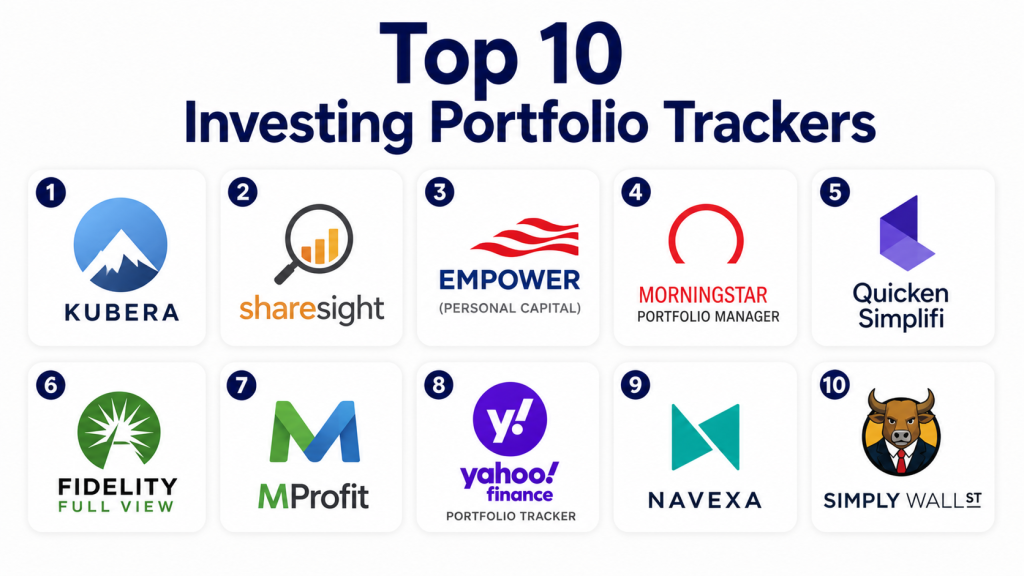
Top 10 Investing Portfolio Trackers
#1 — Empower
Short description: Empower offers a comprehensive wealth management dashboard that has become the standard for free net worth tracking. It excels at aggregating US-based brokerage, bank, and retirement accounts to provide a high-level view of financial health. It is designed for investors who want to see their entire balance sheet, including liabilities like mortgages and credit cards, alongside their investments.
Key Features
- Investment Checkup: Compares your current allocation to a recommended target based on your risk profile.
- Retirement Planner: Uses Monte Carlo simulations to forecast the probability of reaching long-term savings goals.
- Fee Analyzer: Scans portfolios for hidden expense ratios in mutual funds and 401(k) plans.
- Smart Weighting: Provides a visual breakdown of sector exposure and style box concentration.
- Cash Flow Monitoring: Tracks income and spending across all linked accounts to identify savings opportunities.
Pros
- The core dashboard and analytical tools are provided at no cost to the user.
- Highly intuitive interface that simplifies complex retirement planning data.
Cons
- Users with higher net worths may receive frequent outreach from the firm’s paid advisory arm.
- Limited support for international brokerages and manual alternative asset tracking.
Platforms / Deployment
- Web / iOS / Android
- Cloud
Security & Compliance
- AES-256 encryption, multi-factor authentication, and SOC 2 compliance.
- Not publicly stated.
Integrations & Ecosystem
Empower utilizes industry-leading aggregators to connect with thousands of US financial institutions.
- Integration with major US 401(k) and 403(b) providers.
- Export capabilities for financial planning data.
Support & Community
Extensive help center, educational webinars, and a robust financial blog for user self-service.
#2 — Morningstar Investor
Short description: Morningstar Investor is a research-heavy platform built for the fundamental investor. It leverages Morningstar’s legendary database of stock and fund research to help users evaluate the quality of their holdings. It is less about day-to-day “net worth” tracking and more about the granular analysis of security performance and portfolio construction.
Key Features
- Portfolio X-Ray: Breaks down the underlying holdings of your mutual funds and ETFs to show true exposure.
- Analyst Ratings: Direct access to independent research and “Star Ratings” for thousands of securities.
- Advanced Screening: A powerful engine to filter stocks and funds based on fundamental metrics and ESG scores.
- Watchlist Real-Time Monitoring: Tracks potential investments with integrated news and analyst updates.
- Valuation Analytics: Shows whether your current holdings are overvalued or undervalued relative to historical norms.
Pros
- Provides institutional-grade data and independent research that is difficult to find elsewhere.
- The X-Ray tool is the gold standard for identifying hidden concentration in a portfolio.
Cons
- The user interface can feel dense and academic for casual retail investors.
- The premium subscription is higher than many other retail-focused tools.
Platforms / Deployment
- Web / iOS / Android
- Cloud
Security & Compliance
- Bank-level encryption and strict data privacy protocols.
- GDPR and CCPA compliant.
Integrations & Ecosystem
Focuses on internal data integrity but allows for manual entry and CSV imports.
- Automated syncing with major US brokerages.
- Integration with various financial planning tools.
Support & Community
Premier customer support, extensive documentation, and a global network of investment professionals.
#3 — Sharesight
Short description: Sharesight is a specialized performance and tax tracking tool that focuses on the “math” of investing. It is particularly popular in global markets like Australia, Canada, and the UK. It excels at handling dividends, corporate actions, and currency fluctuations, making it the preferred choice for long-term investors who care about total return.
Key Features
- Dividend Tracking: Automatically logs and forecasts dividends, including support for DRIPs (Dividend Reinvestment Plans).
- Tax Reporting: Generates capital gains and taxable income reports localized for several countries.
- Benchmarking: Allows users to compare their actual performance against any global index or specific stock.
- Multi-Currency Support: Handles assets across dozens of global exchanges with automated currency conversion.
- Performance Attribution: Breaks down returns by capital gains, dividends, and currency impact.
Pros
- Unmatched accuracy in calculating “Total Return” (price change + dividends).
- Drastically simplifies the process of tax preparation for complex portfolios.
Cons
- The free tier is limited to a small number of holdings (usually 10).
- Does not track “lifestyle” assets like bank accounts or credit card debt.
Platforms / Deployment
- Web / iOS / Android
- Cloud
Security & Compliance
- 2FA support and data encryption at rest and in transit.
- Varies / Not publicly stated.
Integrations & Ecosystem
Sharesight is designed to be part of a broader financial tech stack.
- Direct integration with Xero and QuickBooks for accounting.
- Support for over 200 global brokers via automated file imports or APIs.
Support & Community
Active user forum, comprehensive knowledge base, and email-based support.
#4 — Kubera
Short description: Kubera is a modern, privacy-focused net worth tracker built for the digital asset era. It is designed for individuals with highly diversified portfolios that include stocks, crypto, domain names, real estate, and private equity. It offers a clean, spreadsheet-style interface that prioritizes simplicity and global asset coverage.
Key Features
- Global Asset Sync: Connects to thousands of banks, brokerages, and crypto exchanges across the globe.
- Alternative Asset Tracking: Automated tracking for real estate (via Zillow) and manual tracking for physical assets like cars.
- Crypto Wallet Support: Native tracking of hardware wallets and decentralized finance (DeFi) protocols.
- Dead Man’s Switch: A unique feature that grants a designated beneficiary access to financial data after a period of inactivity.
- Privacy-Centric Model: Operates on a subscription fee rather than selling user data or pushing advisory services.
Pros
- The most versatile “all-in-one” tracker for modern, tech-focused investors.
- Extremely fast and beautiful user interface with no advertisements.
Cons
- No free tier is available; the platform requires a paid subscription.
- Lacks deep fundamental research or analyst reports on individual stocks.
Platforms / Deployment
- Web / iOS / Android
- Cloud
Security & Compliance
- End-to-end encryption and a “Zero Knowledge” architecture.
- Not publicly stated.
Integrations & Ecosystem
Uses multiple data aggregators (Plaid, Salt Edge, Flinks) to provide unmatched global connectivity.
- Extensive integration with crypto exchanges and wallets.
- Real estate valuation via third-party data providers.
Support & Community
Direct access to the founding team and a high-quality help center.
#5 — Stock Rover
Short description: Stock Rover is a powerful research and portfolio analysis platform aimed at the quantitative investor. It sits between a retail tool and a professional terminal, offering massive datasets and screening capabilities. It is ideal for North American investors who want to backtest strategies and monitor their portfolios using hundreds of financial metrics.
Key Features
- Metric-Heavy Screener: Filter over 8,500 stocks using 700+ different financial ratios and metrics.
- Future Income Projections: A dedicated module for forecasting dividend income for the next decade.
- Correlation Matrix: Identifies how closely holdings move together to assess true diversification.
- Strategy Backtesting: Test how specific screening criteria would have performed historically.
- Metric Alerts: Set alerts for complex valuation conditions (e.g., P/E ratio relative to historical mean).
Pros
- Offers an incredible amount of data and customization for its price point.
- Excellent for investors who prioritize “Value” or “Quality” factor investing.
Cons
- The interface is functional but can feel overwhelming and “dense” for beginners.
- Primarily focused on US and Canadian markets.
Platforms / Deployment
- Web-only (Optimized for desktop)
- Cloud
Security & Compliance
- Standard SSL encryption and secure data hosting environments.
- Not publicly stated.
Integrations & Ecosystem
- Integrates with major US brokerages via third-party aggregators.
- Support for CSV exports and data manipulation in external tools.
Support & Community
Detailed user manuals, educational videos, and a responsive technical support desk.
#6 — Koyfin
Short description: Koyfin is a professional-grade analytics platform that provides a visual alternative to the Bloomberg Terminal. It is designed for financial advisors and sophisticated retail investors who need high-quality charting, macro data, and portfolio tracking in a responsive browser-based environment.
Key Features
- World-Class Charting: Superior tools for comparing stocks, indices, and economic indicators visually.
- Model Portfolios: Create and track “paper” portfolios to test strategies before committing capital.
- Market Dashboards: Real-time monitoring of global macro trends, including yield curves and commodities.
- Financial Snapshots: Comprehensive one-page summaries of company financials and analyst estimates.
- Earnings Transcripts: Direct access to corporate presentations and call transcripts.
Pros
- Blazing fast performance with an interface that rivals institutional platforms.
- Highly affordable relative to the depth of data provided.
Cons
- Portfolio tracking features are more research-focused than tax-focused.
- Certain advanced macro data points require a higher-tier subscription.
Platforms / Deployment
- Web / iOS / Android
- Cloud
Security & Compliance
- Enterprise-grade security and SSO options for professional firms.
- Not publicly stated.
Integrations & Ecosystem
Koyfin serves as a centralized research hub for the modern investor.
- Brokerage syncing via automated aggregators.
- API access available for institutional-level integration.
Support & Community
Active social media presence for feedback and a comprehensive online documentation library.
#7 — Portfolio Visualizer
Short description: Portfolio Visualizer is a quantitative tool focused on backtesting and asset allocation modeling. It is the “scientist’s” tool of the investment world, used to optimize portfolios based on historical data and statistical models. It is less of a daily tracker and more of a strategic planning engine for portfolio architecture.
Key Features
- Backtesting Engine: Test asset allocations against decades of historical market data.
- Monte Carlo Simulation: Model future outcomes based on historical volatility and expected returns.
- Asset Correlation Analysis: Visualize how different assets interact to manage systemic risk.
- Mean-Variance Optimization: Calculate the “Efficient Frontier” for your specific holdings.
- Factor Analysis: Identify which investment factors (Value, Growth, Size) are driving returns.
Pros
- Unmatched for rigorous statistical analysis and “what-if” scenario planning.
- Deeply analytical approach helps investors understand the “why” behind their performance.
Cons
- Not a daily “tracker”; lacks mobile push notifications and real-time net worth syncing.
- Requires a basic understanding of financial statistics to be effective.
Platforms / Deployment
- Web-only
- Cloud
Security & Compliance
- Standard web security and data handling protocols.
- Not publicly stated.
Integrations & Ecosystem
- Minimal external integrations; relies on its own robust internal database.
- Data export functionality for further analysis in Excel.
Support & Community
Technical documentation that explains the underlying formulas and models used for simulations.
#8 — Delta
Short description: Delta is a premier multi-asset mobile app that covers everything from stocks and ETFs to crypto and NFTs. It is designed for the modern investor who wants a fast, beautiful, and “always-on” view of their assets. Delta excels at combining the traditional finance world with the decentralized finance world in a single interface.
Key Features
- Live Price Tracking: Real-time updates for over 300,000 different assets globally.
- Direct Wallet Sync: Connects directly to dozens of crypto wallets and exchanges.
- Market Sentiment: Integrated social sentiment analysis and news feeds for holdings.
- Multi-Portfolio Support: Manage separate views for different family members or strategies.
- Brokerage Connections: Syncs with major global stock brokers for automated trade logging.
Pros
- Offers one of the best user experiences and interface designs in the category.
- Exceptional coverage of global markets and niche assets like obscure cryptocurrencies.
Cons
- Advanced analytics and certain “Pro” features require a recurring subscription.
- Not as powerful for fundamental research (e.g., deep balance sheet analysis).
Platforms / Deployment
- iOS / Android / Desktop (Mac/Windows)
- Cloud
Security & Compliance
- Standard app-based security with MFA support.
- Varies / Not publicly stated.
Integrations & Ecosystem
- Massive library of crypto exchange APIs and wallet connectors.
- Deep integration with the eToro ecosystem.
Support & Community
Large, active Discord community and a responsive help desk for technical issues.
#9 — Ziggma
Short description: Ziggma is an investment management platform that simplifies professional-grade analysis for retail users. It uses a proprietary “Stock Score” system to help investors quickly evaluate the health of their portfolio. It is designed to be a middle ground between the simplicity of a basic tracker and the complexity of a research terminal.
Key Features
- Ziggma Stock Score: A 0-100 quality score based on growth, profitability, and valuation.
- Portfolio Simulator: Test how adding or removing a stock affects your overall portfolio risk and score.
- Dividend Dashboard: A specialized view for projected income and historical payout consistency.
- Smart Alerts: Notifications for significant changes in stock scores or analyst sentiment.
- Curated Top Lists: Access to lists like “Dividend Kings” or “Growth Leaders” directly within the app.
Pros
- Very easy to navigate; makes data-driven investing accessible to non-experts.
- The simulator tool is excellent for preventing emotional decision-making.
Cons
- Smaller historical dataset than Morningstar or Stock Rover.
- Fewer tools for technical charting or day trading.
Platforms / Deployment
- Web / iOS / Android
- Cloud
Security & Compliance
- Secure bank connections via industry-standard aggregators.
- Not publicly stated.
Integrations & Ecosystem
- Direct sync with most major US brokerage firms.
- Support for exporting data to CSV.
Support & Community
Responsive email support and a library of guides for new investors.
#10 — Vyzer
Short description: Vyzer is an ultra-high-net-worth focused platform built for “complex wealth.” It is designed for investors whose portfolios go beyond the stock market into private equity, syndications, and multiple business entities. Vyzer uses automation to eliminate the manual work of tracking illiquid and “offline” assets.
Key Features
- Document Scraping: Uses AI to extract data from K-1s, quarterly reports, and investment statements.
- Private Equity Tracker: Monitors capital calls, distributions, and IRR for private placements.
- Estate Planning Vault: Secure storage for legal documents with beneficiary access.
- Cash Flow Management: Tracks when distributions are expected from private investments.
- Peer Benchmarking: Compares your private investment performance against industry averages.
Pros
- The only tool that effectively automates the tracking of “offline” investments like real estate syndications.
- Excellent for high-net-worth individuals who want a truly passive tracking experience.
Cons
- Significant subscription cost relative to standard retail trackers.
- Unnecessary for investors who only hold liquid stocks and bonds.
Platforms / Deployment
- Web / iOS / Android
- Cloud
Security & Compliance
- Enterprise-grade encryption and strict privacy protocols.
- Not publicly stated.
Integrations & Ecosystem
- Integrates with Plaid for liquid assets.
- Custom parsing engine for proprietary financial documents.
Support & Community
Concierge-style support and direct access to wealth tracking specialists.
Comparison Table (Top 10)
| Tool Name | Best For | Platform(s) Supported | Deployment | Standout Feature | Public Rating |
| Empower | Free Net Worth | Web, iOS, Android | Cloud | Retirement Planner | N/A |
| Morningstar | Deep Research | Web, iOS, Android | Cloud | Portfolio X-Ray | N/A |
| Sharesight | Total Return/Tax | Web, iOS, Android | Cloud | Dividend Tracking | N/A |
| Kubera | Modern/Digital Wealth | Web, iOS, Android | Cloud | Dead Man’s Switch | N/A |
| Stock Rover | Quant Screener | Web | Cloud | 700+ Metric Screener | N/A |
| Koyfin | Visual Analytics | Web, iOS, Android | Cloud | Professional Charting | N/A |
| Portfolio Visualizer | Backtesting | Web | Cloud | Monte Carlo Simulation | N/A |
| Delta | Mobile/Multi-Asset | iOS, Android, Desktop | Cloud | 300k+ Asset Tracking | N/A |
| Ziggma | Ease of Use | Web, iOS, Android | Cloud | Ziggma Stock Score | N/A |
| Vyzer | Private Equity | Web, iOS, Android | Cloud | K-1 Data Scraping | N/A |
Evaluation & Scoring of Investing Portfolio Trackers
The scores below reflect a comparative assessment based on the needs of a modern, diversified investor.
| Tool Name | Core (25%) | Ease (15%) | Integrations (15%) | Security (10%) | Performance (10%) | Support (10%) | Value (15%) | Total (0-10) |
| Empower | 8.5 | 9.5 | 9.0 | 9.0 | 9.0 | 8.5 | 10.0 | 9.03 |
| Morningstar | 10.0 | 7.0 | 8.0 | 9.5 | 8.5 | 9.0 | 7.5 | 8.60 |
| Sharesight | 9.0 | 8.5 | 9.5 | 9.0 | 9.0 | 8.5 | 8.5 | 8.83 |
| Kubera | 8.0 | 10.0 | 9.5 | 9.5 | 9.5 | 8.5 | 8.0 | 8.98 |
| Stock Rover | 9.5 | 6.0 | 8.0 | 8.5 | 9.0 | 8.0 | 9.0 | 8.35 |
| Koyfin | 9.0 | 8.5 | 8.5 | 9.0 | 10.0 | 8.5 | 9.0 | 8.93 |
| Portfolio Visualizer | 8.5 | 6.0 | 5.0 | 8.0 | 9.0 | 7.5 | 9.5 | 7.53 |
| Delta | 7.5 | 10.0 | 9.0 | 8.5 | 9.5 | 8.0 | 9.0 | 8.68 |
| Ziggma | 8.0 | 9.0 | 8.5 | 8.5 | 9.0 | 8.0 | 9.0 | 8.55 |
| Vyzer | 9.0 | 8.0 | 9.0 | 9.5 | 8.5 | 9.5 | 7.0 | 8.43 |
How to interpret these scores:
- Core Features: Measures the depth of tracking, performance math, and reporting.
- Integrations: Measures the ability to connect to global banks and alternative assets.
- Weighted Total: A score above 8.5 indicates an industry-leading tool suitable for serious investors.
Which Investing Portfolio Tracker Is Right for You?
Solo / Freelancer
If you are managing your own retirement accounts and want a clean, “set it and forget it” view of your net worth, Empower is the best choice. It provides the necessary high-level overview without the complexity of professional research terminals.
SMB (Small Business / Financial Advisor)
For professionals who manage portfolios for clients or businesses, Koyfin or Morningstar Investor are ideal. They offer the presentation-quality reports and research credibility required to justify investment decisions to stakeholders.
Mid-Market / Professional Traders
If you have a high volume of trades and care about deep quantitative data, Stock Rover provides the screening and backtesting tools necessary to refine a professional trading strategy.
Enterprise / Ultra-High-Net-Worth
For individuals or family offices managing complex wealth including real estate syndications and private equity, Vyzer is the only tool that effectively automates the “manual” side of tracking illiquid assets.
Frequently Asked Questions (FAQs)
1. How do these tools ensure my financial data is secure?
Most modern trackers use “read-only” access, meaning they can only view your data and cannot initiate transactions. They utilize enterprise-grade AES-256 encryption and often rely on established third-party aggregators like Plaid or Yodlee. Additionally, top-tier tools implement Zero Trust protocols and multi-factor authentication (MFA) to ensure that only verified users can access sensitive financial information.
2. Can I track cryptocurrency and NFTs alongside traditional stocks?
Yes, tools like Delta and Kubera are designed specifically for the modern multi-asset investor. They can sync directly with blockchain wallets and exchanges to show real-time balances. Traditional tools like Morningstar or Empower may allow you to add “Crypto” as a manual asset, but they often lack the granular DeFi tracking found in newer platforms.
3. Why should I use a third-party tracker instead of my broker’s dashboard?
Most investors hold accounts with multiple institutions (e.g., a workplace 401(k), a personal Roth IRA, and a crypto exchange). A third-party tracker consolidates these to show your “True Asset Allocation.” It reveals hidden risks, such as being over-weighted in a single stock because it is held in three different mutual funds across three different accounts.
4. How does portfolio tracking assist with tax preparation?
Specialized tools like Sharesight automatically track cost basis, stock splits, and dividend payouts. At the end of the year, they can generate capital gains reports that are ready to be handed to an accountant or imported into tax software. This prevents the manual effort of reconciling dozens of different 1099 forms from multiple brokerages.
5. What is the difference between a net worth tracker and a portfolio tracker?
A net worth tracker (like Empower) looks at the “Total Picture,” including cash, debt, and physical assets. A portfolio tracker (like Sharesight or Stock Rover) is a “deep-dive” tool for investment securities, providing technical data like dividend yield, total return, and performance relative to a benchmark. Most serious investors use a combination of both.
6. Do these trackers support international markets and currencies?
Support varies significantly. Tools like Sharesight and Kubera are built for global use, supporting hundreds of exchanges and automatic currency conversion. US-centric tools like Empower or Stock Rover are primarily focused on North American markets and may not provide the same level of accuracy for international holdings or foreign tax reporting.
7. How often does my portfolio data refresh?
Most cloud-based trackers refresh data at least once every 24 hours, typically overnight. Some premium or mobile-first platforms offer real-time syncing for a more “live” view of market movements. Note that some brokerage connections may require you to re-authenticate with an MFA code periodically to maintain a secure connection.
8. Is it possible to backtest an investment strategy before I buy?
Yes, platforms like Portfolio Visualizer and Stock Rover specialize in this. You can input a hypothetical asset mix and see how it would have performed during historical events like the 2008 financial crisis or the 2020 market dip. This helps you understand the historical volatility and potential drawdown of a strategy before committing real capital.
9. Can I track “illiquid” assets like real estate or private equity?
Traditional trackers often require you to enter these as manual “static” balances. However, modern platforms like Vyzer use AI-driven document scraping to “read” quarterly reports from private equity funds and update your internal rate of return (IRR) automatically. For real estate, some tools integrate with Zillow to provide estimated market values.
10. What are the common mistakes to avoid when choosing a tracker?
The most common mistake is choosing a tool that is too complex for your needs, leading to “dashboard fatigue.” Another error is ignoring the “look-through” capability; if your tracker can’t see inside your ETFs, you won’t know your true exposure to individual companies. Finally, ensure the tool you choose allows for easy data export to avoid being “locked in.”
Conclusion
The selection of an investing portfolio tracker depends entirely on the complexity of your holdings and your personal goals. For those seeking a free, holistic view of their net worth, Empower remains the premier choice. However, as your portfolio diversifies into global markets, alternative assets, and complex tax structures, specialized tools like Sharesight, Kubera, or Vyzer provide the precision and automation necessary to manage wealth efficiently in the modern era.
Choosing the right tool is not just about tracking numbers; it is about gaining the clarity needed to make informed, unemotional decisions. We recommend shortlisting two platforms—perhaps one for broad net worth tracking and one for deep investment analysis—and testing them with your actual data for a month. This hands-on approach will reveal which interface and data set best empowers you to optimize your long-term financial strategy.
