Introduction
Patient Engagement Platforms are digital healthcare solutions that help providers communicate with patients, improve care access, automate reminders, support digital intake, manage outreach, and encourage patients to participate actively in their healthcare journey. These platforms are used by hospitals, clinics, specialty practices, and healthcare networks to improve patient satisfaction, reduce missed appointments, and strengthen long-term care relationships.
A strong patient engagement platform goes beyond basic messaging. It supports appointment reminders, secure communication, digital forms, patient education, feedback collection, care navigation, billing communication, and follow-up workflows. These tools help healthcare organizations reduce administrative burden while giving patients a more convenient and connected experience. Choosing the right platform depends on usability, integration with EHR systems, communication features, automation depth, security, scalability, and support quality.
Key Trends in Patient Engagement Platforms
- Increased focus on digital-first patient communication
- Growth of mobile-friendly patient engagement tools
- Automated appointment reminders and no-show reduction workflows
- Digital intake forms and pre-visit check-in automation
- Integration with EHR, billing, and scheduling systems
- Personalized patient outreach and education campaigns
- Secure messaging between patients and care teams
- Stronger use of analytics to measure patient experience
- Telehealth and virtual care engagement support
- Better patient feedback and satisfaction tracking
How We Selected These Tools
- Patient communication and engagement features
- Ease of use for patients and healthcare staff
- Appointment reminder and scheduling support
- Digital intake and form automation
- EHR and practice management integrations
- Patient education and outreach capabilities
- Security, privacy, and access control features
- Reporting and analytics quality
- Scalability for clinics, hospitals, and health systems
- Overall value and operational impact
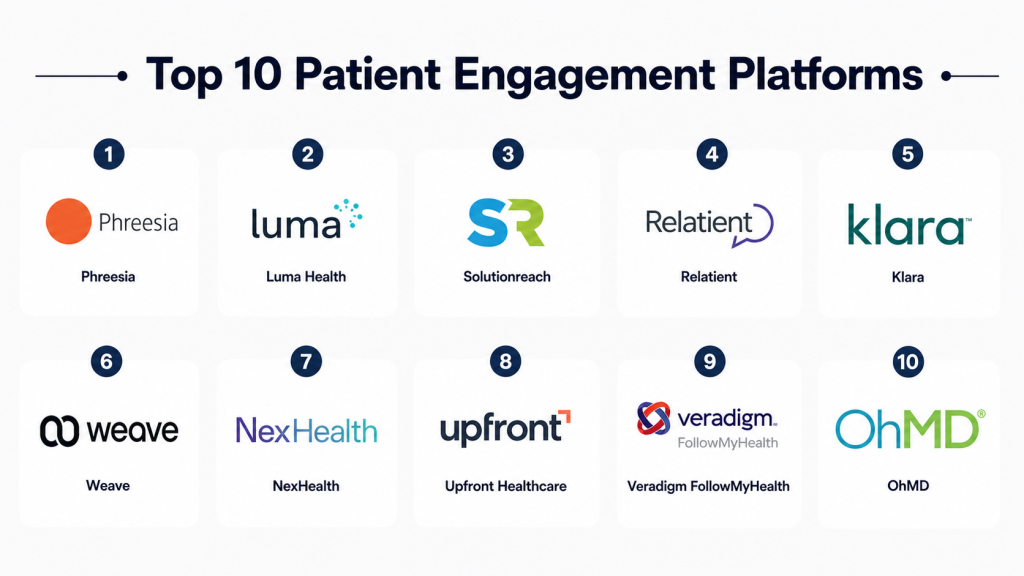
Top 10 Patient Engagement Platforms
#1 — Luma Health
Luma Health is a patient engagement platform focused on access, scheduling, reminders, intake, and communication workflows. It helps healthcare organizations reduce no-shows, improve appointment utilization, and simplify patient journeys. The platform supports digital outreach, appointment reminders, waitlist management, and patient communication. It is useful for clinics, specialty groups, and hospitals that want to improve patient access. Luma Health is especially strong for organizations that need better scheduling efficiency. It is ideal for healthcare teams focused on operational improvement and patient experience.
Key Features
- Appointment reminders
- Patient scheduling workflows
- Digital intake support
- Waitlist management
- Patient communication tools
- Outreach automation
- Access optimization
Pros
- Strong patient access features
- Helps reduce missed appointments
- Good for communication automation
Cons
- Not a full EHR replacement
- Best value depends on integration setup
- May require workflow configuration
Platforms / Deployment
Cloud-based.
Security & Compliance
Healthcare security features are available, but exact compliance details may vary by deployment.
Integrations & Ecosystem
Luma Health integrates with healthcare scheduling, EHR, intake, communication, and patient access workflows depending on configuration.
Support & Community
Vendor support is available depending on plan and implementation scope.
#2 — Phreesia
Phreesia is a patient engagement and intake platform designed to streamline registration, forms, payments, communication, and administrative workflows. It helps healthcare organizations reduce front-desk workload and improve the pre-visit experience. Patients can complete intake forms, update information, make payments, and receive messages digitally. Phreesia is especially useful for high-volume practices and healthcare groups. It supports a smoother check-in experience and improves operational efficiency. It is best for organizations that want strong intake and administrative automation.
Key Features
- Digital patient intake
- Registration forms
- Payment collection
- Patient communication
- Appointment workflow support
- Demographic updates
- Administrative automation
Pros
- Strong digital intake capabilities
- Helps reduce front-desk burden
- Good payment and form support
Cons
- Not a full clinical system
- Works best with integrated workflows
- More intake-focused than full engagement suite
Platforms / Deployment
Cloud-based.
Security & Compliance
Healthcare data protection features are available, but exact details vary by implementation.
Integrations & Ecosystem
Phreesia integrates with EHR, practice management, billing, payment, and patient intake workflows.
Support & Community
Vendor support is available depending on customer plan.
#3 — Solutionreach
Solutionreach is a patient engagement platform built for communication, appointment reminders, recall campaigns, surveys, and patient relationship management. It helps healthcare providers communicate with patients through digital channels and reduce missed appointments. The platform is suitable for medical, dental, and specialty practices looking to improve patient retention. It supports automated reminders, reputation management, and patient messaging. Solutionreach is useful for practices that want consistent communication and better patient follow-up. It is best for organizations focused on patient loyalty and communication efficiency.
Key Features
- Appointment reminders
- Two-way messaging
- Patient recall campaigns
- Surveys and feedback
- Reputation management
- Patient communication automation
- Practice engagement tools
Pros
- Strong communication workflows
- Useful for patient retention
- Good reminder and recall features
Cons
- Advanced clinical depth may be limited
- Best suited for outpatient practices
- Integration quality may vary
Platforms / Deployment
Cloud-based.
Security & Compliance
Not publicly stated in detail for all deployments.
Integrations & Ecosystem
Solutionreach can connect with practice management, scheduling, messaging, and patient communication workflows.
Support & Community
Vendor support availability varies by plan.
#4 — Klara
Klara is a patient communication and engagement platform that helps healthcare teams manage messaging, reminders, care coordination, and patient conversations. It is designed to improve communication between providers and patients while reducing phone calls. The platform supports secure messaging, automated workflows, and team collaboration. Klara is useful for clinics and specialty practices that want faster patient communication. It helps teams manage conversations in a more organized way. It is best for organizations that prioritize messaging and patient responsiveness.
Key Features
- Secure patient messaging
- Automated reminders
- Team communication workflows
- Patient conversation management
- Digital forms support
- Follow-up automation
- Care coordination tools
Pros
- Strong messaging experience
- Helps reduce phone workload
- Easy for patient communication
Cons
- May not cover full intake needs
- Best for communication-heavy workflows
- Advanced reporting may vary
Platforms / Deployment
Cloud-based.
Security & Compliance
Healthcare-grade security features are available, but exact details vary by plan and configuration.
Integrations & Ecosystem
Klara integrates with scheduling, EHR, practice workflows, and patient communication systems depending on setup.
Support & Community
Vendor support is available based on package.
#5 — InteliChart
InteliChart is a patient engagement platform focused on patient communication, portal access, reminders, online forms, and outreach automation. It helps healthcare organizations improve patient participation and reduce manual follow-ups. The platform supports secure messaging, care communication, and digital patient workflows. It is suitable for outpatient providers, clinics, and healthcare groups that want structured engagement tools. InteliChart helps improve communication and patient self-service. It is best for practices needing a balance between portal access and engagement automation.
Key Features
- Patient portal features
- Secure messaging
- Appointment reminders
- Online forms
- Patient outreach
- Care communication
- Engagement automation
Pros
- Good mix of portal and engagement tools
- Useful for outpatient practices
- Supports communication automation
Cons
- May require integration planning
- Advanced customization may vary
- Best for engagement-focused use cases
Platforms / Deployment
Cloud-based.
Security & Compliance
Not publicly stated in detail for all deployments.
Integrations & Ecosystem
InteliChart supports integrations with healthcare systems, scheduling tools, patient portals, and communication workflows.
Support & Community
Support availability depends on vendor package.
#6 — Relatient
Relatient is a patient engagement platform designed for scheduling, messaging, reminders, outreach, and patient communication workflows. It helps healthcare organizations improve patient access and automate routine communication. The platform supports appointment reminders, digital messaging, patient outreach, and scheduling workflows. It is useful for healthcare groups that want to reduce no-shows and improve access. Relatient is best for organizations needing scalable communication automation. It fits clinics, specialty groups, and larger provider networks.
Key Features
- Appointment reminders
- Patient messaging
- Scheduling support
- Outreach campaigns
- Digital communication automation
- Patient access tools
- Reporting dashboards
Pros
- Strong automation features
- Useful for reducing no-shows
- Scales across provider groups
Cons
- Setup may require workflow mapping
- Best value depends on integrations
- Advanced portal features may vary
Platforms / Deployment
Cloud-based.
Security & Compliance
Not publicly stated in detail for all configurations.
Integrations & Ecosystem
Relatient integrates with scheduling, EHR, practice management, and patient communication workflows.
Support & Community
Vendor support is available depending on plan.
#7 — Updox
Updox is a healthcare communication platform that supports patient messaging, forms, telehealth, reminders, and document workflows. It helps healthcare teams manage communication in a centralized digital workspace. The platform is useful for practices that want to reduce calls, improve patient response, and support digital care communication. Updox also supports fax and document-related workflows, which can be valuable for healthcare operations. It is suitable for small and mid-sized practices. It is best for teams needing communication, forms, and telehealth support in one place.
Key Features
- Patient messaging
- Digital forms
- Appointment reminders
- Telehealth support
- Document workflows
- Communication inbox
- Practice collaboration tools
Pros
- Good communication toolkit
- Useful for small and mid-sized practices
- Supports telehealth and forms
Cons
- Not a complete EHR system
- User experience may vary by workflow
- Advanced analytics may be limited
Platforms / Deployment
Cloud-based.
Security & Compliance
Healthcare-focused security features are available, but exact details vary by configuration.
Integrations & Ecosystem
Updox integrates with EHR, forms, communication, telehealth, and administrative workflows.
Support & Community
Vendor support is available depending on plan.
#8 — Artera
Artera is a patient communication platform designed to help healthcare organizations manage patient conversations across multiple digital channels. It supports outreach, reminders, scheduling communication, and care journey messaging. The platform helps providers create more responsive and organized communication workflows. It is useful for health systems and provider groups that need scalable patient messaging. Artera is especially suitable for organizations aiming to modernize patient communication. It is best for teams that need multi-channel engagement at scale.
Key Features
- Patient messaging
- Multi-channel communication
- Appointment reminders
- Outreach workflows
- Care journey communication
- Automation tools
- Reporting support
Pros
- Strong communication focus
- Good for large provider groups
- Supports scalable engagement workflows
Cons
- Not a full patient portal
- Best results depend on integration setup
- May require configuration effort
Platforms / Deployment
Cloud-based.
Security & Compliance
Healthcare security features are available, but exact details vary by implementation.
Integrations & Ecosystem
Artera integrates with healthcare systems, scheduling tools, communication workflows, and patient engagement operations.
Support & Community
Vendor support is available based on customer agreement.
#9 — CipherHealth
CipherHealth is a patient engagement platform focused on outreach, care coordination, rounding, patient follow-up, and experience improvement. It supports healthcare organizations in communicating with patients before, during, and after care episodes. The platform is useful for hospitals and health systems that want to improve patient satisfaction and care transitions. It helps automate outreach and collect patient feedback. CipherHealth is best for organizations focused on patient experience and post-care engagement. It is suitable for hospitals looking to improve communication beyond routine scheduling.
Key Features
- Patient outreach
- Care coordination
- Follow-up automation
- Feedback collection
- Experience management
- Rounding workflows
- Patient communication tools
Pros
- Strong post-care engagement
- Useful for hospitals and health systems
- Supports patient experience improvement
Cons
- May be more hospital-focused
- Not primarily a scheduling platform
- Implementation needs workflow planning
Platforms / Deployment
Cloud-based.
Security & Compliance
Not publicly stated in detail for all deployments.
Integrations & Ecosystem
CipherHealth integrates with healthcare workflows, patient outreach systems, experience management, and care coordination processes.
Support & Community
Vendor support availability depends on package and implementation.
#10 — GetWell
GetWell is a patient engagement platform focused on digital care navigation, patient education, communication, and experience improvement. It helps healthcare organizations guide patients through care journeys and provide timely information. The platform is useful for hospitals, care teams, and health systems that want to improve patient activation and satisfaction. It supports engagement across different stages of care, from pre-visit to post-discharge. GetWell is best suited for organizations focused on patient education and guided care experiences. It can support broader patient experience strategies.
Key Features
- Patient education
- Digital care navigation
- Patient communication
- Experience improvement
- Care journey support
- Outreach workflows
- Engagement analytics
Pros
- Strong care journey focus
- Useful for patient education
- Good for hospitals and health systems
Cons
- May not be ideal for small clinics
- Requires content and workflow planning
- Best value depends on care model
Platforms / Deployment
Cloud-based.
Security & Compliance
Healthcare security features are available, but exact details vary by deployment.
Integrations & Ecosystem
GetWell integrates with healthcare workflows, patient education, communication, and care coordination systems.
Support & Community
Vendor support is available depending on contract and deployment.
Comparison Table
| Tool | Best For | Deployment | Core Strength | Engagement Focus | Standout Feature |
|---|---|---|---|---|---|
| Luma Health | Patient access teams | Cloud | Scheduling and reminders | High | Access optimization |
| Phreesia | Intake-heavy practices | Cloud | Digital intake and payments | High | Front-desk automation |
| Solutionreach | Outpatient practices | Cloud | Reminders and recall | High | Patient retention workflows |
| Klara | Communication-heavy clinics | Cloud | Secure messaging | High | Conversation management |
| InteliChart | Clinics and practices | Cloud | Portal and engagement | High | Forms, reminders, outreach |
| Relatient | Provider groups | Cloud | Scheduling communication | High | Scalable automation |
| Updox | Small and mid-sized practices | Cloud | Communication and telehealth | Medium to High | Unified communication workspace |
| Artera | Large provider groups | Cloud | Multi-channel messaging | High | Scalable patient communication |
| CipherHealth | Hospitals and health systems | Cloud | Outreach and experience | High | Post-care follow-up |
| GetWell | Care navigation teams | Cloud | Patient education | High | Guided care journeys |
Evaluation & Scoring Table
| Tool | Core | Ease | Integrations | Security | Performance | Support | Value | Weighted Total |
|---|---|---|---|---|---|---|---|---|
| Luma Health | 9 | 9 | 8 | 8 | 8 | 8 | 8 | 8.4 |
| Phreesia | 9 | 8 | 8 | 8 | 8 | 8 | 8 | 8.3 |
| Solutionreach | 8 | 9 | 8 | 8 | 8 | 8 | 8 | 8.2 |
| Klara | 8 | 9 | 8 | 8 | 8 | 8 | 8 | 8.2 |
| InteliChart | 8 | 8 | 8 | 8 | 7 | 7 | 8 | 7.8 |
| Relatient | 8 | 8 | 8 | 8 | 8 | 8 | 8 | 8.0 |
| Updox | 8 | 8 | 8 | 8 | 7 | 7 | 8 | 7.8 |
| Artera | 9 | 8 | 9 | 8 | 8 | 8 | 7 | 8.2 |
| CipherHealth | 8 | 8 | 8 | 8 | 8 | 8 | 7 | 8.0 |
| GetWell | 8 | 8 | 8 | 8 | 8 | 8 | 7 | 8.0 |
Which Patient Engagement Platform Is Right for You?
Choosing the right patient engagement platform depends on your healthcare organization’s goals, patient volume, communication needs, and existing systems. Some platforms are stronger for scheduling and reminders, while others focus on intake, messaging, education, or care coordination. The best choice should improve patient experience while reducing manual administrative work.
For appointment reminders and patient access
Luma Health and Relatient are strong choices for organizations that want to reduce no-shows and improve appointment utilization. These tools support reminders, scheduling workflows, outreach, and access optimization. They are useful for clinics, hospitals, and specialty groups managing high appointment volumes. They help patients stay informed and complete scheduling tasks more easily. These platforms are best when patient access and operational efficiency are top priorities.
For digital intake and front-desk automation
Phreesia is a strong fit for healthcare organizations that want to simplify registration, forms, payments, and check-in workflows. It helps patients complete important tasks before arrival and reduces front-desk pressure. This is especially helpful for busy practices and high-volume clinics. It improves administrative efficiency and creates a smoother patient experience. It is best for organizations focused on intake, payments, and pre-visit workflows.
For secure messaging and communication-heavy teams
Klara, Updox, and Artera are suitable for practices and provider groups that want better patient communication. These platforms help reduce phone calls, organize patient conversations, and automate common messages. They are useful for clinics that need quick responses and centralized communication. Artera is better suited for larger groups needing multi-channel messaging at scale. Klara and Updox work well for teams needing simple and practical communication workflows.
For patient retention and recall campaigns
Solutionreach is a good option for outpatient practices that want to improve patient retention, reminders, and recall workflows. It supports patient messaging, surveys, reputation management, and communication automation. This makes it useful for practices that depend on ongoing patient relationships. It helps providers stay connected with patients between visits. It is ideal for organizations focused on relationship-based care and repeat appointments.
For hospitals, care coordination, and patient experience
CipherHealth and GetWell are strong choices for hospitals and health systems focused on care journeys, patient education, follow-up, and experience improvement. They help support communication before, during, and after care. These platforms are useful for improving patient satisfaction and care transitions. They are especially valuable for organizations that want structured outreach beyond appointment reminders. They are best for health systems with broader patient experience goals.
FAQs
1. What is a Patient Engagement Platform?
A Patient Engagement Platform is software that helps healthcare providers communicate with patients and involve them more actively in their care. It supports reminders, messaging, intake, education, feedback, outreach, and follow-up workflows. These platforms improve patient convenience and reduce administrative workload. They are used by clinics, hospitals, and healthcare networks. The main goal is to improve patient experience and care participation.
2. What features should a patient engagement platform include?
Important features include appointment reminders, secure messaging, digital forms, patient outreach, surveys, and communication automation. Many platforms also support online scheduling, payments, education content, and care journey workflows. Integration with EHR and practice management systems is also important. A good platform should be easy for both patients and staff to use. The best feature set depends on your organization’s needs.
3. How do patient engagement platforms reduce no-shows?
These platforms reduce no-shows by sending automated appointment reminders through text, email, voice, or app-based communication. Some tools also allow patients to confirm, cancel, or reschedule appointments easily. This helps providers fill open slots faster and reduce wasted time. Reminders improve patient accountability and convenience. Over time, better communication can improve appointment attendance rates.
4. Are patient engagement platforms useful for small clinics?
Yes, patient engagement platforms can be very useful for small clinics. They reduce phone calls, automate reminders, simplify intake, and improve patient communication. Small clinics can benefit from tools like Klara, Updox, Solutionreach, and Advanced communication-focused platforms. These systems help small teams work more efficiently. The best choice should be easy to use and affordable.
5. Can patient engagement platforms integrate with EHR systems?
Yes, many patient engagement platforms integrate with EHR, scheduling, billing, and practice management systems. Integration helps keep patient data accurate and reduces duplicate work. It also allows reminders, forms, and messages to connect with real appointment and patient records. Strong integration improves workflow efficiency. Healthcare organizations should confirm integration support before selecting a platform.
6. Are these platforms secure for patient communication?
Most patient engagement platforms include healthcare-focused security features such as access control, encrypted communication, authentication, and audit tracking. Security is important because patient information is sensitive. Providers should review vendor security policies and configure permissions carefully. Staff training also plays a role in secure communication. A secure platform helps protect patient trust and organizational reputation.
7. What is the difference between a patient portal and a patient engagement platform?
A patient portal mainly gives patients access to records, appointments, billing, and messages. A patient engagement platform is broader and may include reminders, outreach campaigns, digital intake, surveys, education, and care journey communication. Some tools combine both functions. Patient portals focus on self-service access, while engagement platforms focus on active communication and participation. Many healthcare organizations use both together.
8. Do patient engagement platforms support digital intake?
Yes, many platforms support digital intake forms, pre-visit registration, consent forms, demographic updates, and payment workflows. Tools like Phreesia are especially strong in this area. Digital intake reduces paperwork and improves front-desk efficiency. It also gives patients a smoother check-in experience. This is valuable for busy clinics and high-volume healthcare organizations.
9. Which healthcare organizations need patient engagement platforms?
Patient engagement platforms are useful for clinics, hospitals, specialty practices, diagnostic centers, and provider networks. Any organization that wants better patient communication, fewer no-shows, and smoother workflows can benefit. Small practices may use them for reminders and messaging. Larger systems may use them for outreach, care coordination, and patient experience improvement. The right platform depends on the organization’s goals.
10. Which Patient Engagement Platform is best overall?
There is no single best platform for every healthcare provider. Luma Health and Relatient are strong for scheduling and reminders, while Phreesia is best for intake automation. Klara, Updox, and Artera are useful for patient communication. CipherHealth and GetWell are strong for hospitals focused on care journeys and patient experience. The best choice depends on workflow needs, patient volume, integrations, and budget.
Conclusion
Patient Engagement Platforms are becoming essential for healthcare organizations that want to improve communication, reduce administrative workload, and deliver a better patient experience. These tools help automate reminders, simplify intake, support secure messaging, improve patient access, and strengthen care follow-up. By giving patients easier digital ways to interact with providers, healthcare teams can create more efficient and patient-friendly workflows.
The right platform depends on what your organization wants to improve most. Luma Health and Relatient are strong for scheduling and access, Phreesia is ideal for intake and payments, while Klara, Updox, and Artera are useful for communication-heavy environments. CipherHealth and GetWell are better suited for hospitals focused on patient experience, education, and care coordination. By evaluating integrations, usability, automation, security, and support, providers can choose a platform that improves both operational performance and patient satisfaction.
