Introduction
Healthcare EMR Systems are digital platforms used by healthcare providers to store, manage, and access patient medical records electronically. These systems replace paper-based records and enable clinicians to track patient history, diagnoses, medications, lab results, and treatment plans in a centralized and secure environment.
With the growing demand for digital healthcare, interoperability, and patient-centric care, EMR systems have become essential for hospitals, clinics, and healthcare organizations. Modern EMRs go beyond record-keeping by integrating billing, scheduling, analytics, and telehealth capabilities. They improve efficiency, reduce errors, and enhance patient outcomes.
Real-world use cases:
- Managing patient records and history
- Clinical documentation and e-prescriptions
- Appointment scheduling and billing
- Lab and diagnostic data integration
- Telehealth and remote care support
What buyers should evaluate:
- Patient record management capabilities
- Ease of use and clinician workflow support
- Integration with lab, billing, and imaging systems
- Compliance with healthcare regulations
- Security and data privacy features
- Customization and specialty support
- Reporting and analytics capabilities
- Scalability for growing practices
- Interoperability with other healthcare systems
Best for: Hospitals, clinics, multi-specialty practices, and healthcare organizations managing patient data and clinical workflows.
Not ideal for: Very small practices with minimal patient volume or organizations using basic record-keeping systems.
Key Trends in Healthcare EMR Systems
- Cloud-based EMR adoption increasing rapidly
- AI-assisted clinical decision support emerging
- Integration with telehealth platforms
- Mobile-first EMR access for clinicians
- Interoperability standards improving data exchange
- Automation of clinical documentation
- Patient portals enhancing engagement
- Data analytics for population health management
- Focus on regulatory compliance and security
How We Selected Healthcare EMR Systems (Methodology)
- Evaluated adoption across healthcare providers
- Assessed core EMR features and usability
- Reviewed integration with healthcare systems
- Analyzed compliance and security capabilities
- Considered scalability and performance
- Evaluated reporting and analytics features
- Reviewed vendor reliability and support
- Assessed customization and flexibility
- Considered overall value and cost
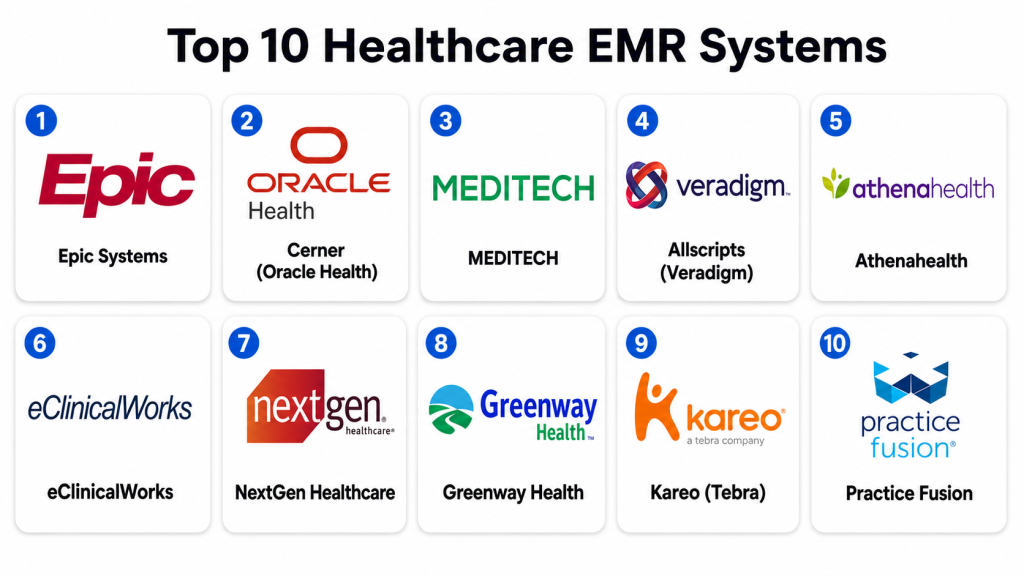
Top 10 Healthcare EMR Systems
#1 — Epic Systems
Short description: Epic Systems is one of the most widely used EMR platforms in large hospitals and healthcare networks. It provides comprehensive patient record management and clinical workflow tools. It supports interoperability and analytics. It is known for scalability. It is ideal for large healthcare organizations.
Key Features
- Patient record management
- Clinical workflows
- Interoperability
- Analytics tools
- Billing integration
- Patient portal
Pros
- Highly scalable
- Comprehensive features
Cons
- Expensive
- Complex implementation
Platforms / Deployment
Web / Cloud / On-premise
Security & Compliance
Encryption, access controls, compliance support
Integrations & Ecosystem
Epic integrates with a wide range of healthcare systems, enabling seamless data exchange.
- Lab systems
- Imaging systems
- Billing platforms
Support & Community
Strong enterprise support
#2 — Cerner (Oracle Health)
Short description: Cerner, now part of Oracle Health, is a leading EMR platform used globally. It offers patient record management, clinical workflows, and analytics. It supports interoperability and compliance. It is widely used in hospitals. It is suitable for large healthcare systems.
Key Features
- Patient data management
- Clinical workflows
- Interoperability
- Analytics tools
- Reporting features
Pros
- Strong global presence
- Robust analytics
Cons
- Complex interface
- High cost
Platforms / Deployment
Web / Cloud
Security & Compliance
Encryption, compliance controls
Integrations & Ecosystem
Cerner integrates with healthcare systems and enterprise platforms for comprehensive workflows.
- APIs
- Healthcare systems
Support & Community
Enterprise support
#3 — Allscripts
Short description: Allscripts provides EMR solutions designed for hospitals and physician practices. It offers flexible workflows and integration capabilities. It supports clinical documentation and billing. It is widely used in healthcare. It is suitable for mid to large practices.
Key Features
- Clinical documentation
- Patient records
- Billing integration
- Workflow management
- Reporting tools
Pros
- Flexible platform
- Good integration
Cons
- Interface complexity
- Implementation challenges
Platforms / Deployment
Web / Cloud
Security & Compliance
Access controls
Integrations & Ecosystem
Allscripts integrates with healthcare and enterprise systems for workflow efficiency.
- APIs
- Healthcare tools
Support & Community
Reliable support
#4 — MEDITECH
Short description: MEDITECH is an EMR platform designed for hospitals and healthcare organizations. It provides patient record management and clinical tools. It supports interoperability and compliance. It is widely used in healthcare systems. It is suitable for mid-sized organizations.
Key Features
- Patient record management
- Clinical workflows
- Interoperability
- Reporting tools
- Data analytics
Pros
- Strong healthcare focus
- Scalable platform
Cons
- Limited customization
- Learning curve
Platforms / Deployment
Web / Cloud
Security & Compliance
Access controls
Integrations & Ecosystem
MEDITECH integrates with healthcare systems and supports data exchange.
- APIs
- Healthcare tools
Support & Community
Strong support
#5 — Athenahealth
Short description: Athenahealth is a cloud-based EMR platform designed for healthcare providers. It offers patient record management, billing, and analytics. It is known for ease of use. It supports small to mid-sized practices. It improves workflow efficiency.
Key Features
- Cloud-based EMR
- Billing integration
- Patient records
- Analytics tools
- Workflow automation
Pros
- Easy to use
- Cloud-native
Cons
- Limited enterprise features
- Subscription cost
Platforms / Deployment
Cloud
Security & Compliance
Encryption, access controls
Integrations & Ecosystem
Athenahealth integrates with healthcare systems and supports workflow automation.
- APIs
- Healthcare tools
Support & Community
Good support
#6 — eClinicalWorks
Short description: eClinicalWorks is an EMR platform designed for ambulatory care providers. It offers patient record management, billing, and telehealth features. It is widely used in clinics. It supports interoperability. It is suitable for small to mid-sized practices.
Key Features
- Patient records
- Telehealth integration
- Billing tools
- Reporting features
- Workflow automation
Pros
- Affordable
- Feature-rich
Cons
- Interface issues
- Learning curve
Platforms / Deployment
Cloud
Security & Compliance
Access controls
Integrations & Ecosystem
eClinicalWorks integrates with healthcare systems and telehealth platforms.
- APIs
- Telehealth tools
Support & Community
Reliable support
#7 — NextGen Healthcare
Short description: NextGen Healthcare provides EMR solutions for ambulatory practices. It offers patient record management and workflow automation. It supports specialty practices. It provides analytics and reporting tools. It is suitable for mid-sized healthcare organizations.
Key Features
- Patient records
- Workflow automation
- Specialty support
- Analytics tools
- Reporting features
Pros
- Specialty-focused
- Scalable
Cons
- Complex interface
- Training required
Platforms / Deployment
Cloud
Security & Compliance
Access controls
Integrations & Ecosystem
NextGen integrates with healthcare systems and supports data exchange.
- APIs
- Healthcare tools
Support & Community
Good support
#8 — Greenway Health
Short description: Greenway Health offers EMR solutions designed for healthcare providers. It supports patient record management, billing, and reporting. It is suitable for small to mid-sized practices. It provides workflow automation. It improves efficiency.
Key Features
- Patient records
- Billing tools
- Reporting features
- Workflow automation
- Data management
Pros
- Easy to use
- Affordable
Cons
- Limited advanced features
- Smaller ecosystem
Platforms / Deployment
Cloud
Security & Compliance
Access controls
Integrations & Ecosystem
Greenway integrates with healthcare systems for efficient workflows.
- APIs
- Healthcare tools
Support & Community
Reliable support
#9 — Kareo (Tebra)
Short description: Kareo, now part of Tebra, is an EMR platform designed for small practices. It offers patient record management and billing features. It is easy to use. It supports workflow automation. It is ideal for small clinics.
Key Features
- Patient records
- Billing integration
- Workflow tools
- Reporting features
- Data management
Pros
- Easy to use
- Affordable
Cons
- Limited scalability
- Basic features
Platforms / Deployment
Cloud
Security & Compliance
Access controls
Integrations & Ecosystem
Kareo integrates with healthcare tools and supports small practice workflows.
- APIs
- Healthcare tools
Support & Community
Good support
#10 — Practice Fusion
Short description: Practice Fusion is a cloud-based EMR platform designed for small healthcare practices. It provides patient record management and clinical documentation tools. It is easy to use. It supports basic workflows. It is suitable for small clinics.
Key Features
- Patient records
- Clinical documentation
- Workflow tools
- Reporting features
- Data management
Pros
- Simple interface
- Cost-effective
Cons
- Limited advanced features
- Smaller ecosystem
Platforms / Deployment
Cloud
Security & Compliance
Access controls
Integrations & Ecosystem
Practice Fusion integrates with healthcare tools for basic workflows.
- APIs
- Healthcare systems
Support & Community
Basic support
Comparison Table (Top 10)
| Tool Name | Best For | Platform(s) Supported | Deployment | Standout Feature | Public Rating |
|---|---|---|---|---|---|
| Epic | Enterprise hospitals | Web | Cloud/On-premise | Scalability | N/A |
| Cerner | Global hospitals | Web | Cloud | Analytics | N/A |
| Allscripts | Mid-large practices | Web | Cloud | Flexibility | N/A |
| MEDITECH | Hospitals | Web | Cloud | Interoperability | N/A |
| Athenahealth | SMB practices | Web | Cloud | Ease of use | N/A |
| eClinicalWorks | Clinics | Web | Cloud | Telehealth | N/A |
| NextGen | Specialty care | Web | Cloud | Customization | N/A |
| Greenway | SMB | Web | Cloud | Affordability | N/A |
| Kareo | Small clinics | Web | Cloud | Simplicity | N/A |
| Practice Fusion | Small practices | Web | Cloud | Cost-effective | N/A |
Evaluation & Scoring of Healthcare EMR Systems
| Tool Name | Core (25%) | Ease (15%) | Integrations (15%) | Security (10%) | Performance (10%) | Support (10%) | Value (15%) | Weighted Total |
|---|---|---|---|---|---|---|---|---|
| Epic | 9 | 6 | 9 | 9 | 9 | 9 | 7 | 8.5 |
| Cerner | 9 | 6 | 9 | 9 | 9 | 9 | 7 | 8.5 |
| Allscripts | 8 | 7 | 8 | 8 | 8 | 8 | 8 | 8.0 |
| MEDITECH | 8 | 7 | 8 | 8 | 8 | 8 | 8 | 8.0 |
| Athenahealth | 8 | 9 | 7 | 8 | 8 | 8 | 8 | 8.2 |
| eClinicalWorks | 8 | 8 | 7 | 7 | 8 | 7 | 8 | 7.8 |
| NextGen | 8 | 7 | 8 | 7 | 8 | 7 | 8 | 7.9 |
| Greenway | 7 | 8 | 7 | 7 | 7 | 7 | 8 | 7.4 |
| Kareo | 7 | 9 | 6 | 7 | 7 | 7 | 8 | 7.5 |
| Practice Fusion | 7 | 9 | 6 | 7 | 7 | 7 | 8 | 7.5 |
Interpretation: These scores provide a comparative view of platform capabilities across usability, performance, and value. Higher scores indicate stronger overall performance, but the best system depends on practice size and workflow needs.
Which Healthcare EMR System Is Right for You?
Solo / Freelancer
Small clinics or solo practitioners should consider Practice Fusion or Kareo. These platforms are easy to use and affordable. They provide essential EMR features without complexity. They are suitable for basic workflows. Choose simple tools for efficiency. Avoid overly complex systems.
SMB
Small to mid-sized practices should look at Athenahealth or eClinicalWorks. These platforms provide a balance between functionality and usability. They support billing, scheduling, and telehealth. SMBs benefit from cloud-based solutions. These tools are scalable. Choose based on workflow needs.
Mid-Market
Mid-sized healthcare organizations should consider Allscripts or NextGen. These platforms offer more advanced features and integration capabilities. They support specialty workflows. Mid-market users need scalability and flexibility. Choose tools that support growth.
Enterprise
Large hospitals should choose Epic or Cerner. These platforms provide enterprise-grade features, scalability, and compliance. They support complex workflows and large patient volumes. Enterprise tools require investment. They are ideal for large healthcare systems.
Budget vs Premium
Affordable tools are suitable for small practices. Premium platforms offer advanced features and scalability. Choose based on long-term needs. Evaluate ROI carefully. Premium tools are better for large organizations.
Feature Depth vs Ease of Use
Simple tools are easier to adopt but may lack advanced features. Enterprise tools provide deep functionality but require training. Balance usability with capability. Choose tools that match team expertise.
Integrations & Scalability
Choose platforms with strong integration capabilities. Integration improves workflow efficiency. Scalability ensures long-term usability. Choose flexible systems.
Security & Compliance Needs
Healthcare data is highly sensitive. Choose platforms with strong security and compliance features. Ensure data protection. Compliance is critical.
Frequently Asked Questions FAQs
1. What is an EMR system?
An EMR system is a digital platform used to store and manage patient medical records. It replaces paper-based systems. It improves data access and accuracy. It supports clinical workflows. It is essential in modern healthcare. It enhances patient care.
2. Why are EMR systems important?
EMR systems improve efficiency and reduce errors. They enable better patient care. They support compliance. They improve data management. They are critical for healthcare operations.
3. Are EMR systems secure?
Most EMR systems provide strong security features. They include encryption and access controls. Security is essential for patient data. Organizations must verify compliance. Data protection is critical.
4. Can EMR systems integrate with other tools?
Yes, EMR systems integrate with lab, billing, and imaging systems. Integration improves workflows. APIs enable automation. Compatibility is important. Choose systems with strong integration.
5. Are EMR systems expensive?
Costs vary depending on features and scale. Enterprise systems are expensive. Smaller tools are affordable. Pricing depends on usage. Evaluate budget carefully.
6. Are EMR systems easy to use?
Ease of use depends on the platform. Some tools are user-friendly. Others require training. Choose based on team expertise. Simpler tools are easier to adopt.
7. Can EMR systems support telehealth?
Yes, many modern EMR systems support telehealth. They enable remote consultations. Integration improves care delivery. Telehealth is growing. Choose systems with this feature.
8. How difficult is implementation?
Implementation varies by system. Enterprise tools require planning. Cloud tools are easier to deploy. Training is important. Proper onboarding ensures success.
9. Can EMR systems improve efficiency?
Yes, they automate workflows and reduce manual work. They improve data access. They enhance productivity. Efficiency is a key benefit.
10. What should I look for in an EMR system?
Focus on features, usability, and integration. Consider security and scalability. Evaluate cost and support. Choose based on your needs.
Conclusion
Healthcare EMR Systems are a foundational component of modern healthcare, enabling providers to manage patient data efficiently while improving clinical outcomes. From enterprise-grade platforms like Epic and Cerner to accessible solutions like Practice Fusion and Kareo, these systems cater to a wide range of healthcare organizations and workflows.
Choosing the right EMR depends on factors such as organization size, budget, and clinical complexity. Smaller practices should prioritize ease of use and affordability, while larger healthcare systems must focus on scalability, interoperability, and compliance. The best approach is to evaluate a shortlist of platforms, conduct trials, and ensure they align with your operational and regulatory requirements before making a final decision.
