Introduction
Healthcare Electronic Health Record (EHR) systems are digital platforms designed to store, manage, and access patient medical records in a secure and efficient way. These systems are widely used by hospitals, clinics, and healthcare providers to streamline patient care, improve data accuracy, and enhance operational efficiency. EHR systems replace traditional paper-based records, enabling faster access to critical information.
Modern EHR systems go beyond basic record-keeping by offering features such as clinical decision support, billing integration, telehealth capabilities, and analytics. They help healthcare professionals improve patient outcomes and reduce administrative workload. Choosing the right EHR system depends on factors like usability, compliance, scalability, and integration with healthcare workflows.
Key Trends in Healthcare EHR Systems
- Cloud-based EHR adoption
- Integration with telehealth and remote care
- AI-driven clinical decision support
- Interoperability across healthcare systems
- Mobile access for healthcare providers
- Enhanced data security and compliance
- Patient engagement through portals
- Advanced analytics and reporting
How We Selected These Tools
- Core EHR functionality and usability
- Compliance with healthcare standards
- Integration with healthcare systems
- Scalability for different organizations
- Data security and privacy features
- Reporting and analytics capabilities
- Support and reliability
- Overall value and flexibility
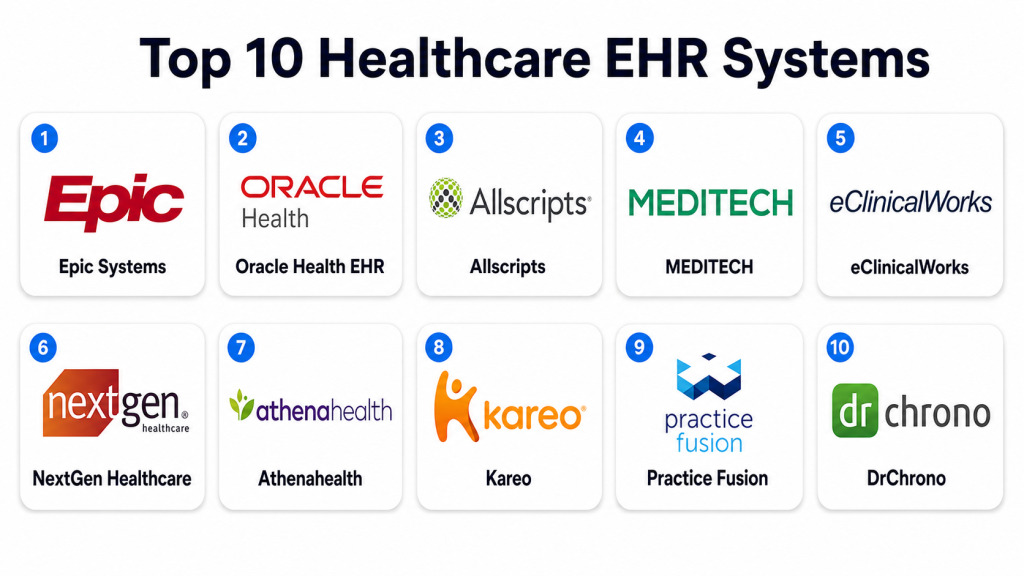
Top 10 Healthcare EHR Systems
#1 — Epic Systems
Epic Systems is one of the most widely used EHR platforms in large hospitals and healthcare networks. It offers comprehensive features for patient records, billing, and clinical workflows. The system supports integration across departments. It is highly scalable and reliable. It provides strong analytics and reporting tools. It is suitable for enterprise healthcare environments.
Key Features
- Patient record management
- Clinical workflows
- Billing integration
- Analytics tools
Pros
- Comprehensive features
- Scalable
- Reliable
Cons
- Expensive
- Complex implementation
Platforms / Deployment
Cloud and On-premise
#2 — Cerner
Cerner provides a robust EHR platform designed for hospitals and healthcare systems. It supports patient data management, clinical workflows, and analytics. The system integrates with multiple healthcare systems. It ensures compliance with standards. It is widely used globally. It is suitable for large healthcare providers.
Key Features
- Patient data management
- Workflow automation
- Analytics tools
- Integration support
Pros
- Reliable
- Scalable
- Strong integration
Cons
- Complex interface
- High cost
#3 — Allscripts
Allscripts offers EHR solutions focused on interoperability and data sharing. It supports clinical workflows and patient management. The platform integrates with healthcare systems. It provides flexibility and scalability. It is widely used in hospitals and clinics. It is suitable for diverse healthcare environments.
Key Features
- Interoperability
- Patient management
- Workflow tools
- Integration support
Pros
- Flexible
- Scalable
- Good integration
Cons
- Learning curve
- Requires customization
#4 — MEDITECH
MEDITECH is a comprehensive EHR system designed for hospitals and healthcare organizations. It supports clinical workflows, patient management, and analytics. The system is scalable and reliable. It offers integration with healthcare systems. It is widely used in healthcare. It is suitable for mid to large hospitals.
Key Features
- Clinical workflows
- Patient records
- Reporting tools
- Integration
Pros
- Reliable
- Scalable
- Comprehensive
Cons
- Interface complexity
- Training required
#5 — eClinicalWorks
eClinicalWorks is a cloud-based EHR platform designed for small to mid-sized practices. It offers patient management, billing, and telehealth features. The system is easy to use and deploy. It supports workflow automation. It is affordable compared to enterprise systems. It is suitable for clinics and practices.
Key Features
- Cloud-based system
- Patient management
- Billing tools
- Telehealth support
Pros
- Affordable
- Easy to use
- Scalable
Cons
- Limited advanced features
- Customization limits
#6 — NextGen Healthcare
NextGen Healthcare provides EHR solutions tailored for ambulatory care practices. It offers workflow automation, patient engagement tools, and analytics. The platform is flexible and scalable. It integrates with healthcare systems. It is suitable for outpatient environments.
Key Features
- Workflow automation
- Patient engagement
- Analytics tools
- Integration
Pros
- Flexible
- Scalable
- Good support
Cons
- Learning curve
- Setup effort
#7 — Athenahealth
Athenahealth is a cloud-based EHR platform focused on ease of use and interoperability. It offers patient management, billing, and analytics tools. The system supports real-time updates and integration. It is widely used in clinics. It is suitable for small to mid-sized practices.
Key Features
- Cloud-based platform
- Patient management
- Billing integration
- Analytics
Pros
- User-friendly
- Scalable
- Good support
Cons
- Subscription cost
- Limited customization
#8 — Kareo
Kareo is an EHR platform designed for small practices and independent providers. It offers patient management, billing, and reporting tools. The system is easy to use and deploy. It supports workflow automation. It is suitable for small healthcare providers.
Key Features
- Patient management
- Billing tools
- Reporting
- Workflow support
Pros
- Easy to use
- Affordable
- Quick setup
Cons
- Limited scalability
- Basic features
#9 — Practice Fusion
Practice Fusion is a cloud-based EHR system designed for small practices. It offers patient records, billing, and reporting tools. The system is simple and accessible. It supports integration with healthcare tools. It is suitable for small clinics.
Key Features
- Patient records
- Billing tools
- Reporting
- Integration
Pros
- Easy to use
- Affordable
- Cloud-based
Cons
- Limited advanced features
- Smaller ecosystem
#10 — DrChrono
DrChrono is a modern EHR platform offering mobile-friendly solutions for healthcare providers. It supports patient management, billing, and telehealth. The system is flexible and easy to use. It integrates with healthcare tools. It is suitable for mobile-first practices.
Key Features
- Mobile access
- Patient management
- Billing tools
- Telehealth
Pros
- User-friendly
- Flexible
- Mobile support
Cons
- Limited enterprise features
- Customization limits
Comparison Table
| Tool | Best For | Deployment | Automation | Scalability | Standout Feature |
|---|---|---|---|---|---|
| Epic | Enterprise hospitals | Hybrid | High | High | Comprehensive system |
| Cerner | Large providers | Hybrid | High | High | Integration |
| Allscripts | Diverse environments | Hybrid | Medium | High | Interoperability |
| MEDITECH | Hospitals | Hybrid | High | High | Reliability |
| eClinicalWorks | Clinics | Cloud | Medium | Medium | Affordability |
| NextGen | Ambulatory care | Hybrid | Medium | Medium | Flexibility |
| Athenahealth | Small practices | Cloud | Medium | Medium | Ease of use |
| Kareo | Small providers | Cloud | Medium | Low | Simplicity |
| Practice Fusion | Small clinics | Cloud | Medium | Low | Accessibility |
| DrChrono | Mobile practices | Cloud | Medium | Medium | Mobile support |
Evaluation & Scoring Table
| Tool | Core | Ease | Integrations | Security | Performance | Support | Value | Total |
|---|---|---|---|---|---|---|---|---|
| Epic | 9 | 7 | 9 | 9 | 9 | 8 | 7 | 8.4 |
| Cerner | 9 | 7 | 9 | 9 | 9 | 8 | 7 | 8.4 |
| Allscripts | 8 | 7 | 9 | 8 | 8 | 7 | 8 | 7.9 |
| MEDITECH | 8 | 7 | 8 | 9 | 8 | 7 | 8 | 7.9 |
| eClinicalWorks | 7 | 9 | 7 | 8 | 7 | 7 | 9 | 7.8 |
| NextGen | 8 | 8 | 8 | 8 | 8 | 8 | 8 | 8.0 |
| Athenahealth | 8 | 9 | 8 | 8 | 8 | 8 | 8 | 8.1 |
| Kareo | 7 | 9 | 7 | 7 | 7 | 7 | 9 | 7.6 |
| Practice Fusion | 7 | 9 | 7 | 7 | 7 | 7 | 9 | 7.6 |
| DrChrono | 8 | 9 | 8 | 8 | 8 | 7 | 8 | 8.0 |
Which Healthcare EHR System Is Right for You?
Choosing the right EHR system depends on your organization’s size, workflow complexity, and budget. Small clinics and independent practitioners should prioritize ease of use and affordability. Tools like Kareo, Practice Fusion, and DrChrono provide simple interfaces and quick deployment. They are ideal for practices that need basic functionality without complexity.
Mid-sized healthcare providers and growing clinics require scalability and integration. Platforms like Athenahealth, NextGen Healthcare, and eClinicalWorks offer balanced solutions with workflow automation and patient engagement features. They help improve efficiency while supporting growth. These systems are suitable for organizations transitioning to more advanced digital systems.
Large hospitals and enterprise healthcare networks need comprehensive systems with strong integration and compliance capabilities. Epic Systems, Cerner, Allscripts, and MEDITECH are best suited for these environments. They support complex workflows, large datasets, and multiple departments. Choosing the right system ensures improved patient care and operational efficiency.
FAQs
1. What is an EHR system?
An EHR system is a digital platform used to store and manage patient health records. It replaces paper-based records and improves accessibility. These systems help healthcare providers track patient history and treatment. They improve efficiency and accuracy. They are widely used in healthcare organizations.
2. What features should an EHR have?
Key features include patient records, billing, workflow automation, and reporting. Integration with healthcare systems is also important. Telehealth and analytics features add value. These capabilities improve patient care. Choosing the right features depends on your needs.
3. Are cloud-based EHR systems better?
Cloud-based systems are easier to deploy and maintain. They allow remote access and scalability. On-premise systems offer more control but require infrastructure. The choice depends on your requirements. Both options have advantages.
4. Are EHR systems secure?
Most EHR systems include strong security features such as encryption and access control. They also support compliance standards. Security varies by provider. Choosing a secure platform is essential. It protects patient data.
5. Can EHR systems integrate with other tools?
Yes, most EHR systems integrate with healthcare and billing systems. Integration improves workflow efficiency. It allows seamless data sharing. This enhances overall system performance. It is important for modern healthcare environments.
6. Are EHR systems suitable for small practices?
Yes, many EHR systems are designed for small practices. They offer affordable pricing and easy setup. Cloud-based tools are especially suitable. They require minimal maintenance. This makes them accessible.
7. How scalable are EHR systems?
Modern EHR systems are designed to scale with growing organizations. They can handle increasing data and users. Cloud-based systems offer flexible scaling. This ensures long-term usability. Scalability is important for growth.
8. What industries use EHR systems?
EHR systems are used in hospitals, clinics, and healthcare organizations. They help manage patient data efficiently. Different healthcare providers use them. However, the core functionality remains the same. They improve care delivery.
9. What is interoperability in EHR?
Interoperability refers to the ability of systems to share data. It allows healthcare providers to access patient information across systems. This improves care coordination. It is a key feature of modern EHR systems. It enhances efficiency.
10. Which EHR system is best?
There is no single best system. Epic and Cerner are strong enterprise options. Athenahealth and eClinicalWorks are good for mid-sized providers. Kareo and DrChrono are suitable for small practices. The best choice depends on your needs.
Conclusion
Healthcare EHR systems have become essential for modern medical practices, enabling efficient management of patient data and improving care delivery. These platforms streamline workflows, reduce administrative burden, and enhance data accuracy. With the increasing demand for digital healthcare solutions, adopting the right EHR system is critical for success.
Choosing the best system depends on your organization’s size, budget, and operational needs. While enterprise solutions offer advanced features and scalability, smaller practices benefit from simpler and cost-effective tools. By carefully evaluating available options, healthcare providers can select a system that improves efficiency and supports long-term growth.
