Introduction
Core Banking Systems are the central platforms that manage a bank’s fundamental operations, including accounts, transactions, payments, loans, and customer data. In simple terms, they are the backbone of any bank, enabling real-time processing of financial activities across branches and digital channels.
In today’s banking landscape, institutions face digital transformation demands, regulatory compliance, and customer expectations for seamless online services. Modern core banking systems now offer cloud-native architecture, API integrations, and real-time processing to support innovation and scalability.
Real-world use cases include:
- Account management and transaction processing
- Loan and deposit management
- Payment processing and settlements
- Customer onboarding and lifecycle management
- Regulatory reporting and compliance
What buyers should evaluate:
- Core banking functionality coverage
- Real-time processing capabilities
- Integration with fintech and APIs
- Scalability and performance
- Security and compliance features
- Deployment flexibility
- Customization options
- Reporting and analytics
- Ease of use
- Cost and ROI
Best for: Banks, credit unions, digital banks, and financial institutions managing high transaction volumes.
Not ideal for: Small financial setups with limited operations or non-banking organizations.
Key Trends in Core Banking Systems
- Cloud-native core banking platforms
- API-first architecture for fintech integration
- Real-time transaction processing systems
- AI-driven analytics and personalization
- Composable and modular banking systems
- Open banking and ecosystem integration
- Automation of banking workflows
- Digital-first customer experience platforms
- Enhanced cybersecurity and compliance tools
- Microservices-based architecture adoption
How We Evaluate Core Banking Systems (Methodology)
- Market adoption and vendor credibility
- Depth of banking functionality
- Ease of implementation and usability
- Integration with fintech and enterprise systems
- Security and compliance capabilities
- Reporting and analytics features
- Scalability for high transaction volumes
- Vendor support and onboarding
- Flexibility and customization
- Value for cost
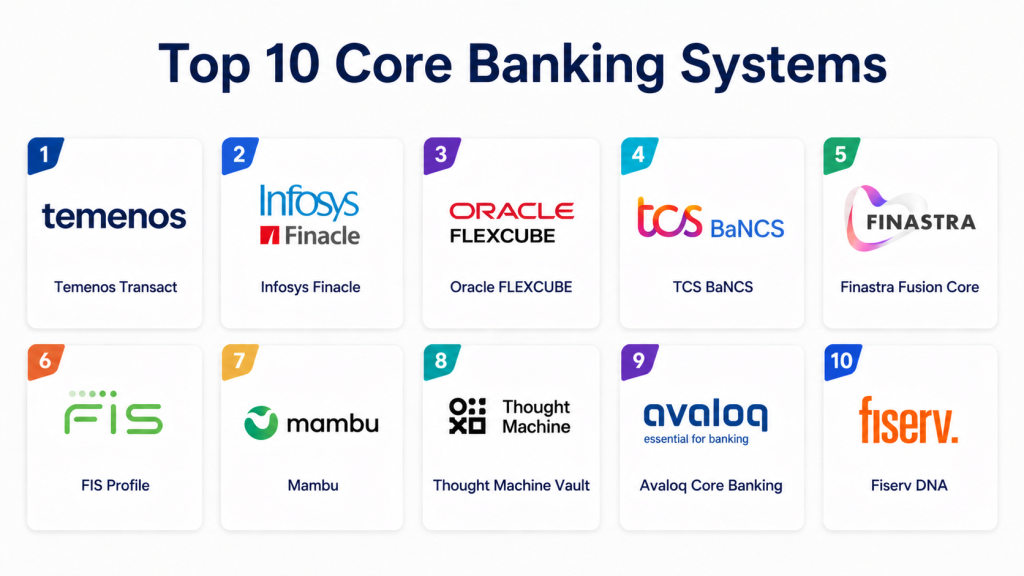
Top 10 Core Banking Systems
#1 — Temenos Transact
Short description :
Temenos Transact is a leading core banking system used by banks worldwide. It supports real-time banking operations and digital transformation. Known for scalability and flexibility. Suitable for large financial institutions. Provides analytics and automation tools. Helps modernize banking infrastructure.
Key Features
- Real-time core banking
- Account and transaction management
- Workflow automation
- Reporting dashboards
- API integrations
- Analytics tools
Pros
- Industry-leading platform
- Highly scalable
Cons
- Complex implementation
- High cost
Platforms / Deployment
Cloud / On-premise
Security & Compliance
SSO, MFA, encryption, RBAC
Integrations & Ecosystem
- Fintech APIs
- Payment systems
- ERP integrations
Support & Community
Strong enterprise support.
#2 — Finastra Fusion Core
Short description :
Finastra Fusion Core is a comprehensive banking platform supporting core operations and digital banking. It offers strong integration capabilities and automation tools. Known for reliability and scalability. Suitable for banks and financial institutions. Provides analytics and reporting. Helps improve operational efficiency.
Key Features
- Core banking operations
- Workflow automation
- API integrations
- Reporting
- Analytics
Pros
- Reliable platform
- Strong integration
Cons
- Complex setup
- Pricing
Platforms / Deployment
Cloud
Security & Compliance
SSO, MFA, encryption
Integrations & Ecosystem
- Banking systems
- APIs
Support & Community
Enterprise support available.
#3 — Oracle FLEXCUBE
Short description :
Oracle FLEXCUBE is a global core banking platform designed for banks and financial institutions. It supports a wide range of banking operations. Known for scalability and performance. Suitable for large enterprises. Provides analytics and reporting tools. Helps manage complex banking systems.
Key Features
- Core banking management
- Real-time processing
- Workflow automation
- Reporting
- Analytics
Pros
- Scalable platform
- Strong performance
Cons
- Complex implementation
- High cost
Platforms / Deployment
Cloud
Security & Compliance
SSO, MFA, encryption
Integrations & Ecosystem
- Oracle ecosystem
- APIs
Support & Community
Enterprise-level support.
#4 — SAP for Banking
Short description :
SAP for Banking is part of the SAP ecosystem offering core banking capabilities. It supports integration with ERP and analytics systems. Known for scalability and enterprise features. Suitable for large banks. Provides reporting tools. Helps streamline banking operations.
Key Features
- Core banking operations
- ERP integration
- Workflow automation
- Reporting
- Analytics
Pros
- Strong ERP integration
- Scalable
Cons
- Complex setup
- High cost
Platforms / Deployment
Cloud / On-premise
Security & Compliance
SSO, MFA, encryption
Integrations & Ecosystem
- SAP ecosystem
- APIs
Support & Community
Strong enterprise support.
#5 — TCS BaNCS
Short description :
TCS BaNCS is a core banking platform offering comprehensive banking solutions. It supports retail, corporate, and investment banking. Known for scalability and flexibility. Suitable for large financial institutions. Provides analytics and reporting tools. Helps manage global banking operations.
Key Features
- Core banking operations
- Multi-line support
- Workflow automation
- Reporting
- Analytics
Pros
- Flexible platform
- Global scalability
Cons
- Implementation complexity
- Pricing
Platforms / Deployment
Cloud
Security & Compliance
SSO, encryption
Integrations & Ecosystem
- APIs
- Banking systems
Support & Community
Enterprise support.
#6 — Infosys Finacle
Short description :
Infosys Finacle is a digital core banking platform used by banks worldwide. It supports real-time processing and digital transformation. Known for scalability and integration capabilities. Suitable for banks of all sizes. Provides analytics and reporting tools. Helps improve customer experience.
Key Features
- Core banking operations
- Real-time processing
- Workflow automation
- Reporting
- Analytics
Pros
- Scalable platform
- Strong digital capabilities
Cons
- Learning curve
- Pricing
Platforms / Deployment
Cloud
Security & Compliance
SSO, MFA, encryption
Integrations & Ecosystem
- APIs
- Fintech systems
Support & Community
Strong support available.
#7 — FIS Profile
Short description :
FIS Profile is a core banking system designed for retail and commercial banking. It supports real-time processing and integration. Known for reliability and scalability. Suitable for mid-market and enterprise banks. Provides analytics and reporting. Helps manage banking operations efficiently.
Key Features
- Core banking operations
- Real-time processing
- Workflow automation
- Reporting
- Analytics
Pros
- Reliable platform
- Scalable
Cons
- Limited customization
- Pricing
Platforms / Deployment
Cloud
Security & Compliance
Encryption, access controls
Integrations & Ecosystem
- APIs
- Banking systems
Support & Community
Good enterprise support.
#8 — Mambu
Short description :
Mambu is a cloud-native core banking platform focused on digital banking. It offers flexible product configuration and API-first architecture. Known for ease of use and scalability. Suitable for fintechs and banks. Provides analytics and reporting tools. Helps accelerate digital transformation.
Key Features
- Core banking operations
- API-first design
- Workflow automation
- Reporting
- Analytics
Pros
- Flexible platform
- Developer-friendly
Cons
- Requires technical expertise
- Pricing
Platforms / Deployment
Cloud
Security & Compliance
Encryption, access controls
Integrations & Ecosystem
- APIs
- Fintech tools
Support & Community
Growing ecosystem.
#9 — Thought Machine Vault
Short description :
Vault by Thought Machine is a modern cloud-native core banking platform. It supports real-time processing and composable banking architecture. Known for innovation and scalability. Suitable for digital banks. Provides analytics and reporting tools. Helps build modern banking systems.
Key Features
- Real-time processing
- Composable architecture
- API integrations
- Reporting
- Analytics
Pros
- Modern platform
- Highly flexible
Cons
- Emerging ecosystem
- Pricing
Platforms / Deployment
Cloud
Security & Compliance
Encryption, access controls
Integrations & Ecosystem
- APIs
- Fintech systems
Support & Community
Growing support.
#10 — Avaloq Core Banking
Short description :
Avaloq Core Banking is a platform designed for wealth management and banking operations. It supports core banking and investment management. Known for scalability and integration. Suitable for enterprises. Provides analytics and reporting tools. Helps manage financial operations efficiently.
Key Features
- Core banking operations
- Wealth management tools
- Workflow automation
- Reporting
- Analytics
Pros
- Strong wealth features
- Scalable
Cons
- Complex setup
- Pricing
Platforms / Deployment
Cloud
Security & Compliance
SSO, MFA, encryption
Integrations & Ecosystem
- APIs
- Financial systems
Support & Community
Enterprise-level support.
Comparison Table (Top 10)
| Tool Name | Best For | Platform(s) Supported | Deployment | Standout Feature | Public Rating |
|---|---|---|---|---|---|
| Temenos Transact | Enterprise | Web | Hybrid | Real-time banking | N/A |
| Finastra Fusion | Enterprise | Web | Cloud | Integration | N/A |
| Oracle FLEXCUBE | Enterprise | Web | Cloud | Performance | N/A |
| SAP Banking | Enterprise | Web | Hybrid | ERP integration | N/A |
| TCS BaNCS | Enterprise | Web | Cloud | Multi-line support | N/A |
| Finacle | Enterprise | Web | Cloud | Digital banking | N/A |
| FIS Profile | Mid-market | Web | Cloud | Reliability | N/A |
| Mambu | Fintech | Web | Cloud | API-first | N/A |
| Thought Machine | Digital banks | Web | Cloud | Composable core | N/A |
| Avaloq | Enterprise | Web | Cloud | Wealth mgmt | N/A |
Evaluation & Scoring of Core Banking Systems
| Tool Name | Core | Ease | Integrations | Security | Performance | Support | Value | Weighted Total |
|---|---|---|---|---|---|---|---|---|
| Temenos | 9 | 6 | 9 | 9 | 9 | 9 | 7 | 8.4 |
| Finastra | 9 | 6 | 9 | 9 | 9 | 9 | 7 | 8.4 |
| Oracle | 9 | 6 | 9 | 9 | 9 | 9 | 7 | 8.4 |
| SAP | 9 | 6 | 9 | 9 | 9 | 9 | 7 | 8.4 |
| TCS | 9 | 7 | 8 | 8 | 9 | 8 | 7 | 8.1 |
| Finacle | 9 | 7 | 8 | 8 | 9 | 8 | 7 | 8.1 |
| FIS | 8 | 7 | 8 | 8 | 8 | 8 | 7 | 7.9 |
| Mambu | 8 | 8 | 9 | 7 | 8 | 7 | 7 | 7.9 |
| Thought Machine | 8 | 8 | 9 | 7 | 8 | 7 | 7 | 7.9 |
| Avaloq | 8 | 7 | 8 | 8 | 8 | 8 | 7 | 7.9 |
Interpretation:
Enterprise systems dominate in scalability and integration, while newer cloud-native platforms excel in flexibility and innovation.
Which Core Banking System Is Right for You?
Solo / Freelancer
- Not applicable
SMB
- Mambu
- Focus on flexibility
Mid-Market
- FIS Profile
- Balanced features
Enterprise
- Temenos, Finastra, Oracle
- Full-scale capabilities
Budget vs Premium
- Budget: Mambu
- Premium: Temenos
Feature Depth vs Ease of Use
- Deep: Oracle
- Easy: Mambu
Integrations & Scalability
- Strong: Enterprise tools
- Moderate: SMB tools
Security & Compliance Needs
- High: Enterprise systems
- Moderate: SMB tools
Frequently Asked Questions (FAQs)
1. What is a core banking system?
It is software that manages banking operations. It handles accounts, transactions, and loans. It supports real-time processing. It is essential for banks.
2. How much does it cost?
Pricing varies based on features and scale. Enterprise systems use custom pricing. SMB tools may offer subscriptions.
3. How long does implementation take?
Implementation can take months or years. SMB tools deploy faster. Planning is essential.
4. Is it secure?
Most systems include encryption and access controls. Enterprise tools offer advanced security.
5. Can it integrate with fintech systems?
Yes, most systems support API integrations. This improves flexibility and innovation.
6. What industries use these systems?
Banks, credit unions, and fintechs use them. They manage financial operations.
7. What are common mistakes?
Ignoring scalability and integrations can cause issues. Evaluate carefully.
8. Can small banks use these systems?
Yes, cloud-native platforms support smaller banks.
9. How effective are these systems?
They improve efficiency and customer experience.
10. Is switching systems easy?
Switching is complex. Data migration and integration are challenging.
Conclusion
Core Banking Systems are the foundation of modern financial institutions, enabling real-time transaction processing, seamless customer experiences, and efficient management of banking operations. With increasing pressure for digital transformation, banks are moving toward cloud-native, API-driven platforms that support innovation and scalability.
However, the best system depends on your institution’s size, complexity, and strategic goals. Large banks may require robust platforms like Temenos or Oracle, while fintechs and smaller banks may benefit from flexible solutions like Mambu or Thought Machine. Selecting the right system requires balancing performance, flexibility, and cost.
As a next step, shortlist a few platforms, conduct pilot implementations, and evaluate their integration capabilities and scalability to ensure long-term success.
