Introduction
Travel Management Software helps organizations plan, book, manage, and optimize business travel from a centralized platform. It streamlines everything from flight and hotel bookings to expense tracking, policy compliance, and traveler safety.
Modern travel platforms go far beyond booking tools. They now include AI-powered itinerary optimization, real-time alerts, identity management, cybersecurity controls, Zero Trust access, and role-based permissions, ensuring both operational efficiency and secure handling of travel data.
Common use cases:
- Corporate travel booking and approvals
- Expense tracking and reimbursement
- Travel policy compliance management
- Real-time itinerary tracking and alerts
- Vendor and supplier management
Key evaluation criteria:
- Booking capabilities for flights, hotels, and transport
- Expense management integration
- Policy enforcement and compliance
- Real-time tracking and alerts
- Mobile accessibility
- Security features like MFA and encryption
- Integration with HR, finance, and ERP systems
- Pricing and scalability
Best for: Enterprises, SMBs, and organizations managing frequent business travel.
Not ideal for: Individuals or small teams with occasional travel needs.
Key Trends in Travel Management Software
- AI-driven travel recommendations and optimization
- Integration with expense and finance systems
- Mobile-first travel management
- Real-time alerts and disruption management
- Cloud-based travel platforms
- Increased focus on traveler safety and risk management
- Integration with HR and ERP systems
- Automation of approvals and workflows
- Sustainability tracking for business travel
- Subscription-based SaaS pricing models
How We Evaluated Travel Management Software (Methodology)
- Market adoption and global presence
- Feature completeness across travel workflows
- Reliability and platform performance
- Security posture including data protection
- Integration ecosystem with finance and HR systems
- Ease of use and onboarding
- Scalability across organizations
- Support quality and documentation
- Overall value and ROI
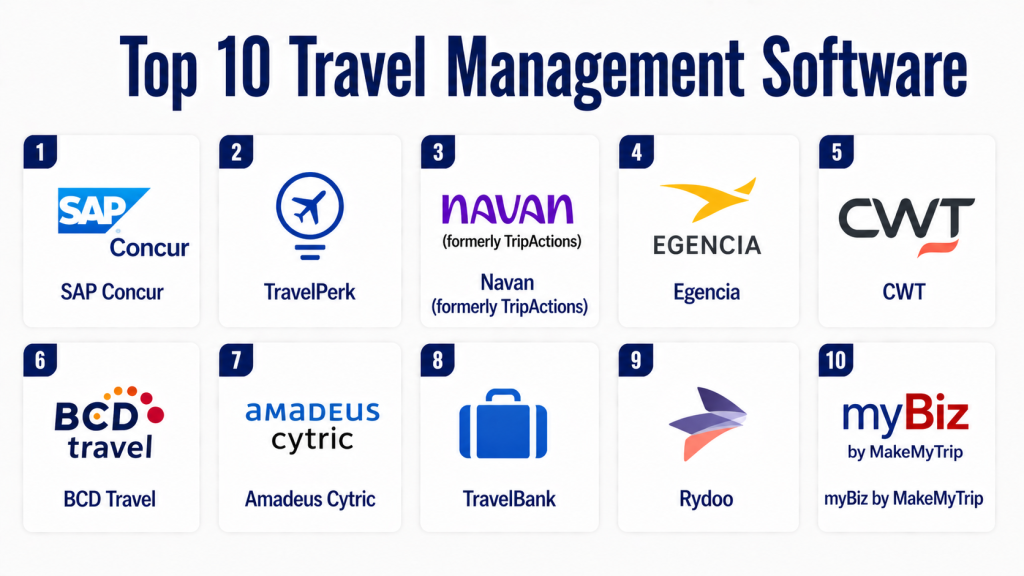
Top 10 Travel Management Software
#1 — SAP Concur
Short description:
SAP Concur is a leading travel and expense management platform designed for enterprises. It provides booking, expense tracking, and policy compliance tools. The platform integrates with ERP systems. It supports real-time tracking and reporting. It is widely used globally. It enhances travel efficiency and compliance.
Key Features
- Travel booking
- Expense management
- Policy compliance
- Real-time reporting
- Integration support
Pros
- Enterprise-grade solution
- Strong integrations
Cons
- Complex setup
- High cost
Platforms / Deployment
Web / Mobile / Cloud
Security & Compliance
SSO, MFA, encryption, RBAC. Compliance: Not publicly stated
Integrations & Ecosystem
- ERP systems
- HR tools
- Finance platforms
Support & Community
Enterprise support with strong documentation
#2 — TravelPerk
Short description:
TravelPerk is a modern travel management platform designed for SMBs and enterprises. It offers booking, expense management, and real-time updates. The platform integrates with business tools. It is user-friendly and flexible. It improves travel planning and cost control.
Key Features
- Travel booking
- Expense integration
- Real-time alerts
- Reporting tools
- Integration support
Pros
- Easy to use
- Flexible pricing
Cons
- Limited advanced features
- Pricing varies
Platforms / Deployment
Web / Mobile / Cloud
Security & Compliance
Encryption. Compliance: Not publicly stated
Integrations & Ecosystem
- Finance tools
- HR systems
Support & Community
Good support
#3 — TripActions
Short description:
TripActions is a travel management platform offering booking, expense tracking, and analytics. It provides real-time travel insights and automation. The platform integrates with enterprise systems. It is suitable for mid-market and enterprise organizations. It enhances travel efficiency.
Key Features
- Travel booking
- Expense tracking
- Analytics
- Integration support
- Alerts
Pros
- Strong analytics
- Modern interface
Cons
- Cost
- Limited customization
Platforms / Deployment
Web / Mobile / Cloud
Security & Compliance
Encryption, MFA. Compliance: Not publicly stated
Integrations & Ecosystem
- ERP systems
- Finance tools
Support & Community
Enterprise support
#4 — Egencia
Short description:
Egencia is a corporate travel management platform offering booking, policy enforcement, and analytics. It integrates with enterprise systems. The platform provides real-time updates and reporting. It is suitable for enterprises. It enhances travel compliance and efficiency.
Key Features
- Travel booking
- Policy enforcement
- Analytics
- Integration support
- Alerts
Pros
- Enterprise capabilities
- Reliable
Cons
- Cost
- Learning curve
Platforms / Deployment
Web / Mobile / Cloud
Security & Compliance
Encryption. Compliance: Not publicly stated
Integrations & Ecosystem
- Business systems
- APIs
Support & Community
Enterprise support
#5 — Navan
Short description:
Navan is a travel and expense management platform designed for modern businesses. It offers booking, expense tracking, and automation. The platform provides real-time updates and analytics. It integrates with business tools. It enhances efficiency and user experience.
Key Features
- Travel booking
- Expense management
- Automation
- Analytics
- Integration support
Pros
- User-friendly
- Strong automation
Cons
- Pricing varies
- Limited customization
Platforms / Deployment
Web / Mobile / Cloud
Security & Compliance
Encryption. Compliance: Not publicly stated
Integrations & Ecosystem
- Finance tools
- HR systems
Support & Community
Good support
#6 — CWT
Short description:
CWT is a global travel management company offering booking and travel services. It provides policy compliance and reporting tools. The platform integrates with enterprise systems. It is suitable for large organizations. It enhances travel efficiency and compliance.
Key Features
- Travel booking
- Policy compliance
- Reporting
- Integration support
- Alerts
Pros
- Global presence
- Reliable
Cons
- Complex processes
- Cost
Platforms / Deployment
Web / Mobile / Cloud
Security & Compliance
Not publicly stated
Integrations & Ecosystem
- Enterprise systems
- APIs
Support & Community
Enterprise support
#7 — BCD Travel
Short description:
BCD Travel provides travel management solutions for enterprises. It offers booking, expense tracking, and analytics. The platform integrates with business systems. It is suitable for large organizations. It enhances travel planning and cost control.
Key Features
- Travel booking
- Expense tracking
- Analytics
- Integration support
- Reporting
Pros
- Strong enterprise features
- Global reach
Cons
- Cost
- Setup complexity
Platforms / Deployment
Web / Mobile / Cloud
Security & Compliance
Not publicly stated
Integrations & Ecosystem
- Finance systems
- ERP tools
Support & Community
Enterprise support
#8 — Amadeus Cytric
Short description:
Amadeus Cytric is a travel management platform offering booking and expense tools. It integrates with enterprise systems and provides real-time updates. It is suitable for large organizations. It enhances travel efficiency and compliance.
Key Features
- Travel booking
- Expense integration
- Analytics
- Integration support
- Alerts
Pros
- Strong integrations
- Scalable
Cons
- Learning curve
- Cost
Platforms / Deployment
Web / Mobile / Cloud
Security & Compliance
Encryption. Compliance: Not publicly stated
Integrations & Ecosystem
- ERP systems
- Finance tools
Support & Community
Enterprise support
#9 — TravelBank
Short description:
TravelBank is a travel and expense management platform designed for SMBs. It offers booking, expense tracking, and automation. The platform integrates with business tools. It is easy to use and flexible. It enhances efficiency and cost control.
Key Features
- Travel booking
- Expense management
- Automation
- Reporting
- Integration support
Pros
- Affordable
- Easy to use
Cons
- Limited enterprise features
- Basic analytics
Platforms / Deployment
Web / Mobile / Cloud
Security & Compliance
Encryption. Compliance: Not publicly stated
Integrations & Ecosystem
- Finance tools
- HR systems
Support & Community
Good support
#10 — Rydoo
Short description:
Rydoo is a travel and expense management platform focused on simplicity and efficiency. It offers booking, expense tracking, and automation. The platform integrates with business systems. It is suitable for SMBs and mid-market organizations. It improves travel management.
Key Features
- Travel booking
- Expense tracking
- Automation
- Reporting
- Integration support
Pros
- Easy to use
- Flexible
Cons
- Limited advanced features
- Pricing varies
Platforms / Deployment
Web / Mobile / Cloud
Security & Compliance
Encryption. Compliance: Not publicly stated
Integrations & Ecosystem
- Finance tools
- HR systems
Support & Community
Good support
Comparison Table (Top 10)
| Tool Name | Best For | Platform(s) Supported | Deployment | Standout Feature | Public Rating |
|---|---|---|---|---|---|
| SAP Concur | Enterprise | Web/Mobile | Cloud | Expense integration | N/A |
| TravelPerk | SMB | Web/Mobile | Cloud | Ease of use | N/A |
| TripActions | Mid-market | Web/Mobile | Cloud | Analytics | N/A |
| Egencia | Enterprise | Web/Mobile | Cloud | Policy enforcement | N/A |
| Navan | SMB/Enterprise | Web/Mobile | Cloud | Automation | N/A |
| CWT | Enterprise | Web/Mobile | Cloud | Global reach | N/A |
| BCD Travel | Enterprise | Web/Mobile | Cloud | Cost control | N/A |
| Amadeus Cytric | Enterprise | Web/Mobile | Cloud | Integrations | N/A |
| TravelBank | SMB | Web/Mobile | Cloud | Affordability | N/A |
| Rydoo | SMB | Web/Mobile | Cloud | Simplicity | N/A |
Evaluation & Scoring of Travel Management Software
| Tool Name | Core | Ease | Integrations | Security | Performance | Support | Value | Weighted Total |
|---|---|---|---|---|---|---|---|---|
| SAP Concur | 9 | 6 | 9 | 8 | 9 | 9 | 7 | 8.3 |
| TravelPerk | 8 | 9 | 8 | 7 | 8 | 8 | 8 | 8.1 |
| TripActions | 8 | 8 | 8 | 7 | 8 | 8 | 7 | 7.8 |
| Egencia | 9 | 7 | 9 | 8 | 9 | 9 | 7 | 8.4 |
| Navan | 8 | 9 | 8 | 7 | 8 | 8 | 8 | 8.1 |
| CWT | 8 | 7 | 8 | 7 | 8 | 8 | 7 | 7.7 |
| BCD Travel | 9 | 6 | 9 | 8 | 9 | 9 | 7 | 8.4 |
| Amadeus | 9 | 7 | 9 | 8 | 9 | 9 | 7 | 8.4 |
| TravelBank | 7 | 9 | 7 | 7 | 7 | 7 | 8 | 7.6 |
| Rydoo | 7 | 9 | 7 | 7 | 7 | 7 | 8 | 7.6 |
Which Travel Management Software Is Right for You?
Solo / Freelancer
Basic booking tools are sufficient.
SMB
TravelPerk and TravelBank offer ease and affordability.
Mid-Market
Navan and TripActions provide scalability.
Enterprise
SAP Concur, Egencia, and Amadeus offer advanced features.
Budget vs Premium
Budget tools focus on simplicity. Premium tools offer integrations.
Feature Depth vs Ease of Use
Advanced tools require training but offer deeper insights.
Integrations & Scalability
Choose tools with finance and HR integrations.
Security & Compliance Needs
Look for MFA, encryption, and compliance support.
Frequently Asked Questions1. What is travel management software?
Travel management software is a platform that helps businesses plan, book, and manage business travel in one place. It includes features like flight and hotel booking, expense tracking, and reporting. It reduces manual work and improves efficiency. It ensures travel policy compliance. It also provides better visibility into travel spending.
2. How much does travel management software cost?
The cost varies depending on features, company size, and usage. Some platforms offer subscription-based pricing, while others charge per booking. Enterprise solutions are usually more expensive due to advanced features. Additional costs may include integrations and support. Businesses should evaluate ROI before selecting a tool.
3. Is travel management software secure?
Most modern travel platforms offer strong security features like encryption, role-based access control, and multi-factor authentication. Some also follow industry compliance standards. Security levels vary by provider. It is important to review data protection policies. Organizations should choose tools that meet their security requirements.
4. Can travel management software integrate with other systems?
Yes, most tools integrate with finance, HR, ERP, and expense management systems. These integrations help automate workflows and improve data accuracy. APIs allow customization and flexibility. Integration capabilities vary across platforms. It is important to check compatibility before implementation.
5. How long does it take to implement travel management software?
Implementation time depends on the complexity of the platform and organization size. Small businesses can set up systems within a few days. Enterprise deployments may take several weeks or months. Proper planning and configuration are required. Training employees is also an important part of the process.
6. Can small businesses use travel management software?
Yes, many platforms are designed specifically for small and mid-sized businesses. They offer affordable pricing and easy-to-use interfaces. These tools help improve efficiency and reduce travel costs. They also provide automation and reporting features. SMBs can scale these tools as they grow.
7. What are common mistakes when choosing travel software?
Common mistakes include choosing based only on price, ignoring integration needs, and not evaluating scalability. Some businesses overlook user experience and training requirements. Poor planning can lead to implementation issues. It is important to test the platform before finalizing. Always align the tool with business needs.
8. How does AI help in travel management software?
AI helps optimize travel planning by suggesting cost-effective routes and accommodations. It predicts travel patterns and improves booking decisions. AI can automate approvals and reduce manual effort. It also provides insights through analytics. This improves efficiency and cost control.
9. Can travel management software scale with business growth?
Yes, most platforms are designed to scale as businesses grow. They support multiple users, locations, and travel policies. Enterprise tools handle complex workflows and high volumes. SMB tools can expand with additional features. Choosing a scalable platform ensures long-term usability.
10. Can you switch travel management software later?
Yes, switching is possible but requires proper planning. Data migration, integration updates, and employee training are necessary. Some downtime may occur during transition. Compatibility with existing systems should be checked. Choosing a flexible platform initially can reduce switching challenges.
Conclusion
Travel Management Software has become a vital solution for organizations aiming to streamline business travel, control expenses, and improve operational efficiency. By automating booking, integrating expense management, and providing real-time visibility into travel activities, these platforms help businesses reduce costs and enhance employee experience. As organizations continue to adopt digital-first strategies, travel management tools are evolving with AI-driven insights and mobile-first capabilities to deliver smarter and more efficient travel processes.
The right platform depends on your organization’s size, travel volume, and integration needs. Enterprise solutions like SAP Concur, Egencia, and Amadeus Cytric offer advanced features and global scalability, while platforms like TravelPerk, Navan, and TravelBank provide flexibility and ease of use for growing businesses. Key considerations include integration with finance systems, ease of deployment, and overall cost efficiency.
To make the best decision, shortlist a few tools, evaluate their features, and test how well they align with your travel policies and workflows. Focus on scalability, security, and ROI to ensure long-term success. With the right travel management software, organizations can simplify travel operations, improve compliance, and deliver a better experience for employees.
