Introduction
Queue Management Software helps organizations manage customer flow, reduce wait times, and improve service efficiency by organizing queues digitally instead of relying on manual systems. These platforms are widely used in banks, hospitals, retail stores, government offices, and service centers to streamline customer experiences.
Modern queue management solutions go beyond simple ticketing systems. They now include AI-driven forecasting, real-time analytics, identity management, cybersecurity controls, Zero Trust access, and role-based permissions, ensuring both operational efficiency and secure handling of customer data.
Common use cases:
- Customer queue management in banks and retail
- Appointment scheduling and token systems
- Hospital and clinic patient flow management
- Government service centers
- Customer service and support desks
Key evaluation criteria:
- Queue handling and ticketing capabilities
- Real-time monitoring and analytics
- Integration with CRM and service systems
- Ease of deployment and usability
- Mobile and kiosk support
- Security features like encryption and RBAC
- Scalability across locations
- Pricing and value
Best for: Retail businesses, healthcare providers, banks, and service centers managing high customer volumes.
Not ideal for: Small businesses with minimal customer queues or simple appointment needs.
Key Trends in Queue Management Software
- AI-driven queue forecasting and optimization
- Mobile-based virtual queuing systems
- Integration with CRM and customer service platforms
- Real-time analytics and reporting
- Cloud-based queue management solutions
- Contactless check-ins and digital kiosks
- Zero Trust security models for customer data
- Omnichannel queue management
- Automation of customer notifications
- Subscription-based SaaS pricing models
How We Evaluated Queue Management Software (Methodology)
- Market adoption and industry usage
- Feature completeness across queue workflows
- Reliability and system performance
- Security posture including data protection
- Integration ecosystem with business systems
- Ease of use and onboarding
- Scalability across locations
- Support quality and documentation
- Overall value and ROI
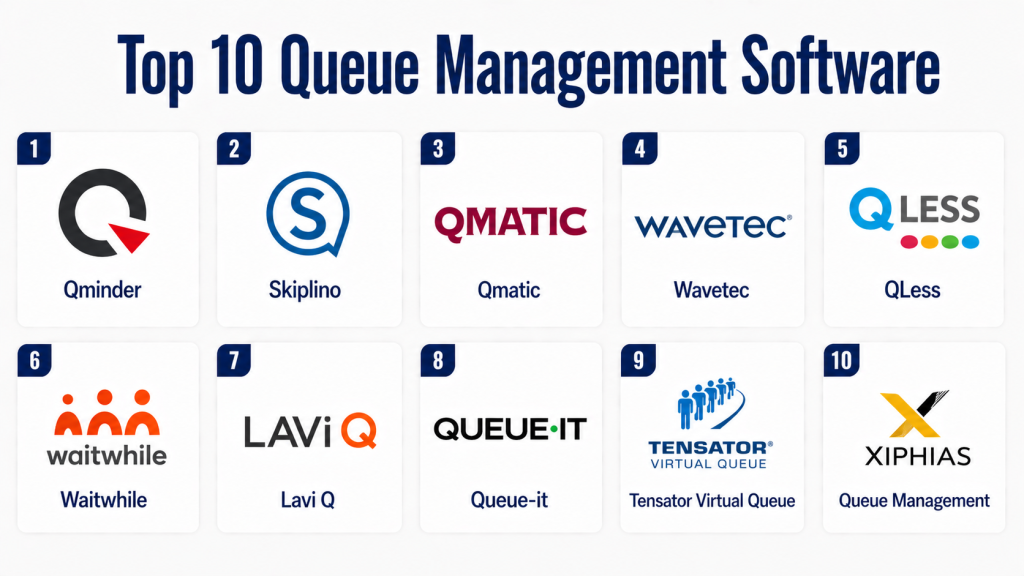
Top 10 Queue Management Software
#1 — Qminder
Short description:
Qminder is a modern queue management platform designed to improve customer experience. It offers virtual queuing, real-time analytics, and notifications. The platform integrates with CRM systems. It is suitable for retail and healthcare. It enhances service efficiency. It supports scalable deployments.
Key Features
- Virtual queue management
- Real-time analytics
- Customer notifications
- Integration support
- Reporting tools
Pros
- Easy to use
- Strong analytics
Cons
- Pricing varies
- Limited customization
Platforms / Deployment
Web / Mobile / Cloud
Security & Compliance
Encryption, RBAC. Compliance: Not publicly stated
Integrations & Ecosystem
- CRM systems
- Customer service tools
Support & Community
Good support and documentation
#2 — Skiplino
Short description:
Skiplino is a digital queue management system that enables businesses to manage customer flow efficiently. It provides mobile-based queuing and analytics. The platform is easy to deploy. It integrates with business systems. It is suitable for banks and retail. It improves customer satisfaction.
Key Features
- Digital queue system
- Mobile check-in
- Analytics
- Integration support
- Notifications
Pros
- User-friendly
- Mobile-first
Cons
- Limited advanced features
- Pricing varies
Platforms / Deployment
Web / Mobile / Cloud
Security & Compliance
Encryption. Compliance: Not publicly stated
Integrations & Ecosystem
- Business tools
- APIs
Support & Community
Standard support
#3 — Qmatic
Short description:
Qmatic is an enterprise queue management platform offering advanced customer journey management. It provides real-time monitoring and analytics. The platform integrates with enterprise systems. It is suitable for large organizations. It enhances operational efficiency. It supports scalability.
Key Features
- Queue management
- Analytics
- Customer journey tracking
- Integration support
- Alerts
Pros
- Enterprise capabilities
- Strong analytics
Cons
- Complex setup
- Cost
Platforms / Deployment
Web / Cloud / Hybrid
Security & Compliance
SSO, encryption. Compliance: Not publicly stated
Integrations & Ecosystem
- Enterprise systems
- CRM tools
Support & Community
Enterprise support
#4 — Wavetec
Short description:
Wavetec provides queue management solutions for customer service environments. It offers digital queueing, analytics, and reporting tools. The platform integrates with enterprise systems. It is suitable for banks and retail. It enhances service efficiency. It supports scalability.
Key Features
- Digital queueing
- Analytics
- Reporting
- Integration support
- Notifications
Pros
- Scalable
- Reliable
Cons
- Learning curve
- Cost
Platforms / Deployment
Web / Cloud
Security & Compliance
Encryption. Compliance: Not publicly stated
Integrations & Ecosystem
- Business systems
- APIs
Support & Community
Enterprise support
#5 — QLess
Short description:
QLess is a virtual queue management platform that eliminates physical lines. It allows customers to join queues remotely. The platform provides real-time updates and notifications. It integrates with business systems. It is suitable for various industries. It improves customer experience.
Key Features
- Virtual queuing
- Notifications
- Analytics
- Integration support
- Reporting
Pros
- No physical queues
- Easy to use
Cons
- Limited customization
- Pricing varies
Platforms / Deployment
Web / Mobile / Cloud
Security & Compliance
Encryption. Compliance: Not publicly stated
Integrations & Ecosystem
- CRM tools
- APIs
Support & Community
Good support
#6 — Waitwhile
Short description:
Waitwhile is a queue management platform designed for customer service optimization. It provides virtual queues, scheduling, and analytics. The platform integrates with business tools. It is suitable for SMBs and enterprises. It enhances service efficiency. It supports scalability.
Key Features
- Virtual queues
- Scheduling
- Analytics
- Integration support
- Notifications
Pros
- Flexible
- Easy to use
Cons
- Pricing varies
- Limited offline support
Platforms / Deployment
Web / Mobile / Cloud
Security & Compliance
Encryption. Compliance: Not publicly stated
Integrations & Ecosystem
- CRM
- Business tools
Support & Community
Good support
#7 — Lavi Q
Short description:
Lavi Q is a queue management solution designed for improving customer flow. It offers real-time monitoring and analytics. The platform integrates with enterprise systems. It is suitable for service centers. It enhances efficiency. It supports scalable deployments.
Key Features
- Queue management
- Monitoring
- Analytics
- Integration support
- Alerts
Pros
- Reliable
- Scalable
Cons
- Complex setup
- Cost
Platforms / Deployment
Web / Cloud
Security & Compliance
Not publicly stated
Integrations & Ecosystem
- Enterprise tools
- APIs
Support & Community
Enterprise support
#8 — Queue-it
Short description:
Queue-it is a virtual waiting room platform used to manage online traffic and queues. It ensures fair access during high demand. The platform integrates with websites and applications. It is suitable for e-commerce and ticketing. It improves user experience. It supports scalability.
Key Features
- Virtual waiting room
- Traffic control
- Analytics
- Integration support
- Alerts
Pros
- Handles high traffic
- Reliable
Cons
- Limited offline use
- Pricing varies
Platforms / Deployment
Web / Cloud
Security & Compliance
Encryption. Compliance: Not publicly stated
Integrations & Ecosystem
- Web platforms
- APIs
Support & Community
Good support
#9 — Tensator Virtual Queue
Short description:
Tensator Virtual Queue is a digital queue management solution designed for customer service environments. It offers virtual queuing and analytics. The platform integrates with business systems. It is suitable for retail and public services. It enhances customer experience. It supports scalability.
Key Features
- Virtual queue
- Analytics
- Reporting
- Integration support
- Notifications
Pros
- Easy to use
- Flexible
Cons
- Limited advanced features
- Pricing varies
Platforms / Deployment
Web / Cloud
Security & Compliance
Not publicly stated
Integrations & Ecosystem
- Business tools
- APIs
Support & Community
Standard support
#10 — XIPHIAS Queue Management
Short description:
XIPHIAS Queue Management is a solution designed for managing customer queues efficiently. It provides real-time monitoring and reporting. The platform integrates with enterprise systems. It is suitable for banks and service centers. It enhances operational efficiency. It supports scalability.
Key Features
- Queue management
- Monitoring
- Reporting
- Integration support
- Alerts
Pros
- Scalable
- Reliable
Cons
- Limited UI
- Setup complexity
Platforms / Deployment
Web / Cloud
Security & Compliance
Not publicly stated
Integrations & Ecosystem
- Enterprise systems
- APIs
Support & Community
Standard support
Comparison Table (Top 10)
| Tool Name | Best For | Platform(s) Supported | Deployment | Standout Feature | Public Rating |
|---|---|---|---|---|---|
| Qminder | SMB/Enterprise | Web/Mobile | Cloud | Analytics | N/A |
| Skiplino | Retail | Web/Mobile | Cloud | Mobile queue | N/A |
| Qmatic | Enterprise | Web | Hybrid | Customer journey | N/A |
| Wavetec | Banks | Web | Cloud | Scalability | N/A |
| QLess | All industries | Web/Mobile | Cloud | Virtual queues | N/A |
| Waitwhile | SMB | Web/Mobile | Cloud | Flexibility | N/A |
| Lavi Q | Enterprise | Web | Cloud | Monitoring | N/A |
| Queue-it | Online traffic | Web | Cloud | Traffic control | N/A |
| Tensator | Retail | Web | Cloud | Virtual queue | N/A |
| XIPHIAS | Service centers | Web | Cloud | Reporting | N/A |
Evaluation & Scoring of Queue Management Software
| Tool Name | Core | Ease | Integrations | Security | Performance | Support | Value | Weighted Total |
|---|---|---|---|---|---|---|---|---|
| Qminder | 8 | 9 | 8 | 7 | 8 | 8 | 8 | 8.1 |
| Skiplino | 7 | 9 | 7 | 7 | 7 | 7 | 8 | 7.6 |
| Qmatic | 9 | 6 | 9 | 8 | 9 | 9 | 7 | 8.4 |
| Wavetec | 8 | 7 | 8 | 7 | 8 | 8 | 7 | 7.8 |
| QLess | 8 | 9 | 8 | 7 | 8 | 8 | 8 | 8.2 |
| Waitwhile | 8 | 9 | 8 | 7 | 8 | 8 | 8 | 8.2 |
| Lavi Q | 8 | 7 | 8 | 7 | 8 | 8 | 7 | 7.8 |
| Queue-it | 9 | 8 | 8 | 8 | 9 | 8 | 7 | 8.3 |
| Tensator | 7 | 8 | 7 | 6 | 7 | 7 | 7 | 7.1 |
| XIPHIAS | 7 | 7 | 7 | 6 | 7 | 7 | 7 | 7.0 |
Which Queue Management Software Is Right for You?
Solo / Freelancer
Basic scheduling tools are enough.
SMB
Qminder and Waitwhile offer simplicity and flexibility.
Mid-Market
QLess and Wavetec provide scalability.
Enterprise
Qmatic and Queue-it offer advanced capabilities.
Budget vs Premium
Budget tools focus on ease of use. Premium tools offer analytics.
Feature Depth vs Ease of Use
Advanced tools require training.
Integrations & Scalability
Choose tools with CRM integrations.
Security & Compliance Needs
Look for encryption and RBAC.
Frequently Asked Questions
1. What is queue management software?
Queue management software is a digital solution that helps businesses manage customer waiting lines efficiently. It replaces physical queues with virtual or token-based systems. Customers can check in, receive updates, and wait remotely. This improves service flow and reduces congestion. It is widely used in banks, hospitals, and retail environments.
2. How does queue management software work?
The software assigns a token or position to each customer upon check-in. It tracks the queue in real time and notifies customers when their turn is approaching. Staff can manage queues through dashboards. Some systems include analytics and reporting features. This helps optimize service efficiency and reduce wait times.
3. What are the benefits of using queue management software?
Queue management software reduces waiting time and improves customer satisfaction. It helps businesses manage peak hours more efficiently. It also provides data insights for better decision-making. Automation reduces manual effort. Overall, it enhances both customer experience and operational efficiency.
4. Is queue management software suitable for small businesses?
Yes, small businesses can benefit from queue management software. Many tools offer simple and affordable solutions. These systems help organize customer flow and reduce crowding. Even basic features can improve service quality. It depends on customer volume and business needs.
5. Can queue management software integrate with other systems?
Yes, most modern solutions support integration with CRM, POS, and appointment scheduling systems. Integration helps streamline workflows and improve data accuracy. It allows businesses to manage customer interactions more effectively. Compatibility should be checked before selecting a tool. Integration enhances overall efficiency.
6. Does queue management software support mobile devices?
Yes, many platforms offer mobile apps or web-based access. Customers can join queues remotely using their smartphones. Staff can also manage queues from mobile devices. This improves flexibility and convenience. Mobile support is a key feature in modern systems.
7. How much does queue management software cost?
Pricing varies depending on features, scale, and deployment type. Some tools offer affordable plans for small businesses. Enterprise solutions are more expensive and feature-rich. Costs may include subscriptions or hardware requirements. It is important to compare pricing before choosing.
8. Is queue management software secure?
Security depends on the provider. Many systems offer secure data handling and user access controls. Some include compliance features for sensitive environments. Businesses should evaluate security before implementation. Protecting customer data is essential.
9. What features should I look for in queue management software?
Look for features like virtual queuing, real-time tracking, and notifications. Analytics and reporting are also important. Integration capabilities improve efficiency. Ease of use should be considered. Choose features based on your business needs.
10. What are alternatives to queue management software?
Alternatives include manual queues or token systems. These methods are less efficient and harder to manage. Digital solutions provide automation and insights. They improve customer experience and reduce wait times. Queue management software is a better long-term solution.
Conclusion
Queue Management Software has become an essential solution for organizations aiming to improve customer experience and operational efficiency. By replacing traditional waiting lines with digital systems, these platforms enable businesses to manage high volumes of customers seamlessly while reducing wait times and improving service delivery. With the integration of AI, real-time analytics, and mobile-first capabilities, queue management systems are evolving into intelligent tools that enhance both customer satisfaction and business performance.
The right solution depends on your organization’s scale and requirements. Enterprise platforms like Qmatic and Queue-it provide advanced capabilities and scalability, while tools like Qminder, Waitwhile, and Skiplino offer user-friendly solutions for small and mid-sized businesses. Key considerations should include ease of use, integration capabilities, and real-time analytics.
To choose the best platform, shortlist a few tools, test their features, and evaluate how well they align with your operational goals. Focus on scalability, ROI, and security to ensure long-term success. With the right queue management software, organizations can deliver faster, smoother, and more efficient customer experiences.
