Introduction
Smart Lighting Apps are mobile and web-based applications that allow users to control, automate, and optimize lighting systems remotely. These apps connect with smart bulbs, switches, and IoT devices to provide features like scheduling, dimming, color control, and energy monitoring.
With the growth of smart homes and connected devices, lighting control has evolved beyond simple on/off switches. Modern smart lighting apps now offer voice control, automation routines, and integration with home ecosystems. They help improve convenience, energy efficiency, and ambiance in homes and workplaces.
Common use cases:
- Controlling lights remotely
- Scheduling lighting automation
- Adjusting brightness and colors
- Integrating with smart home systems
- Improving energy efficiency
What buyers should evaluate:
- Compatibility with devices
- Ease of use and interface
- Automation and scheduling features
- Integration with smart home ecosystems
- Mobile and voice control support
- Security and data privacy
- Performance and reliability
- Support and updates
Best for: Homeowners, smart home enthusiasts, and businesses using connected lighting systems.
Not ideal for: Users with traditional lighting setups without smart devices.
Key Trends in Smart Lighting Apps
- Voice assistant integration for hands-free control
- AI-driven lighting automation
- Energy monitoring and optimization
- Integration with smart home ecosystems
- Mobile-first and remote control capabilities
- Custom scenes and ambiance settings
- IoT-based automation and connectivity
- Focus on security and privacy
How We Evaluate Smart Lighting Apps (Methodology)
- Market adoption and popularity
- Feature completeness and usability
- Compatibility with devices and ecosystems
- Performance and reliability
- Security features
- Integration capabilities
- Ease of setup and onboarding
- Customer support and updates
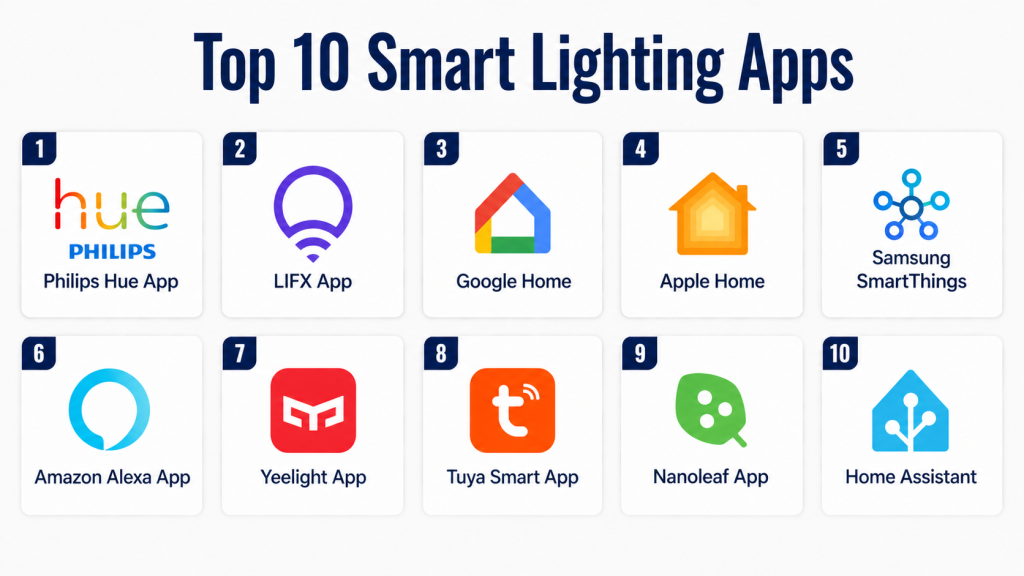
Top 10 Smart Lighting Apps
#1 — Philips Hue App
Short description:
Philips Hue App is one of the most popular smart lighting control apps. It allows users to control Hue lights remotely. The app supports automation, scenes, and color customization. It integrates with smart home ecosystems. It is ideal for home users.
Key Features
- Remote lighting control
- Scene customization
- Scheduling
- Voice integration
Pros
- Easy to use
- Strong ecosystem
Cons
- Requires Hue devices
- Higher cost
Platforms / Deployment
iOS, Android / Cloud
Security & Compliance
Not publicly stated
Integrations & Ecosystem
Integrates with major smart home platforms.
- Voice assistants
- Smart home systems
Support & Community
Strong support.
#2 — LIFX App
Short description:
LIFX App controls LIFX smart bulbs without requiring a hub. It offers color control and automation features. The app is user-friendly. It is suitable for home users. It provides flexibility and convenience.
Key Features
- Color control
- Scheduling
- Remote access
- Scenes
Pros
- No hub required
- Easy setup
Cons
- Limited ecosystem
- Connectivity issues
Platforms / Deployment
iOS, Android / Cloud
Security & Compliance
Not publicly stated
Integrations & Ecosystem
Supports integrations with smart home systems.
- Voice assistants
- Smart platforms
Support & Community
Good support.
#3 — Google Home
Short description:
Google Home app controls smart lighting along with other devices. It provides centralized control for smart homes. The app supports automation and voice commands. It is widely used. It is suitable for integrated smart homes.
Key Features
- Device control
- Voice integration
- Automation routines
- Centralized dashboard
Pros
- Wide compatibility
- Easy integration
Cons
- Limited lighting-specific features
- Requires Google ecosystem
Platforms / Deployment
iOS, Android / Cloud
Security & Compliance
Not publicly stated
Integrations & Ecosystem
Integrates with smart devices.
- Smart home devices
- Voice assistants
Support & Community
Strong community support.
#4 — Apple Home App
Short description:
Apple Home app provides smart lighting control within the Apple ecosystem. It allows automation and remote control. The app is secure and easy to use. It is suitable for Apple users. It integrates seamlessly with HomeKit devices.
Key Features
- Automation
- Remote control
- Scene setup
- Voice control
Pros
- Strong security
- Seamless integration
Cons
- Apple-only ecosystem
- Limited compatibility
Platforms / Deployment
iOS / Cloud
Security & Compliance
Encryption
Other: Not publicly stated
Integrations & Ecosystem
Integrates with Apple ecosystem.
- HomeKit devices
- Apple services
Support & Community
Strong support.
#5 — Samsung SmartThings
Short description:
SmartThings app controls a wide range of smart devices including lighting. It offers automation and remote access features. The platform supports multiple ecosystems. It is suitable for smart homes. It provides flexibility.
Key Features
- Device control
- Automation
- Remote access
- Integration
Pros
- Wide compatibility
- Flexible
Cons
- Complex setup
- UI improvements needed
Platforms / Deployment
iOS, Android / Cloud
Security & Compliance
Not publicly stated
Integrations & Ecosystem
Supports multiple integrations.
- Smart devices
- IoT systems
Support & Community
Strong community.
#6 — Amazon Alexa App
Short description:
Amazon Alexa app allows voice and app-based control of smart lighting. It integrates with Alexa-enabled devices. The app supports automation routines. It is suitable for smart homes. It enhances convenience.
Key Features
- Voice control
- Automation
- Device management
- Scheduling
Pros
- Easy voice control
- Wide compatibility
Cons
- Limited advanced features
- Requires Alexa devices
Platforms / Deployment
iOS, Android / Cloud
Security & Compliance
Not publicly stated
Integrations & Ecosystem
Integrates with smart home devices.
- Smart lighting devices
- IoT systems
Support & Community
Strong support.
#7 — Sengled Home App
Short description:
Sengled Home App provides control over Sengled smart lighting devices. It offers scheduling and automation features. The app is simple to use. It is suitable for home users. It provides good value.
Key Features
- Lighting control
- Scheduling
- Automation
- Scenes
Pros
- Affordable
- Easy to use
Cons
- Limited ecosystem
- Basic features
Platforms / Deployment
iOS, Android / Cloud
Security & Compliance
Not publicly stated
Integrations & Ecosystem
Supports integrations with smart systems.
- Voice assistants
Support & Community
Basic support.
#8 — Yeelight App
Short description:
Yeelight App controls Yeelight smart bulbs and lighting systems. It provides color customization and automation. The app is user-friendly. It is suitable for home users. It offers good features at a low cost.
Key Features
- Color control
- Automation
- Scheduling
- Scenes
Pros
- Affordable
- Easy setup
Cons
- Limited integrations
- Basic features
Platforms / Deployment
iOS, Android / Cloud
Security & Compliance
Not publicly stated
Integrations & Ecosystem
Supports integrations with smart platforms.
- Voice assistants
Support & Community
Moderate support.
#9 — Tuya Smart App
Short description:
Tuya Smart App supports a wide range of smart lighting devices. It provides centralized control and automation. The platform is widely used. It is suitable for smart homes. It supports multiple devices.
Key Features
- Device control
- Automation
- Scheduling
- Integration
Pros
- Wide compatibility
- Flexible
Cons
- Data privacy concerns
- UI complexity
Platforms / Deployment
iOS, Android / Cloud
Security & Compliance
Not publicly stated
Integrations & Ecosystem
Supports integrations with IoT devices.
- Smart devices
- IoT platforms
Support & Community
Large user base.
#10 — Home Assistant
Short description:
Home Assistant is an open-source platform for smart home automation. It supports advanced lighting control. The platform is highly customizable. It is suitable for advanced users. It provides flexibility and control.
Key Features
- Automation
- Custom control
- Integration support
- Open-source
Pros
- Highly customizable
- Strong community
Cons
- Complex setup
- Requires technical knowledge
Platforms / Deployment
Web, Linux / Self-hosted
Security & Compliance
Not publicly stated
Integrations & Ecosystem
Supports extensive integrations.
- IoT devices
- Smart systems
Support & Community
Strong community support.
Comparison Table
| Tool Name | Best For | Platform(s) | Deployment | Standout Feature | Public Rating |
|---|---|---|---|---|---|
| Philips Hue | Home users | Mobile | Cloud | Ecosystem | N/A |
| LIFX | Small setups | Mobile | Cloud | No hub | N/A |
| Google Home | Smart homes | Mobile | Cloud | Integration | N/A |
| Apple Home | Apple users | Mobile | Cloud | Security | N/A |
| SmartThings | Flexible setups | Mobile | Cloud | Compatibility | N/A |
| Alexa App | Voice control | Mobile | Cloud | Voice | N/A |
| Sengled | Budget users | Mobile | Cloud | Affordability | N/A |
| Yeelight | Budget setups | Mobile | Cloud | Simplicity | N/A |
| Tuya Smart | Multi-device | Mobile | Cloud | Flexibility | N/A |
| Home Assistant | Advanced users | Web | Self-hosted | Customization | N/A |
Evaluation & Scoring Table
| Tool | Core | Ease | Integrations | Security | Performance | Support | Value | Total |
|---|---|---|---|---|---|---|---|---|
| Philips Hue | 9 | 9 | 9 | 7 | 9 | 9 | 8 | 8.6 |
| LIFX | 8 | 9 | 7 | 6 | 8 | 7 | 8 | 7.8 |
| Google Home | 8 | 9 | 9 | 7 | 8 | 8 | 8 | 8.3 |
| Apple Home | 8 | 9 | 8 | 8 | 8 | 8 | 7 | 8.1 |
| SmartThings | 9 | 7 | 9 | 7 | 8 | 8 | 8 | 8.2 |
| Alexa App | 8 | 9 | 9 | 7 | 8 | 8 | 8 | 8.3 |
| Sengled | 7 | 9 | 6 | 6 | 7 | 7 | 8 | 7.4 |
| Yeelight | 7 | 9 | 6 | 6 | 7 | 7 | 8 | 7.4 |
| Tuya Smart | 8 | 8 | 9 | 6 | 8 | 7 | 8 | 7.9 |
| Home Assistant | 9 | 6 | 10 | 8 | 9 | 9 | 9 | 8.7 |
Which Smart Lighting App Is Right for You?
Solo / Basic Home Users
If you are just starting with smart lighting, apps like Philips Hue or Sengled Home are ideal. These apps are easy to use and require minimal setup. They provide basic controls like on/off, dimming, and scheduling. You don’t need advanced automation at this stage. Simplicity and reliability should be your priority.
SMB / Smart Home Users
For users managing multiple smart devices, Google Home or Amazon Alexa apps are great choices. These platforms provide centralized control and voice integration. They allow you to manage lighting along with other smart devices. This makes them suitable for connected homes. They offer a balance of features and ease of use.
Mid-Market / Advanced Users
Users who want more customization should consider SmartThings or LIFX. These apps provide better automation and flexibility. They support multiple device integrations and advanced control options. They are suitable for users with growing smart home setups. They offer more control without being overly complex.
Power Users / Tech Enthusiasts
Advanced users should choose Home Assistant for full customization and control. It allows deep automation and integration with various devices. However, it requires technical knowledge and setup. It is ideal for users who want complete control. This platform offers maximum flexibility and scalability.
Budget vs Premium
Budget apps like Yeelight and Tuya Smart offer basic features at a lower cost. Premium apps like Philips Hue provide a richer ecosystem and better reliability. If you need simple functionality, budget apps work well. For long-term use and stability, premium options are better. Choose based on your budget and expectations.
Feature Depth vs Ease of Use
Some apps offer advanced automation but require setup and learning. Others are simple and easy to use but limited in features. Beginners should choose easy apps. Advanced users can opt for feature-rich platforms. The right balance depends on your experience level.
Integrations & Scalability
If you plan to expand your smart home, choose apps with strong integrations. Platforms like Google Home and SmartThings support many devices. Scalability ensures your system grows with your needs. Integration compatibility is critical for long-term use. Always check supported devices.
Security & Privacy Needs
Smart lighting apps connect to home networks, so security is important. Choose apps that provide secure access and data protection. Privacy policies should be considered before use. Enterprise or advanced users should prioritize secure platforms. Protecting your smart home is essential.
Frequently Asked Questions (FAQs)
1. What is a smart lighting app?
A smart lighting app allows you to control lighting using a mobile device. It connects to smart bulbs and systems. You can turn lights on or off, adjust brightness, and set schedules. It improves convenience and efficiency. It is widely used in smart homes.
2. Do I need special devices to use these apps?
Yes, most apps require compatible smart bulbs or devices. These devices connect via Wi-Fi or hubs. Without compatible hardware, apps will not function. Always check compatibility before choosing. Devices and apps work together.
3. Can I control lights remotely?
Yes, most smart lighting apps allow remote control. You can manage lights from anywhere using your phone. This adds convenience and security. Remote access is a key feature. It helps save energy and improve control.
4. Are smart lighting apps secure?
Security depends on the platform. Some apps offer encryption and secure connections. Others provide basic protection. It is important to choose trusted platforms. Always review security settings and permissions.
5. Can I use voice commands?
Yes, many apps support voice assistants. You can control lights using voice commands. This makes operation hands-free. It improves convenience. Voice integration is a popular feature.
6. How much do smart lighting apps cost?
Most apps are free, but devices cost money. Some premium features may require subscriptions. Costs vary depending on the ecosystem. Budget options are available. Choose based on your needs.
7. Can I automate lighting schedules?
Yes, automation is a core feature. You can schedule lights to turn on or off. You can also create scenes and routines. This improves efficiency. It enhances user experience.
8. Do these apps work with all devices?
Not all apps support all devices. Compatibility depends on the ecosystem. Some apps support multiple brands. Others are device-specific. Always check compatibility before purchase.
9. What are the benefits of smart lighting?
Smart lighting improves convenience and energy efficiency. It allows automation and remote control. It enhances home ambiance. It can improve security. It is a key part of smart homes.
10. What are alternatives to smart lighting apps?
Alternatives include manual switches or timers. These are less flexible and efficient. Smart apps provide automation and control. They improve user experience. They are better for modern homes.
Conclusion
Smart Lighting Apps have transformed how users interact with lighting systems, offering convenience, automation, and energy efficiency. These tools are essential for modern smart homes and connected environments.
Choosing the right app depends on your ecosystem, budget, and technical expertise. Simple apps are ideal for beginners, while advanced platforms offer customization and deeper control.
Start by identifying your needs, testing a few apps, and selecting the one that fits your setup. The right smart lighting solution can significantly enhance comfort, efficiency, and overall experience.
