Introduction
Work Order Management Software helps organizations create, assign, track, and complete maintenance and service tasks efficiently. These tools streamline workflows for maintenance teams, field service operations, and facility management by replacing manual processes with automated systems.
In modern operations, especially across manufacturing, facilities, and service industries, managing work orders manually leads to delays, errors, and lack of visibility. Today’s software solutions provide real-time tracking, mobile access, automation, and analytics to improve productivity and operational efficiency.
Common use cases:
- Managing maintenance and repair tasks
- Assigning work orders to technicians
- Tracking task progress and completion
- Managing assets and equipment
- Generating reports and performance analytics
What buyers should evaluate:
- Ease of use and interface
- Mobile access for field teams
- Workflow automation capabilities
- Asset management features
- Reporting and analytics
- Integration with other systems
- Security and access control
- Scalability and flexibility
Best for: Maintenance teams, facility managers, manufacturing units, and service organizations.
Not ideal for: Small teams with minimal maintenance needs or manual workflows.
Key Trends in Work Order Management Software
- Mobile-first solutions for field technicians
- AI-driven predictive maintenance
- Integration with IoT and smart devices
- Real-time tracking and notifications
- Cloud-based deployment for accessibility
- Automation of workflows and approvals
- Data-driven maintenance planning
- Enhanced reporting and analytics
How We Evaluate Work Order Management Software (Methodology)
- Market adoption and industry usage
- Feature completeness and flexibility
- Ease of use for technical and non-technical users
- Integration ecosystem
- Performance and reliability
- Security features
- Scalability across organizations
- Customer support and onboarding
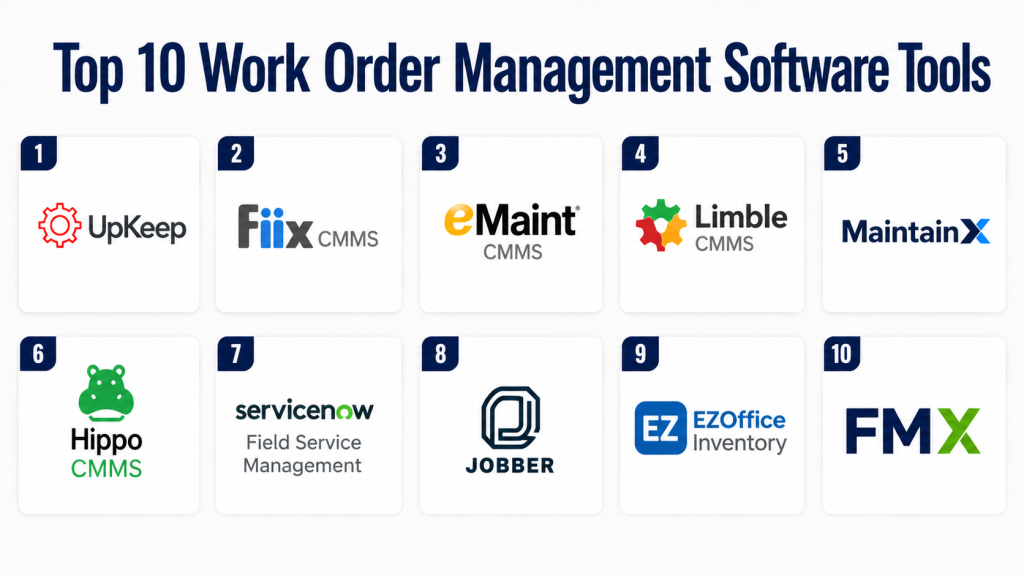
Top 10 Work Order Management Software
#1 — UpKeep
Short description:
UpKeep is a mobile-first work order management platform designed for maintenance teams. It allows users to create, assign, and track work orders easily. The platform includes asset management and reporting features. It is ideal for field technicians. UpKeep improves operational efficiency.
Key Features
- Work order tracking
- Mobile app
- Asset management
- Reporting tools
- Notifications
Pros
- Easy to use
- Strong mobile support
Cons
- Limited advanced customization
- Pricing varies
Platforms / Deployment
Web, iOS, Android / Cloud
Security & Compliance
Not publicly stated
Integrations & Ecosystem
Integrates with business tools and systems.
- CRM tools
- ERP systems
Support & Community
Good support and onboarding.
#2 — Fiix
Short description:
Fiix is a cloud-based CMMS platform for managing maintenance operations. It provides work order tracking, asset management, and analytics. The platform is suitable for manufacturing and facilities. It helps improve maintenance efficiency. Fiix supports predictive maintenance.
Key Features
- Work order management
- Asset tracking
- Maintenance scheduling
- Analytics dashboard
Pros
- Strong analytics
- Scalable
Cons
- Learning curve
- Pricing varies
Platforms / Deployment
Web / Cloud
Security & Compliance
Not publicly stated
Integrations & Ecosystem
Supports integrations with enterprise systems.
- ERP systems
- IoT tools
Support & Community
Reliable support.
#3 — eMaint
Short description:
eMaint is a maintenance management platform with strong work order capabilities. It helps organizations manage assets and workflows. The platform offers reporting and analytics. It is suitable for large enterprises. eMaint improves maintenance operations.
Key Features
- Work order management
- Asset tracking
- Reporting tools
- Maintenance scheduling
Pros
- Comprehensive features
- Enterprise-ready
Cons
- Complex interface
- Higher cost
Platforms / Deployment
Web / Cloud
Security & Compliance
Not publicly stated
Integrations & Ecosystem
Integrates with enterprise tools.
- ERP systems
- Maintenance tools
Support & Community
Enterprise support.
#4 — MaintainX
Short description:
MaintainX is a modern work order management platform designed for teams. It offers real-time tracking and collaboration features. The platform is easy to use. It is suitable for small to mid-sized businesses. MaintainX improves team productivity.
Key Features
- Work order tracking
- Team collaboration
- Mobile access
- Reporting
Pros
- User-friendly
- Strong collaboration
Cons
- Limited advanced features
- Pricing varies
Platforms / Deployment
Web, iOS, Android / Cloud
Security & Compliance
Not publicly stated
Integrations & Ecosystem
Supports integrations with business tools.
- CRM systems
- Workflow tools
Support & Community
Good support.
#5 — Hippo CMMS
Short description:
Hippo CMMS is a maintenance management tool with work order tracking features. It helps organizations manage assets and tasks efficiently. The platform is easy to use. It is suitable for small businesses. It provides good value.
Key Features
- Work order tracking
- Asset management
- Maintenance scheduling
- Reporting
Pros
- Easy setup
- Affordable
Cons
- Limited scalability
- Basic analytics
Platforms / Deployment
Web / Cloud
Security & Compliance
Not publicly stated
Integrations & Ecosystem
Supports basic integrations.
- Maintenance tools
Support & Community
Reliable support.
#6 — Limble CMMS
Short description:
Limble CMMS is a cloud-based maintenance management platform. It offers work order tracking and asset management features. The platform is user-friendly. It is suitable for growing businesses. Limble improves maintenance efficiency.
Key Features
- Work order management
- Asset tracking
- Preventive maintenance
- Reporting
Pros
- Easy to use
- Good mobile support
Cons
- Limited customization
- Pricing varies
Platforms / Deployment
Web, Mobile / Cloud
Security & Compliance
Not publicly stated
Integrations & Ecosystem
Integrates with business tools.
- ERP systems
- Maintenance tools
Support & Community
Strong support.
#7 — ServiceNow Field Service Management
Short description:
ServiceNow provides enterprise-level work order and field service management. It offers automation and analytics tools. The platform is suitable for large organizations. It integrates with enterprise systems. It improves operational workflows.
Key Features
- Work order automation
- Field service management
- Analytics
- Workflow automation
Pros
- Enterprise-ready
- Strong integrations
Cons
- Complex setup
- Expensive
Platforms / Deployment
Web / Cloud
Security & Compliance
RBAC, encryption
Other: Not publicly stated
Integrations & Ecosystem
Integrates with enterprise platforms.
- ERP systems
- ITSM tools
Support & Community
Enterprise support.
#8 — Jobber
Short description:
Jobber is a work order and field service management platform. It helps manage jobs, scheduling, and invoicing. The platform is suitable for service businesses. It is easy to use. Jobber improves workflow efficiency.
Key Features
- Job scheduling
- Work order tracking
- Invoicing
- Client management
Pros
- Easy to use
- Good for service businesses
Cons
- Limited enterprise features
- Pricing varies
Platforms / Deployment
Web, Mobile / Cloud
Security & Compliance
Not publicly stated
Integrations & Ecosystem
Supports integrations with business tools.
- Payment systems
- CRM tools
Support & Community
Good support.
#9 — EZOfficeInventory
Short description:
EZOfficeInventory is an asset and work order management platform. It helps track equipment and maintenance tasks. The platform offers reporting tools. It is suitable for businesses of all sizes. It improves asset visibility.
Key Features
- Work order management
- Asset tracking
- Reporting tools
- Maintenance scheduling
Pros
- Strong asset tracking
- Scalable
Cons
- Interface complexity
- Pricing varies
Platforms / Deployment
Web, Mobile / Cloud
Security & Compliance
Not publicly stated
Integrations & Ecosystem
Integrates with business systems.
- ERP tools
- Inventory systems
Support & Community
Reliable support.
#10 — FMX
Short description:
FMX is a facilities management platform with work order tracking features. It helps organizations manage maintenance tasks efficiently. The platform is easy to use. It is suitable for schools and facilities. FMX improves workflow management.
Key Features
- Work order tracking
- Asset management
- Scheduling
- Reporting
Pros
- Easy to use
- Good support
Cons
- Limited advanced features
- Smaller ecosystem
Platforms / Deployment
Web / Cloud
Security & Compliance
Not publicly stated
Integrations & Ecosystem
Supports integrations with facility tools.
- Maintenance systems
Support & Community
Strong support.
Comparison Table
| Tool Name | Best For | Platform(s) | Deployment | Standout Feature | Public Rating |
|---|---|---|---|---|---|
| UpKeep | Field teams | Web/Mobile | Cloud | Mobile-first | N/A |
| Fiix | Manufacturing | Web | Cloud | Analytics | N/A |
| eMaint | Enterprise | Web | Cloud | Asset management | N/A |
| MaintainX | SMB | Web/Mobile | Cloud | Collaboration | N/A |
| Hippo CMMS | Small business | Web | Cloud | Simplicity | N/A |
| Limble CMMS | Growing teams | Web/Mobile | Cloud | Ease of use | N/A |
| ServiceNow | Enterprise | Web | Cloud | Automation | N/A |
| Jobber | Service businesses | Web/Mobile | Cloud | Scheduling | N/A |
| EZOfficeInventory | Asset tracking | Web/Mobile | Cloud | Inventory | N/A |
| FMX | Facilities | Web | Cloud | Simplicity | N/A |
Evaluation & Scoring Table
| Tool | Core | Ease | Integrations | Security | Performance | Support | Value | Total |
|---|---|---|---|---|---|---|---|---|
| UpKeep | 9 | 9 | 8 | 7 | 8 | 9 | 8 | 8.4 |
| Fiix | 9 | 7 | 8 | 7 | 9 | 8 | 7 | 8.1 |
| eMaint | 9 | 7 | 8 | 7 | 9 | 8 | 7 | 8.1 |
| MaintainX | 8 | 9 | 7 | 6 | 8 | 8 | 8 | 7.9 |
| Hippo CMMS | 7 | 9 | 6 | 6 | 7 | 7 | 8 | 7.4 |
| Limble CMMS | 8 | 9 | 7 | 6 | 8 | 8 | 8 | 7.9 |
| ServiceNow | 9 | 6 | 9 | 8 | 9 | 9 | 7 | 8.3 |
| Jobber | 8 | 9 | 7 | 6 | 8 | 8 | 8 | 7.9 |
| EZOfficeInventory | 8 | 7 | 8 | 6 | 8 | 7 | 7 | 7.6 |
| FMX | 7 | 9 | 6 | 6 | 7 | 7 | 8 | 7.4 |
Which Work Order Management Software Is Right for You?
Solo / Small Teams
If you are a small team or startup, simple and easy-to-use tools like Hippo CMMS or FMX are ideal. These platforms offer basic work order tracking without complexity. They are affordable and quick to set up. You don’t need advanced automation at this stage. Focus on usability and fast adoption.
SMB
Small to medium businesses should consider MaintainX, Limble CMMS, or Jobber. These tools provide a good balance of features and simplicity. They offer mobile access, scheduling, and collaboration features. They are perfect for growing teams managing multiple tasks. These platforms improve efficiency without being overwhelming.
Mid-Market
Mid-sized organizations can benefit from tools like UpKeep or Fiix. These platforms provide better analytics, asset management, and automation features. They help improve maintenance planning and reporting. They also support integrations with other systems. This makes them suitable for scaling operations.
Enterprise
Large enterprises should choose ServiceNow or eMaint. These platforms offer advanced automation, integration, and scalability. They support complex workflows and multi-location operations. They also provide strong reporting and analytics. These tools are ideal for organizations with high operational demands.
Budget vs Premium
Budget tools focus on basic functionality and affordability. Premium tools offer advanced features like predictive maintenance and deep analytics. If your needs are simple, budget tools work well. For long-term growth and optimization, premium solutions are better. Choose based on your goals and budget.
Feature Depth vs Ease of Use
Some platforms offer powerful features but require training and setup. Others are simple but limited in functionality. If your team is non-technical, choose easy-to-use tools. If you need advanced capabilities, go for feature-rich platforms. Balance is key.
Integrations & Scalability
Choose tools that integrate with your existing systems like ERP or CRM. This improves workflow efficiency and data accuracy. Scalability is important if your operations are growing. Make sure the platform can handle future expansion. Integration capabilities are critical.
Security & Compliance Needs
Work order systems may handle sensitive operational data. Look for tools with role-based access and secure data handling. Enterprise users should prioritize security features. Data protection becomes more important as operations grow. Always review security capabilities before choosing.
Frequently Asked Questions (FAQs)
1. What is work order management software?
Work order management software helps organizations create, assign, and track maintenance tasks. It replaces manual processes with automation. This improves efficiency and reduces errors. It also provides real-time visibility into operations. It is widely used in maintenance and service industries.
2. Do small businesses need work order software?
Small businesses can benefit from work order software as they grow. It helps organize tasks and reduce manual effort. However, very small teams may manage with basic tools. As operations expand, software becomes essential. It improves efficiency and saves time.
3. Can these tools be used on mobile devices?
Yes, most modern tools offer mobile apps. This allows technicians to manage tasks on the go. Mobile access improves productivity and response time. It is especially useful for field service teams. It ensures real-time updates and communication.
4. How much does work order management software cost?
Pricing varies depending on features and scale. Some tools offer affordable plans for small teams. Others provide enterprise-level pricing with advanced features. Costs may be subscription-based. It is important to compare pricing before choosing.
5. What features should I look for?
Look for work order tracking, mobile access, and reporting tools. Automation features are also important. Integration with other systems is useful. Ease of use should be a priority. Choose features based on your needs.
6. Can it integrate with other systems?
Yes, many tools integrate with ERP, CRM, and IoT systems. This helps streamline workflows and improve data accuracy. Integration reduces manual work. It allows better coordination across teams. Always check compatibility before selecting a tool.
7. Is work order software secure?
Security depends on the platform. Some tools offer encryption and access control features. Enterprise tools provide stronger security measures. It is important to evaluate security capabilities. Protecting operational data is essential.
8. Can it handle multiple locations?
Yes, many tools support multi-location management. This is useful for large organizations. It allows centralized control of operations. It improves efficiency across sites. Enterprise tools are best for this.
9. What are common mistakes when choosing software?
Choosing overly complex tools is a common mistake. Ignoring integration needs can cause issues. Not considering ease of use affects adoption. Focusing only on price can lead to poor decisions. Proper evaluation is important.
10. What are alternatives to work order software?
Alternatives include spreadsheets or manual tracking. These methods are less efficient and error-prone. Software solutions provide automation and visibility. They improve productivity and accuracy. They are better for growing operations.Conclusion
Work Order Management Software is essential for organizations looking to streamline maintenance and service operations. These tools improve efficiency, reduce downtime, and provide better visibility into workflows.
Choosing the right solution depends on your organization size, industry, and operational needs. Smaller teams benefit from simple tools, while enterprises require advanced features and integrations.
Start by evaluating your requirements, testing a few tools, and selecting the one that aligns best with your workflow. The right platform can significantly improve productivity and operational performance.
