Introduction
Retail merchandising tools are software solutions that help retailers plan, manage, and optimize how products are displayed, priced, and promoted across physical stores and digital channels. These tools play a crucial role in improving product visibility, increasing conversions, and maximizing revenue by ensuring the right products are available at the right time, in the right place, and at the right price.
In modern retail, merchandising is no longer manual. It is driven by data, automation, and AI-based insights. Retailers use merchandising tools to manage assortments, optimize categories, track product performance, and execute promotions across multiple channels.
Common use cases include:
- Product assortment and category planning
- Promotion and campaign management
- Visual and digital merchandising optimization
- Demand-driven product placement
- Pricing and markdown planning
What buyers should evaluate:
- Assortment planning capabilities
- AI-driven merchandising intelligence
- Integration with POS and ERP systems
- Omnichannel support
- Reporting and analytics strength
- Automation capabilities
- Scalability for large catalogs
- Ease of use and workflow design
- Real-time data processing
Best for: Retail chains, e-commerce platforms, fashion brands, supermarkets, and omnichannel retailers.
Not ideal for: Very small businesses with limited product range or manual-only retail operations.
Key Trends in Retail Merchandising Tools
- AI-powered product assortment optimization
- Real-time merchandising adjustments based on demand
- Omnichannel merchandising synchronization
- Automated category management systems
- Personalized product recommendations
- Data-driven visual merchandising strategies
- Integration with POS, ERP, and e-commerce platforms
- Predictive analytics for demand planning
- Dynamic promotion and discount optimization
- Cloud-based merchandising platforms
How We Evaluate Retail Merchandising Tools (Methodology)
- Market adoption and industry usage
- Feature depth in merchandising and planning
- AI and automation capabilities
- Integration ecosystem strength
- Performance and scalability
- Ease of implementation and usability
- Reporting and analytics capabilities
- Security and compliance readiness
- Value for money and ROI impact
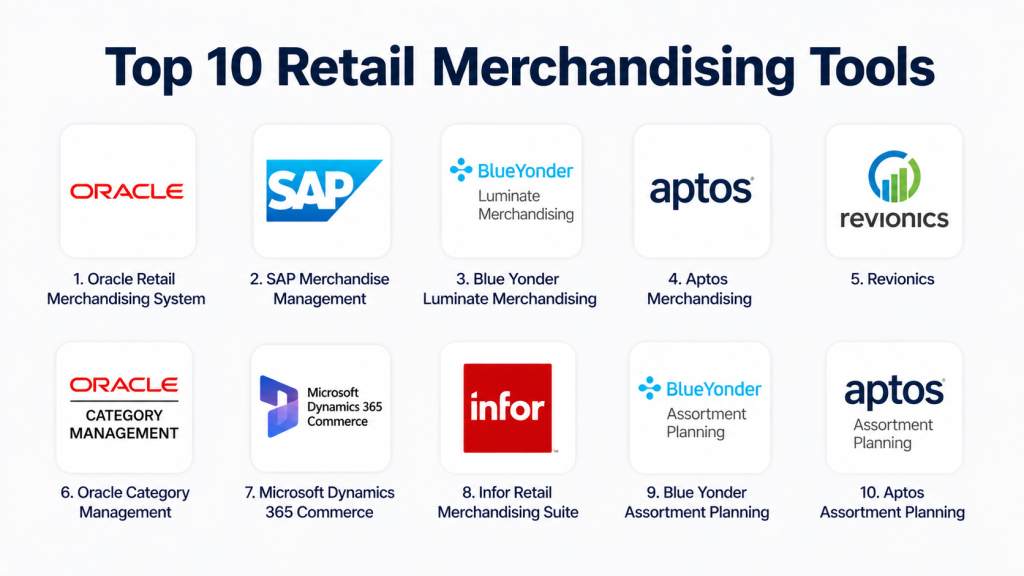
Top 10 Retail Merchandising Tools
#1 — Oracle Retail Merchandising System
Short description:
Oracle Retail Merchandising System is an enterprise-grade platform designed for large retail organizations. It helps manage product lifecycle, pricing, inventory, and assortment planning in a unified system. It is widely used by global retail chains with complex operations. The platform supports multi-channel retail environments and large-scale product catalogs. Oracle RMS is known for its depth, reliability, and scalability.
Key Features
- Product lifecycle management
- Assortment planning
- Pricing and promotion management
- Inventory optimization
- Category management
Pros
- Highly scalable enterprise solution
- Strong retail analytics capabilities
Cons
- Complex implementation
- High cost
Platforms / Deployment
Web / Cloud / On-premise
Security & Compliance
Enterprise-grade RBAC, audit logging, compliance support
Integrations & Ecosystem
- ERP systems
- POS systems
- Retail analytics tools
Support & Community
Enterprise-level support
#2 — SAP Merchandise Management
Short description:
SAP Merchandise Management is part of SAP’s retail suite designed for large-scale merchandising operations. It enables retailers to manage assortment planning, pricing strategies, and inventory control. It integrates deeply with SAP ERP systems, ensuring consistent data flow across business operations. It is widely used by global enterprises for retail management.
Key Features
- Assortment planning
- Pricing optimization
- Inventory control
- Sales forecasting
- Supplier coordination
Pros
- Strong ERP integration
- Reliable enterprise-grade solution
Cons
- Complex setup
- High licensing cost
Platforms / Deployment
Cloud / On-premise
Security & Compliance
SAP enterprise security framework
Integrations & Ecosystem
- SAP ERP
- SAP analytics tools
Support & Community
Global enterprise support
#3 — Blue Yonder Luminate Merchandising
Short description:
Blue Yonder Luminate Merchandising is an AI-driven retail optimization platform that focuses on demand forecasting, pricing, and product assortment planning. It is widely used by large retailers to improve decision-making through predictive analytics. The platform supports real-time retail optimization across channels. It helps improve profitability and operational efficiency.
Key Features
- AI-based assortment planning
- Demand forecasting
- Pricing optimization
- Promotion management
- Inventory optimization
Pros
- Strong AI and automation
- Real-time insights
Cons
- Enterprise complexity
- Expensive solution
Platforms / Deployment
Cloud
Security & Compliance
Enterprise compliance standards
Integrations & Ecosystem
- ERP systems
- Supply chain platforms
Support & Community
Enterprise support
#4 — Aptos Merchandising
Short description:
Aptos Merchandising is an omnichannel retail platform designed for managing inventory, pricing, and product assortments across multiple channels. It supports real-time data synchronization, making it suitable for modern retail environments. The platform is widely used by mid to large retailers. It improves merchandising efficiency and consistency.
Key Features
- Omnichannel merchandising
- Inventory management
- Product lifecycle tracking
- Pricing optimization
- Category management
Pros
- Strong omnichannel capabilities
- Real-time synchronization
Cons
- Learning curve
- Not ideal for small businesses
Platforms / Deployment
Cloud / On-premise
Security & Compliance
RBAC and enterprise controls
Integrations & Ecosystem
- POS systems
- E-commerce platforms
Support & Community
Vendor support
#5 — Revionics
Short description:
Revionics is an AI-powered pricing and merchandising optimization platform focused on improving profitability through intelligent pricing strategies. It helps retailers optimize pricing, promotions, and markdowns using predictive analytics. The platform is widely adopted in enterprise retail environments. It enhances pricing accuracy and revenue performance.
Key Features
- Dynamic pricing optimization
- Markdown management
- Demand forecasting
- Promotion planning
- Competitive pricing analysis
Pros
- Strong AI capabilities
- Revenue optimization focus
Cons
- Enterprise-only focus
- Complex implementation
Platforms / Deployment
Cloud
Security & Compliance
Enterprise security standards
Integrations & Ecosystem
- ERP systems
- Retail analytics platforms
Support & Community
Enterprise support
#6 — Oracle Category Management
Short description:
Oracle Category Management helps retailers optimize product categories and assortment strategies. It provides data-driven insights to improve product placement and category performance. It integrates tightly with Oracle’s retail ecosystem. It is widely used in large retail organizations.
Key Features
- Category planning
- Assortment optimization
- Sales analysis
- Space planning
- Performance tracking
Pros
- Strong analytics capabilities
- Enterprise integration
Cons
- Complex setup
- High cost
Platforms / Deployment
Cloud / On-premise
Security & Compliance
Enterprise-grade security
Integrations & Ecosystem
Oracle retail ecosystem
Support & Community
Enterprise support
#7 — Microsoft Dynamics 365 Commerce
Short description:
Microsoft Dynamics 365 Commerce provides merchandising and retail management capabilities as part of its unified commerce platform. It supports product catalog management, pricing, and omnichannel operations. The platform is widely used in enterprise retail environments. It integrates deeply with Microsoft ecosystem tools.
Key Features
- Product catalog management
- Pricing and promotions
- Omnichannel support
- Customer insights
- Sales analytics
Pros
- Strong Microsoft integration
- Scalable architecture
Cons
- Complex configuration
- Licensing cost
Platforms / Deployment
Cloud
Security & Compliance
Microsoft enterprise security standards
Integrations & Ecosystem
- Azure services
- Microsoft ERP tools
Support & Community
Enterprise support
#8 — Infor Retail Merchandising Suite
Short description:
Infor Retail Merchandising Suite provides tools for pricing, assortment, and inventory optimization. It is designed for global retail operations. The platform helps retailers make data-driven merchandising decisions. It supports complex retail environments with multiple channels.
Key Features
- Merchandising planning
- Pricing optimization
- Inventory tracking
- Demand analytics
Pros
- Strong enterprise capabilities
- Flexible deployment options
Cons
- Complex setup
- Higher cost
Platforms / Deployment
Cloud / On-premise
Security & Compliance
Enterprise security framework
Integrations & Ecosystem
ERP and retail systems
Support & Community
Enterprise support
#9 — Blue Yonder Assortment Planning
Short description:
Blue Yonder Assortment Planning helps retailers optimize product assortments based on demand signals and customer behavior. It uses predictive analytics to improve product mix and availability. The platform is widely used in large retail chains. It enhances category performance and profitability.
Key Features
- Assortment optimization
- Demand forecasting
- Product lifecycle analysis
- Inventory alignment
Pros
- Strong AI-driven insights
- High scalability
Cons
- Enterprise complexity
- Expensive solution
Platforms / Deployment
Cloud
Security & Compliance
Enterprise compliance standards
Integrations & Ecosystem
Retail ERP systems
Support & Community
Enterprise support
#10 — Aptos Assortment Planning
Short description:
Aptos Assortment Planning helps retailers design optimized product assortments and improve category performance. It supports omnichannel retail strategies and data-driven decision-making. The platform is suitable for mid to large retailers. It improves product availability and merchandising efficiency.
Key Features
- Assortment planning
- Category optimization
- Demand analysis
- Inventory alignment
Pros
- Strong retail focus
- Omnichannel support
Cons
- Learning curve
- Enterprise pricing
Platforms / Deployment
Cloud / On-premise
Security & Compliance
RBAC and enterprise security controls
Integrations & Ecosystem
Retail systems and POS platforms
Support & Community
Vendor support
Comparison Table
| Tool Name | Best For | Platform(s) | Deployment | Standout Feature | Public Rating |
|---|---|---|---|---|---|
| Oracle RMS | Enterprise retail | Web | Hybrid | Lifecycle merchandising | N/A |
| SAP MM | Global retail | Web | Hybrid | ERP integration | N/A |
| Blue Yonder | Large retail | Web | Cloud | AI forecasting | N/A |
| Aptos Merchandising | Omnichannel retail | Web | Hybrid | Real-time sync | N/A |
| Revionics | Pricing optimization | Web | Cloud | AI pricing | N/A |
| Oracle Category Mgmt | Category planning | Web | Hybrid | Category analytics | N/A |
| Dynamics 365 | Enterprise retail | Web | Cloud | Unified commerce | N/A |
| Infor Suite | Global retail | Web | Hybrid | Retail analytics | N/A |
| Blue Yonder Assortment | Retail chains | Web | Cloud | Demand-driven assortments | N/A |
| Aptos Assortment | Mid-large retail | Web | Hybrid | Product optimization | N/A |
Evaluation & Scoring of Retail Merchandising Tools
| Tool | Core | Ease | Integrations | Security | Performance | Support | Value | Total |
|---|---|---|---|---|---|---|---|---|
| Oracle RMS | 10 | 6 | 9 | 10 | 9 | 9 | 6 | 8.5 |
| SAP MM | 10 | 6 | 9 | 10 | 9 | 9 | 6 | 8.5 |
| Blue Yonder | 9 | 7 | 8 | 9 | 9 | 9 | 7 | 8.3 |
| Aptos Merchandising | 8 | 7 | 8 | 8 | 8 | 8 | 7 | 7.9 |
| Revionics | 9 | 7 | 8 | 9 | 9 | 8 | 7 | 8.2 |
| Dynamics 365 | 9 | 7 | 9 | 9 | 8 | 9 | 7 | 8.4 |
| Infor Suite | 8 | 7 | 8 | 8 | 8 | 8 | 7 | 7.8 |
| Blue Yonder Assortment | 9 | 7 | 8 | 9 | 9 | 9 | 7 | 8.3 |
| Oracle Category Mgmt | 9 | 6 | 9 | 9 | 9 | 9 | 6 | 8.3 |
| Aptos Assortment | 8 | 7 | 8 | 8 | 8 | 8 | 7 | 7.8 |
Which Retail Merchandising Tool Is Right for You?
Small Retailers
Lightweight tools are better; enterprise platforms may be too complex.
SMB Retailers
Aptos and Dynamics 365 offer balanced features and scalability.
Mid-Market Retail
Blue Yonder and Revionics provide strong AI-driven merchandising.
Enterprise Retail
SAP, Oracle, and Infor are best for large-scale operations.
Budget vs Premium
Enterprise tools are premium; mid-market tools are more flexible.
Feature Depth vs Ease of Use
Enterprise tools are powerful but complex; SMB tools are easier.
Integrations & Scalability
Choose tools with strong ERP, POS, and e-commerce integration.
Security & Compliance
Enterprise tools provide strong governance and compliance support.
Frequently Asked Questions (FAQs)
1. What are retail merchandising tools?
Retail merchandising tools help businesses manage product assortment, placement, and promotions across retail channels. They use data and analytics to improve product visibility. These tools optimize how products are displayed to customers. They also help improve sales performance. They are widely used in modern retail operations.
2. Why are merchandising tools important?
They help retailers make better product decisions using data. This leads to improved sales and customer experience. They reduce manual errors in planning. They also improve inventory and category performance. Overall, they increase retail efficiency.
3. Do these tools use AI?
Yes, many modern tools use AI for demand forecasting and assortment optimization. AI helps identify trends and customer behavior patterns. It also supports dynamic merchandising decisions. This improves accuracy and speed. AI is becoming a core feature in retail systems.
4. Can small retailers use these tools?
Yes, but many enterprise tools are too complex for small retailers. SMB-focused solutions are more suitable in such cases. These tools offer simplified features and lower cost. Small businesses often start with basic versions. Scalability depends on the chosen platform.
5. Do these tools integrate with POS systems?
Yes, integration with POS systems is common. It ensures real-time inventory and sales synchronization. This improves accuracy in merchandising decisions. It also supports omnichannel retail operations. Integration is a key requirement.
6. Are retail merchandising tools expensive?
Enterprise solutions can be expensive due to advanced features. SMB tools are more affordable and subscription-based. Pricing depends on scale and functionality. Larger retailers invest more for advanced analytics. ROI is generally high for these tools.
7. How do they improve sales?
They optimize product placement and promotions. They help ensure high-demand products are visible. They improve category performance. They reduce overstock and understock issues. This leads to better conversion rates.
8. Do they support e-commerce?
Yes, most modern tools support e-commerce platforms. They help manage online product assortments. They ensure consistent pricing and promotions. They also unify online and offline merchandising. This is essential for omnichannel retail.
9. Are these tools secure?
Yes, enterprise tools follow strict security standards. They include role-based access and audit logging. Compliance depends on the vendor. Security is critical for retail data. Proper configuration is important.
10. What are alternatives to these tools?
Alternatives include manual planning and spreadsheets. However, they are not scalable or efficient. They lack automation and real-time insights. Merchandising tools provide better accuracy. They are preferred in modern retail environments.
Conclusion
Retail merchandising tools have become essential for modern retail success. They enable businesses to optimize product placement, pricing strategies, and promotional planning using data-driven insights. As retail becomes increasingly digital and omnichannel, these tools help ensure consistency and efficiency across all channels.
The biggest advantage of these platforms is their ability to turn raw retail data into actionable insights. From AI-driven assortment planning to real-time merchandising adjustments, they help retailers stay competitive in a fast-changing market.
Choosing the right tool depends on business size, complexity, and growth goals. While enterprise platforms offer deep analytics and scalability, mid-market solutions provide flexibility and ease of use. A well-chosen merchandising tool can significantly improve sales performance, customer experience, and overall retail profitability.
