Introduction
Retail Point of Sale (POS) systems are software and hardware solutions that help businesses manage sales transactions, inventory, customer data, and payments in real time. Modern POS systems go far beyond simple billing machines—they act as complete retail management platforms that connect sales, inventory, analytics, and customer engagement.
In today’s retail environment, where omnichannel shopping is standard, POS systems play a critical role in unifying in-store and online operations. They help retailers improve checkout speed, track stock levels accurately, and deliver better customer experiences.
Common use cases include:
- Processing in-store and online sales transactions
- Managing inventory across multiple locations
- Tracking customer purchase history and loyalty programs
- Generating sales reports and analytics
- Integrating with accounting and CRM systems
What buyers should evaluate:
- Ease of use and checkout speed
- Inventory and order management capabilities
- Omnichannel integration support
- Hardware compatibility (barcode scanners, printers, etc.)
- Reporting and analytics features
- Payment processing flexibility
- Security and compliance standards
- Scalability for business growth
- Pricing and transaction fees
Best for: Retail stores, supermarkets, restaurants, fashion outlets, and multi-location retail chains.
Not ideal for: Businesses with very low transaction volume or those that only need basic invoicing tools.
Key Trends in Retail POS Systems
- Cloud-based POS adoption replacing traditional on-premise systems
- Omnichannel retail integration (online + offline unified systems)
- AI-powered sales analytics and forecasting
- Mobile POS systems (mPOS) for flexible checkout experiences
- Contactless and digital payment integration
- Customer loyalty automation and personalization
- Real-time inventory synchronization across channels
- Subscription-based pricing models instead of one-time licenses
- Self-checkout and kiosk-based POS systems
- Integration with CRM and ERP platforms
How We Evaluate POS Systems (Methodology)
- Market adoption and retail industry usage
- Feature completeness (sales, inventory, CRM, reporting)
- Hardware and software compatibility
- Ease of setup and usability
- Security and payment compliance readiness
- Integration ecosystem strength
- Scalability for multi-store operations
- Pricing transparency and value for money
- Customer support and reliability
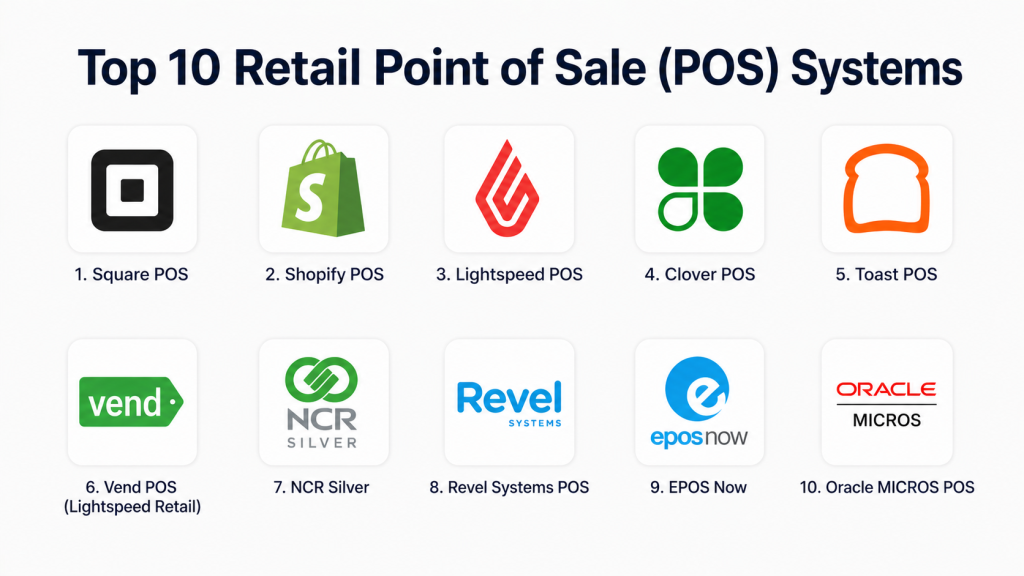
Top 10 Retail Point of Sale (POS) Systems
#1 — Square POS
Short description:
Square POS is a widely used retail POS system known for its simplicity and accessibility. It is designed for small to medium-sized businesses and supports both online and offline sales. The platform includes payment processing, inventory tracking, and sales reporting. It is easy to set up and requires minimal hardware. Square POS is especially popular among small retailers and startups.
Key Features
- Payment processing
- Inventory management
- Sales analytics
- Customer management
- Mobile POS support
Pros
- Easy to use
- Quick setup
Cons
- Limited advanced features for large enterprises
- Transaction fees apply
Platforms / Deployment
Mobile / Web / Cloud
Security & Compliance
PCI-DSS compliant, encryption supported
Integrations & Ecosystem
- E-commerce platforms
- Accounting tools
- CRM systems
Support & Community
Strong documentation and community support
#2 — Shopify POS
Short description:
Shopify POS is designed for retailers using Shopify’s e-commerce platform. It unifies online and offline sales in one system. The platform supports seamless inventory synchronization and customer data tracking. It is ideal for omnichannel retailers. Shopify POS is widely used in fashion and retail industries.
Key Features
- Omnichannel sales
- Inventory sync
- Customer profiles
- Order management
- Payment processing
Pros
- Strong e-commerce integration
- Unified sales system
Cons
- Best suited for Shopify users
- Subscription costs can add up
Platforms / Deployment
Web / Mobile / Cloud
Security & Compliance
PCI compliance, secure payment processing
Integrations & Ecosystem
- Shopify ecosystem
- Marketing tools
- Accounting software
Support & Community
Extensive support and documentation
#3 — Lightspeed POS
Short description:
Lightspeed POS is a powerful retail and restaurant POS system designed for growing businesses. It offers advanced inventory management and analytics features. The platform supports multi-location retail operations. It is suitable for medium to large retailers. Lightspeed provides strong reporting capabilities.
Key Features
- Advanced inventory management
- Multi-store support
- Sales analytics
- Customer insights
- Omnichannel capabilities
Pros
- Scalable solution
- Strong analytics
Cons
- Learning curve
- Higher pricing tiers
Platforms / Deployment
Cloud / Web / Mobile
Security & Compliance
PCI compliance, role-based access
Integrations & Ecosystem
- E-commerce platforms
- Accounting systems
- Marketing tools
Support & Community
Professional support available
#4 — Clover POS
Short description:
Clover POS is a flexible retail POS system offering hardware and software solutions. It is designed for small and mid-sized businesses. The platform supports payment processing and inventory tracking. It provides customizable hardware options. Clover is widely used in retail and hospitality.
Key Features
- Payment processing
- Inventory tracking
- Employee management
- Reporting dashboards
- Hardware customization
Pros
- Flexible hardware options
- Easy to use
Cons
- Limited advanced analytics
- Hardware dependency
Platforms / Deployment
Hardware-based / Cloud
Security & Compliance
PCI compliant
Integrations & Ecosystem
- Accounting tools
- CRM systems
Support & Community
Vendor support and resources
#5 — Toast POS
Short description:
Toast POS is a restaurant-focused POS system but also used in retail food businesses. It offers order management, payments, and inventory tracking. The platform is cloud-based and scalable. It is designed for high-volume operations. Toast is widely used in food service retail.
Key Features
- Order management
- Payment processing
- Inventory control
- Kitchen display integration
- Reporting tools
Pros
- Built for high-volume environments
- Strong reliability
Cons
- Industry-specific
- Hardware costs
Platforms / Deployment
Cloud / Hardware
Security & Compliance
PCI compliance
Integrations & Ecosystem
- Delivery platforms
- Accounting systems
Support & Community
Strong support system
#6 — Vend POS (Lightspeed Retail)
Short description:
Vend POS is a retail-focused system offering inventory and customer management features. It is suitable for small and medium retailers. The platform is cloud-based and easy to use. It integrates well with e-commerce systems. Vend is now part of Lightspeed.
Key Features
- Inventory tracking
- Customer management
- Sales reporting
- Offline mode
- Multi-store support
Pros
- Easy to deploy
- Good usability
Cons
- Limited enterprise features
- Dependent on ecosystem
Platforms / Deployment
Cloud / Web
Security & Compliance
PCI compliant
Integrations & Ecosystem
- Shopify
- Accounting tools
Support & Community
Standard support available
#7 — NCR Silver
Short description:
NCR Silver is a cloud-based POS system designed for small businesses. It offers sales tracking, inventory management, and reporting. The platform is known for reliability. It is widely used in retail and food service businesses.
Key Features
- Sales tracking
- Inventory management
- Customer insights
- Reporting dashboards
Pros
- Reliable system
- Easy to use
Cons
- Limited customization
- Pricing variability
Platforms / Deployment
Cloud / Mobile
Security & Compliance
PCI compliant
Integrations & Ecosystem
- Payment systems
- Accounting tools
Support & Community
Vendor support available
#8 — Revel Systems POS
Short description:
Revel Systems is an enterprise-grade POS platform offering advanced retail and restaurant capabilities. It supports complex operations and multi-location businesses. The platform is cloud-based and highly scalable. It is suitable for large enterprises.
Key Features
- Multi-location management
- Advanced reporting
- Inventory control
- Employee management
Pros
- Highly scalable
- Enterprise-ready
Cons
- Expensive
- Complex setup
Platforms / Deployment
Cloud
Security & Compliance
Enterprise security controls
Integrations & Ecosystem
- ERP systems
- Accounting tools
Support & Community
Enterprise support
#9 — EPOS Now
Short description:
EPOS Now is a retail POS system designed for small and medium businesses. It offers payment processing and inventory tracking. The platform is easy to set up. It supports retail and hospitality sectors.
Key Features
- Inventory management
- Payment processing
- Reporting tools
- Customer tracking
Pros
- Easy setup
- Affordable options
Cons
- Limited advanced features
- Add-on costs
Platforms / Deployment
Cloud / Hardware
Security & Compliance
PCI compliant
Integrations & Ecosystem
- Accounting software
- E-commerce tools
Support & Community
Standard support
#10 — Oracle MICROS POS
Short description:
Oracle MICROS is an enterprise POS system used in retail and hospitality. It provides advanced transaction management and analytics. The platform is highly scalable. It is widely used in large organizations. MICROS is known for reliability.
Key Features
- Transaction management
- Inventory tracking
- Advanced analytics
- Multi-location support
Pros
- Enterprise-grade
- Highly reliable
Cons
- Expensive
- Complex deployment
Platforms / Deployment
Cloud / On-premise
Security & Compliance
Enterprise security standards
Integrations & Ecosystem
- Oracle ERP
- CRM systems
Support & Community
Enterprise-level support
Comparison Table
| Tool Name | Best For | Platform(s) | Deployment | Standout Feature | Public Rating |
|---|---|---|---|---|---|
| Square POS | Small retail | Mobile/Web | Cloud | Simplicity | N/A |
| Shopify POS | Omnichannel | Web/Mobile | Cloud | E-commerce sync | N/A |
| Lightspeed POS | Retail chains | Web | Cloud | Analytics | N/A |
| Clover POS | SMB retail | Hardware/Web | Hybrid | Flexible hardware | N/A |
| Toast POS | Food retail | Cloud | Cloud | Order management | N/A |
| Vend POS | Small retail | Web | Cloud | Ease of use | N/A |
| NCR Silver | SMB | Mobile/Web | Cloud | Reliability | N/A |
| Revel Systems | Enterprise | Web | Cloud | Scalability | N/A |
| EPOS Now | SMB retail | Cloud/Hardware | Hybrid | Affordable setup | N/A |
| Oracle MICROS | Enterprise | Web | Hybrid | Enterprise control | N/A |
Evaluation & Scoring of POS Systems
| Tool | Core | Ease | Integrations | Security | Performance | Support | Value | Total |
|---|---|---|---|---|---|---|---|---|
| Square POS | 9 | 9 | 8 | 8 | 8 | 9 | 9 | 8.7 |
| Shopify POS | 9 | 8 | 9 | 8 | 8 | 9 | 8 | 8.5 |
| Lightspeed | 9 | 7 | 9 | 9 | 9 | 8 | 7 | 8.3 |
| Clover POS | 8 | 8 | 7 | 8 | 8 | 8 | 8 | 7.9 |
| Toast POS | 8 | 7 | 8 | 8 | 9 | 8 | 7 | 7.9 |
| Vend POS | 8 | 8 | 8 | 8 | 8 | 8 | 8 | 8.0 |
| NCR Silver | 7 | 8 | 7 | 8 | 8 | 8 | 8 | 7.7 |
| Revel Systems | 9 | 6 | 8 | 9 | 9 | 8 | 6 | 8.0 |
| EPOS Now | 8 | 8 | 7 | 8 | 7 | 8 | 8 | 7.8 |
| Oracle MICROS | 10 | 6 | 9 | 10 | 9 | 9 | 6 | 8.5 |
Which POS System Is Right for You?
Small Retailers
Square POS and EPOS Now are ideal for affordability and simplicity.
SMB Retail Chains
Shopify POS and Lightspeed POS offer scalability and integration.
Enterprise Retail
Oracle MICROS and Revel Systems support complex operations.
Omnichannel Businesses
Shopify POS and Lightspeed excel in unified commerce.
Budget vs Premium
Budget tools focus on essentials; premium tools offer analytics and scalability.
Ease of Use vs Features
Simple tools are easy to deploy, while enterprise tools offer advanced control.
Integrations & Scalability
Choose systems that integrate with e-commerce and accounting tools.
Security & Compliance
Always ensure PCI compliance and secure payment processing.
Frequently Asked Questions (FAQs)
1. What is a POS system?
A POS system is a combination of software and hardware used to process sales transactions. It helps manage payments, inventory, and customer data. Modern POS systems also include analytics and reporting. They improve operational efficiency. They are essential for retail businesses.
2. Why are POS systems important?
They streamline checkout processes and reduce errors. They improve inventory management. They provide real-time sales insights. They enhance customer experience. They support business growth.
3. Do POS systems work offline?
Some systems offer offline mode. Transactions are stored and synced later. This ensures business continuity. Cloud-based systems may have limited offline capabilities. Always check this feature before choosing.
4. Are POS systems secure?
Yes, most systems follow PCI compliance standards. They encrypt payment data. Role-based access improves security. Security levels vary by vendor. Proper setup is important.
5. Can POS systems manage inventory?
Yes, inventory management is a core feature. They track stock levels in real time. Alerts can be set for low stock. Multi-location tracking is also supported. This improves efficiency.
6. Do POS systems support online stores?
Many modern POS systems integrate with e-commerce platforms. This enables omnichannel selling. Inventory is synced across channels. It improves customer experience. Integration is key for modern retail.
7. How much do POS systems cost?
Costs vary based on features and scale. Some offer free plans with transaction fees. Others require monthly subscriptions. Hardware costs may apply. Enterprise systems are more expensive.
8. Can POS systems scale?
Yes, many systems support multi-store operations. Cloud-based systems scale easily. Enterprise solutions handle large volumes. Scalability is important for growing businesses. Choose accordingly.
9. What hardware is needed for POS systems?
Common hardware includes barcode scanners, receipt printers, and cash drawers. Mobile POS systems may require tablets or smartphones. Requirements vary by vendor. Some systems are hardware-free. Check compatibility before purchase.
10. What are alternatives to POS systems?
Alternatives include manual billing or basic invoicing tools. However, they lack automation. POS systems provide better efficiency. They are essential for modern retail. Alternatives are only suitable for very small operations.
Conclusion
Retail Point of Sale (POS) systems have become the backbone of modern retail operations. They are no longer just billing tools but complete business management platforms that connect sales, inventory, customer data, and analytics in real time. From small shops to large enterprise retail chains, POS systems help streamline operations, reduce manual errors, and improve overall customer experience. As retail continues to shift toward omnichannel and digital-first models, the role of POS systems is becoming even more critical.
Choosing the right POS system depends on your business size, industry, and growth goals. Small retailers may prioritize simplicity and affordability, while larger enterprises require advanced features like multi-store management, deep analytics, and strong integrations. Cloud-based systems are now leading the market due to their flexibility and scalability.
Ultimately, a well-chosen POS system can significantly improve operational efficiency, enhance customer satisfaction, and support long-term business growth. The key is to evaluate your requirements carefully and select a solution that aligns with both your current needs and future expansion plans.
