Introduction
Payroll & Benefits Administration tools are software platforms that help businesses manage employee salaries, tax deductions, benefits, and compliance in a streamlined and automated way. These tools handle payroll processing, employee benefits enrollment, and statutory compliance, reducing manual effort and errors.
With evolving labor laws, remote workforces, and increasing demand for employee experience, payroll and benefits systems have become critical for HR and finance teams. Modern platforms now integrate automation, AI-driven payroll processing, and strong cybersecurity practices such as Identity Management, Zero Trust access, and role-based permissions to protect sensitive employee data.
Common use cases:
- Payroll processing and salary disbursement
- Tax calculation and compliance
- Employee benefits management
- Leave and attendance tracking
- Reporting and analytics
Key evaluation criteria:
- Payroll automation and accuracy
- Compliance with local and global regulations
- Integration with HR, accounting, and ERP systems
- Scalability for growing organizations
- Security features like RBAC, MFA, encryption
- Employee self-service capabilities
- Reporting and analytics
- Pricing and ROI
Best for: HR teams, finance departments, SMBs, enterprises, and organizations managing employee payroll and benefits.
Not ideal for: Very small teams with minimal payroll complexity or those using manual payroll processes.
Key Trends in Payroll & Benefits Administration
- AI-driven payroll processing and automation
- Cloud-based payroll systems replacing legacy tools
- Real-time payroll reporting and analytics
- Zero Trust security frameworks for employee data protection
- Integration with HRIS, ERP, and accounting platforms
- Employee self-service portals for payroll and benefits
- Global payroll and compliance support
- Automated tax filing and statutory compliance
- Mobile-first payroll applications
- Subscription-based pricing models
How We Selected These Payroll & Benefits Tools (Methodology)
- Evaluated market adoption and HR software popularity
- Assessed payroll automation and compliance capabilities
- Reviewed integration ecosystem with HR and finance systems
- Analyzed security posture including RBAC and encryption
- Considered scalability across SMB and enterprise use cases
- Evaluated user experience and employee self-service features
- Assessed support quality and onboarding
- Reviewed pricing and value for money
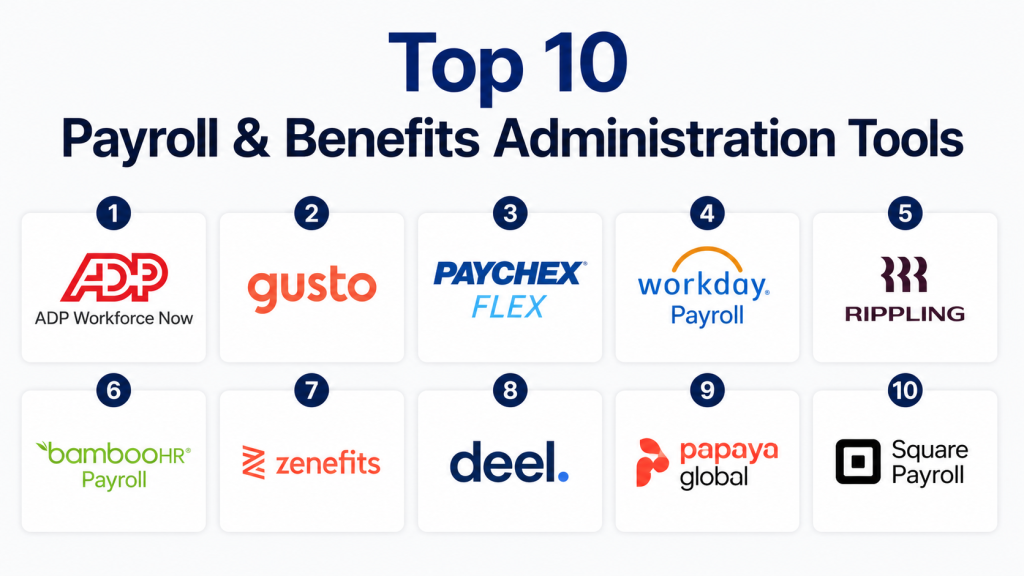
Top 10 Payroll & Benefits Administration Tools
#1 — ADP Workforce Now
Short description: ADP Workforce Now is a comprehensive payroll and HR management platform designed for mid-market and enterprise organizations. It offers payroll processing, benefits administration, and compliance management. Known for reliability and scalability. Provides strong reporting tools. Integrates with HR systems. Ideal for large organizations managing complex payroll operations.
Key Features
- Payroll processing
- Benefits management
- Compliance tools
- Reporting dashboards
- Employee self-service
Pros
- Enterprise-grade solution
- Strong compliance support
Cons
- Expensive
- Complex setup
Platforms / Deployment
Cloud
Security & Compliance
SSO, RBAC, encryption
Integrations & Ecosystem
- HR systems
- ERP platforms
- APIs
Support & Community
Strong enterprise support
#2 — Gusto
Short description: Gusto is a popular payroll and benefits platform designed for SMBs. It simplifies payroll processing and tax filing. Offers employee benefits and onboarding tools. Easy to use and affordable. Provides automation and reporting. Ideal for startups and small businesses.
Key Features
- Payroll automation
- Tax filing
- Benefits management
- Employee onboarding
Pros
- Easy to use
- Affordable
Cons
- Limited enterprise features
- Regional limitations
Platforms / Deployment
Cloud
Security & Compliance
RBAC, encryption
Integrations & Ecosystem
- Accounting tools
- HR apps
- APIs
Support & Community
Strong SMB support
#3 — Paychex Flex
Short description: Paychex Flex is a payroll and HR solution designed for businesses of all sizes. It offers payroll processing, compliance, and benefits management. Known for flexibility and scalability. Provides strong reporting tools. Suitable for growing organizations.
Key Features
- Payroll processing
- Compliance management
- Benefits administration
- Reporting
Pros
- Flexible platform
- Scalable
Cons
- UI can be complex
- Pricing varies
Platforms / Deployment
Cloud
Security & Compliance
RBAC, encryption
Integrations & Ecosystem
- HR systems
- APIs
Support & Community
Good support
#4 — Workday Payroll
Short description: Workday Payroll is an enterprise-grade payroll solution integrated with Workday HR systems. It offers real-time payroll processing and reporting. Designed for large organizations. Provides automation and analytics. Suitable for global payroll operations.
Key Features
- Real-time payroll
- Reporting tools
- Compliance management
- Integration with Workday
Pros
- Strong enterprise features
- Real-time insights
Cons
- Expensive
- Requires implementation effort
Platforms / Deployment
Cloud
Security & Compliance
RBAC, encryption
Integrations & Ecosystem
- Workday ecosystem
- APIs
Support & Community
Enterprise support
#5 — Rippling
Short description: Rippling is an all-in-one HR, payroll, and IT management platform. It offers payroll automation and benefits administration. Known for ease of use and integration capabilities. Suitable for SMBs and mid-market companies. Provides automation and analytics.
Key Features
- Payroll automation
- Benefits management
- Employee management
- Reporting
Pros
- All-in-one platform
- Easy to use
Cons
- Pricing varies
- Limited enterprise features
Platforms / Deployment
Cloud
Security & Compliance
RBAC, encryption
Integrations & Ecosystem
- HR tools
- APIs
Support & Community
Good support
#6 — BambooHR Payroll
Short description: BambooHR Payroll is part of the BambooHR platform focused on SMBs. It provides payroll processing and employee management features. Easy to use. Offers automation and reporting. Ideal for small to mid-sized organizations.
Key Features
- Payroll processing
- Employee management
- Reporting tools
Pros
- User-friendly
- Good SMB fit
Cons
- Limited advanced features
- Not for large enterprises
Platforms / Deployment
Cloud
Security & Compliance
RBAC
Integrations & Ecosystem
- HR systems
- APIs
Support & Community
Good support
#7 — Zenefits
Short description: Zenefits is a cloud-based HR and payroll platform designed for SMBs. It offers payroll processing, benefits administration, and compliance tools. Known for ease of use. Provides automation and reporting.
Key Features
- Payroll processing
- Benefits management
- Compliance tools
- Reporting
Pros
- Easy to use
- Affordable
Cons
- Limited enterprise features
- Customization limits
Platforms / Deployment
Cloud
Security & Compliance
RBAC, encryption
Integrations & Ecosystem
- HR apps
- APIs
Support & Community
Moderate support
#8 — Deel
Short description: Deel is a global payroll and compliance platform designed for remote and international teams. It offers payroll processing, contractor payments, and compliance management. Known for global reach. Suitable for distributed organizations.
Key Features
- Global payroll
- Contractor payments
- Compliance tools
- Reporting
Pros
- Strong global support
- Easy onboarding
Cons
- Pricing varies
- Limited customization
Platforms / Deployment
Cloud
Security & Compliance
RBAC, encryption
Integrations & Ecosystem
- HR systems
- APIs
Support & Community
Good support
#9 — Papaya Global
Short description: Papaya Global is a payroll and workforce management platform focused on global operations. It offers payroll processing, compliance, and analytics. Designed for enterprises and global businesses. Provides automation and reporting.
Key Features
- Global payroll
- Compliance management
- Analytics tools
Pros
- Strong global capabilities
- Scalable
Cons
- Expensive
- Complex setup
Platforms / Deployment
Cloud
Security & Compliance
RBAC, encryption
Integrations & Ecosystem
- HR systems
- APIs
Support & Community
Enterprise support
#10 — Square Payroll
Short description: Square Payroll is a simple payroll solution designed for small businesses. It offers payroll processing, tax filing, and reporting. Easy to use and affordable. Suitable for startups and small teams.
Key Features
- Payroll processing
- Tax filing
- Reporting
Pros
- Affordable
- Easy to use
Cons
- Limited features
- Not scalable
Platforms / Deployment
Cloud
Security & Compliance
Basic security
Integrations & Ecosystem
- Accounting tools
- APIs
Support & Community
Good support
Comparison Table (Top 10)
| Tool Name | Best For | Platform(s) | Deployment | Standout Feature | Public Rating |
|---|---|---|---|---|---|
| ADP | Enterprise | Web | Cloud | Compliance | N/A |
| Gusto | SMB | Web | Cloud | Ease of use | N/A |
| Paychex | SMB/Mid | Web | Cloud | Flexibility | N/A |
| Workday | Enterprise | Web | Cloud | Real-time payroll | N/A |
| Rippling | SMB/Mid | Web | Cloud | All-in-one | N/A |
| BambooHR | SMB | Web | Cloud | Simplicity | N/A |
| Zenefits | SMB | Web | Cloud | Benefits mgmt | N/A |
| Deel | Global | Web | Cloud | Global payroll | N/A |
| Papaya | Enterprise | Web | Cloud | Global compliance | N/A |
| Square Payroll | SMB | Web | Cloud | Simplicity | N/A |
Evaluation & Scoring of Payroll & Benefits Tools
| Tool | Core | Ease | Integrations | Security | Performance | Support | Value | Total |
|---|---|---|---|---|---|---|---|---|
| ADP | 9 | 6 | 9 | 9 | 9 | 9 | 6 | 8.4 |
| Gusto | 8 | 9 | 8 | 8 | 8 | 8 | 9 | 8.4 |
| Paychex | 8 | 7 | 8 | 8 | 8 | 8 | 8 | 7.9 |
| Workday | 9 | 6 | 9 | 9 | 9 | 9 | 6 | 8.4 |
| Rippling | 8 | 8 | 8 | 8 | 8 | 8 | 8 | 8.0 |
| BambooHR | 7 | 9 | 7 | 7 | 7 | 7 | 9 | 7.7 |
| Zenefits | 7 | 9 | 7 | 7 | 7 | 7 | 9 | 7.7 |
| Deel | 8 | 8 | 8 | 8 | 8 | 8 | 8 | 8.0 |
| Papaya | 9 | 6 | 9 | 9 | 9 | 8 | 6 | 8.2 |
| Square | 6 | 9 | 6 | 6 | 7 | 7 | 9 | 7.2 |
Which Payroll & Benefits Tool Is Right for You?
SMB
Gusto, Zenefits, Square Payroll
Mid-Market
Rippling, Paychex
Enterprise
ADP, Workday
Global Teams
Deel, Papaya
Budget vs Premium
Budget = Square Payroll, Zenefits
Premium = ADP, Workday
Frequently Asked Questions (FAQs)
1. What is payroll software?
Payroll software helps businesses calculate and manage employee salaries and taxes. It automates salary processing and deductions. Companies use it to ensure compliance with regulations. It also generates reports and payslips. Overall, it simplifies payroll operations.
2. How much does payroll software cost?
Pricing depends on features, users, and company size. SMB tools are generally affordable with subscription plans. Enterprise solutions are more expensive. Some tools charge per employee. Businesses should evaluate ROI before choosing.
3. Is payroll software secure?
Most tools include encryption and role-based access control. Many platforms support multi-factor authentication. Enterprise tools follow strict compliance standards. Zero Trust security is becoming common. Always verify vendor security practices.
4. Can payroll tools integrate with HR systems?
Yes, most payroll tools integrate with HR and accounting systems. APIs enable seamless data flow. Integration reduces manual work and errors. Enterprise tools provide deeper integration. This improves efficiency and reporting.
5. Who should use payroll software?
Businesses with employees need payroll software. HR and finance teams use it regularly. SMBs and enterprises both benefit. It is essential for managing salaries and compliance. Growing organizations gain the most value.
6. Is payroll software easy to use?
SMB tools are designed for ease of use with simple interfaces. Enterprise tools may require training and onboarding. Many vendors provide tutorials and support. Ease of use depends on complexity. User experience varies.
7. Can I switch payroll software later?
Yes, switching is possible but requires planning. Data migration and integration updates may be needed. Some tools offer import/export features. Costs and time should be considered. Choosing the right tool early helps avoid issues.
8. Do small businesses need payroll software?
Yes, it simplifies payroll processing and reduces errors. Saves time compared to manual methods. Ensures compliance with tax regulations. Provides better financial visibility. Essential for scaling businesses.
9. What are alternatives to payroll software?
Manual payroll processing and spreadsheets are common alternatives. Some accounting tools include basic payroll features. However, they lack automation and scalability. Dedicated tools are more efficient. They provide better accuracy and compliance.
10. What industries use payroll tools?
Payroll tools are used across all industries including IT, retail, healthcare, and manufacturing. Any business with employees can benefit. Industry-specific requirements may vary. These tools improve efficiency and compliance. Adoption is widespread.
Conclusion
Payroll & Benefits Administration tools have become essential for organizations aiming to manage employee compensation, compliance, and benefits efficiently. With features like automated payroll processing, real-time reporting, and secure data handling, these platforms reduce manual work and improve accuracy. Enterprise solutions provide deep functionality and global scalability, while SMB-focused tools prioritize ease of use and affordability.
The right tool depends on your organization’s size, workforce complexity, and geographic presence. Instead of focusing only on features, evaluate usability, integration capabilities, and compliance support. Start by shortlisting a few tools, test workflows, and ensure they align with your HR and finance processes before making a final decision.
