Introduction
Accounting Software helps businesses manage financial transactions, track income and expenses, generate reports, and ensure compliance with financial regulations. It replaces manual bookkeeping with automated systems that improve accuracy and efficiency.
In today’s digital economy, accounting tools are essential for maintaining financial transparency, managing cash flow, and making informed business decisions. Modern platforms now include automation, AI-powered insights, and real-time reporting to streamline financial operations.
Common use cases include:
- Managing invoices and payments
- Tracking expenses and income
- Generating financial reports
- Handling payroll and taxes
- Ensuring compliance and audits
Key evaluation criteria:
- Core accounting features
- Automation and reporting capabilities
- Integration with business tools
- Ease of use and onboarding
- Security and access control
- Scalability and performance
- Compliance and audit readiness
- Pricing and value
Best for: Small businesses, startups, finance teams, accountants, and enterprises managing financial operations.
Not ideal for: Individuals or businesses with very simple finances that can be managed manually.
Key Trends in Accounting Software
- AI-driven financial insights and forecasting
- Automation of bookkeeping and reconciliation
- Cloud-based accounting platforms
- Real-time dashboards and reporting
- Integration with banking and payment systems
- Mobile-first accounting applications
- API-first architecture for integrations
- Enhanced security with RBAC and encryption
- Subscription-based pricing models
- Compliance automation and tax handling
How We Evaluated Accounting Software
- Market adoption across SMB and enterprise segments
- Feature completeness for accounting workflows
- Performance, scalability, and reliability
- Security features and compliance readiness
- Integration ecosystem with finance tools
- Ease of use and onboarding experience
- Vendor support and documentation quality
- Suitability for different business sizes
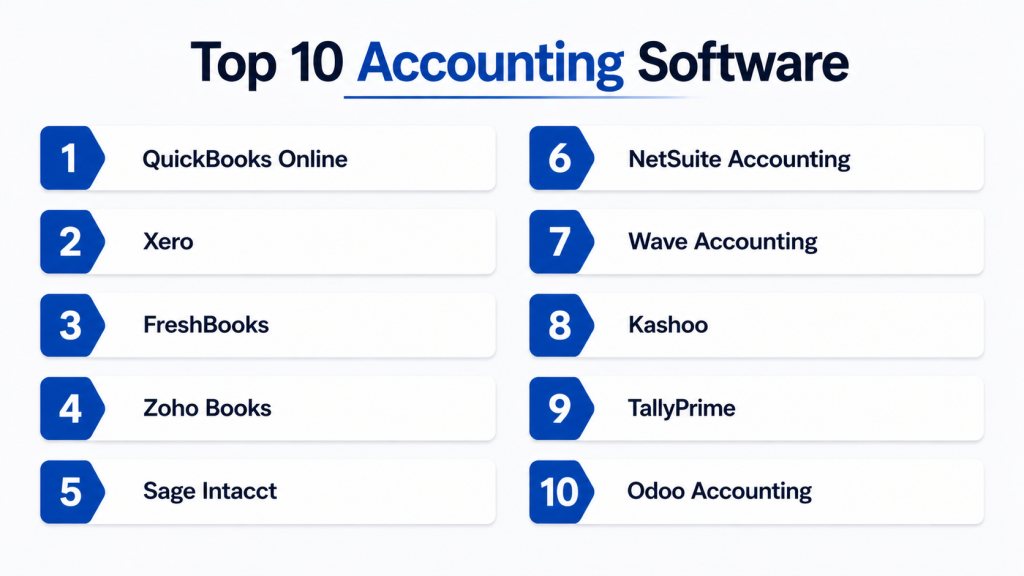
Top 10 Accounting Software
#1 — QuickBooks Online
Short description :
QuickBooks Online is one of the most widely used accounting platforms for small and medium-sized businesses. It provides comprehensive tools for invoicing, expense tracking, and reporting. The platform is easy to use and highly scalable. It integrates with numerous third-party applications. QuickBooks is ideal for businesses seeking an all-in-one accounting solution. It supports growth and automation.
Key Features
- Invoicing and billing
- Expense tracking
- Financial reporting
- Bank reconciliation
- Payroll support
Pros
- User-friendly
- Strong ecosystem
Cons
- Pricing can increase
- Limited advanced features
Platforms / Deployment
Web / Mobile / Cloud
Security & Compliance
SSO, encryption
Integrations & Ecosystem
- Banking systems
- Payment gateways
- Business apps
Support & Community
Strong community and support
#2 — Xero
Short description :
Xero is a cloud-based accounting platform designed for SMBs. It provides real-time financial tracking and reporting. The platform is known for its clean interface and usability. It integrates with many business tools. Xero is ideal for growing businesses. It supports multi-currency transactions.
Key Features
- Real-time tracking
- Invoicing
- Bank reconciliation
- Reporting
- Multi-currency support
Pros
- Easy to use
- Strong integrations
Cons
- Limited payroll features
- Pricing varies
Platforms / Deployment
Cloud
Security & Compliance
Encryption
Integrations & Ecosystem
- Banking systems
- Apps marketplace
Support & Community
Good support
#3 — FreshBooks
Short description :
FreshBooks is an accounting tool focused on freelancers and small businesses. It offers invoicing, expense tracking, and time tracking features. The platform is simple and easy to use. It is ideal for service-based businesses. FreshBooks helps streamline billing processes. It provides reporting and automation.
Key Features
- Invoicing
- Expense tracking
- Time tracking
- Reporting
- Automation
Pros
- Simple interface
- Great for freelancers
Cons
- Limited scalability
- Fewer advanced features
Platforms / Deployment
Cloud
Security & Compliance
Encryption
Integrations & Ecosystem
- Payment tools
- Business apps
Support & Community
Reliable support
#4 — Zoho Books
Short description :
Zoho Books is a cloud-based accounting platform for small and mid-sized businesses. It provides invoicing, expense tracking, and reporting features. The platform integrates with Zoho ecosystem tools. It is affordable and easy to use. Zoho Books supports automation. It helps manage finances efficiently.
Key Features
- Invoicing
- Expense tracking
- Reporting
- Automation
- Integration
Pros
- Affordable
- Easy to use
Cons
- Limited enterprise features
- Depends on Zoho ecosystem
Platforms / Deployment
Cloud
Security & Compliance
Encryption
Integrations & Ecosystem
- Zoho apps
- Banking systems
Support & Community
Strong SMB support
#5 — Sage Intacct
Short description :
Sage Intacct is a cloud-based accounting solution for mid-market and enterprise businesses. It provides advanced financial management and reporting capabilities. The platform supports automation and scalability. It integrates with ERP systems. Sage Intacct is ideal for growing organizations. It offers strong compliance features.
Key Features
- Financial management
- Reporting
- Automation
- Integration
- Compliance
Pros
- Scalable
- Strong reporting
Cons
- Complex
- Expensive
Platforms / Deployment
Cloud
Security & Compliance
SSO, RBAC
Integrations & Ecosystem
- ERP systems
- Finance tools
Support & Community
Enterprise support
#6 — NetSuite Accounting
Short description :
NetSuite Accounting is part of the NetSuite ERP platform. It provides comprehensive accounting and financial management features. The platform offers real-time reporting and automation. It is ideal for mid-market and enterprise companies. NetSuite ensures scalability. It integrates with business systems.
Key Features
- Financial management
- Reporting
- Automation
- Integration
- Real-time insights
Pros
- Scalable
- Strong integration
Cons
- Expensive
- Requires NetSuite ecosystem
Platforms / Deployment
Cloud
Security & Compliance
RBAC, encryption
Integrations & Ecosystem
- ERP systems
- CRM tools
Support & Community
Enterprise support
#7 — Wave Accounting
Short description :
Wave Accounting is a free accounting platform for small businesses and freelancers. It provides invoicing, expense tracking, and reporting. The platform is easy to use and accessible. It is ideal for startups. Wave helps manage finances efficiently. It offers basic features for free.
Key Features
- Invoicing
- Expense tracking
- Reporting
- Automation
- Integration
Pros
- Free to use
- Easy setup
Cons
- Limited features
- Not scalable
Platforms / Deployment
Cloud
Security & Compliance
Encryption
Integrations & Ecosystem
- Payment tools
- Banking systems
Support & Community
Good SMB support
#8 — Kashoo
Short description :
Kashoo is a simple accounting software for small businesses. It offers invoicing, expense tracking, and reporting. The platform is easy to use and affordable. It is ideal for freelancers and small teams. Kashoo helps streamline accounting. It provides automation features.
Key Features
- Invoicing
- Expense tracking
- Reporting
- Automation
- Integration
Pros
- Simple
- Affordable
Cons
- Limited features
- Not for large businesses
Platforms / Deployment
Cloud
Security & Compliance
Encryption
Integrations & Ecosystem
- Banking systems
- Apps
Support & Community
Reliable support
#9 — TallyPrime
Short description :
TallyPrime is a popular accounting software used in India and other regions. It provides comprehensive accounting and compliance features. The platform supports GST and tax management. It is widely used by SMBs. TallyPrime offers strong local compliance. It helps manage finances effectively.
Key Features
- Accounting
- GST compliance
- Reporting
- Inventory management
- Automation
Pros
- Strong compliance
- Widely used
Cons
- Limited cloud features
- Traditional UI
Platforms / Deployment
Windows / On-prem
Security & Compliance
RBAC, encryption
Integrations & Ecosystem
- Local tools
- Accounting systems
Support & Community
Strong regional support
#10 — Odoo Accounting
Short description :
Odoo Accounting is part of the Odoo ERP suite. It offers flexible accounting features and automation. The platform supports invoicing, reporting, and integration. It is suitable for SMBs and enterprises. Odoo is highly customizable. It helps streamline financial operations.
Key Features
- Accounting
- Reporting
- Automation
- Integration
- Customization
Pros
- Flexible
- Scalable
Cons
- Requires setup
- Customization needed
Platforms / Deployment
Cloud / On-prem
Security & Compliance
RBAC, encryption
Integrations & Ecosystem
- Odoo apps
- ERP modules
Support & Community
Large community
Comparison Table (Top 10)
| Tool Name | Best For | Platform(s) | Deployment | Standout Feature | Rating |
|---|---|---|---|---|---|
| QuickBooks | SMB | Web/Mobile | Cloud | Ease of use | N/A |
| Xero | SMB | Web | Cloud | Real-time tracking | N/A |
| FreshBooks | Freelancers | Web | Cloud | Simplicity | N/A |
| Zoho Books | SMB | Web | Cloud | Affordability | N/A |
| Sage Intacct | Enterprise | Web | Cloud | Reporting | N/A |
| NetSuite | Enterprise | Web | Cloud | ERP integration | N/A |
| Wave | SMB | Web | Cloud | Free plan | N/A |
| Kashoo | SMB | Web | Cloud | Simplicity | N/A |
| TallyPrime | SMB | Windows | On-prem | Compliance | N/A |
| Odoo | All sizes | Web | Hybrid | Customization | N/A |
Evaluation & Scoring of Accounting Software
| Tool | Core | Ease | Integrations | Security | Performance | Support | Value | Total |
|---|---|---|---|---|---|---|---|---|
| QuickBooks | 8 | 9 | 8 | 8 | 8 | 8 | 8 | 8.2 |
| Xero | 8 | 9 | 8 | 8 | 8 | 8 | 8 | 8.2 |
| FreshBooks | 7 | 9 | 7 | 7 | 7 | 7 | 8 | 7.6 |
| Zoho | 7 | 9 | 7 | 7 | 7 | 7 | 9 | 7.7 |
| Sage | 9 | 6 | 9 | 9 | 9 | 9 | 6 | 8.4 |
| NetSuite | 9 | 6 | 9 | 9 | 9 | 9 | 6 | 8.4 |
| Wave | 6 | 9 | 6 | 7 | 7 | 7 | 9 | 7.3 |
| Kashoo | 6 | 8 | 6 | 7 | 7 | 7 | 8 | 7.0 |
| Tally | 8 | 7 | 7 | 8 | 8 | 8 | 8 | 7.9 |
| Odoo | 8 | 7 | 8 | 8 | 8 | 8 | 8 | 7.9 |
How to interpret scores:
These scores provide a relative comparison across key criteria such as features, usability, and value. Enterprise tools score higher in scalability and performance, while SMB tools perform better in ease of use and affordability. These are comparative insights, not absolute benchmarks.
Which Accounting Software Is Right for You?
Solo / Freelancer
FreshBooks or Wave is sufficient.
SMB
QuickBooks, Xero, and Zoho Books are ideal.
Mid-Market
NetSuite and Odoo provide balanced features.
Enterprise
Sage Intacct and NetSuite are best.
Budget vs Premium
Budget: Wave, Zoho
Premium: Sage, NetSuite
Feature Depth vs Ease of Use
Deep: NetSuite, Sage
Easy: QuickBooks, FreshBooks
Integrations & Scalability
Strong: NetSuite, Xero
Scalable: Sage, Odoo
Security & Compliance Needs
High: Sage, NetSuite
Moderate: QuickBooks, Zoho
Frequently Asked Questions (FAQs)
1. What is accounting software?
Accounting software helps businesses manage financial transactions and records. It automates bookkeeping processes and reduces errors. These tools provide reports and insights. They improve efficiency and accuracy. Businesses use them for financial management.
2. How much does accounting software cost?
Pricing varies depending on features and scale. Cloud tools use subscription pricing. SMB tools are affordable. Enterprise solutions are expensive. Additional costs may include integrations and customization.
3. Is accounting software necessary?
Yes, it is essential for managing finances efficiently. It automates processes and improves accuracy. It helps with compliance and reporting. Businesses benefit from using it. Manual methods are less efficient.
4. How long does implementation take?
Cloud tools can be deployed quickly. Enterprise systems take longer. Integration complexity affects timelines. Planning helps reduce delays. Testing ensures smooth deployment.
5. What integrations are important?
Important integrations include banking, ERP, and payment systems. APIs enable flexibility. Integration improves efficiency. It reduces manual work. Compatibility is important.
6. Can accounting software help with taxes?
Yes, many tools support tax calculations and reporting. They automate compliance tasks. This reduces errors. It helps businesses stay compliant. It simplifies tax processes.
7. What security features should it have?
Accounting software should include encryption and RBAC. Authentication mechanisms improve security. Data protection is critical. Compliance is important. Secure systems ensure reliability.
8. Can you switch accounting software later?
Switching is possible but complex. It involves data migration and integration changes. Costs may be high. Planning reduces risks. Choose scalable tools initially.
9. What are alternatives?
Alternatives include spreadsheets or manual bookkeeping. These lack automation. Accounting software improves efficiency. It provides better insights. It is more scalable.
10. Which is best for small businesses?
QuickBooks, Xero, and Zoho Books are popular choices. They are easy to use and affordable. They provide essential features. They scale with growth. They are ideal for SMBs.
Conclusion
Accounting Software has become a critical component for businesses aiming to manage their financial operations efficiently. From enterprise-grade solutions like NetSuite and Sage Intacct to SMB-friendly tools like QuickBooks and Zoho Books, there are options available for every business size and complexity. These platforms help automate bookkeeping, improve financial visibility, and ensure compliance with regulations.
Choosing the right accounting software depends on your business needs, budget, and growth plans. Instead of focusing only on features, consider ease of use, scalability, and integration capabilities. A practical approach is to shortlist a few tools, test them in real scenarios, and validate how well they fit into your workflow. This ensures long-term success and better financial management.
