Introduction
Order Management Systems (OMS) are platforms that help businesses track, manage, and fulfill customer orders across multiple channels. From order capture to delivery and returns, OMS ensures that every step of the order lifecycle is streamlined, accurate, and efficient.
In today’s omnichannel commerce environment, OMS plays a critical role in connecting eCommerce platforms, warehouses, logistics providers, and customer service teams. With increasing demand for real-time visibility, faster delivery, and personalized experiences, modern OMS solutions now include automation, AI-driven routing, and advanced analytics.
Common use cases include:
- Managing multi-channel orders from eCommerce, marketplaces, and retail stores
- Automating order routing and fulfillment workflows
- Tracking inventory and order status in real-time
- Handling returns, exchanges, and refunds
- Improving customer experience with accurate delivery updates
Key evaluation criteria:
- Order processing and workflow automation
- Multi-channel integration capabilities
- Inventory and fulfillment management
- Scalability and performance
- Ease of use and onboarding
- Security and access control
- Reporting and analytics
- Integration ecosystem
- Deployment flexibility
Best for: Retailers, eCommerce businesses, logistics companies, wholesalers, and enterprises handling high order volumes.
Not ideal for: Very small businesses with low order volume or those managing orders manually using spreadsheets or basic tools.
Key Trends in Order Management Systems (OMS)
- AI-powered order routing for optimized fulfillment
- Real-time inventory visibility across channels
- Cloud-native OMS platforms replacing legacy systems
- Integration with last-mile delivery solutions
- Automation of returns and reverse logistics
- Headless commerce and API-first architectures
- Advanced analytics and demand forecasting
- Enhanced security with Zero Trust and RBAC models
- Integration with CRM and customer experience tools
- Subscription and usage-based pricing models
How We Evaluated Order Management Systems (OMS)
- Assessed market adoption and industry usage
- Evaluated core OMS capabilities and feature depth
- Reviewed performance, reliability, and scalability
- Analyzed security features and compliance readiness
- Considered integration flexibility with commerce ecosystems
- Measured ease of implementation and usability
- Evaluated vendor support and ecosystem strength
- Reviewed fit across SMB, mid-market, and enterprise segments
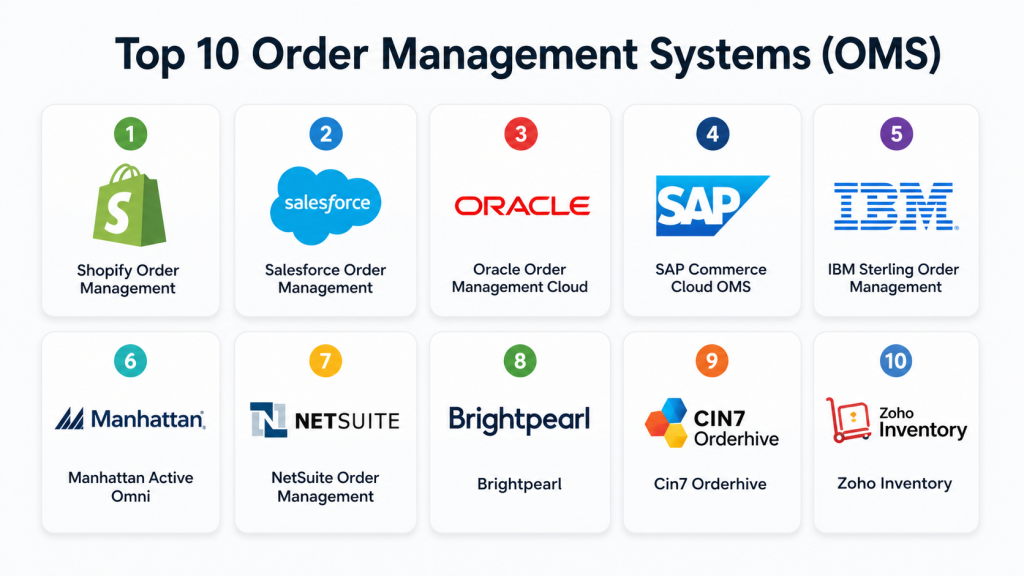
Top 10 Order Management Systems (OMS)
#1 — Shopify Order Management
Short description :
Shopify OMS is a built-in order management solution designed for eCommerce businesses operating on the Shopify platform. It provides centralized order tracking, inventory management, and fulfillment workflows. The system is highly intuitive and integrates seamlessly with Shopify stores and apps. It is ideal for SMBs and growing online businesses. Shopify OMS supports multi-channel selling across marketplaces and social platforms. It enables fast setup and easy scaling.
Key Features
- Centralized order dashboard
- Multi-channel order processing
- Inventory tracking
- Automated fulfillment workflows
- Returns and refunds management
Pros
- Easy to use and deploy
- Strong eCommerce ecosystem
Cons
- Limited outside Shopify ecosystem
- Less suitable for complex enterprise needs
Platforms / Deployment
Web / Cloud
Security & Compliance
SSO, encryption, RBAC
Integrations & Ecosystem
Shopify OMS integrates with payment gateways, shipping providers, and apps.
- Shopify Apps
- Payment gateways
- Logistics tools
Support & Community
Strong community and extensive documentation
#2 — Salesforce Order Management
Short description :
Salesforce OMS is an enterprise-grade solution designed to unify order data across sales, service, and commerce. It enables real-time visibility into orders and inventory. The platform integrates deeply with Salesforce CRM and Commerce Cloud. It is ideal for businesses seeking a customer-centric order management approach. Salesforce OMS supports automation and AI-driven insights. It is best suited for enterprises and large-scale operations.
Key Features
- Unified order lifecycle management
- Real-time inventory visibility
- AI-powered insights
- Omnichannel support
- Workflow automation
Pros
- Strong CRM integration
- Scalable enterprise solution
Cons
- Higher cost
- Requires Salesforce ecosystem
Platforms / Deployment
Cloud
Security & Compliance
SSO, MFA, encryption
Integrations & Ecosystem
- Salesforce CRM
- Commerce Cloud
- ERP systems
Support & Community
Enterprise-level support with strong ecosystem
#3 — Oracle Order Management Cloud
Short description :
Oracle OMS is part of Oracle’s cloud suite, offering robust order orchestration and fulfillment capabilities. It supports complex supply chain operations and global order processing. The platform provides real-time visibility and advanced analytics. It is widely used by large enterprises. Oracle OMS excels in scalability and compliance. It integrates well with Oracle ERP systems.
Key Features
- Order orchestration
- Global fulfillment support
- Inventory visibility
- Analytics and reporting
- Workflow automation
Pros
- Strong enterprise capabilities
- Scalable architecture
Cons
- Complex setup
- Requires Oracle ecosystem
Platforms / Deployment
Cloud
Security & Compliance
RBAC, encryption, audit logs
Integrations & Ecosystem
- Oracle ERP
- Supply chain tools
Support & Community
Strong enterprise support
#4 — SAP Commerce Cloud OMS
Short description :
SAP Commerce Cloud OMS provides end-to-end order management integrated with SAP’s commerce and ERP systems. It supports omnichannel commerce and complex order workflows. The platform enables real-time inventory and fulfillment tracking. It is ideal for large enterprises with SAP infrastructure. SAP OMS focuses on scalability and compliance. It is widely used in global retail operations.
Key Features
- Omnichannel order management
- Real-time inventory tracking
- Integration with SAP ERP
- Workflow automation
- Returns management
Pros
- Strong SAP integration
- Enterprise scalability
Cons
- Complex implementation
- High cost
Platforms / Deployment
Cloud
Security & Compliance
SSO, RBAC, compliance tools
Integrations & Ecosystem
- SAP ERP
- Commerce tools
Support & Community
Enterprise-grade support
#5 — IBM Sterling Order Management
Short description :
IBM Sterling OMS is a powerful solution designed for complex supply chain environments. It offers advanced order orchestration and inventory visibility. The platform supports AI-driven decision-making. It is ideal for enterprises handling high-volume orders. Sterling OMS enables seamless omnichannel experiences. It also provides strong analytics capabilities.
Key Features
- Order orchestration
- Inventory visibility
- AI-driven insights
- Omnichannel support
- Analytics
Pros
- Strong supply chain features
- Advanced analytics
Cons
- Complex setup
- Requires expertise
Platforms / Deployment
Cloud / Hybrid
Security & Compliance
RBAC, encryption
Integrations & Ecosystem
- ERP systems
- Logistics platforms
Support & Community
Enterprise support
#6 — Manhattan Active Omni
Short description :
Manhattan Active Omni is a cloud-native OMS designed for unified commerce. It combines order management, inventory, and fulfillment in one platform. The system supports real-time visibility and advanced order routing. It is ideal for retail and supply chain operations. Manhattan OMS is known for its scalability and flexibility. It supports modern commerce environments.
Key Features
- Unified commerce platform
- Real-time inventory
- Order routing
- Fulfillment optimization
- Returns management
Pros
- Cloud-native design
- Strong retail capabilities
Cons
- Premium pricing
- Requires configuration
Platforms / Deployment
Cloud
Security & Compliance
Encryption, RBAC
Integrations & Ecosystem
- Retail systems
- ERP platforms
Support & Community
Strong enterprise support
#7 — NetSuite Order Management
Short description :
NetSuite OMS is part of Oracle NetSuite’s ERP suite, providing integrated order management capabilities. It supports order processing, inventory management, and fulfillment. The platform is suitable for growing businesses. It provides real-time visibility into orders and financial data. NetSuite OMS is known for its ease of use. It is widely used by SMBs and mid-market companies.
Key Features
- Order processing
- Inventory management
- Financial integration
- Reporting
- Workflow automation
Pros
- Easy integration with ERP
- Scalable for growth
Cons
- Limited customization
- Dependent on NetSuite ecosystem
Platforms / Deployment
Cloud
Security & Compliance
SSO, encryption
Integrations & Ecosystem
- NetSuite ERP
- CRM tools
Support & Community
Good support and documentation
#8 — Brightpearl
Short description :
Brightpearl is an OMS designed for retail and wholesale businesses. It focuses on automation and operational efficiency. The platform supports order processing, inventory management, and accounting integration. It is ideal for mid-sized retailers. Brightpearl offers strong reporting capabilities. It helps streamline operations across channels.
Key Features
- Order automation
- Inventory management
- Accounting integration
- Reporting
- Multi-channel support
Pros
- Strong automation
- Good for retail operations
Cons
- Limited enterprise features
- Learning curve
Platforms / Deployment
Cloud
Security & Compliance
Encryption, RBAC
Integrations & Ecosystem
- eCommerce platforms
- Accounting tools
Support & Community
Reliable support
#9 — Cin7 Orderhive
Short description :
Cin7 Orderhive is a cloud-based OMS designed for inventory-driven businesses. It provides order management, shipping automation, and warehouse management. The platform is easy to use and integrates with multiple sales channels. It is ideal for SMBs. Orderhive offers strong automation features. It helps streamline fulfillment operations.
Key Features
- Order and inventory management
- Shipping automation
- Warehouse management
- Multi-channel support
- Reporting
Pros
- Affordable solution
- Easy to use
Cons
- Limited advanced features
- Not ideal for large enterprises
Platforms / Deployment
Cloud
Security & Compliance
Encryption
Integrations & Ecosystem
- Marketplaces
- Shipping tools
Support & Community
Good SMB support
#10 — Zoho Inventory (OMS)
Short description :
Zoho Inventory provides order management capabilities as part of Zoho’s business suite. It supports order tracking, inventory control, and shipping integration. The platform is ideal for small businesses and startups. It offers a user-friendly interface and quick setup. Zoho Inventory integrates with Zoho ecosystem tools. It is cost-effective and scalable for smaller operations.
Key Features
- Order tracking
- Inventory management
- Shipping integration
- Multi-channel selling
- Reporting
Pros
- Affordable pricing
- Easy setup
Cons
- Limited enterprise features
- Basic functionality
Platforms / Deployment
Cloud
Security & Compliance
SSO, encryption
Integrations & Ecosystem
- Zoho apps
- Payment gateways
Support & Community
Strong SMB support
Comparison Table (Top 10)
| Tool Name | Best For | Platform(s) Supported | Deployment | Standout Feature | Public Rating |
|---|---|---|---|---|---|
| Shopify OMS | SMB eCommerce | Web | Cloud | Ease of use | N/A |
| Salesforce OMS | Enterprise | Web | Cloud | CRM integration | N/A |
| Oracle OMS | Large enterprises | Web | Cloud | Order orchestration | N/A |
| SAP OMS | SAP users | Web | Cloud | ERP integration | N/A |
| IBM Sterling | Supply chain | Web | Hybrid | AI insights | N/A |
| Manhattan Active Omni | Retail | Web | Cloud | Unified commerce | N/A |
| NetSuite OMS | Mid-market | Web | Cloud | ERP integration | N/A |
| Brightpearl | Retail SMB | Web | Cloud | Automation | N/A |
| Cin7 Orderhive | SMB | Web | Cloud | Inventory focus | N/A |
| Zoho Inventory | Small business | Web | Cloud | Affordability | N/A |
Evaluation & Scoring of Batch Processing Frameworks
| Tool | Core | Ease | Integrations | Security | Performance | Support | Value | Total |
|---|---|---|---|---|---|---|---|---|
| Shopify | 8 | 9 | 8 | 7 | 8 | 8 | 9 | 8.3 |
| Salesforce | 9 | 7 | 9 | 9 | 9 | 9 | 7 | 8.6 |
| Oracle | 9 | 6 | 9 | 9 | 9 | 9 | 6 | 8.4 |
| SAP | 9 | 6 | 9 | 9 | 9 | 9 | 6 | 8.4 |
| IBM | 9 | 6 | 8 | 9 | 9 | 9 | 6 | 8.3 |
| Manhattan | 8 | 7 | 8 | 8 | 8 | 8 | 7 | 7.9 |
| NetSuite | 8 | 8 | 8 | 8 | 8 | 8 | 8 | 8.0 |
| Brightpearl | 7 | 8 | 7 | 7 | 7 | 7 | 8 | 7.5 |
| Cin7 | 7 | 8 | 7 | 7 | 7 | 7 | 8 | 7.5 |
| Zoho | 6 | 9 | 7 | 7 | 7 | 7 | 9 | 7.6 |
How to interpret scores:
These scores provide a comparative view across tools based on weighted criteria. Higher scores indicate better balance across features, usability, and value. Enterprise tools score high on performance and security, while SMB tools excel in ease and affordability. Use these scores as guidance, not absolute benchmarks.
Which Order Management System (OMS) Is Right for You?
Solo / Freelancer
Zoho Inventory or Shopify OMS is sufficient for basic needs.
SMB
Cin7, Brightpearl, and Zoho Inventory offer affordable and easy solutions.
Mid-Market
NetSuite and Manhattan Active Omni provide scalability and features.
Enterprise
Salesforce OMS, SAP, and Oracle OMS offer full capabilities.
Budget vs Premium
- Budget: Zoho, Cin7
- Premium: SAP, Oracle
Feature Depth vs Ease of Use
- Deep features: Oracle, SAP
- Easy to use: Shopify, Zoho
Integrations & Scalability
- Strong integrations: Salesforce, NetSuite
- Scalable: SAP, Oracle
Security & Compliance Needs
- High compliance: SAP, Oracle
- Moderate: Shopify, Zoho
Frequently Asked Questions (FAQs)
1. What is an OMS system?
An OMS system manages the complete order lifecycle, from order placement to delivery and returns. It centralizes all order-related data, helping businesses track and process orders efficiently. It reduces manual work and errors through automation. OMS also improves customer experience with real-time updates. It is essential for businesses handling multiple sales channels.
2. How much does OMS software cost?
OMS pricing varies based on features, scale, and deployment model. Cloud-based systems typically follow subscription pricing, while enterprise solutions may require higher upfront investment. SMB-focused tools are generally more affordable. Additional costs may include integrations and customization. Always evaluate the total cost of ownership before selecting a tool.
3. Is OMS necessary for small businesses?
OMS is not always required for very small businesses with limited order volume. However, as the number of orders increases, managing them manually becomes inefficient. OMS helps automate workflows and improve accuracy. It also enhances customer experience through better tracking. Small businesses planning to scale can benefit from adopting OMS early.
4. How long does OMS implementation take?
Implementation time depends on the complexity of the system and business requirements. Cloud-based OMS can be deployed within weeks, while enterprise systems may take several months. Integration with ERP, CRM, and logistics systems can extend timelines. Proper planning and vendor support can speed up implementation. Testing is also an important step before full rollout.
5. What integrations are important for OMS?
Important integrations include eCommerce platforms, ERP systems, CRM tools, and logistics providers. These integrations ensure seamless data flow across systems. APIs and connectors play a key role in enabling flexibility. Strong integration capabilities improve efficiency and reduce manual errors. Always verify compatibility with your existing tech stack.
6. Can OMS improve delivery speed?
Yes, OMS improves delivery speed by optimizing order routing and fulfillment processes. It automates decision-making based on inventory availability and location. Real-time tracking ensures faster processing and fewer delays. It also reduces manual intervention in workflows. Overall, it helps businesses deliver orders more efficiently and reliably.
7. What security features should an OMS have?
An OMS should include role-based access control, encryption, and audit logs. Authentication mechanisms like SSO and MFA add an extra layer of security. Data protection is critical, especially for customer information. Compliance with regulations is also important. Choosing a secure OMS ensures safe and reliable operations.
8. Can OMS handle returns and refunds?
Most OMS platforms include built-in returns and refund management features. These systems automate reverse logistics and track returned items. They simplify refund processing and improve accuracy. Efficient return handling enhances customer satisfaction. It also reduces operational overhead for businesses.
9. Can businesses switch OMS later?
Switching OMS is possible but can be complex and costly. It involves data migration, integration adjustments, and employee retraining. Poor planning can lead to disruptions. Choosing a scalable OMS initially helps avoid frequent changes. Evaluate long-term needs before selecting a system.
10. What are alternatives to OMS?
Alternatives include ERP systems, inventory tools, and manual tracking methods like spreadsheets. However, these options lack full OMS capabilities. They may not support automation or multi-channel operations effectively. OMS provides a centralized and scalable solution. It is generally the better choice for growing businesses.
Conclusion
Order Management Systems have become a foundational component for businesses operating in modern, multi-channel environments. From enterprise platforms like Salesforce and SAP to SMB-friendly tools like Zoho Inventory and Cin7, the OMS landscape offers a wide range of solutions tailored to different operational needs. The right OMS can significantly improve order accuracy, fulfillment speed, and overall customer satisfaction.
However, selecting the best OMS depends on your business size, order complexity, and integration requirements. Instead of focusing only on features, evaluate usability, scalability, and ecosystem compatibility. A practical approach is to shortlist a few tools, run pilot implementations, and validate how well they integrate with your existing systems. This ensures you choose an OMS that truly supports long-term growth and operational efficiency.
