Introduction
Recommendation System Toolkits are platforms and libraries that help developers build systems capable of suggesting products, content, or actions based on user behavior, preferences, and data patterns. These tools power personalized experiences across industries by leveraging machine learning, collaborative filtering, content-based filtering, and deep learning models.
In today’s digital ecosystem, recommendation systems are essential for e-commerce, streaming platforms, social media, fintech, and SaaS products. They drive engagement, increase conversions, and improve user satisfaction. Modern toolkits also integrate with Identity Management, Cybersecurity frameworks, Zero Trust architectures, and Access Control systems, ensuring secure and compliant personalization at scale.
Real-world use cases include:
- Product recommendations in e-commerce
- Content suggestions in streaming platforms
- Personalized feeds in social media
- Fraud detection and risk-based recommendations
- Marketing personalization and targeting
What buyers should evaluate:
- Algorithm support (collaborative, content-based, hybrid)
- Scalability and performance
- Data integration capabilities
- Real-time recommendation support
- Customization and flexibility
- Ease of implementation
- Security and compliance features
- Community and ecosystem support
Best for: Data scientists, ML engineers, product teams, and enterprises building personalized user experiences.
Not ideal for: Small-scale applications without personalization needs.
Key Trends in Recommendation System Toolkits
- Deep learning-based recommendation models gaining adoption
- Real-time personalization becoming standard
- Integration with streaming data platforms
- Hybrid recommendation systems combining multiple techniques
- AI-driven explainability and transparency features
- Privacy-first recommendation systems emerging
- Cloud-native recommendation platforms growing rapidly
- Graph-based recommendations improving accuracy
- Context-aware and behavioral recommendations expanding
- Integration with generative AI for dynamic recommendations
How We Recommendation System Toolkits (Methodology)
We evaluated tools based on:
- Algorithm diversity and flexibility
- Performance and scalability
- Integration capabilities
- Ease of use and developer experience
- Security and compliance readiness
- Community support and adoption
- Real-time processing capabilities
- Enterprise readiness
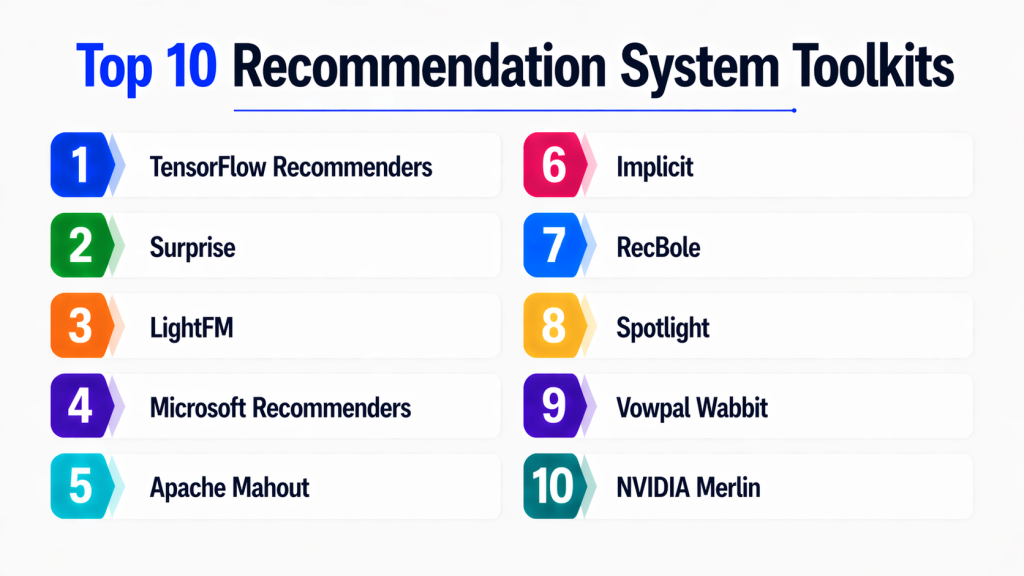
Top 10 Recommendation System Toolkits
#1 — TensorFlow Recommenders
Short description :
TensorFlow Recommenders is a powerful library built on TensorFlow for creating recommendation systems. It supports deep learning models and scalable architectures. Ideal for production-grade ML systems. Widely used in enterprise applications.
Key Features
- Deep learning models
- Scalable architecture
- Integration with TensorFlow
- Flexible pipelines
- Training and evaluation tools
Pros
- Highly scalable
- Strong ecosystem
Cons
- Learning curve
- Requires ML expertise
Platforms / Deployment
Cloud / Local
Security & Compliance
Depends on deployment
Integrations & Ecosystem
- TensorFlow ecosystem
- Data pipelines
Support & Community
Large developer community.
#2 — Surprise
Short Descriptions
Surprise is a Python library focused on collaborative filtering techniques for recommendation systems. It is simple and beginner-friendly, making it ideal for learning and experimentation. Provides built-in datasets and evaluation tools. Best suited for small-scale or academic projects. Limited scalability for production systems. Great starting point for beginners.
Key Features
- Collaborative filtering
- Easy API
- Model evaluation
Pros
- Easy to use
- Beginner-friendly
Cons
- Limited scalability
- Not production-ready
Platforms / Deployment
Local
Security & Compliance
Not publicly stated
Integrations & Ecosystem
- Python ecosystem
Support & Community
Active community.
#3 — LightFM
Short Descriptions
LightFM is a hybrid recommendation library that combines collaborative and content-based filtering. It is designed for efficiency and scalability with large datasets. Supports flexible feature representations. Ideal for real-world recommendation use cases. Provides a balance between simplicity and performance. Requires tuning for optimal results..
Key Features
- Hybrid models
- Scalable training
- Flexible features
Pros
- Flexible
- Efficient
Cons
- Limited deep learning
- Requires tuning
Platforms / Deployment
Local / Cloud
Security & Compliance
Not publicly stated
Integrations & Ecosystem
- Python tools
Support & Community
Active support.
#4 — Microsoft Recommenders
Short description :
Microsoft Recommenders is a collection of tools and best practices for building recommendation systems. It supports multiple algorithms and real-world implementations. Designed for enterprise and research use cases. Integrates well with cloud-based environments. Offers scalable and flexible architectures. Suitable for production-ready systems.
Key Features
- Multiple algorithms
- Scalable solutions
- Cloud integration
Pros
- Enterprise-ready
- Flexible
Cons
- Requires setup
- Learning curve
Platforms / Deployment
Cloud / Local
Security & Compliance
Varies
Integrations & Ecosystem
- Azure ecosystem
Support & Community
Strong support.
#5 — Apache Mahout
Short description :
Apache Mahout is a distributed machine learning library for building recommendation systems at scale. It works well with big data ecosystems like Hadoop and Spark. Provides scalable algorithms for large datasets. Ideal for enterprise-level data processing. Requires technical expertise to set up and use. Best suited for big data environments.
Key Features
- Distributed processing
- Scalable algorithms
- Big data support
Pros
- Scalable
- Open-source
Cons
- Complex
- Requires Hadoop ecosystem
Platforms / Deployment
Cloud / On-premise
Security & Compliance
Depends on deployment
Integrations & Ecosystem
- Hadoop
- Spark
Support & Community
Open-source community.
#6 — Implicit
Short description :
Implicit is a fast recommendation toolkit designed for implicit feedback datasets. It focuses on matrix factorization techniques for efficient computation. Known for high performance and scalability. Ideal for large-scale recommendation systems. Limited feature set compared to full frameworks. Developer-focused tool.
Key Features
- Matrix factorization
- Fast processing
- Implicit data support
Pros
- High performance
- Efficient
Cons
- Limited features
- Developer-focused
Platforms / Deployment
Local
Security & Compliance
Not publicly stated
Integrations & Ecosystem
- Python tools
Support & Community
Growing community.
#7 — RecBole
Short description :
RecBole is a unified recommendation system library supporting a wide range of algorithms. It is designed for research and benchmarking purposes. Offers flexibility in experimenting with models. Ideal for academic and experimental use cases. Not always optimized for production environments. Strong support for evaluation.
Key Features
- Multiple algorithms
- Benchmarking tools
- Flexible design
Pros
- Comprehensive
- Research-focused
Cons
- Complex
- Limited production use
Platforms / Deployment
Local / Cloud
Security & Compliance
Not publicly stated
Integrations & Ecosystem
- ML frameworks
Support & Community
Research community.
#8 — Spotlight
Short description :
Spotlight is a deep learning-based recommendation system toolkit built on PyTorch. It supports neural network-based recommendation models. Provides flexibility for modern AI workflows. Suitable for developers working with deep learning. Smaller ecosystem compared to larger tools. Requires ML expertise.
Key Features
- Deep learning models
- Flexible architecture
- PyTorch integration
Pros
- Modern approach
- Flexible
Cons
- Smaller ecosystem
- Limited support
Platforms / Deployment
Local
Security & Compliance
Not publicly stated
Integrations & Ecosystem
- PyTorch
Support & Community
Growing support.
#9 — Vowpal Wabbit
Short description :
Vowpal Wabbit is a high-performance machine learning system used for recommendation tasks. It supports online learning and large-scale data processing. Known for speed and efficiency. Suitable for production environments. Complex to configure and use. Best for advanced users.
Key Features
- Fast processing
- Online learning
- Scalable
Pros
- High performance
- Efficient
Cons
- Complex
- Limited usability
Platforms / Deployment
Local / Cloud
Security & Compliance
Not publicly stated
Integrations & Ecosystem
- ML tools
Support & Community
Active community.
#10 — NVIDIA Merlin
Short description :
NVIDIA Merlin is an end-to-end framework for building large-scale recommendation systems using GPU acceleration. It supports deep learning pipelines and real-time inference. Designed for enterprise-grade applications. Delivers high performance for massive datasets. Requires GPU infrastructure. Ideal for high-performance workloads.
- GPU acceleration
- End-to-end pipelines
- Deep learning models
Pros
- High performance
- Scalable
Cons
- Requires GPU
- Complex setup
Platforms / Deployment
Cloud / On-premise
Security & Compliance
Varies
Integrations & Ecosystem
- NVIDIA ecosystem
- ML frameworks
Support & Community
Enterprise and developer support.
Comparison Table (Top 10)
| Tool Name | Best For | Platform(s) | Deployment | Standout Feature | Public Rating |
|---|---|---|---|---|---|
| TensorFlow Rec | Enterprise | Multi | Hybrid | Deep learning | N/A |
| Surprise | Beginners | Local | Local | Simplicity | N/A |
| LightFM | Hybrid | Multi | Hybrid | Flexibility | N/A |
| MS Recommenders | Enterprise | Multi | Hybrid | Variety | N/A |
| Mahout | Big data | Multi | Hybrid | Scalability | N/A |
| Implicit | Performance | Local | Local | Speed | N/A |
| RecBole | Research | Multi | Hybrid | Benchmarking | N/A |
| Spotlight | DL | Local | Local | Neural models | N/A |
| Vowpal Wabbit | Speed | Multi | Hybrid | Online learning | N/A |
| NVIDIA Merlin | Enterprise | Multi | Hybrid | GPU | N/A |
Evaluation & Scoring of Recommendation System Toolkits
| Tool | Core | Ease | Integration | Security | Performance | Support | Value | Total |
|---|---|---|---|---|---|---|---|---|
| TensorFlow Rec | 10 | 7 | 10 | 8 | 10 | 10 | 8 | 9.1 |
| Surprise | 7 | 10 | 6 | 6 | 7 | 8 | 9 | 7.9 |
| LightFM | 8 | 8 | 8 | 7 | 8 | 8 | 8 | 8.0 |
| MS Recommenders | 9 | 7 | 9 | 8 | 9 | 9 | 8 | 8.6 |
| Mahout | 9 | 6 | 8 | 8 | 9 | 8 | 7 | 8.1 |
| Implicit | 8 | 7 | 7 | 6 | 9 | 7 | 8 | 7.8 |
| RecBole | 8 | 7 | 8 | 7 | 8 | 7 | 8 | 7.9 |
| Spotlight | 8 | 7 | 7 | 6 | 8 | 7 | 8 | 7.6 |
| Vowpal | 8 | 6 | 8 | 7 | 9 | 7 | 7 | 7.7 |
| Merlin | 10 | 6 | 9 | 8 | 10 | 9 | 7 | 8.9 |
Which Recommendation Toolkit Is Right for You?
Solo / Freelancer
Use Surprise, Implicit
SMB
Use LightFM, RecBole
Mid-Market
Use TensorFlow Recommenders, MS Recommenders
Enterprise
Use NVIDIA Merlin, Mahout
Budget vs Premium
Budget: Surprise
Premium: NVIDIA Merlin
Feature Depth vs Ease
Depth: TensorFlow Rec
Ease: Surprise
Security & Compliance
Best: Enterprise deployments
Frequently Asked Questions (FAQs)
1. What is a recommendation system toolkit?
A recommendation system toolkit is a library or platform used to build systems that suggest items to users. These tools use algorithms like collaborative filtering and deep learning. They help personalize user experiences. Commonly used in e-commerce and media platforms. They improve engagement and conversions.
2. Why are recommendation systems important?
They enhance user experience by providing personalized suggestions. This increases engagement and retention. Businesses use them to boost sales and conversions. They also help users discover relevant content. They are critical for modern digital platforms.
3. Are these toolkits scalable?
Yes, many modern toolkits support large-scale deployments. Cloud-based and distributed systems enable scalability. Performance depends on architecture. Proper configuration is important. Enterprise tools handle massive datasets efficiently.
4. Are recommendation systems secure?
Security depends on the platform and implementation. Enterprise tools include encryption and access controls. Data privacy must be considered. Compliance varies by tool. Proper governance ensures security.
5. Which toolkit is best for beginners?
Surprise is one of the easiest toolkits for beginners. It has a simple API and clear documentation. Ideal for learning collaborative filtering. Other tools may require more expertise. Start simple and scale gradually.
6. Can recommendation systems work in real-time?
Yes, many modern systems support real-time recommendations. Streaming data platforms enable instant updates. Real-time systems improve user experience. Implementation depends on infrastructure. Performance tuning is important.
7. Are these tools expensive?
Some tools are open-source and free. Enterprise solutions may have costs. Pricing depends on infrastructure and scale. Cloud services charge based on usage. Evaluate total cost carefully.
8. What industries use recommendation systems?
E-commerce, media, finance, and social platforms use them widely. They power personalized experiences. Adoption is growing across industries. They are essential for digital platforms.
9. What are limitations of recommendation systems?
They require large datasets for accuracy. Cold-start problems can occur. Bias in data affects results. Complex systems require expertise. Continuous optimization is needed.
10. How do I choose the right toolkit?
Choose based on your use case and scale. Evaluate features and integrations. Consider ease of use and cost. Test multiple tools before deciding. Align with long-term goals.
Conclusion
Recommendation system toolkits are essential for building personalized digital experiences that drive engagement, retention, and revenue. By leveraging advanced algorithms and scalable architectures, these tools enable organizations to deliver relevant and meaningful suggestions to users across various platforms. As personalization becomes a core expectation, recommendation systems are evolving to support real-time processing, deep learning models, and integration with broader AI ecosystems.
Selecting the right toolkit depends on your technical expertise, data scale, and business objectives. While beginner-friendly tools like Surprise are ideal for learning and small projects, enterprise solutions like TensorFlow Recommenders and NVIDIA Merlin provide the scalability and performance required for large-scale applications. The best approach is to experiment with a few tools, evaluate their performance, and choose the one that aligns with your long-term strategy.
