Introduction
Retrieval-Augmented Generation (RAG) Tools are platforms and frameworks that combine information retrieval with generative AI models to produce more accurate, context-aware, and up-to-date responses. Instead of relying only on pre-trained knowledge, RAG systems fetch relevant data from external sources such as documents, databases, or APIs and use it to generate better outputs.
In the modern AI ecosystem, RAG has become a critical architecture for building reliable AI applications. It helps reduce hallucinations, improves factual accuracy, and enables domain-specific intelligence. From enterprise search to AI copilots, RAG tools are widely used to connect large language models with real-world data.
Common use cases include:
- Enterprise knowledge assistants
- Document search and Q&A systems
- Customer support automation
- Research and data analysis
- AI copilots with contextual awareness
Key evaluation criteria buyers should consider:
- Retrieval accuracy and indexing capabilities
- Integration with LLMs and vector databases
- Context management and memory
- Scalability and performance
- Security and access controls
- Ease of implementation
- Data ingestion and pipeline support
- Ecosystem and community
Best for: AI engineers, developers, enterprises building intelligent assistants and knowledge systems
Not ideal for: Simple chatbot use cases without external data dependency
Key Trends in RAG Tools
- Hybrid search systems: Combining vector and keyword search
- Real-time data retrieval: Dynamic and up-to-date responses
- Multimodal RAG: Supporting text, images, and structured data
- Agentic RAG systems: Integration with AI agents
- Vector database evolution: Improved indexing and search
- Enterprise RAG pipelines: Scalable production systems
- Context optimization: Better prompt and memory handling
- Security-aware RAG: Access control and data governance
Methodology
- Market adoption and usage
- Feature completeness for RAG workflows
- Integration with LLMs and data systems
- Performance and scalability
- Security and governance capabilities
- Ease of use and developer experience
- Community and ecosystem strength
- Value for implementation
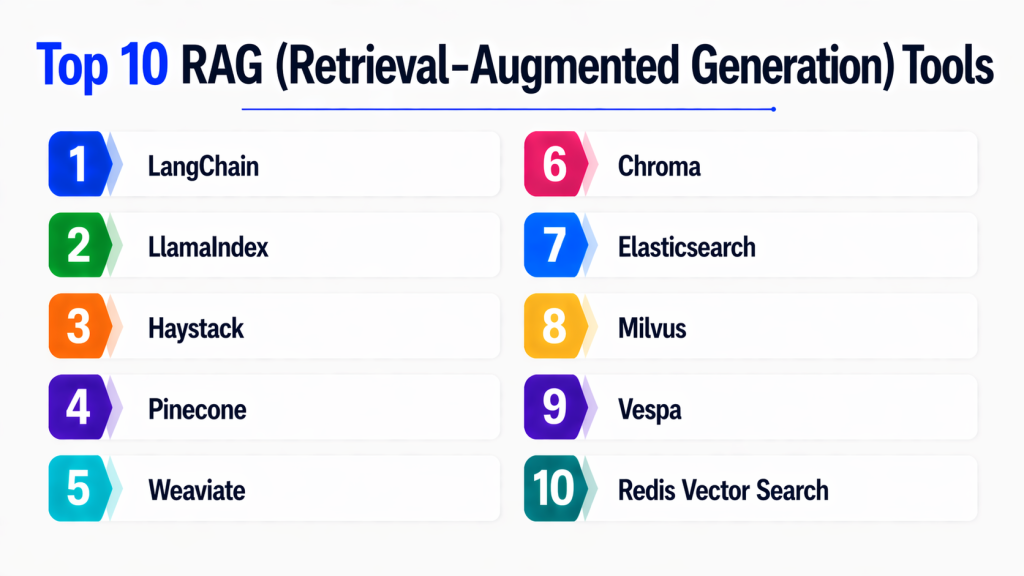
Top 10 RAG (Retrieval-Augmented Generation) Tools
#1 — LangChain
Short description:
LangChain is one of the most widely used frameworks for building RAG applications. It provides tools for connecting LLMs with external data sources, enabling retrieval and generation workflows. The platform supports document loaders, vector stores, and chains for orchestration. It is highly flexible and widely adopted. It is ideal for developers building custom RAG systems.
Key Features
- Document loaders
- Vector store integrations
- Chain orchestration
- Memory support
- LLM integrations
Pros
- Highly flexible
- Large ecosystem
Cons
- Learning curve
- Rapid changes
Platforms / Deployment
- Cloud / Self-hosted
Security & Compliance
- Not publicly stated
#2 — LlamaIndex
Short description:
LlamaIndex is a data framework designed specifically for RAG applications. It enables efficient indexing and retrieval of structured and unstructured data. The platform helps connect LLMs with enterprise data sources. It provides strong context management capabilities. It is ideal for data-driven RAG workflows.
Key Features
- Data indexing
- Context retrieval
- Query pipelines
- LLM integration
- Data connectors
Pros
- Strong data handling
- Optimized for RAG
Cons
- Setup complexity
- Learning curve
Platforms / Deployment
- Cloud / Self-hosted
#3 — Haystack
Short description:
Haystack is an open-source framework for building search and question-answering systems using RAG architecture. It supports pipelines for retrieval and generation. The platform integrates with various data sources. It is widely used in enterprise search applications. It is ideal for scalable RAG systems.
Key Features
- Search pipelines
- Document retrieval
- Question answering
- Data integration
- LLM support
Pros
- Open-source
- Scalable
Cons
- Complex setup
- Limited UI
Platforms / Deployment
- Cloud / Self-hosted
#4 — Pinecone
Short description:
Pinecone is a vector database platform that powers RAG systems by enabling fast and accurate similarity search. It stores embeddings and retrieves relevant data efficiently. The platform is highly scalable and optimized for performance. It integrates with LLM frameworks. It is ideal for production RAG deployments.
Key Features
- Vector search
- Embedding storage
- Real-time retrieval
- Scalability
- API access
Pros
- High performance
- Managed service
Cons
- Cost
- Dependency on cloud
Platforms / Deployment
- Cloud
#5 — Weaviate
Short description:
Weaviate is an open-source vector database that supports semantic search and RAG applications. It enables efficient retrieval of data using embeddings. The platform supports hybrid search and integrates with AI models. It is flexible and scalable. It is ideal for enterprise RAG use cases.
Key Features
- Semantic search
- Hybrid search
- Vector storage
- APIs
- AI integrations
Pros
- Open-source
- Flexible
Cons
- Setup required
- Learning curve
Platforms / Deployment
- Cloud / Self-hosted
#6 — Chroma
Short description:
Chroma is a lightweight vector database designed for building RAG applications. It is easy to set up and integrates with popular frameworks. The platform is developer-friendly. It supports fast prototyping. It is ideal for small to mid-scale RAG systems.
Key Features
- Vector storage
- Fast retrieval
- Simple setup
- Integration support
- Lightweight design
Pros
- Easy to use
- Fast setup
Cons
- Limited scalability
- Fewer enterprise features
Platforms / Deployment
- Self-hosted
#7 — Elasticsearch
Short description:
Elasticsearch is a powerful search engine that supports RAG workflows through hybrid search capabilities. It combines keyword and vector search. The platform is widely used in enterprise environments. It supports large-scale data indexing. It is ideal for complex search systems.
Key Features
- Full-text search
- Vector search
- Indexing
- Scalability
- Analytics
Pros
- Highly scalable
- Mature ecosystem
Cons
- Complex setup
- Resource-intensive
Platforms / Deployment
- Cloud / Self-hosted
#8 — Milvus
Short description:
Milvus is an open-source vector database optimized for similarity search. It supports large-scale data retrieval for RAG systems. The platform is designed for performance and scalability. It integrates with AI workflows. It is ideal for enterprise applications.
Key Features
- Vector search
- High performance
- Scalability
- Embedding support
- APIs
Pros
- Scalable
- Open-source
Cons
- Setup complexity
- Maintenance
Platforms / Deployment
- Cloud / Self-hosted
#9 — Vespa
Short description:
Vespa is a platform for building real-time search and recommendation systems. It supports RAG workflows through fast retrieval and ranking. The platform is designed for large-scale applications. It integrates with AI models. It is ideal for real-time systems.
Key Features
- Real-time search
- Ranking
- Data processing
- Scalability
- APIs
Pros
- High performance
- Real-time capabilities
Cons
- Complex
- Requires expertise
Platforms / Deployment
- Cloud / Self-hosted
#10 — Redis Vector Search
Short description:
Redis Vector Search enables RAG workflows by supporting vector similarity search within Redis. It provides fast and scalable retrieval capabilities. The platform integrates with existing Redis infrastructure. It is ideal for low-latency applications. It is suitable for real-time AI systems.
Key Features
- Vector search
- Low latency
- Scalability
- Integration
- APIs
Pros
- Fast
- Easy integration
Cons
- Limited advanced features
- Memory usage
Platforms / Deployment
- Cloud / Self-hosted
Comparison Table (Top 10 RAG Tools)
| Tool Name | Best For | Platform(s) Supported | Deployment | Standout Feature | Public Rating |
|---|---|---|---|---|---|
| LangChain | Developers | Python | Hybrid | RAG orchestration | N/A |
| LlamaIndex | Data apps | Python | Hybrid | Context retrieval | N/A |
| Haystack | Search systems | Python | Hybrid | QA pipelines | N/A |
| Pinecone | Production RAG | API | Cloud | Vector DB | N/A |
| Weaviate | Semantic search | API | Hybrid | Hybrid search | N/A |
| Chroma | Prototyping | Python | Self-hosted | Lightweight | N/A |
| Elasticsearch | Enterprise search | Multi | Hybrid | Hybrid search | N/A |
| Milvus | Large-scale RAG | API | Hybrid | Scalability | N/A |
| Vespa | Real-time systems | Multi | Hybrid | Ranking | N/A |
| Redis Vector | Low latency | Multi | Hybrid | Speed | N/A |
Evaluation & Scoring of RAG Tools
| Tool Name | Core (25%) | Ease (15%) | Integrations (15%) | Security (10%) | Performance (10%) | Support (10%) | Value (15%) | Weighted Total |
|---|---|---|---|---|---|---|---|---|
| LangChain | 9 | 7 | 9 | 7 | 8 | 9 | 8 | 8.3 |
| LlamaIndex | 8 | 7 | 8 | 7 | 8 | 8 | 8 | 7.9 |
| Haystack | 8 | 6 | 8 | 7 | 8 | 8 | 8 | 7.8 |
| Pinecone | 9 | 8 | 9 | 8 | 9 | 8 | 7 | 8.4 |
| Weaviate | 8 | 7 | 8 | 7 | 8 | 8 | 8 | 7.9 |
| Chroma | 7 | 9 | 7 | 6 | 7 | 7 | 8 | 7.5 |
| Elasticsearch | 9 | 6 | 9 | 8 | 9 | 9 | 7 | 8.4 |
| Milvus | 8 | 6 | 8 | 7 | 9 | 7 | 8 | 7.9 |
| Vespa | 8 | 6 | 7 | 7 | 9 | 7 | 7 | 7.6 |
| Redis Vector | 8 | 8 | 8 | 7 | 9 | 7 | 8 | 8.0 |
Which RAG Tool Is Right for You?
Solo / Freelancer
- Chroma, Redis Vector
SMB
- LlamaIndex, Weaviate
Mid-Market
- LangChain, Haystack
Enterprise
- Pinecone, Elasticsearch, Vespa
Frequently Asked Questions (FAQs)
1. What is RAG in AI?
RAG stands for Retrieval-Augmented Generation, a technique that combines retrieval systems with generative AI models. Instead of relying only on pre-trained knowledge, it fetches relevant data from external sources. This improves the accuracy and relevance of responses. It is widely used in modern AI systems. It helps create context-aware and reliable outputs.
2. Why is RAG important for AI systems?
RAG improves the reliability of AI-generated content by grounding responses in real data. It reduces hallucinations and enhances factual correctness. It allows AI models to stay updated with dynamic data sources. It is especially useful for enterprise applications. It ensures better decision-making and trust.
3. Who should use RAG tools?
RAG tools are best suited for developers, AI engineers, and organizations building intelligent applications. They are useful for enterprises handling large datasets. Teams building chatbots, copilots, and search systems benefit the most. It is ideal for knowledge-driven workflows. Adoption is growing across industries.
4. Are RAG tools open-source or paid?
Many RAG tools like LangChain, Haystack, and Milvus are open-source. Others like Pinecone offer managed services with pricing models. Open-source tools provide flexibility and customization. Paid tools offer scalability and ease of use. The choice depends on project requirements.
5. Do RAG systems reduce hallucinations in AI?
Yes, RAG significantly reduces hallucinations by retrieving real data before generating responses. It ensures that outputs are based on factual information. This improves reliability and trust. It is widely used in enterprise AI systems. It enhances overall performance.
6. Can RAG tools integrate with databases and APIs?
Yes, RAG tools are designed to integrate with vector databases, APIs, and data sources. They connect to both structured and unstructured data. Integration is a key part of RAG architecture. It allows real-time data access. This improves system capabilities.
7. Are RAG tools scalable for enterprise use?
Yes, many RAG tools are built for scalability. Cloud-based tools offer high performance and flexibility. Enterprise-grade tools support large datasets and real-time queries. Performance depends on architecture. Scalability is a major advantage of RAG systems.
8. What industries use RAG tools the most?
Industries like finance, healthcare, retail, and technology widely use RAG tools. They are used for search systems, automation, and AI assistants. Enterprises rely on them for knowledge management. Adoption is increasing rapidly. They are becoming a standard AI approach.
9. How do I choose the right RAG tool?
Choose based on your use case, technical expertise, and scalability needs. Evaluate integration capabilities and performance. Consider whether you need open-source flexibility or managed services. Test tools with real data. Select the one that fits your workflow.
10. Are RAG tools expensive?
Costs vary depending on the tool and deployment model. Open-source tools are cost-effective but require setup and maintenance. Managed platforms offer convenience but come at a cost. Pricing depends on usage and scale. Budget should be considered carefully.
Conclusion
RAG tools are reshaping the way AI systems generate responses by combining retrieval and generation into a unified workflow. They improve accuracy, reduce hallucinations, and enable AI to work with real-world data dynamically. As organizations increasingly rely on AI for critical operations, RAG is becoming a foundational architecture for building trustworthy and intelligent systems.
The best RAG tool depends on your specific requirements, including scale, technical expertise, and data complexity. While open-source tools offer flexibility and customization, managed platforms provide scalability and ease of deployment. A practical approach is to shortlist a few tools, test them with real-world use cases, and choose the one that aligns with your long-term AI strategy and operational goals.
