Introduction
AI Governance & Policy Tools are platforms that help organizations manage the risks, compliance requirements, and ethical considerations of deploying artificial intelligence. These tools provide visibility into how models behave, ensure decisions are explainable, and enforce policies across the AI lifecycle—from development to production.
As AI adoption accelerates across industries, governance is no longer optional. Organizations must ensure their AI systems are fair, transparent, secure, and compliant with evolving regulations. Without governance, AI can introduce bias, risk, and operational failures. These tools enable structured oversight, accountability, and trust in AI-driven decisions.
Common use cases include:
- Bias detection and fairness monitoring
- Model explainability and transparency
- AI risk and compliance management
- Policy enforcement across ML pipelines
- Audit trails and reporting
- Lifecycle governance of AI systems
Key evaluation criteria buyers should consider:
- Governance and policy management features
- Explainability and interpretability capabilities
- Risk detection and monitoring
- Integration with ML pipelines and tools
- Security and access controls
- Scalability and enterprise readiness
- Ease of deployment and usability
- Reporting and audit capabilities
Best for: Enterprises, compliance teams, AI governance leaders, regulated industries, and organizations deploying AI at scale
Not ideal for: Small teams with limited AI usage or non-critical applications
Key Trends in AI Governance & Policy Tools
- Responsible AI adoption: Strong focus on ethical AI frameworks
- Regulatory compliance: Alignment with global AI regulations
- Explainable AI: Demand for transparency in model decisions
- Bias detection advancements: Improving fairness and accountability
- AI lifecycle governance: Monitoring from development to deployment
- Policy automation: Automated enforcement of governance rules
- Cross-platform governance: Managing AI across multiple environments
- AI observability: Real-time monitoring of model behavior
Methodology
- Market adoption and enterprise usage
- Feature completeness for governance and compliance
- Risk management and monitoring capabilities
- Integration with ML and data ecosystems
- Security and audit readiness
- Ease of use and deployment flexibility
- Community and vendor support
- Overall value for organizations
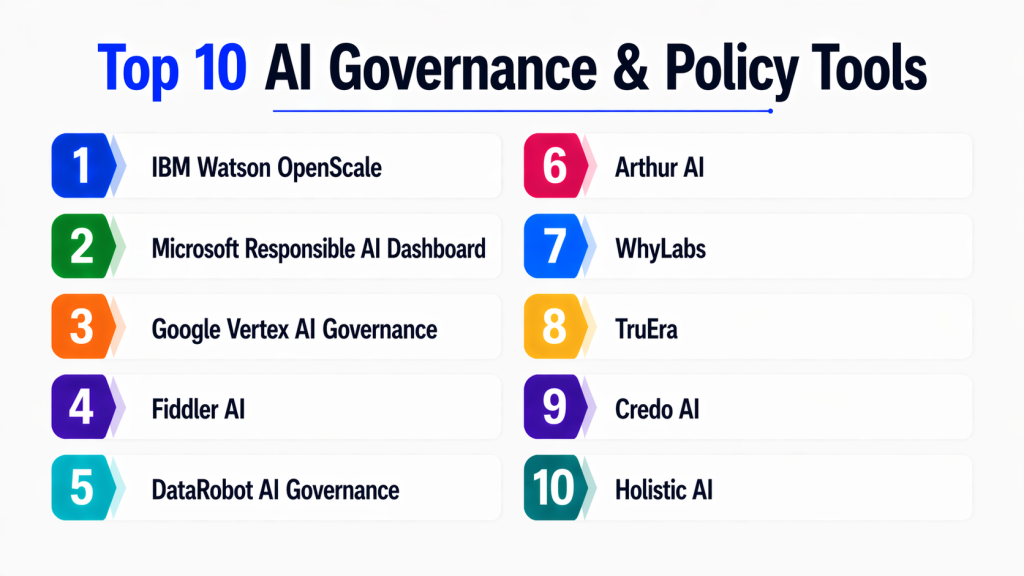
Top 10 AI Governance & Policy Tools
#1 — IBM Watson OpenScale
Short description:
IBM Watson OpenScale is a comprehensive AI governance platform designed to monitor, explain, and manage AI models in production. It provides tools for bias detection, model explainability, and compliance tracking. The platform integrates with enterprise ML pipelines. It supports audit trails and lifecycle governance. It is ideal for large organizations requiring strong governance frameworks.
Key Features
- Bias detection
- Explainability
- Model monitoring
- Compliance tracking
- Audit logs
Pros
- Enterprise-grade
- Strong governance
Cons
- Complex setup
- Expensive
Platforms / Deployment
- Cloud / Hybrid
Security & Compliance
- Enterprise-grade controls
#2 — Microsoft Responsible AI Dashboard
Short description:
Microsoft Responsible AI Dashboard helps organizations evaluate fairness, interpretability, and performance of AI models. It provides visual insights into model behavior and supports debugging. The platform integrates deeply with Azure ML. It is designed for building responsible AI systems. It is ideal for teams using Microsoft ecosystem.
Key Features
- Fairness analysis
- Model interpretability
- Error analysis
- Performance metrics
- Visualization
Pros
- Easy integration
- Strong insights
Cons
- Azure dependency
- Requires expertise
Platforms / Deployment
- Cloud
#3 — Google Vertex AI Governance
Short description:
Google Vertex AI Governance provides tools for managing AI lifecycle, ensuring compliance, and maintaining transparency. It supports monitoring, explainability, and governance workflows. The platform integrates with Google Cloud services. It is scalable for enterprise use. It is ideal for organizations using GCP.
Key Features
- Lifecycle governance
- Explainability
- Monitoring
- Compliance tools
- Integration
Pros
- Scalable
- Strong ecosystem
Cons
- GCP dependency
- Pricing complexity
Platforms / Deployment
- Cloud
#4 — Fiddler AI
Short description:
Fiddler AI focuses on model explainability, monitoring, and fairness. It provides insights into model performance and behavior. The platform supports governance workflows and compliance needs. It integrates with ML pipelines. It is ideal for organizations prioritizing responsible AI.
Key Features
- Explainability
- Bias detection
- Monitoring
- Debugging
- Governance workflows
Pros
- Strong insights
- Enterprise-ready
Cons
- Setup complexity
- Cost
Platforms / Deployment
- Cloud / On-premise
#5 — DataRobot AI Governance
Short description:
DataRobot AI Governance provides tools for managing AI risk, enforcing policies, and monitoring models. It supports lifecycle governance and compliance tracking. The platform integrates with enterprise workflows. It is widely used in regulated industries. It is ideal for large-scale AI deployments.
Key Features
- Risk management
- Policy enforcement
- Monitoring
- Compliance tracking
- Lifecycle tools
Pros
- Strong governance
- Enterprise focus
Cons
- Expensive
- Platform dependency
Platforms / Deployment
- Cloud / Hybrid
#6 — Arthur AI
Short description:
Arthur AI is a platform focused on monitoring AI models in production and detecting bias. It provides real-time insights into model performance and behavior. The platform helps ensure fairness and reliability. It integrates with ML pipelines. It is ideal for production monitoring and governance.
Key Features
- Model monitoring
- Bias detection
- Performance tracking
- Alerts
- Insights
Pros
- Real-time monitoring
- Easy integration
Cons
- Limited governance depth
- Cost
Platforms / Deployment
- Cloud
#7 — WhyLabs
Short description:
WhyLabs is a data and model observability platform that helps detect anomalies and maintain data quality. It supports governance workflows by providing monitoring insights. The platform integrates with ML tools. It is widely used for data reliability. It is ideal for data-focused governance.
Key Features
- Data monitoring
- Anomaly detection
- Observability
- Alerts
- Insights
Pros
- Easy to use
- Lightweight
Cons
- Limited advanced governance
- Smaller ecosystem
Platforms / Deployment
- Cloud
#8 — TruEra
Short description:
TruEra is a platform focused on model quality, explainability, and fairness. It helps organizations evaluate and improve AI systems. The platform supports governance workflows and compliance. It is widely used in regulated industries. It is ideal for enterprise AI governance.
Key Features
- Model evaluation
- Explainability
- Fairness
- Performance analysis
- Governance tools
Pros
- Strong insights
- Enterprise-ready
Cons
- Complex
- Cost
Platforms / Deployment
- Cloud
#9 — Credo AI
Short description:
Credo AI is a governance platform designed to manage AI risk and enforce policies. It provides tools for compliance tracking and audit reporting. The platform supports enterprise governance frameworks. It integrates with AI systems. It is ideal for organizations managing multiple AI applications.
Key Features
- Policy management
- Risk tracking
- Compliance
- Audit tools
- Governance
Pros
- Strong compliance
- Policy focus
Cons
- Limited flexibility
- Cost
Platforms / Deployment
- Cloud
#10 — Holistic AI
Short description:
Holistic AI provides governance tools for auditing and monitoring AI systems. It focuses on risk management, compliance, and fairness. The platform helps organizations ensure responsible AI usage. It supports enterprise workflows. It is ideal for governance teams.
Key Features
- Risk management
- Auditing
- Compliance
- Monitoring
- Governance
Pros
- Strong auditing
- Compliance focus
Cons
- Limited integrations
- Smaller ecosystem
Platforms / Deployment
- Cloud
Comparison Table (Top 10 AI Governance & Policy Tools)
| Tool Name | Best For | Platform(s) Supported | Deployment | Standout Feature | Public Rating |
|---|---|---|---|---|---|
| IBM OpenScale | Enterprise AI | Web | Hybrid | Bias detection | N/A |
| Microsoft RAI | Azure users | Web | Cloud | Fairness tools | N/A |
| Vertex AI Gov | GCP users | Web | Cloud | Lifecycle governance | N/A |
| Fiddler AI | Explainability | Web | Hybrid | Model insights | N/A |
| DataRobot | Enterprises | Web | Hybrid | Risk management | N/A |
| Arthur AI | Monitoring | Web | Cloud | Real-time insights | N/A |
| WhyLabs | Data monitoring | Web | Cloud | Data observability | N/A |
| TruEra | Model quality | Web | Cloud | Explainability | N/A |
| Credo AI | Compliance | Web | Cloud | Policy management | N/A |
| Holistic AI | Risk management | Web | Cloud | AI auditing | N/A |
Evaluation & Scoring of AI Governance & Policy Tools
| Tool Name | Core (25%) | Ease (15%) | Integrations (15%) | Security (10%) | Performance (10%) | Support (10%) | Value (15%) | Weighted Total (0–10) |
|---|---|---|---|---|---|---|---|---|
| IBM OpenScale | 9 | 6 | 8 | 9 | 8 | 9 | 7 | 8.2 |
| Microsoft RAI | 8 | 8 | 8 | 9 | 8 | 8 | 7 | 8.0 |
| Vertex AI Gov | 8 | 7 | 9 | 9 | 8 | 8 | 7 | 8.1 |
| Fiddler AI | 8 | 7 | 8 | 8 | 8 | 8 | 7 | 7.9 |
| DataRobot | 9 | 7 | 8 | 9 | 8 | 8 | 6 | 8.0 |
| Arthur AI | 8 | 7 | 7 | 8 | 8 | 7 | 7 | 7.7 |
| WhyLabs | 7 | 8 | 7 | 7 | 7 | 7 | 8 | 7.4 |
| TruEra | 8 | 7 | 7 | 8 | 8 | 7 | 7 | 7.6 |
| Credo AI | 8 | 7 | 7 | 9 | 8 | 7 | 7 | 7.8 |
| Holistic AI | 7 | 7 | 7 | 8 | 7 | 7 | 7 | 7.3 |
Which AI Governance & Policy Tools Is Right for You?
Solo / Freelancer
- WhyLabs
Simple monitoring and data observability tools are sufficient for small-scale AI projects. These tools are easy to use and require minimal setup. They help maintain data quality and detect issues early. Ideal for experimentation and learning. Cost-effective and lightweight solutions.
SMB
- Arthur AI, Fiddler AI
These tools provide a balance between monitoring and governance. SMBs benefit from explainability and performance tracking. They are scalable without being overly complex. Suitable for growing AI adoption. Help maintain trust and reliability.
Mid-Market
- TruEra, Credo AI
Mid-sized organizations need structured governance and compliance capabilities. These platforms offer fairness analysis and policy management. They help scale AI responsibly. Integration with workflows is strong. Suitable for expanding operations.
Enterprise
- IBM OpenScale, DataRobot
Enterprises require full governance frameworks with compliance, auditing, and monitoring. These platforms offer enterprise-grade features. They support large-scale deployments. Integration with enterprise systems is strong. Ideal for regulated industries.
Budget vs Premium
- Budget: WhyLabs, Arthur AI
- Premium: IBM OpenScale, DataRobot
Budget tools provide basic monitoring, while premium tools offer advanced governance and compliance features.
Feature Depth vs Ease of Use
- Advanced features: IBM OpenScale, Vertex AI Governance
- Easy to use: WhyLabs, Arthur AI
Choose based on technical expertise and governance needs.
Integrations & Scalability
- Best integrations: Vertex AI, Microsoft RAI
- Best scalability: IBM OpenScale, DataRobot
Integration is critical for enterprise workflows and automation.
Security & Compliance Needs
- Best options: IBM OpenScale, DataRobot, Credo AI
These platforms provide strong compliance and governance frameworks for regulated environments.
Frequently Asked Questions (FAQs)
1. What are AI governance tools?
AI governance tools help organizations monitor and manage AI systems responsibly. They ensure fairness, transparency, and compliance. They provide insights into model behavior. They support risk management. They are essential for enterprise AI.
2. Why is AI governance important?
AI governance reduces risks and ensures ethical AI usage. It helps detect bias and improve fairness. It ensures compliance with regulations. It builds trust in AI systems. It supports long-term sustainability.
3. Who should use AI governance tools?
Enterprises and organizations using AI at scale. Compliance teams and AI leaders. Regulated industries benefit the most. They help manage risks effectively. Adoption is growing rapidly.
4. Do these tools detect bias?
Yes, most governance tools provide bias detection. They analyze model outputs for fairness. They help improve decision-making. They are critical for responsible AI. They support compliance.
5. Are AI governance tools expensive?
Costs vary depending on features and scale. Enterprise tools are expensive. Smaller tools offer affordable options. Pricing depends on deployment. Budget should be considered.
6. Can they integrate with ML pipelines?
Yes, most tools integrate with ML workflows. They monitor models in production. They provide insights and reporting. Integration is essential. It improves efficiency.
7. Are these tools secure?
Enterprise tools provide strong security features. They include encryption and access control. Security varies by platform. Evaluation is important. Compliance matters.
8. What industries use AI governance?
Finance, healthcare, retail, and government. Any industry using AI at scale. Regulated sectors need it most. Adoption is increasing. It is becoming standard practice.
9. How scalable are these tools?
Most enterprise tools are highly scalable. Cloud platforms offer flexibility. Performance depends on architecture. Large organizations benefit most. Scalability is key.
10. How do I choose the right tool?
Evaluate features, integrations, and security. Consider your use case and scale. Test tools before selecting. Focus on compliance needs. Choose the best fit.
Conclusion
AI governance and policy tools are essential for ensuring responsible and compliant use of artificial intelligence. As AI systems become more complex and widely adopted, organizations must implement governance frameworks to manage risks, ensure fairness, and maintain transparency. These tools provide visibility into model behavior and help enforce policies across the AI lifecycle.
Choosing the right tool depends on your organization’s size, regulatory requirements, and AI maturity. While some platforms focus on monitoring and explainability, others provide full governance frameworks for enterprise-scale deployments. A practical approach is to shortlist a few tools, test them in real-world scenarios, and select the one that aligns with your governance strategy and long-term AI goals.
