Introduction
Natural Language Processing (NLP) Toolkits are software libraries and platforms that enable machines to understand, process, and generate human language. These toolkits provide pre-built models, algorithms, and APIs for tasks such as text classification, sentiment analysis, named entity recognition, translation, and conversational AI.
In the modern AI landscape, NLP toolkits are essential for building intelligent applications such as chatbots, search engines, voice assistants, recommendation systems, and document processing pipelines. With the rise of generative AI and large language models, NLP toolkits now integrate with Identity Management, Cybersecurity frameworks, Zero Trust architectures, and Access Control systems to ensure secure and compliant deployments.
Real-world use cases include:
- Chatbots and virtual assistants
- Sentiment analysis for customer feedback
- Document classification and summarization
- Language translation and localization
- Search and recommendation systems
What buyers should evaluate:
- Language support and accuracy
- Model flexibility and customization
- Integration with AI/ML pipelines
- Performance and scalability
- Ease of use and developer experience
- Security and compliance features
- Deployment options (cloud, on-premise, hybrid)
- Community support and ecosystem
Best for: Developers, data scientists, AI engineers, enterprises building language-based applications, and research teams.
Not ideal for: Non-technical users or simple automation tasks that do not require advanced language processing.
Key Trends in NLP Toolkits
- Large language model integration becoming standard
- Multilingual and cross-lingual NLP capabilities
- Pre-trained transformer models dominating workflows
- Low-code NLP tools emerging for business users
- Integration with conversational AI and voice systems
- Zero Trust security for AI pipelines
- Real-time NLP processing for chat and analytics
- Open-source ecosystems growing rapidly
- Domain-specific NLP models (legal, medical, finance)
- Focus on responsible AI and bias mitigation
How We NLP Toolkits (Methodology)
We evaluated NLP toolkits based on:
- Market adoption and developer popularity
- Feature completeness (text processing, ML, transformers)
- Performance and scalability
- Security and enterprise readiness
- Integration ecosystem and APIs
- Ease of use and documentation
- Deployment flexibility
- Community and support strength
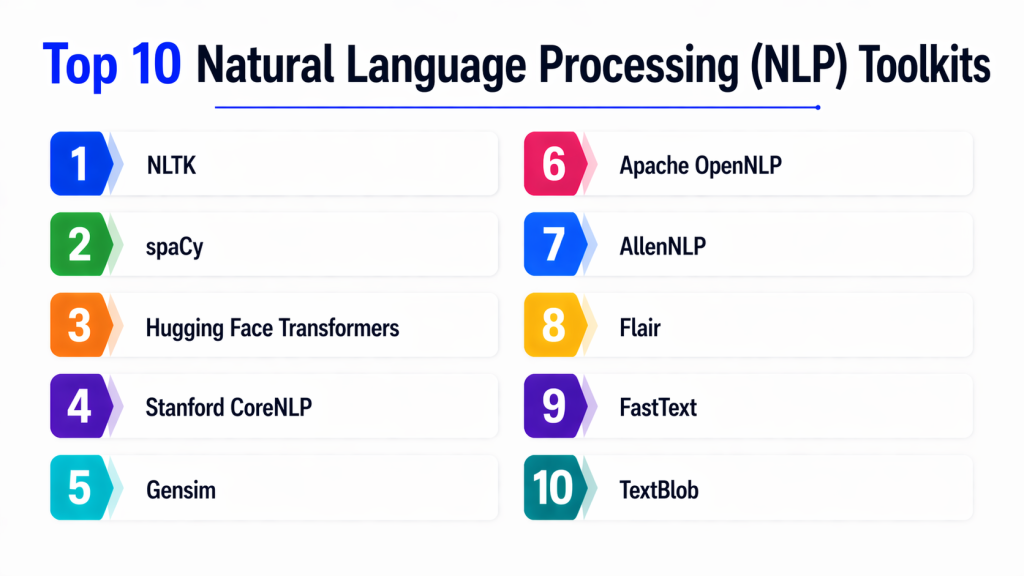
Top 10 Natural Language Processing (NLP) Toolkits
#1 — NLTK
Short description :
NLTK is one of the oldest and most widely used NLP toolkits for Python. It provides a comprehensive set of libraries for text processing and linguistic analysis. Ideal for beginners and academic use. It supports tokenization, parsing, and classification tasks. Widely used in education and research.
Key Features
- Tokenization and parsing
- Text classification
- Linguistic datasets
- Pre-built algorithms
- Easy integration
Pros
- Beginner-friendly
- Extensive documentation
Cons
- Not optimized for production
- Slower performance
Platforms / Deployment
Windows / macOS / Linux
Local / Cloud
Security & Compliance
Not publicly stated
Integrations & Ecosystem
- Python ecosystem
- Data science libraries
Support & Community
Large academic community.
#2 — spaCy
Short description :
spaCy is a modern NLP toolkit designed for production use. It offers high performance and efficient processing. Widely used in enterprise applications. Supports advanced NLP tasks. Ideal for developers building scalable systems.
Key Features
- Named entity recognition
- Dependency parsing
- Fast processing
- Pre-trained models
- Pipeline architecture
Pros
- High performance
- Production-ready
Cons
- Less beginner-friendly
- Limited deep learning features
Platforms / Deployment
Multi-platform
Cloud / Local
Security & Compliance
Not publicly stated
Integrations & Ecosystem
- Python ML stack
- APIs
Support & Community
Strong developer community.
#3 — Hugging Face Transformers
Short description :
Hugging Face Transformers is a leading toolkit for working with transformer-based models. It provides access to thousands of pre-trained models. Supports NLP, vision, and audio tasks. Ideal for modern AI development. Widely used in research and production.
Key Features
- Pre-trained transformer models
- Model hub
- Multi-task support
- Fine-tuning capabilities
- GPU acceleration
Pros
- State-of-the-art models
- Large ecosystem
Cons
- Requires compute resources
- Learning curve
Platforms / Deployment
Cloud / Local
Security & Compliance
Not publicly stated
Integrations & Ecosystem
- PyTorch
- TensorFlow
- APIs
Support & Community
Very active community.
#4 — Stanford CoreNLP
Short description :
Stanford CoreNLP is a robust NLP toolkit developed by Stanford University. It provides a wide range of linguistic analysis tools. Suitable for academic and enterprise use. Supports multiple languages. Known for reliability and depth.
Key Features
- Part-of-speech tagging
- Named entity recognition
- Parsing
- Sentiment analysis
Pros
- Comprehensive features
- Strong research backing
Cons
- Heavy resource usage
- Complex setup
Platforms / Deployment
Java-based
Local / Server
Security & Compliance
Not publicly stated
Integrations & Ecosystem
- Java ecosystem
- APIs
Support & Community
Academic and enterprise support.
#5 — Gensim
Short description :
Gensim is an NLP toolkit focused on topic modeling and document similarity. It is lightweight and efficient. Ideal for large text corpora. Widely used in research and analytics. Supports scalable text processing.
Key Features
- Topic modeling
- Word embeddings
- Document similarity
- Streaming data processing
Pros
- Efficient for large datasets
- Easy to use
Cons
- Limited general NLP features
- Not full NLP suite
Platforms / Deployment
Multi-platform
Security & Compliance
Not publicly stated
Integrations & Ecosystem
- Python ecosystem
Support & Community
Active community.
#6 — OpenNLP
Short description :
Apache OpenNLP is a machine learning-based NLP toolkit for Java. It supports common NLP tasks like tokenization and classification. Suitable for enterprise applications. Known for flexibility and scalability.
Key Features
- Tokenization
- Sentence detection
- Named entity recognition
- Classification
Pros
- Flexible
- Enterprise-ready
Cons
- Requires Java knowledge
- Limited modern AI features
Platforms / Deployment
Java-based
Security & Compliance
Not publicly stated
Integrations & Ecosystem
- Java tools
Support & Community
Open-source community.
#7 — AllenNLP
Short description :
AllenNLP is a research-focused NLP toolkit built on PyTorch. It provides tools for building and evaluating NLP models. Ideal for advanced research. Supports deep learning workflows.
Key Features
- Deep learning models
- Research tools
- Model evaluation
- Pre-trained models
Pros
- Research-friendly
- Flexible
Cons
- Not beginner-friendly
- Limited production focus
Platforms / Deployment
Cloud / Local
Security & Compliance
Not publicly stated
Integrations & Ecosystem
- PyTorch
Support & Community
Research community.
#8 — Flair
Short description :
Flair is an NLP library focused on contextual embeddings and sequence labeling. It provides simple APIs for complex tasks. Ideal for researchers and developers. Known for ease of use.
Key Features
- Contextual embeddings
- Sequence labeling
- Pre-trained models
Pros
- Easy to use
- Strong NLP features
Cons
- Smaller ecosystem
- Limited scalability
Platforms / Deployment
Multi-platform
Security & Compliance
Not publicly stated
Integrations & Ecosystem
- Python ecosystem
Support & Community
Growing community.
#9 — FastText
Short description :
FastText is a library for efficient text classification and word representation. Developed for speed and scalability. Ideal for large datasets. Widely used in production systems.
Key Features
- Text classification
- Word embeddings
- Fast processing
Pros
- Very fast
- Scalable
Cons
- Limited advanced NLP
- Basic features
Platforms / Deployment
Multi-platform
Security & Compliance
Not publicly stated
Integrations & Ecosystem
- Python tools
Support & Community
Strong community.
#10 — TextBlob
Short description :
TextBlob is a simple NLP library for Python. It provides easy-to-use APIs for text processing. Ideal for beginners. Supports sentiment analysis and translation.
Key Features
- Sentiment analysis
- Text processing
- Translation
- Simple API
Pros
- Easy to use
- Beginner-friendly
Cons
- Limited advanced features
- Not scalable
Platforms / Deployment
Multi-platform
Security & Compliance
Not publicly stated
Integrations & Ecosystem
- Python ecosystem
Support & Community
Beginner-friendly community.
Comparison Table (Top 10)
| Tool Name | Best For | Platform(s) | Deployment | Standout Feature | Public Rating |
|---|---|---|---|---|---|
| NLTK | Beginners | Multi | Local | Simplicity | N/A |
| spaCy | Production | Multi | Hybrid | Speed | N/A |
| Transformers | AI models | Multi | Hybrid | Pre-trained models | N/A |
| CoreNLP | Research | Java | Server | Linguistic depth | N/A |
| Gensim | Topic modeling | Multi | Local | Efficiency | N/A |
| OpenNLP | Enterprise | Java | Hybrid | Flexibility | N/A |
| AllenNLP | Research | Multi | Hybrid | Deep learning | N/A |
| Flair | NLP devs | Multi | Local | Embeddings | N/A |
| FastText | Large data | Multi | Local | Speed | N/A |
| TextBlob | Beginners | Multi | Local | Ease of use | N/A |
Evaluation & Scoring of NLP Toolkits
| Tool | Core | Ease | Integration | Security | Performance | Support | Value | Total |
|---|---|---|---|---|---|---|---|---|
| NLTK | 8 | 10 | 7 | 6 | 7 | 9 | 9 | 8.3 |
| spaCy | 9 | 8 | 9 | 7 | 9 | 9 | 8 | 8.7 |
| Transformers | 10 | 7 | 10 | 8 | 10 | 10 | 7 | 9.1 |
| CoreNLP | 9 | 6 | 8 | 7 | 8 | 8 | 7 | 7.9 |
| Gensim | 7 | 9 | 7 | 6 | 8 | 8 | 8 | 7.8 |
| OpenNLP | 8 | 7 | 8 | 7 | 8 | 7 | 8 | 7.9 |
| AllenNLP | 9 | 6 | 8 | 7 | 9 | 8 | 7 | 8.0 |
| Flair | 8 | 8 | 7 | 6 | 8 | 7 | 8 | 7.8 |
| FastText | 7 | 8 | 7 | 6 | 9 | 8 | 8 | 7.9 |
| TextBlob | 6 | 10 | 6 | 6 | 6 | 8 | 9 | 7.6 |
Interpretation:
Higher scores indicate stronger overall capabilities across performance, scalability, and ecosystem support. Enterprise-grade toolkits excel in integration and performance, while beginner tools score higher in ease of use and value. Choose based on your project requirements and team expertise.
Which NLP Toolkit Is Right for You?
Solo / Freelancer
Use TextBlob, NLTK
SMB
Use spaCy, Gensim
Mid-Market
Use Transformers, FastText
Enterprise
Use Transformers, spaCy, OpenNLP
Budget vs Premium
Budget: NLTK
Premium: Transformers
Feature Depth vs Ease of Use
Depth: Transformers
Ease: TextBlob
Integrations & Scalability
Best: Transformers, spaCy
Security & Compliance Needs
Best: Enterprise deployments with custom configurations
Frequently Asked Questions (FAQs)
1. What is an NLP toolkit?
An NLP toolkit is a collection of libraries and tools that help process and analyze human language. It enables tasks like text classification, translation, and sentiment analysis. These toolkits provide pre-built models and algorithms. Developers use them to build AI applications. They are essential for modern language-based systems.
2. Which NLP toolkit is best for beginners?
TextBlob and NLTK are ideal for beginners because they offer simple APIs and easy learning curves. They provide basic NLP functionalities without requiring deep technical knowledge. These tools are widely used in education and small projects. They help build foundational understanding. Advanced tasks may require more powerful toolkits.
3. Are NLP toolkits free to use?
Many NLP toolkits are open-source and free to use. However, some advanced features or hosted services may require payment. Costs can also arise from infrastructure usage. Enterprise deployments may involve licensing fees. It is important to evaluate total cost of ownership.
4. Can NLP toolkits handle multiple languages?
Yes, most modern NLP toolkits support multiple languages. Some provide multilingual models and translation capabilities. Accuracy may vary depending on language complexity. Advanced frameworks offer better multilingual support. It is important to verify language coverage before selection.
5. What are the limitations of NLP toolkits?
NLP toolkits may struggle with context, sarcasm, and ambiguous language. Performance depends on training data and model quality. Some tools require significant computational resources. Real-world language complexity can impact accuracy. Continuous improvements are being made in this field.
6. Can NLP toolkits be used in production systems?
Yes, many NLP toolkits like spaCy and Transformers are designed for production use. They support scalable deployment and integration with applications. Proper optimization and monitoring are required. Enterprise systems often use these tools. They are widely adopted in industry.
7. How do NLP toolkits integrate with other systems?
Most NLP toolkits provide APIs and SDKs for integration. They can connect with data pipelines, cloud platforms, and applications. Integration enables automation and scalability. Compatibility varies across tools. Choosing a toolkit with strong ecosystem support is important.
8. Are NLP toolkits secure?
Security depends on how the toolkit is deployed and configured. Open-source tools require additional security measures. Enterprise deployments include encryption and access controls. Compliance varies by platform. Organizations should follow best practices for secure AI development.
9. What factors affect NLP performance?
Performance depends on data quality, model architecture, and computational resources. Pre-trained models improve accuracy. Hardware acceleration enhances speed. Proper tuning and evaluation are essential. Performance optimization is a continuous process.
10. How long does it take to learn an NLP toolkit?
Learning time depends on prior experience with programming and AI. Beginners can start with basic tools in a few weeks. Advanced frameworks require more time to master. Practice and real-world projects accelerate learning. Documentation and community support help significantly.
Conclusion
Natural Language Processing toolkits have become a cornerstone of modern AI development, enabling machines to understand and interact with human language at scale. From simple text processing libraries to advanced transformer-based frameworks, these tools empower developers and organizations to build intelligent applications across industries.
Choosing the right NLP toolkit depends on your specific needs, including ease of use, scalability, integration capabilities, and performance requirements. Instead of relying on a single solution, it is recommended to evaluate multiple toolkits, experiment with real use cases, and select the one that best aligns with your project goals and technical expertise.
