Introduction
Model Monitoring & Drift Detection Tools are essential components of modern machine learning systems that ensure models continue to perform accurately after deployment. Once a model goes live, real-world data can change over time, leading to performance degradation. These tools continuously track model behavior, detect drift, and trigger alerts or retraining workflows.
In today’s AI-driven ecosystem, deploying a model is just the beginning. Organizations must ensure models remain reliable, unbiased, and compliant with regulations. With the rise of MLOps, AI governance, and real-time decision systems, monitoring tools have become critical for maintaining trust in machine learning outcomes.
Common use cases include:
- Detecting data drift and concept drift
- Monitoring prediction accuracy and latency
- Identifying bias and fairness issues
- Ensuring regulatory compliance and auditability
- Triggering automated retraining workflows
Key evaluation criteria buyers should consider:
- Drift detection accuracy and coverage
- Real-time vs batch monitoring capabilities
- Integration with ML pipelines and tools
- Alerting and automation features
- Explainability and observability
- Scalability and performance
- Security and compliance readiness
- Ease of deployment and usability
Best for: ML engineers, data scientists, MLOps teams, and enterprises deploying production-grade AI systems.
Not ideal for: Teams not yet operationalizing models or those working only with static analytics datasets.
Key Trends in Model Monitoring & Drift Detection Tools
- AI-powered anomaly detection: Automated identification of drift and irregular patterns
- Unified ML observability: Combining logs, metrics, and model insights in one platform
- Real-time monitoring: Increasing adoption for low-latency use cases
- Explainability integration: Understanding model decisions alongside performance
- Bias and fairness tracking: Ethical AI becoming a standard requirement
- Cloud-native platforms: Managed services gaining popularity
- MLOps integration: Seamless connection with CI/CD and deployment pipelines
- Hybrid monitoring models: Support for both batch and streaming data
How We Evaluated Model Monitoring & Drift Detection Tools (Methodology)
- Industry adoption and enterprise relevance
- Depth of monitoring and drift detection capabilities
- Performance and scalability benchmarks
- Security and compliance features
- Integration with modern ML ecosystems
- Ease of use and onboarding experience
- Community strength and vendor support
- Cost-effectiveness and deployment flexibility
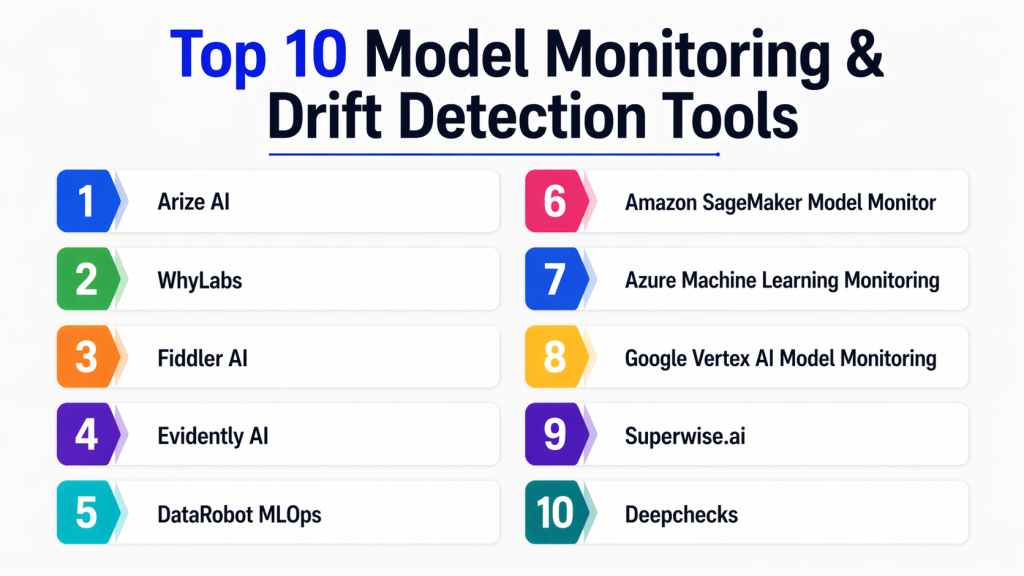
Top 10 Model Monitoring & Drift Detection Tools
#1 — Arize AI
Short description:
Arize AI is a leading ML observability platform designed to monitor, debug, and improve machine learning models in production. It provides deep insights into model performance, helping teams quickly identify issues such as drift, anomalies, and data quality problems. It is widely used by organizations that need real-time visibility into AI systems and want to ensure model reliability at scale.
Key Features
- Data and concept drift detection
- Model performance monitoring
- Root cause analysis tools
- Real-time observability dashboards
- Alerting and anomaly detection
- Data quality monitoring
Pros
- Strong debugging and visualization capabilities
- Scales well for enterprise workloads
Cons
- Requires integration effort
- Premium pricing for advanced features
Platforms / Deployment
- Cloud
Security & Compliance
- Encryption, RBAC, audit logging
Integrations & Ecosystem
Arize integrates with modern ML and data platforms to provide end-to-end observability.
- Data warehouses and data lakes
- Python-based ML pipelines
- APIs and monitoring systems
Support & Community
Enterprise-grade support with growing adoption and strong documentation.
#2 — WhyLabs
Short description:
WhyLabs is a model monitoring platform focused on data observability and drift detection. It helps teams detect anomalies early, monitor model inputs and outputs, and maintain data quality across pipelines. It is particularly useful for organizations looking to build reliable and transparent ML systems with minimal overhead.
Key Features
- Data drift detection
- Model performance tracking
- Data profiling and validation
- Alerting and anomaly detection
- Integration with open-source tools
Pros
- Easy to implement and integrate
- Strong focus on data quality
Cons
- Limited advanced customization
- Pricing not always transparent
Platforms / Deployment
- Cloud
Security & Compliance
- Encryption, access control
Integrations & Ecosystem
- Python libraries
- Data pipelines
- APIs
Support & Community
Growing community with solid documentation and support.
#3 — Fiddler AI
Short description:
Fiddler AI is an enterprise platform focused on explainable AI and model monitoring. It helps teams understand model decisions, detect drift, and ensure fairness. It is particularly valuable for industries that require transparency and regulatory compliance.
Key Features
- Explainable AI insights
- Drift and bias detection
- Model performance tracking
- Debugging tools
- Compliance monitoring
Pros
- Strong explainability capabilities
- Enterprise-ready features
Cons
- Complex setup
- Higher cost
Platforms / Deployment
- Cloud / On-premise
Security & Compliance
- Enterprise-grade security features
Integrations & Ecosystem
- ML frameworks
- Data pipelines
- APIs
Support & Community
Enterprise-level support.
#4 — Evidently AI
Short description:
Evidently AI is an open-source tool for monitoring machine learning models and detecting data drift. It provides detailed reports and visualizations that help teams understand how their models perform over time. It is ideal for teams looking for a flexible and cost-effective monitoring solution.
Key Features
- Data drift detection
- Model monitoring dashboards
- Custom metrics and reports
- Visualization tools
- Open-source flexibility
Pros
- Free and customizable
- Strong community support
Cons
- Requires technical setup
- Limited enterprise features
Platforms / Deployment
- Self-hosted
Security & Compliance
- Not publicly stated
Integrations & Ecosystem
- Python
- Jupyter notebooks
- ML pipelines
Support & Community
Active open-source community.
#5 — DataRobot MLOps
Short description:
DataRobot MLOps is an enterprise-grade solution for managing and monitoring machine learning models. It provides tools for tracking model performance, detecting drift, and ensuring governance across the ML lifecycle.
Key Features
- Model performance monitoring
- Drift detection
- Governance and compliance tools
- Deployment tracking
- Alerting and reporting
Pros
- End-to-end lifecycle support
- Strong governance capabilities
Cons
- Expensive
- Best suited for DataRobot users
Platforms / Deployment
- Cloud / On-premise
Security & Compliance
- Enterprise compliance features
Integrations & Ecosystem
- APIs
- Data pipelines
- ML platforms
Support & Community
Enterprise-grade support.
#6 — Amazon SageMaker Model Monitor
Short description:
SageMaker Model Monitor is a monitoring tool within AWS that tracks model performance and detects drift in production environments. It is ideal for organizations already using AWS for ML workloads.
Key Features
- Data drift detection
- Monitoring dashboards
- Automated alerts
- Integration with SageMaker
- Data quality tracking
Pros
- Seamless AWS integration
- Scalable infrastructure
Cons
- Limited outside AWS
- AWS dependency
Platforms / Deployment
- Cloud
Security & Compliance
- IAM, encryption
Integrations & Ecosystem
- S3
- Lambda
- AWS analytics tools
Support & Community
Strong AWS support.
#7 — Azure ML Monitoring
Short description:
Azure ML Monitoring provides tools for tracking model performance and detecting drift within the Microsoft ecosystem. It is designed for enterprise-scale AI deployments.
Key Features
- Drift detection
- Model performance metrics
- Alerting system
- Integration with Azure ML
- Monitoring dashboards
Pros
- Strong enterprise integration
- Scalable and reliable
Cons
- Azure dependency
- Setup complexity
Platforms / Deployment
- Cloud
Security & Compliance
- Azure AD, encryption
Integrations & Ecosystem
- Azure services
- Data pipelines
Support & Community
Enterprise support.
#8 — Google Vertex AI Model Monitoring
Short description:
Vertex AI Model Monitoring helps track model performance and detect drift for models deployed on Google Cloud. It provides automated insights and alerts.
Key Features
- Drift detection
- Monitoring dashboards
- Alerts and notifications
- Integration with Vertex AI
- Automated analysis
Pros
- Easy GCP integration
- Scalable
Cons
- GCP dependency
- Pricing complexity
Platforms / Deployment
- Cloud
Security & Compliance
- IAM, encryption
Integrations & Ecosystem
- BigQuery
- Cloud AI tools
Support & Community
Strong cloud support.
#9 — Superwise.ai
Short description:
Superwise.ai is a specialized platform for monitoring machine learning models and detecting anomalies in real time. It focuses on observability and alerting.
Key Features
- Real-time monitoring
- Drift detection
- Alerts and notifications
- Performance tracking
- Observability tools
Pros
- Specialized monitoring focus
- Easy deployment
Cons
- Smaller ecosystem
- Premium pricing
Platforms / Deployment
- Cloud
Security & Compliance
- Not publicly stated
Integrations & Ecosystem
- APIs
- ML tools
Support & Community
Growing support ecosystem.
#10 — Deepchecks
Short description:
Deepchecks is a validation and monitoring tool that helps ensure model quality and detect issues like drift and data inconsistencies. It is available as both open-source and enterprise versions.
Key Features
- Drift detection
- Model validation
- Data quality checks
- Testing framework
- Visualization tools
Pros
- Strong validation capabilities
- Open-source option
Cons
- Requires technical expertise
- Limited enterprise features
Platforms / Deployment
- Cloud / Self-hosted
Security & Compliance
- Not publicly stated
Integrations & Ecosystem
- Python
- ML frameworks
Support & Community
Active community support.
Comparison Table (Top 10)
| Tool | Best For | Platform(s) Supported | Deployment | Standout Feature | Public Rating |
|---|---|---|---|---|---|
| Arize AI | ML observability | Web | Cloud | Root cause analysis | N/A |
| WhyLabs | Data observability | Web | Cloud | Data profiling | N/A |
| Fiddler AI | Explainability | Web | Hybrid | Bias detection | N/A |
| Evidently AI | Open-source | Python | Self-hosted | Drift reports | N/A |
| DataRobot MLOps | Enterprise AI | Web | Hybrid | Governance | N/A |
| SageMaker Monitor | AWS users | Web | Cloud | Native monitoring | N/A |
| Azure ML Monitoring | Azure users | Web | Cloud | Integration | N/A |
| Vertex AI Monitoring | GCP users | Web | Cloud | Auto insights | N/A |
| Superwise.ai | Real-time monitoring | Web | Cloud | Alerts | N/A |
| Deepchecks | Validation | Python | Hybrid | Testing framework | N/A |
Evaluation & Scoring of Model Monitoring & Drift Detection Tools
| Tool Name | Core (25%) | Ease (15%) | Integrations (15%) | Security (10%) | Performance (10%) | Support (10%) | Value (15%) | Weighted Total (0–10) |
|---|---|---|---|---|---|---|---|---|
| Arize AI | 9 | 7 | 8 | 8 | 9 | 8 | 7 | 8.1 |
| WhyLabs | 8 | 8 | 7 | 7 | 8 | 7 | 7 | 7.6 |
| Fiddler AI | 8 | 6 | 7 | 9 | 8 | 7 | 6 | 7.5 |
| DataRobot MLOps | 9 | 7 | 8 | 9 | 8 | 8 | 6 | 8.0 |
| SageMaker Monitor | 8 | 7 | 9 | 9 | 8 | 8 | 7 | 8.1 |
| Azure ML Monitoring | 8 | 7 | 8 | 9 | 8 | 8 | 7 | 8.0 |
| Vertex AI Monitoring | 8 | 7 | 8 | 9 | 8 | 8 | 7 | 8.0 |
| Superwise.ai | 7 | 8 | 6 | 6 | 7 | 6 | 7 | 6.9 |
| Evidently AI | 7 | 7 | 6 | 6 | 7 | 7 | 9 | 7.2 |
| Deepchecks | 7 | 7 | 6 | 6 | 7 | 7 | 8 | 7.1 |
Score interpretation:
These scores are comparative and based on weighted evaluation criteria. A higher score reflects a more balanced tool across enterprise needs, usability, and scalability. However, the best tool depends on your specific environment, data complexity, and monitoring requirements.
Which Model Monitoring & Drift Detection Tool Is Right for You?
Solo / Freelancer
- Evidently AI, Deepchecks
SMB
- WhyLabs, Superwise.ai
Mid-Market
- Arize AI, Fiddler AI
Enterprise
- DataRobot MLOps, SageMaker Monitor, Vertex AI Monitoring
Budget vs Premium
- Budget: Evidently AI
- Premium: DataRobot, Fiddler AI
Feature Depth vs Ease of Use
- Deep features: Arize AI, DataRobot
- Easy to use: WhyLabs
Integrations & Scalability
- Best integrations: SageMaker Monitor, Vertex AI
Security & Compliance Needs
- Strongest: Azure ML Monitoring, DataRobot
Frequently Asked Questions (FAQs)
1. What is model drift?
Model drift refers to changes in data patterns over time that cause machine learning models to lose accuracy. It can result from shifting user behavior, market changes, or evolving datasets. Detecting drift early helps maintain model performance.
2. Why is model monitoring important?
Model monitoring ensures that deployed models remain accurate and reliable. Without monitoring, models can degrade silently, leading to incorrect predictions and business risks. It also supports compliance and governance.
3. What types of drift exist?
There are two main types: data drift and concept drift. Data drift occurs when input data changes, while concept drift happens when relationships between inputs and outputs change.
4. Can these tools handle real-time monitoring?
Yes, many tools support both batch and real-time monitoring. Real-time monitoring is essential for applications like fraud detection and recommendation systems.
5. Are open-source tools reliable?
Open-source tools like Evidently AI are reliable and widely used. However, they may lack enterprise features like governance and compliance.
6. How do monitoring tools detect anomalies?
They use statistical techniques and machine learning algorithms to identify unusual patterns in data or predictions. Alerts are triggered when thresholds are exceeded.
7. Do these tools support explainability?
Yes, many tools include explainability features to help users understand model decisions and improve trust in AI systems.
8. What industries use these tools?
Industries like finance, healthcare, retail, and telecom rely on these tools to ensure AI accuracy and compliance.
9. How do I choose the right tool?
Evaluate tools based on scalability, integration, ease of use, and cost. Choose one that fits your infrastructure and monitoring needs.
10. Is implementation difficult?
Implementation complexity varies. Cloud-based tools are easier to deploy, while open-source tools require more setup.
Conclusion
Model monitoring and drift detection tools are no longer optional—they are essential for any organization running machine learning models in production. These tools provide visibility into model performance, detect issues early, and help maintain reliability, fairness, and compliance. As AI systems become more complex, continuous monitoring ensures that models remain aligned with real-world data and business goals.
The right tool depends on your organization’s scale, infrastructure, and expertise. Enterprise platforms offer robust governance and scalability, while open-source tools provide flexibility and cost advantages. The best approach is to shortlist a few tools, run pilot implementations, and validate how well they integrate with your workflows before making a final decision.
