Introduction
Deep Learning Frameworks are software libraries and tools that enable developers and researchers to design, train, and deploy neural networks efficiently. These frameworks abstract complex mathematical operations and provide optimized environments for building AI models across industries.
In today’s AI-driven landscape, deep learning frameworks are foundational for computer vision, natural language processing, recommendation systems, robotics, and generative AI. With the rapid evolution of AI capabilities, these frameworks now integrate GPU acceleration, distributed training, MLOps pipelines, and enterprise-grade security features, making them essential for modern organizations.
Real-world use cases include:
- Image recognition and object detection
- Natural language processing and chatbots
- Recommendation engines (e-commerce, streaming)
- Autonomous systems and robotics
- Fraud detection and predictive analytics
What buyers should evaluate:
- Performance and scalability
- Ease of use and learning curve
- Community support and documentation
- Hardware acceleration support (GPU/TPU)
- Integration with data pipelines and MLOps tools
- Deployment capabilities
- Security and compliance features
- Model flexibility and customization
Best for: AI engineers, data scientists, research teams, enterprises building AI products, and startups focused on machine learning innovation.
Not ideal for: Simple scripting tasks, lightweight automation, or teams without AI/ML expertise.
Key Trends in Deep Learning Frameworks
- AI-native frameworks with built-in optimization and auto-tuning
- Distributed training at scale across GPUs and clusters
- Integration with MLOps platforms for lifecycle management
- Low-code and AutoML features emerging for non-experts
- Enhanced security and governance controls for enterprise AI
- Support for edge AI and mobile deployment
- Cross-framework interoperability improvements
- Hardware-specific optimizations (NVIDIA, TPU, custom chips)
- Growing focus on responsible AI and explainability
- Cloud-first development environments
How We Deep Learning Frameworks (Methodology)
We evaluated frameworks based on:
- Adoption across industry and research
- Feature richness and flexibility
- Performance benchmarks and scalability
- Security and enterprise readiness
- Integration with ecosystems and tools
- Community support and documentation quality
- Ease of onboarding and developer experience
- Deployment and production readiness
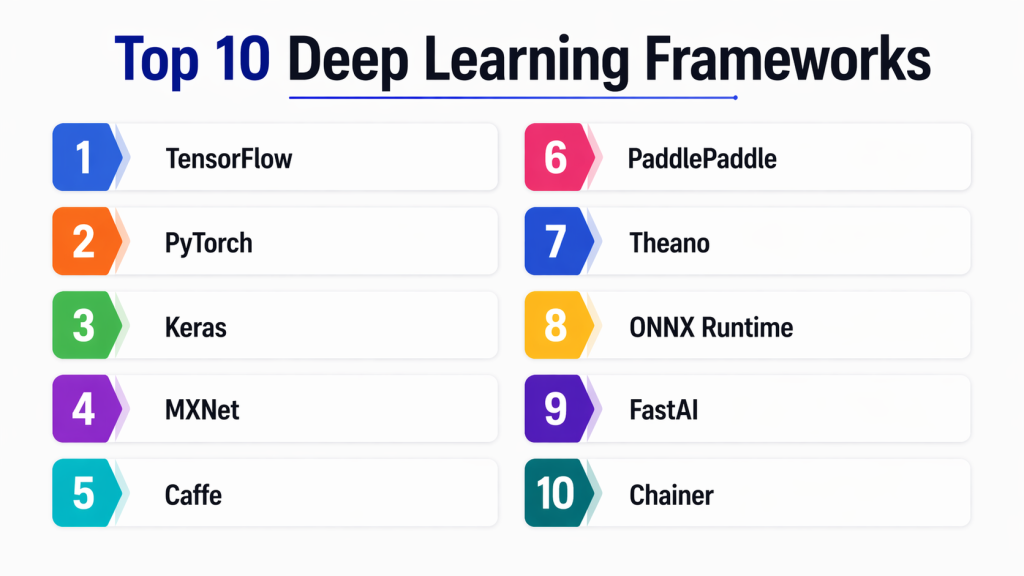
Top 10 Deep Learning Frameworks
#1 — TensorFlow
Short description :
TensorFlow is one of the most widely used deep learning frameworks, developed for scalable machine learning applications. It supports everything from research prototyping to production deployment. Known for its flexibility and performance, it enables distributed training across large datasets. TensorFlow is widely adopted in enterprises and research labs. It supports multiple languages and deployment environments.
Key Features
- Scalable distributed training
- TensorBoard visualization
- Cross-platform deployment
- Support for mobile and edge devices
- Pre-trained models and libraries
- GPU/TPU acceleration
Pros
- Highly scalable and production-ready
- Strong ecosystem and tooling
Cons
- Steep learning curve
- Verbose syntax compared to alternatives
Platforms / Deployment
Web / Windows / macOS / Linux
Cloud / Self-hosted / Hybrid
Security & Compliance
Encryption, access control supported
Compliance: Not publicly stated
Integrations & Ecosystem
TensorFlow integrates with a wide range of tools for data processing and deployment.
- Kubernetes
- TensorFlow Serving
- Data pipelines
- Cloud ML platforms
Support & Community
Extensive documentation and one of the largest AI communities globally.
#2 — PyTorch
Short description :
PyTorch is a flexible and developer-friendly deep learning framework known for its dynamic computation graph. It is widely used in research and production. Its intuitive design makes it popular among developers. PyTorch supports rapid prototyping and debugging. It is heavily adopted in academia and AI startups.
Key Features
- Dynamic computation graph
- Easy debugging
- Strong GPU acceleration
- TorchScript for deployment
- Extensive libraries
Pros
- Easy to learn and use
- Strong research adoption
Cons
- Slightly less mature deployment tools
- Performance tuning required
Platforms / Deployment
Windows / macOS / Linux
Cloud / Self-hosted
Security & Compliance
Basic controls, encryption supported
Compliance: Not publicly stated
Integrations & Ecosystem
- ONNX
- Hugging Face
- Cloud platforms
Support & Community
Large and active developer community.
#3 — Keras
Short description :
Keras is a high-level deep learning API that runs on top of TensorFlow. It simplifies model building with an intuitive interface. Ideal for beginners and rapid prototyping. Keras allows fast experimentation. It is widely used in education and small-scale projects.
Key Features
- Simple API
- Fast prototyping
- Modular design
- Integration with TensorFlow
- Pre-built layers
Pros
- Easy to learn
- Quick model development
Cons
- Limited flexibility for advanced use
- Dependent on backend
Platforms / Deployment
Multi-platform
Cloud / Local
Security & Compliance
Not publicly stated
Integrations & Ecosystem
- TensorFlow
- Python libraries
Support & Community
Strong community and learning resources.
#4 — MXNet
Short description :
MXNet is a scalable deep learning framework designed for efficiency and flexibility. It supports multiple programming languages and distributed training. Known for high performance. Used in enterprise AI solutions. Suitable for large-scale deployments.
Key Features
- Distributed training
- Multi-language support
- Efficient memory usage
- Scalable architecture
- GPU acceleration
Pros
- High performance
- Scalable
Cons
- Smaller community
- Complex setup
Platforms / Deployment
Linux / Windows
Cloud / Self-hosted
Security & Compliance
Not publicly stated
Integrations & Ecosystem
- Cloud platforms
- Data pipelines
Support & Community
Moderate community support.
#5 — Caffe
Short description :
Caffe is a deep learning framework focused on speed and efficiency. It is widely used in computer vision tasks. Known for its performance in image processing. Suitable for research and production. Best for CNN-based models.
Key Features
- Fast execution
- Pre-trained models
- Image processing focus
- Modular architecture
- GPU support
Pros
- High speed
- Efficient for vision tasks
Cons
- Limited flexibility
- Not actively evolving
Platforms / Deployment
Linux
Self-hosted
Security & Compliance
Not publicly stated
Integrations & Ecosystem
- OpenCV
- Vision libraries
Support & Community
Declining but still relevant in legacy systems.
#6 — PaddlePaddle
Short description :
PaddlePaddle is a deep learning framework designed for industrial applications. It focuses on scalability and deployment. Supports a wide range of AI use cases. Strong in enterprise adoption. Suitable for production AI systems.
Key Features
- Industrial AI support
- Distributed training
- Pre-trained models
- Scalable architecture
- Deployment tools
Pros
- Enterprise-ready
- Good performance
Cons
- Smaller global community
- Limited documentation in some regions
Platforms / Deployment
Cloud / On-premise
Security & Compliance
Not publicly stated
Integrations & Ecosystem
- AI tools
- Cloud services
Support & Community
Growing ecosystem.
#7 — Theano
Short description :
Theano is an early deep learning framework used for mathematical computations. It laid the foundation for modern frameworks. Suitable for research and experimentation. However, it is no longer actively maintained. Still used for legacy systems.
Key Features
- Mathematical computation
- GPU acceleration
- Symbolic differentiation
Pros
- Strong foundation
- Flexible
Cons
- Deprecated
- Limited support
Platforms / Deployment
Linux
Self-hosted
Security & Compliance
Not publicly stated
Integrations & Ecosystem
- Python libraries
Support & Community
Minimal support.
#8 — ONNX Runtime
Short description :
ONNX Runtime is designed for model interoperability and performance optimization. It allows models to run across different frameworks. Ideal for deployment and inference. Supports multiple hardware environments. Widely used in production.
Key Features
- Cross-framework support
- Optimized inference
- Hardware acceleration
- Model portability
Pros
- High performance
- Flexible deployment
Cons
- Not for training
- Requires integration
Platforms / Deployment
Multi-platform
Cloud / Edge
Security & Compliance
Not publicly stated
Integrations & Ecosystem
- PyTorch
- TensorFlow
Support & Community
Strong enterprise backing.
#9 — FastAI
Short description :
FastAI simplifies deep learning using PyTorch. It provides high-level APIs for rapid development. Focuses on ease of use and performance. Ideal for beginners and practitioners. Supports modern AI workflows.
Key Features
- High-level APIs
- Built on PyTorch
- Fast experimentation
- Pre-trained models
Pros
- Easy to use
- Fast development
Cons
- Limited low-level control
- Dependent on PyTorch
Platforms / Deployment
Multi-platform
Security & Compliance
Not publicly stated
Integrations & Ecosystem
- PyTorch
- Data tools
Support & Community
Active learning community.
#10 — Chainer
Short description :
Chainer is a flexible deep learning framework focused on dynamic computation graphs. It allows intuitive model building. Suitable for research and experimentation. Supports GPU acceleration. Used in academic environments.
Key Features
- Dynamic graphs
- Flexible design
- GPU support
Pros
- Easy experimentation
- Flexible
Cons
- Declining usage
- Limited updates
Platforms / Deployment
Linux / Windows
Security & Compliance
Not publicly stated
Integrations & Ecosystem
- Python ecosystem
Support & Community
Limited support.
Comparison Table (Top 10)
| Tool Name | Best For | Platform(s) | Deployment | Standout Feature | Public Rating |
|---|---|---|---|---|---|
| TensorFlow | Enterprise AI | Multi | Hybrid | Scalability | N/A |
| PyTorch | Research | Multi | Hybrid | Flexibility | N/A |
| Keras | Beginners | Multi | Cloud/Local | Simplicity | N/A |
| MXNet | Large-scale AI | Multi | Cloud | Performance | N/A |
| Caffe | Vision tasks | Linux | Self-hosted | Speed | N/A |
| PaddlePaddle | Enterprise | Multi | Hybrid | Industrial AI | N/A |
| Theano | Legacy | Linux | Self-hosted | Math engine | N/A |
| ONNX Runtime | Deployment | Multi | Hybrid | Interoperability | N/A |
| FastAI | Learning | Multi | Cloud | Ease of use | N/A |
| Chainer | Research | Multi | Self-hosted | Dynamic graphs | N/A |
Evaluation & Scoring of Deep Learning Frameworks
| Tool Name | Core | Ease | Integrations | Security | Performance | Support | Value | Total |
|---|---|---|---|---|---|---|---|---|
| TensorFlow | 10 | 7 | 10 | 8 | 10 | 9 | 8 | 8.9 |
| PyTorch | 9 | 9 | 9 | 7 | 9 | 9 | 9 | 8.9 |
| Keras | 7 | 10 | 8 | 6 | 7 | 9 | 9 | 8.0 |
| MXNet | 8 | 7 | 8 | 7 | 9 | 7 | 8 | 8.0 |
| Caffe | 7 | 6 | 7 | 6 | 9 | 6 | 7 | 7.0 |
| Paddle | 8 | 7 | 7 | 7 | 8 | 7 | 8 | 7.8 |
| Theano | 6 | 6 | 6 | 6 | 7 | 5 | 6 | 6.1 |
| ONNX | 8 | 7 | 9 | 7 | 9 | 8 | 8 | 8.2 |
| FastAI | 7 | 9 | 8 | 6 | 8 | 8 | 9 | 8.1 |
| Chainer | 6 | 7 | 6 | 6 | 7 | 6 | 7 | 6.6 |
Interpretation:
Scores reflect comparative strengths across usability, performance, and ecosystem. Enterprise tools rank higher in scalability, while beginner tools excel in ease of use. Choose based on your project needs.
Which Deep Learning Framework Is Right for You?
Solo / Freelancer
Use Keras, FastAI, PyTorch
SMB
Use PyTorch, TensorFlow
Mid-Market
Use TensorFlow, ONNX
Enterprise
Use TensorFlow, PyTorch, PaddlePaddle
Budget vs Premium
Budget: Keras, FastAI
Premium: TensorFlow ecosystem
Feature Depth vs Ease
Depth: TensorFlow
Ease: Keras
Integrations & Scalability
Best: TensorFlow, PyTorch
Security & Compliance
Best: TensorFlow (enterprise setups)
Frequently Asked Questions (FAQs)
1. What is a deep learning framework?
Deep learning frameworks are software tools that simplify building neural networks. They handle computations, training, and deployment. These tools allow developers to focus on model design. They are essential for AI development. Most frameworks support GPU acceleration.
2. Which framework is best for beginners?
Keras and FastAI are ideal for beginners due to simplicity. They provide high-level APIs. Easy to learn and quick to use. Great for experimentation. They reduce complexity significantly.
3. Which framework is best for production?
TensorFlow and PyTorch are widely used in production. They offer scalability and deployment tools. Suitable for enterprise AI. Provide strong ecosystem support. Ideal for large-scale applications.
4. Are deep learning frameworks free?
Most frameworks are open-source and free. However, infrastructure costs may apply. Cloud usage can increase expenses. Enterprise features may require paid services. Costs vary based on usage.
5. What is the difference between TensorFlow and PyTorch?
TensorFlow focuses on production scalability. PyTorch is more flexible and easier for research. Both are powerful frameworks. Choice depends on use case. Many teams use both.
6. Can I switch frameworks easily?
Switching is possible but may require code changes. Tools like ONNX help portability. Migration depends on model complexity. Planning ahead helps. Some features may not translate directly.
7. Do these frameworks support GPUs?
Yes, most frameworks support GPU acceleration. This improves performance significantly. Some also support TPUs. Hardware compatibility varies. GPU usage is critical for deep learning.
8. What are common mistakes when choosing frameworks?
Ignoring scalability, choosing based on popularity, and overlooking ecosystem support are common mistakes. Not considering deployment needs is another issue. Always evaluate long-term requirements.
9. Are these frameworks secure?
Security depends on deployment. Enterprise setups include encryption and access control. Open-source tools need configuration. Always follow best practices. Compliance varies by platform.
10. How long does it take to learn a framework?
Learning time depends on experience. Beginners can start in weeks. Mastery takes months. Practice is essential. Documentation and community help accelerate learning.
Conclusion
Deep learning frameworks are the backbone of modern AI systems, enabling organizations to build, train, and deploy intelligent applications at scale. From beginner-friendly tools like Keras and FastAI to enterprise-grade platforms like TensorFlow and PyTorch, the ecosystem offers a wide range of options tailored to different skill levels and use cases.
Choosing the right framework depends on your goals, whether it’s rapid prototyping, research, or production deployment. Instead of chasing a single “best” option, focus on aligning the framework with your team’s expertise, infrastructure, and long-term AI strategy. Start by shortlisting 2–3 frameworks, experiment with real workloads, and validate performance, integrations, and scalability before making a final decision.
