Introduction
Batch Processing Frameworks are systems designed to process large volumes of data in chunks (batches) rather than in real-time. Instead of handling data continuously, these frameworks collect, store, and process data at scheduled intervals—making them ideal for heavy workloads like analytics, ETL pipelines, and large-scale data transformations.
In today’s data-driven world, especially with the rise of AI, machine learning, and cloud-native architectures, batch processing remains a backbone for enterprises managing massive datasets. Even as real-time processing grows, batch frameworks still dominate in cost-efficient, reliable, and scalable data workflows.
Common use cases include:
- Data warehousing and ETL pipelines
- Financial reporting and reconciliation
- Machine learning model training
- Log processing and analytics
- Large-scale data migrations
Key evaluation criteria buyers should consider:
- Scalability and performance
- Ease of integration with data ecosystems
- Security and compliance capabilities
- Cost efficiency
- Deployment flexibility
- Community and support
- Automation and orchestration features
- Compatibility with AI/ML workflows
Best for: Data engineers, DevOps teams, analytics teams, enterprises handling large-scale data pipelines, and AI/ML engineers.
Not ideal for: Applications requiring real-time processing, low-latency systems, or event-driven architectures where stream processing frameworks are more suitable.
Key Trends in Batch Processing Frameworks
- AI-driven optimization: Intelligent scheduling and workload balancing using machine learning
- Cloud-native evolution: Increased adoption of serverless and managed batch platforms
- Hybrid processing models: Combining batch + streaming for unified data pipelines
- Security-first architectures: Stronger emphasis on encryption, RBAC, and compliance
- Data lake integration: Tight coupling with modern data lakes and lakehouse platforms
- Automation & orchestration: Workflow automation becoming standard (DAG-based pipelines)
- Cost optimization models: Pay-as-you-go and resource auto-scaling
- Interoperability: Integration with tools like Kubernetes, Spark, and data warehouses
- Open-source dominance: Strong ecosystems around open frameworks
How We Evaluated Batch Processing Frameworks (Methodology)
- Market adoption and industry usage
- Feature completeness and flexibility
- Performance benchmarks and scalability signals
- Security features and compliance readiness
- Integration with modern data ecosystems
- Community support and documentation quality
- Suitability across SMBs to enterprise environments
- Ease of deployment and operations
- Cost-efficiency and value for money
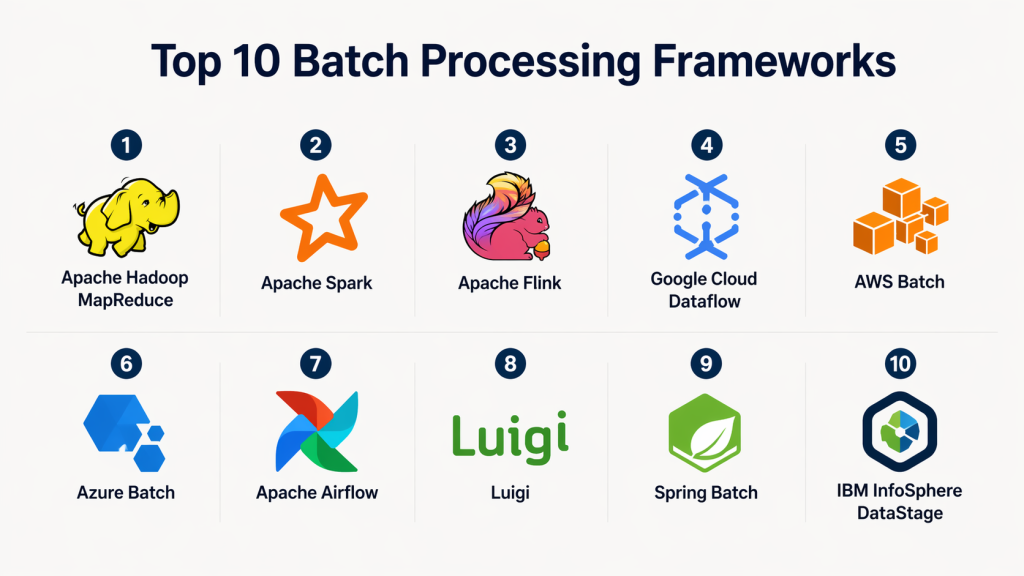
Top 10 Batch Processing Frameworks
#1 — Apache Hadoop
Short description:
Apache Hadoop is one of the earliest and most widely adopted batch processing frameworks designed for distributed storage and processing of large datasets. It uses the MapReduce model and HDFS for scalable data operations. Ideal for enterprises handling massive data workloads and legacy big data systems.
Key Features
- Distributed storage via HDFS
- MapReduce processing model
- Fault-tolerant architecture
- Scalable cluster-based processing
- Data locality optimization
- Integration with Hive, Pig, and Spark
Pros
- Highly scalable for big data workloads
- Strong ecosystem and community
Cons
- Complex setup and maintenance
- Slower compared to modern frameworks
Platforms / Deployment
- Linux / Cloud / Self-hosted
Security & Compliance
- Kerberos authentication, encryption support, RBAC
Integrations & Ecosystem
Integrates with major big data tools and cloud platforms.
- Hive
- Pig
- Spark
- HBase
- Kafka
Support & Community
Very strong open-source community with extensive documentation.
#2 — Apache Spark
Short description:
Apache Spark is a fast, in-memory data processing engine widely used for batch and real-time analytics. It significantly improves performance over traditional Hadoop MapReduce and supports multiple languages including Python, Java, and Scala.
Key Features
- In-memory data processing
- DAG-based execution engine
- Multi-language support
- MLlib for machine learning
- Structured data processing
- Unified batch and streaming
Pros
- Extremely fast performance
- Versatile across use cases
Cons
- Memory-intensive
- Requires tuning for optimization
Platforms / Deployment
- Cloud / Self-hosted / Hybrid
Security & Compliance
- Encryption, authentication, RBAC support
Integrations & Ecosystem
Works seamlessly with modern data stacks.
- Hadoop
- Kubernetes
- AWS, Azure, GCP
- Delta Lake
Support & Community
Large community and strong enterprise adoption.
#3 — Apache Flink
Short description:
Apache Flink is a stream-first processing engine that also supports batch processing with high efficiency. Known for low-latency and fault tolerance, it is suitable for modern data pipelines.
Key Features
- Stream-first architecture
- Stateful processing
- Fault-tolerant execution
- Event-time processing
- Scalable data pipelines
Pros
- High performance and scalability
- Strong for hybrid processing
Cons
- Complex learning curve
- Smaller ecosystem than Spark
Platforms / Deployment
- Cloud / Self-hosted
Security & Compliance
- Encryption and authentication support
Integrations & Ecosystem
- Kafka
- Hadoop
- Kubernetes
- Data lakes
Support & Community
Growing community with increasing enterprise adoption.
#4 — Google Cloud Dataflow
Short description:
A fully managed service for batch and stream processing based on Apache Beam. Ideal for organizations using Google Cloud for scalable data pipelines.
Key Features
- Serverless batch processing
- Auto-scaling
- Unified programming model
- Dataflow templates
- Integration with GCP services
Pros
- Fully managed infrastructure
- Easy scaling
Cons
- Vendor lock-in
- Pricing complexity
Platforms / Deployment
- Cloud
Security & Compliance
- IAM, encryption, audit logs
Integrations & Ecosystem
- BigQuery
- Pub/Sub
- Cloud Storage
Support & Community
Strong enterprise support via Google Cloud.
#5 — AWS Batch
Short description:
AWS Batch enables developers to run batch computing workloads on AWS infrastructure. It handles provisioning, scheduling, and scaling automatically.
Key Features
- Fully managed batch service
- Job scheduling
- Auto-scaling compute resources
- Container support
- Integration with ECS/EKS
Pros
- Seamless AWS integration
- Flexible compute options
Cons
- AWS dependency
- Learning curve for AWS ecosystem
Platforms / Deployment
- Cloud
Security & Compliance
- IAM, encryption, audit logs
Integrations & Ecosystem
- S3
- Lambda
- ECS/EKS
Support & Community
Enterprise-grade AWS support.
#6 — Azure Batch
Short description:
Microsoft Azure Batch is a cloud-based service for running large-scale parallel and batch workloads efficiently on Azure infrastructure.
Key Features
- Parallel workload execution
- Job scheduling
- Auto-scaling
- Resource provisioning
- Integration with Azure services
Pros
- Strong Microsoft ecosystem
- Scalable workloads
Cons
- Azure lock-in
- Configuration complexity
Platforms / Deployment
- Cloud
Security & Compliance
- Azure AD, encryption
Integrations & Ecosystem
- Azure Storage
- Azure ML
- Data Factory
Support & Community
Strong enterprise support from Microsoft.
#7 — Apache Airflow
Short description:
Airflow is a workflow orchestration tool rather than a pure processing engine, but it plays a critical role in managing batch pipelines using DAGs.
Key Features
- DAG-based workflows
- Scheduling and monitoring
- Extensible via plugins
- Task dependency management
- Web UI
Pros
- Excellent orchestration
- Highly flexible
Cons
- Not a processing engine itself
- Requires setup and maintenance
Platforms / Deployment
- Cloud / Self-hosted
Security & Compliance
- RBAC, authentication
Integrations & Ecosystem
- Spark
- Hadoop
- AWS, GCP, Azure
Support & Community
Strong open-source ecosystem.
#8 — Luigi
Short description:
Luigi is a Python-based workflow engine used for building complex pipelines of batch jobs. It focuses on dependency resolution and workflow management.
Key Features
- Pipeline orchestration
- Dependency management
- Visualization
- Python-based
Pros
- Simple and lightweight
- Easy to use for developers
Cons
- Limited UI
- Less scalable than Airflow
Platforms / Deployment
- Self-hosted
Security & Compliance
- Not publicly stated
Integrations & Ecosystem
- Hadoop
- Spark
- Databases
Support & Community
Moderate community support.
#9 — Spring Batch
Short description:
Spring Batch is a Java-based framework designed for enterprise batch processing. It provides robust transaction management and job processing capabilities.
Key Features
- Job processing framework
- Transaction management
- Retry and skip logic
- Integration with Spring ecosystem
Pros
- Enterprise-grade reliability
- Strong Java integration
Cons
- Java-only ecosystem
- Requires development effort
Platforms / Deployment
- Web / Linux / Self-hosted
Security & Compliance
- Integration with Spring Security
Integrations & Ecosystem
- Databases
- Spring Boot
- REST APIs
Support & Community
Strong enterprise and developer support.
#10 — IBM InfoSphere DataStage
Short description:
An enterprise-grade ETL and batch processing platform designed for large-scale data integration and transformation.
Key Features
- ETL processing
- Data integration
- Parallel processing
- Enterprise scalability
Pros
- Powerful enterprise features
- High reliability
Cons
- Expensive
- Complex implementation
Platforms / Deployment
- Cloud / On-premise
Security & Compliance
- Enterprise security features
Integrations & Ecosystem
- Databases
- Data warehouses
- IBM ecosystem
Support & Community
Enterprise-level support.
Comparison Table (Top 10)
| Tool Name | Best For | Platform(s) | Deployment | Standout Feature | Public Rating |
|---|---|---|---|---|---|
| Hadoop | Big data storage | Linux | Self-hosted | HDFS storage | N/A |
| Spark | Fast processing | Multi | Hybrid | In-memory engine | N/A |
| Flink | Hybrid pipelines | Multi | Hybrid | Stream-first design | N/A |
| Dataflow | GCP users | Cloud | Cloud | Serverless | N/A |
| AWS Batch | AWS workloads | Cloud | Cloud | Auto scaling | N/A |
| Azure Batch | Azure workloads | Cloud | Cloud | Parallel jobs | N/A |
| Airflow | Orchestration | Multi | Hybrid | DAG workflows | N/A |
| Luigi | Python pipelines | Linux | Self-hosted | Simplicity | N/A |
| Spring Batch | Java apps | Multi | Self-hosted | Transaction control | N/A |
| DataStage | Enterprise ETL | Multi | Hybrid | Data integration | N/A |
Evaluation & Scoring of Batch Processing Frameworks
| Tool | Core | Ease | Integrations | Security | Performance | Support | Value | Total |
|---|---|---|---|---|---|---|---|---|
| Spark | 9 | 7 | 9 | 8 | 9 | 9 | 8 | 8.6 |
| Hadoop | 8 | 5 | 8 | 8 | 7 | 9 | 7 | 7.6 |
| Flink | 8 | 6 | 7 | 7 | 9 | 7 | 7 | 7.6 |
| Dataflow | 8 | 8 | 8 | 9 | 8 | 8 | 7 | 8.0 |
| AWS Batch | 8 | 7 | 9 | 9 | 8 | 8 | 7 | 8.1 |
| Azure Batch | 8 | 7 | 8 | 9 | 8 | 8 | 7 | 8.0 |
| Airflow | 7 | 7 | 9 | 7 | 7 | 9 | 8 | 7.8 |
| Luigi | 6 | 8 | 6 | 6 | 6 | 6 | 8 | 6.6 |
| Spring Batch | 8 | 6 | 7 | 8 | 7 | 8 | 7 | 7.4 |
| DataStage | 9 | 6 | 8 | 9 | 8 | 8 | 6 | 7.9 |
How to interpret scores:
These scores are comparative and reflect relative strengths across categories. Higher scores indicate better balance across features, usability, and enterprise readiness. Organizations should prioritize criteria based on their specific needs rather than relying solely on total scores.
Which Batch Processing Frameworks Is Right for You?
Solo / Freelancer
- Use Luigi or Spring Batch
- Lightweight, developer-friendly, low overhead
SMB
- Use Apache Spark or Airflow
- Balance between scalability and usability
Mid-Market
- Use Flink, AWS Batch, or Azure Batch
- Need scalable pipelines and integrations
Enterprise
- Use Hadoop, DataStage, or Dataflow
- High performance, compliance, and large-scale data handling
Budget vs Premium
- Budget: Luigi, Airflow
- Premium: DataStage, Dataflow
Feature Depth vs Ease of Use
- Deep features: Spark, Hadoop
- Easy to use: Dataflow, AWS Batch
Integrations & Scalability
- Best integrations: Spark, AWS Batch
- Best scalability: Hadoop, Flink
Security & Compliance Needs
- Strongest: AWS Batch, Azure Batch, Dataflow
Frequently Asked Questions (FAQs)
1. What is a batch processing framework?
Batch processing frameworks process large volumes of data at scheduled intervals instead of real-time. They are widely used in data engineering, analytics, and enterprise workflows where processing latency is not critical. These frameworks improve efficiency by handling data in chunks, optimizing resource usage and reducing operational costs.
2. How is batch processing different from stream processing?
Batch processing handles data in bulk after collection, while stream processing handles data in real-time as it arrives. Batch is more cost-efficient and suitable for large-scale analytics, whereas stream processing is ideal for low-latency applications like fraud detection or live monitoring systems.
3. Which framework is best for beginners?
For beginners, tools like Luigi or Apache Airflow are more accessible due to simpler setup and Python-based workflows. They allow developers to learn pipeline orchestration without needing deep expertise in distributed systems.
4. Are batch frameworks still relevant today?
Yes, batch processing remains critical for large-scale data processing tasks like ETL, reporting, and machine learning. Even with real-time systems growing, batch frameworks are essential for cost-effective and reliable data processing.
5. What industries use batch processing frameworks?
Industries like finance, healthcare, retail, telecom, and manufacturing rely heavily on batch processing. Use cases include reporting, billing, fraud analysis, and customer analytics.
6. How do these frameworks handle scalability?
Most modern frameworks support horizontal scaling by distributing workloads across clusters or cloud infrastructure. Tools like Spark and Hadoop are designed to scale efficiently for massive datasets.
7. Are these tools secure?
Security varies by platform. Cloud-based tools like AWS Batch and Dataflow offer strong built-in security features, while open-source tools require additional configuration for authentication, encryption, and access control.
8. Can batch frameworks integrate with AI/ML workflows?
Yes, frameworks like Apache Spark and Dataflow integrate well with machine learning pipelines. They are commonly used for data preprocessing, feature engineering, and training large models.
9. What are common mistakes when choosing a framework?
Common mistakes include ignoring scalability needs, underestimating setup complexity, and choosing tools that don’t integrate well with existing systems. It’s important to evaluate long-term requirements.
10. Is it hard to switch between frameworks?
Switching frameworks can be complex due to differences in architecture, APIs, and data handling. However, using abstraction layers like Apache Beam can help reduce migration effort.
Conclusion
Batch processing frameworks continue to play a vital role in modern data ecosystems, especially for organizations dealing with large-scale analytics, ETL workflows, and machine learning pipelines. While newer real-time technologies are gaining attention, batch processing remains unmatched in cost efficiency, reliability, and scalability for many use cases. The tools listed above offer a wide spectrum—from open-source flexibility to enterprise-grade managed services—ensuring that businesses of all sizes can find a suitable solution.
Ultimately, the “best” framework depends on your specific needs—whether it’s ease of use, scalability, integration capabilities, or security requirements. The smartest approach is to shortlist 2–3 tools that align with your architecture, run a pilot, and validate performance, integrations, and compliance before making a final decision.
Introduction
Batch Processing Frameworks are systems designed to process large volumes of data in chunks (batches) rather than in real-time. Instead of handling data continuously, these frameworks collect, store, and process data at scheduled intervals—making them ideal for heavy workloads like analytics, ETL pipelines, and large-scale data transformations.
In today’s data-driven world, especially with the rise of AI, machine learning, and cloud-native architectures, batch processing remains a backbone for enterprises managing massive datasets. Even as real-time processing grows, batch frameworks still dominate in cost-efficient, reliable, and scalable data workflows.
Common use cases include:
- Data warehousing and ETL pipelines
- Financial reporting and reconciliation
- Machine learning model training
- Log processing and analytics
- Large-scale data migrations
Key evaluation criteria buyers should consider:
- Scalability and performance
- Ease of integration with data ecosystems
- Security and compliance capabilities
- Cost efficiency
- Deployment flexibility
- Community and support
- Automation and orchestration features
- Compatibility with AI/ML workflows
Best for: Data engineers, DevOps teams, analytics teams, enterprises handling large-scale data pipelines, and AI/ML engineers.
Not ideal for: Applications requiring real-time processing, low-latency systems, or event-driven architectures where stream processing frameworks are more suitable.
Key Trends in Batch Processing Frameworks
- AI-driven optimization: Intelligent scheduling and workload balancing using machine learning
- Cloud-native evolution: Increased adoption of serverless and managed batch platforms
- Hybrid processing models: Combining batch + streaming for unified data pipelines
- Security-first architectures: Stronger emphasis on encryption, RBAC, and compliance
- Data lake integration: Tight coupling with modern data lakes and lakehouse platforms
- Automation & orchestration: Workflow automation becoming standard (DAG-based pipelines)
- Cost optimization models: Pay-as-you-go and resource auto-scaling
- Interoperability: Integration with tools like Kubernetes, Spark, and data warehouses
- Open-source dominance: Strong ecosystems around open frameworks
How We Evaluated Batch Processing Frameworks (Methodology)
- Market adoption and industry usage
- Feature completeness and flexibility
- Performance benchmarks and scalability signals
- Security features and compliance readiness
- Integration with modern data ecosystems
- Community support and documentation quality
- Suitability across SMBs to enterprise environments
- Ease of deployment and operations
- Cost-efficiency and value for money
Top 10 Batch Processing Frameworks
#1 — Apache Hadoop
Short description:
Apache Hadoop is one of the earliest and most widely adopted batch processing frameworks designed for distributed storage and processing of large datasets. It uses the MapReduce model and HDFS for scalable data operations. Ideal for enterprises handling massive data workloads and legacy big data systems.
Key Features
- Distributed storage via HDFS
- MapReduce processing model
- Fault-tolerant architecture
- Scalable cluster-based processing
- Data locality optimization
- Integration with Hive, Pig, and Spark
Pros
- Highly scalable for big data workloads
- Strong ecosystem and community
Cons
- Complex setup and maintenance
- Slower compared to modern frameworks
Platforms / Deployment
- Linux / Cloud / Self-hosted
Security & Compliance
- Kerberos authentication, encryption support, RBAC
Integrations & Ecosystem
Integrates with major big data tools and cloud platforms.
- Hive
- Pig
- Spark
- HBase
- Kafka
Support & Community
Very strong open-source community with extensive documentation.
#2 — Apache Spark
Short description:
Apache Spark is a fast, in-memory data processing engine widely used for batch and real-time analytics. It significantly improves performance over traditional Hadoop MapReduce and supports multiple languages including Python, Java, and Scala.
Key Features
- In-memory data processing
- DAG-based execution engine
- Multi-language support
- MLlib for machine learning
- Structured data processing
- Unified batch and streaming
Pros
- Extremely fast performance
- Versatile across use cases
Cons
- Memory-intensive
- Requires tuning for optimization
Platforms / Deployment
- Cloud / Self-hosted / Hybrid
Security & Compliance
- Encryption, authentication, RBAC support
Integrations & Ecosystem
Works seamlessly with modern data stacks.
- Hadoop
- Kubernetes
- AWS, Azure, GCP
- Delta Lake
Support & Community
Large community and strong enterprise adoption.
#3 — Apache Flink
Short description:
Apache Flink is a stream-first processing engine that also supports batch processing with high efficiency. Known for low-latency and fault tolerance, it is suitable for modern data pipelines.
Key Features
- Stream-first architecture
- Stateful processing
- Fault-tolerant execution
- Event-time processing
- Scalable data pipelines
Pros
- High performance and scalability
- Strong for hybrid processing
Cons
- Complex learning curve
- Smaller ecosystem than Spark
Platforms / Deployment
- Cloud / Self-hosted
Security & Compliance
- Encryption and authentication support
Integrations & Ecosystem
- Kafka
- Hadoop
- Kubernetes
- Data lakes
Support & Community
Growing community with increasing enterprise adoption.
#4 — Google Cloud Dataflow
Short description:
A fully managed service for batch and stream processing based on Apache Beam. Ideal for organizations using Google Cloud for scalable data pipelines.
Key Features
- Serverless batch processing
- Auto-scaling
- Unified programming model
- Dataflow templates
- Integration with GCP services
Pros
- Fully managed infrastructure
- Easy scaling
Cons
- Vendor lock-in
- Pricing complexity
Platforms / Deployment
- Cloud
Security & Compliance
- IAM, encryption, audit logs
Integrations & Ecosystem
- BigQuery
- Pub/Sub
- Cloud Storage
Support & Community
Strong enterprise support via Google Cloud.
#5 — AWS Batch
Short description:
AWS Batch enables developers to run batch computing workloads on AWS infrastructure. It handles provisioning, scheduling, and scaling automatically.
Key Features
- Fully managed batch service
- Job scheduling
- Auto-scaling compute resources
- Container support
- Integration with ECS/EKS
Pros
- Seamless AWS integration
- Flexible compute options
Cons
- AWS dependency
- Learning curve for AWS ecosystem
Platforms / Deployment
- Cloud
Security & Compliance
- IAM, encryption, audit logs
Integrations & Ecosystem
- S3
- Lambda
- ECS/EKS
Support & Community
Enterprise-grade AWS support.
#6 — Azure Batch
Short description:
Microsoft Azure Batch is a cloud-based service for running large-scale parallel and batch workloads efficiently on Azure infrastructure.
Key Features
- Parallel workload execution
- Job scheduling
- Auto-scaling
- Resource provisioning
- Integration with Azure services
Pros
- Strong Microsoft ecosystem
- Scalable workloads
Cons
- Azure lock-in
- Configuration complexity
Platforms / Deployment
- Cloud
Security & Compliance
- Azure AD, encryption
Integrations & Ecosystem
- Azure Storage
- Azure ML
- Data Factory
Support & Community
Strong enterprise support from Microsoft.
#7 — Apache Airflow
Short description:
Airflow is a workflow orchestration tool rather than a pure processing engine, but it plays a critical role in managing batch pipelines using DAGs.
Key Features
- DAG-based workflows
- Scheduling and monitoring
- Extensible via plugins
- Task dependency management
- Web UI
Pros
- Excellent orchestration
- Highly flexible
Cons
- Not a processing engine itself
- Requires setup and maintenance
Platforms / Deployment
- Cloud / Self-hosted
Security & Compliance
- RBAC, authentication
Integrations & Ecosystem
- Spark
- Hadoop
- AWS, GCP, Azure
Support & Community
Strong open-source ecosystem.
#8 — Luigi
Short description:
Luigi is a Python-based workflow engine used for building complex pipelines of batch jobs. It focuses on dependency resolution and workflow management.
Key Features
- Pipeline orchestration
- Dependency management
- Visualization
- Python-based
Pros
- Simple and lightweight
- Easy to use for developers
Cons
- Limited UI
- Less scalable than Airflow
Platforms / Deployment
- Self-hosted
Security & Compliance
- Not publicly stated
Integrations & Ecosystem
- Hadoop
- Spark
- Databases
Support & Community
Moderate community support.
#9 — Spring Batch
Short description:
Spring Batch is a Java-based framework designed for enterprise batch processing. It provides robust transaction management and job processing capabilities.
Key Features
- Job processing framework
- Transaction management
- Retry and skip logic
- Integration with Spring ecosystem
Pros
- Enterprise-grade reliability
- Strong Java integration
Cons
- Java-only ecosystem
- Requires development effort
Platforms / Deployment
- Web / Linux / Self-hosted
Security & Compliance
- Integration with Spring Security
Integrations & Ecosystem
- Databases
- Spring Boot
- REST APIs
Support & Community
Strong enterprise and developer support.
#10 — IBM InfoSphere DataStage
Short description:
An enterprise-grade ETL and batch processing platform designed for large-scale data integration and transformation.
Key Features
- ETL processing
- Data integration
- Parallel processing
- Enterprise scalability
Pros
- Powerful enterprise features
- High reliability
Cons
- Expensive
- Complex implementation
Platforms / Deployment
- Cloud / On-premise
Security & Compliance
- Enterprise security features
Integrations & Ecosystem
- Databases
- Data warehouses
- IBM ecosystem
Support & Community
Enterprise-level support.
Comparison Table (Top 10)
| Tool Name | Best For | Platform(s) | Deployment | Standout Feature | Public Rating |
|---|---|---|---|---|---|
| Hadoop | Big data storage | Linux | Self-hosted | HDFS storage | N/A |
| Spark | Fast processing | Multi | Hybrid | In-memory engine | N/A |
| Flink | Hybrid pipelines | Multi | Hybrid | Stream-first design | N/A |
| Dataflow | GCP users | Cloud | Cloud | Serverless | N/A |
| AWS Batch | AWS workloads | Cloud | Cloud | Auto scaling | N/A |
| Azure Batch | Azure workloads | Cloud | Cloud | Parallel jobs | N/A |
| Airflow | Orchestration | Multi | Hybrid | DAG workflows | N/A |
| Luigi | Python pipelines | Linux | Self-hosted | Simplicity | N/A |
| Spring Batch | Java apps | Multi | Self-hosted | Transaction control | N/A |
| DataStage | Enterprise ETL | Multi | Hybrid | Data integration | N/A |
Evaluation & Scoring of Batch Processing Frameworks
| Tool | Core | Ease | Integrations | Security | Performance | Support | Value | Total |
|---|---|---|---|---|---|---|---|---|
| Spark | 9 | 7 | 9 | 8 | 9 | 9 | 8 | 8.6 |
| Hadoop | 8 | 5 | 8 | 8 | 7 | 9 | 7 | 7.6 |
| Flink | 8 | 6 | 7 | 7 | 9 | 7 | 7 | 7.6 |
| Dataflow | 8 | 8 | 8 | 9 | 8 | 8 | 7 | 8.0 |
| AWS Batch | 8 | 7 | 9 | 9 | 8 | 8 | 7 | 8.1 |
| Azure Batch | 8 | 7 | 8 | 9 | 8 | 8 | 7 | 8.0 |
| Airflow | 7 | 7 | 9 | 7 | 7 | 9 | 8 | 7.8 |
| Luigi | 6 | 8 | 6 | 6 | 6 | 6 | 8 | 6.6 |
| Spring Batch | 8 | 6 | 7 | 8 | 7 | 8 | 7 | 7.4 |
| DataStage | 9 | 6 | 8 | 9 | 8 | 8 | 6 | 7.9 |
How to interpret scores:
These scores are comparative and reflect relative strengths across categories. Higher scores indicate better balance across features, usability, and enterprise readiness. Organizations should prioritize criteria based on their specific needs rather than relying solely on total scores.
Which Batch Processing Frameworks Is Right for You?
Solo / Freelancer
- Use Luigi or Spring Batch
- Lightweight, developer-friendly, low overhead
SMB
- Use Apache Spark or Airflow
- Balance between scalability and usability
Mid-Market
- Use Flink, AWS Batch, or Azure Batch
- Need scalable pipelines and integrations
Enterprise
- Use Hadoop, DataStage, or Dataflow
- High performance, compliance, and large-scale data handling
Budget vs Premium
- Budget: Luigi, Airflow
- Premium: DataStage, Dataflow
Feature Depth vs Ease of Use
- Deep features: Spark, Hadoop
- Easy to use: Dataflow, AWS Batch
Integrations & Scalability
- Best integrations: Spark, AWS Batch
- Best scalability: Hadoop, Flink
Security & Compliance Needs
- Strongest: AWS Batch, Azure Batch, Dataflow
Frequently Asked Questions (FAQs)
1. What is a batch processing framework?
Batch processing frameworks process large volumes of data at scheduled intervals instead of real-time. They are widely used in data engineering, analytics, and enterprise workflows where processing latency is not critical. These frameworks improve efficiency by handling data in chunks, optimizing resource usage and reducing operational costs.
2. How is batch processing different from stream processing?
Batch processing handles data in bulk after collection, while stream processing handles data in real-time as it arrives. Batch is more cost-efficient and suitable for large-scale analytics, whereas stream processing is ideal for low-latency applications like fraud detection or live monitoring systems.
3. Which framework is best for beginners?
For beginners, tools like Luigi or Apache Airflow are more accessible due to simpler setup and Python-based workflows. They allow developers to learn pipeline orchestration without needing deep expertise in distributed systems.
4. Are batch frameworks still relevant today?
Yes, batch processing remains critical for large-scale data processing tasks like ETL, reporting, and machine learning. Even with real-time systems growing, batch frameworks are essential for cost-effective and reliable data processing.
5. What industries use batch processing frameworks?
Industries like finance, healthcare, retail, telecom, and manufacturing rely heavily on batch processing. Use cases include reporting, billing, fraud analysis, and customer analytics.
6. How do these frameworks handle scalability?
Most modern frameworks support horizontal scaling by distributing workloads across clusters or cloud infrastructure. Tools like Spark and Hadoop are designed to scale efficiently for massive datasets.
7. Are these tools secure?
Security varies by platform. Cloud-based tools like AWS Batch and Dataflow offer strong built-in security features, while open-source tools require additional configuration for authentication, encryption, and access control.
8. Can batch frameworks integrate with AI/ML workflows?
Yes, frameworks like Apache Spark and Dataflow integrate well with machine learning pipelines. They are commonly used for data preprocessing, feature engineering, and training large models.
9. What are common mistakes when choosing a framework?
Common mistakes include ignoring scalability needs, underestimating setup complexity, and choosing tools that don’t integrate well with existing systems. It’s important to evaluate long-term requirements.
10. Is it hard to switch between frameworks?
Switching frameworks can be complex due to differences in architecture, APIs, and data handling. However, using abstraction layers like Apache Beam can help reduce migration effort.
Conclusion
Batch processing frameworks continue to play a vital role in modern data ecosystems, especially for organizations dealing with large-scale analytics, ETL workflows, and machine learning pipelines. While newer real-time technologies are gaining attention, batch processing remains unmatched in cost efficiency, reliability, and scalability for many use cases. The tools listed above offer a wide spectrum—from open-source flexibility to enterprise-grade managed services—ensuring that businesses of all sizes can find a suitable solution.
Ultimately, the “best” framework depends on your specific needs—whether it’s ease of use, scalability, integration capabilities, or security requirements. The smartest approach is to shortlist 2–3 tools that align with your architecture, run a pilot, and validate performance, integrations, and compliance before making a final decision.
