Introduction
Stream processing frameworks enable organizations to process and analyze data continuously as it flows through systems. Unlike traditional batch processing, which handles data in chunks at scheduled intervals, stream processing works in real time or near real time. In simple terms, these frameworks allow businesses to react instantly to events such as user activity, transactions, sensor data, or system logs.
This category is critical in modern architectures because data is increasingly generated as continuous streams—from applications, IoT devices, financial systems, and digital platforms. Stream processing frameworks power real-time analytics, fraud detection, monitoring systems, personalization engines, and AI pipelines. They are foundational to event-driven architectures and modern data platforms.
Common use cases include:
- Real-time fraud detection
- Monitoring and alerting systems
- IoT and sensor data processing
- Real-time recommendation engines
- Log and event processing
Buyers should evaluate:
- Processing latency and throughput
- Scalability and fault tolerance
- Integration with data pipelines
- Ease of deployment and management
- Support for stateful processing
- Developer experience and APIs
- Security and compliance features
- Cost and infrastructure requirements
- Community and ecosystem support
- Compatibility with modern data stacks
Best for: data engineers, backend developers, platform teams, and organizations handling high-velocity data streams. Especially valuable for finance, e-commerce, SaaS, and IoT industries.
Not ideal for: teams with batch-only workflows or low-frequency data processing needs. If real-time insights are not required, batch processing tools may be sufficient.
Key Trends in Stream Processing Frameworks
- Event-driven architectures are becoming the norm
- Low-latency processing is a top priority
- Integration with AI and ML pipelines is increasing
- Cloud-native and serverless streaming solutions are growing
- Unified batch and stream processing is gaining traction
- Stateful stream processing is becoming more advanced
- Streaming data lakes and lakehouses are emerging
- Managed services are reducing operational complexity
- Observability and monitoring features are improving
- Security and compliance requirements are increasing
How We Chose These Stream Processing Frameworks (Methodology)
We selected the Top 10 frameworks based on:
- Industry adoption and ecosystem strength
- Real-time processing capabilities
- Scalability and performance
- Developer experience and flexibility
- Integration with modern data platforms
- Fault tolerance and reliability
- Security and governance features
- Innovation in streaming and event processing
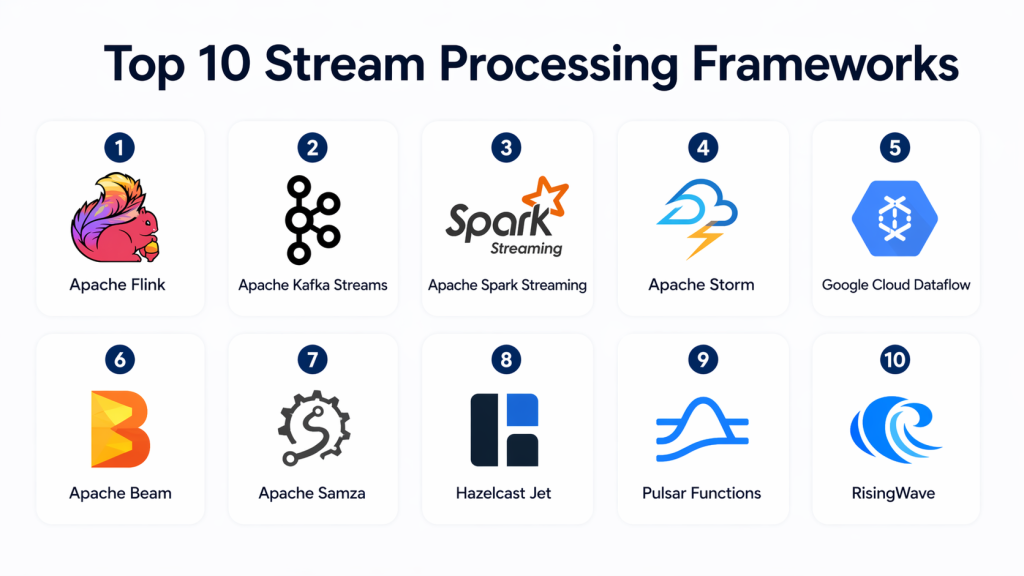
Top 10 Stream Processing Frameworks
#1 — Apache Flink
Short description
: Apache Flink is one of the most powerful stream processing frameworks available today. It provides low-latency, high-throughput processing and supports complex event-driven applications. Flink is widely used for real-time analytics and streaming pipelines. It supports both batch and stream processing in a unified model. A top choice for large-scale data environments.
Key Features
- Low-latency stream processing
- Stateful computations
- Fault tolerance
- Event-time processing
- Scalability
- Unified batch and stream processing
Pros
- High performance
- Flexible architecture
- Strong community
Cons
- Complex setup
- Requires expertise
- Limited UI
Platforms / Deployment
Cloud / Self-hosted
Security & Compliance
Supports enterprise-grade security controls.
Integrations & Ecosystem
Works with Kafka, data lakes, and modern pipelines.
Support & Community
Strong open-source community.
#2 — Apache Kafka Streams
Short description
: Kafka Streams is a lightweight stream processing library built on Apache Kafka. It allows developers to process data directly within Kafka applications. It is easy to integrate and deploy. Kafka Streams is ideal for microservices-based architectures. A popular choice for event-driven systems.
Key Features
- Stream processing within Kafka
- Stateful operations
- Scalability
- Fault tolerance
- Integration with Kafka ecosystem
- Developer-friendly APIs
Pros
- Easy to use
- Lightweight
- Strong Kafka integration
Cons
- Limited outside Kafka ecosystem
- Not standalone
- Requires Kafka setup
Platforms / Deployment
Cloud / Self-hosted
Security & Compliance
Supports Kafka security features.
Integrations & Ecosystem
Works within Kafka ecosystem.
Support & Community
Strong community support.
#3 — Apache Spark Streaming
Short description : Apache Spark Streaming extends the Spark platform to support stream processing. It uses micro-batching to process data streams. Spark is widely used for big data analytics. It is suitable for organizations already using Spark. A strong hybrid processing tool.
Key Features
- Micro-batch processing
- Integration with Spark ecosystem
- Scalability
- Fault tolerance
- Data processing APIs
- Streaming analytics
Pros
- Easy integration with Spark
- Scalable
- Strong ecosystem
Cons
- Higher latency than true streaming
- Resource intensive
- Complex tuning
Platforms / Deployment
Cloud / Self-hosted
Security & Compliance
Supports enterprise security features.
Integrations & Ecosystem
Works with big data tools and platforms.
Support & Community
Large community support.
#4 — Apache Storm
Short description : Apache Storm is a real-time computation system for processing streaming data. It provides low-latency processing and is highly scalable. Storm is suitable for simple real-time processing tasks. It is one of the earlier streaming frameworks. Still used in certain environments.
Key Features
- Real-time processing
- Low latency
- Scalability
- Fault tolerance
- Distributed architecture
- Stream processing
Pros
- Low latency
- Scalable
- Mature framework
Cons
- Declining popularity
- Complex setup
- Limited modern features
Platforms / Deployment
Self-hosted
Security & Compliance
Supports basic security features.
Integrations & Ecosystem
Works with streaming tools.
Support & Community
Legacy community support.
#5 — Google Cloud Dataflow
Short description : Dataflow is a managed stream and batch processing service from Google Cloud. It is based on Apache Beam. It simplifies deployment and scaling. It is suitable for cloud-native environments. A strong managed streaming solution.
Key Features
- Managed service
- Stream and batch processing
- Auto-scaling
- Integration with Google Cloud
- Low-latency processing
- Data pipelines
Pros
- Easy to deploy
- Fully managed
- Scalable
Cons
- Cloud dependency
- Cost considerations
- Limited control
Platforms / Deployment
Cloud
Security & Compliance
Supports enterprise-grade security.
Integrations & Ecosystem
Deep Google Cloud integration.
Support & Community
Strong enterprise support.
#6 — Apache Beam
Short description : Apache Beam is a unified programming model for batch and stream processing. It allows developers to write pipelines that run on multiple engines. Beam provides flexibility and portability. It is widely used with Dataflow and Flink. A powerful abstraction layer.
Key Features
- Unified programming model
- Portability across engines
- Stream and batch processing
- Pipeline abstraction
- Scalability
- Integration support
Pros
- Flexible
- Portable
- Strong ecosystem
Cons
- Requires learning curve
- Not standalone execution engine
- Complexity
Platforms / Deployment
Cloud / Self-hosted
Security & Compliance
Depends on execution engine.
Integrations & Ecosystem
Works with multiple frameworks.
Support & Community
Active community.
#7 — Apache Samza
Short description : Apache Samza is a distributed stream processing framework originally developed at LinkedIn. It integrates tightly with Kafka and YARN. Samza is designed for scalability and fault tolerance. It is suitable for large-scale streaming applications. A niche but powerful framework.
Key Features
- Distributed processing
- Kafka integration
- Fault tolerance
- Scalability
- Stateful processing
- Stream pipelines
Pros
- Strong Kafka integration
- Scalable
- Reliable
Cons
- Smaller ecosystem
- Requires expertise
- Limited adoption
Platforms / Deployment
Self-hosted
Security & Compliance
Supports standard security controls.
Integrations & Ecosystem
Works with Kafka and big data tools.
Support & Community
Smaller community.
#8 — Hazelcast Jet
Short description : Hazelcast Jet is a distributed stream processing engine designed for high performance. It supports real-time data processing and analytics. It is easy to deploy and scale. Jet is suitable for modern streaming applications. A growing framework.
Key Features
- Distributed processing
- Low-latency analytics
- Scalability
- Integration support
- Real-time processing
- Pipeline API
Pros
- High performance
- Easy to deploy
- Scalable
Cons
- Smaller ecosystem
- Limited adoption
- Fewer integrations
Platforms / Deployment
Cloud / Self-hosted
Security & Compliance
Supports standard security features.
Integrations & Ecosystem
Works with modern data tools.
Support & Community
Growing community.
#9 — Pulsar Functions
Short description : Pulsar Functions is part of Apache Pulsar, enabling lightweight stream processing. It allows developers to run processing logic directly within the messaging system. It is suitable for event-driven architectures. A modern alternative to Kafka Streams.
Key Features
- Lightweight processing
- Integration with Pulsar
- Event-driven architecture
- Scalability
- Real-time processing
- Developer-friendly
Pros
- Lightweight
- Easy integration
- Modern architecture
Cons
- Requires Pulsar
- Smaller ecosystem
- Limited features
Platforms / Deployment
Cloud / Self-hosted
Security & Compliance
Supports messaging security features.
Integrations & Ecosystem
Works within Pulsar ecosystem.
Support & Community
Growing adoption.
#10 — RisingWave
Short description : RisingWave is a modern stream processing database designed for real-time analytics. It provides SQL-based streaming queries. RisingWave is cloud-native and scalable. It is suitable for modern applications. A new but promising platform.
Key Features
- Streaming database
- SQL interface
- Real-time analytics
- Scalability
- Cloud-native
- Integration support
Pros
- Easy SQL interface
- Modern architecture
- Scalable
Cons
- New platform
- Smaller ecosystem
- Limited maturity
Platforms / Deployment
Cloud
Security & Compliance
Supports standard security controls.
Integrations & Ecosystem
Works with modern data stacks.
Support & Community
Growing community.
Comparison Table (Top 10)
| Tool Name | Best For | Platform(s) Supported | Deployment | Standout Feature | Public Rating |
|---|---|---|---|---|---|
| Apache Flink | High-performance streaming | Web | Cloud / Self-hosted | Low-latency processing | N/A |
| Kafka Streams | Kafka-based apps | Web | Cloud / Self-hosted | Lightweight streaming | N/A |
| Spark Streaming | Big data processing | Web | Cloud / Self-hosted | Micro-batch processing | N/A |
| Apache Storm | Real-time processing | Web | Self-hosted | Low latency | N/A |
| Dataflow | Managed streaming | Web | Cloud | Serverless pipelines | N/A |
| Apache Beam | Unified pipelines | Web | Cloud / Self-hosted | Multi-engine support | N/A |
| Apache Samza | Kafka pipelines | Web | Self-hosted | Distributed processing | N/A |
| Hazelcast Jet | Distributed streaming | Web | Cloud / Self-hosted | High performance | N/A |
| Pulsar Functions | Event processing | Web | Cloud / Self-hosted | Lightweight functions | N/A |
| RisingWave | Streaming DB | Web | Cloud | SQL streaming | N/A |
Evaluation & Scoring of Stream Processing Frameworks
| Tool Name | Core | Ease | Integrations | Security | Performance | Support | Value | Total |
|---|---|---|---|---|---|---|---|---|
| Flink | 9.5 | 7.5 | 9.0 | 9.0 | 9.5 | 9.0 | 8.5 | 8.95 |
| Kafka Streams | 8.8 | 8.5 | 9.2 | 8.8 | 9.0 | 8.8 | 8.8 | 8.86 |
| Spark Streaming | 8.7 | 8.0 | 9.0 | 8.8 | 8.5 | 9.0 | 8.5 | 8.64 |
| Storm | 7.8 | 6.5 | 8.0 | 8.0 | 8.5 | 7.5 | 8.0 | 7.80 |
| Dataflow | 9.0 | 9.0 | 9.0 | 9.0 | 9.0 | 9.0 | 8.5 | 8.95 |
| Beam | 8.5 | 7.5 | 9.0 | 8.8 | 8.8 | 8.5 | 8.5 | 8.52 |
| Samza | 8.2 | 7.0 | 8.5 | 8.5 | 8.8 | 8.0 | 8.5 | 8.21 |
| Hazelcast Jet | 8.3 | 8.0 | 8.0 | 8.0 | 8.8 | 8.0 | 8.5 | 8.19 |
| Pulsar Functions | 8.0 | 8.5 | 8.2 | 8.2 | 8.5 | 8.0 | 8.5 | 8.14 |
| RisingWave | 8.2 | 8.8 | 8.0 | 8.0 | 8.5 | 7.8 | 8.5 | 8.18 |
Which Stream Processing Framework Is Right for You?
Solo / Freelancer
Use managed tools like Dataflow.
SMB
Kafka Streams or Spark.
Mid-Market
Flink, Beam.
Enterprise
Flink, Kafka, Dataflow.
Frequently Asked Questions (FAQs)
1. What is stream processing?
Stream processing is the continuous processing of data as it is generated in real time. Instead of waiting for batch jobs, data is analyzed instantly as it flows through systems. This enables faster insights and quicker decision-making. It is widely used in modern data architectures. It supports event-driven applications and analytics.
2. Why is stream processing important?
Stream processing is important because it allows organizations to react to events immediately. This is critical for use cases like fraud detection, monitoring, and personalization. It improves operational efficiency and customer experience. It also enables real-time analytics and automation. Overall, it provides a competitive advantage.
3. Who uses stream processing frameworks?
These frameworks are used by data engineers, backend developers, and platform teams. They build and manage streaming pipelines and real-time applications. Businesses rely on them for processing high-velocity data. In large organizations, dedicated data platform teams manage these systems. They are essential for modern data-driven companies.
4. Are stream processing frameworks cloud-based?
Many modern stream processing frameworks support cloud deployment, making them easier to scale and manage. However, several frameworks also support self-hosted and hybrid deployments depending on organizational needs. Cloud-based options reduce infrastructure overhead and improve flexibility. They also integrate well with modern data platforms. The choice depends on your architecture and compliance requirements.
5. Is stream processing expensive?
The cost of stream processing depends on the framework, infrastructure, and data volume. Open-source frameworks may reduce licensing costs but require infrastructure and operational investment. Managed cloud services can simplify deployment but may increase usage-based costs. Organizations should evaluate total cost of ownership carefully. Proper scaling and optimization can help control expenses.
6. Do stream processing frameworks support AI and ML?
Yes, many frameworks integrate with AI and machine learning pipelines to enable real-time predictions and automation. This allows organizations to apply models directly to streaming data. It is useful for anomaly detection, personalization, and predictive analytics. Integration with ML enhances the value of streaming systems. It is a growing trend in modern architectures.
7. Is setup complex for stream processing frameworks?
Setup complexity varies depending on the framework and deployment model. Open-source frameworks like Kafka or Flink may require significant configuration and expertise. Managed services simplify deployment but still require planning. Factors like scalability, fault tolerance, and latency must be considered. A phased approach helps reduce complexity.
8. Can stream processing frameworks scale easily?
Yes, scalability is a core feature of stream processing frameworks. They are designed to handle large volumes of data across distributed systems. Cloud-native platforms offer elastic scaling to meet demand. This ensures consistent performance even under heavy workloads. Scalability is essential for enterprise applications.
9. Are stream processing frameworks secure?
Most frameworks support security features such as encryption, authentication, and access control. Enterprise deployments also include governance and compliance measures. Security depends on proper configuration and operational practices. Organizations must ensure secure data pipelines and access management. Regular monitoring enhances security.
10. Which stream processing framework is best?
There is no single best framework, as the choice depends on your use case, scale, and expertise. Flink and Kafka are popular for large-scale systems, while Dataflow offers managed simplicity. Some teams prefer Spark for hybrid workloads. The best approach is to evaluate multiple options and run pilot projects. Choose based on performance, integration, and scalability.
Conclusion
Stream processing frameworks are a critical foundation for modern real-time data systems, enabling organizations to process and analyze data as it is generated. As businesses increasingly rely on streaming data from applications, devices, and services, the ability to act on insights instantly has become essential. These frameworks power everything from fraud detection and monitoring systems to recommendation engines and AI-driven automation. Without stream processing, organizations would struggle to keep up with the speed and volume of modern data.
Choosing the right framework depends on your technical expertise, infrastructure, and use case requirements. Open-source solutions like Apache Flink and Kafka offer flexibility and scalability, while managed services like Dataflow simplify deployment and operations. Instead of selecting a tool based only on popularity, focus on your real-time processing needs and integration requirements. Start with a pilot project, validate performance and scalability, and then scale gradually. This approach ensures a reliable and future-ready streaming data architecture.
